
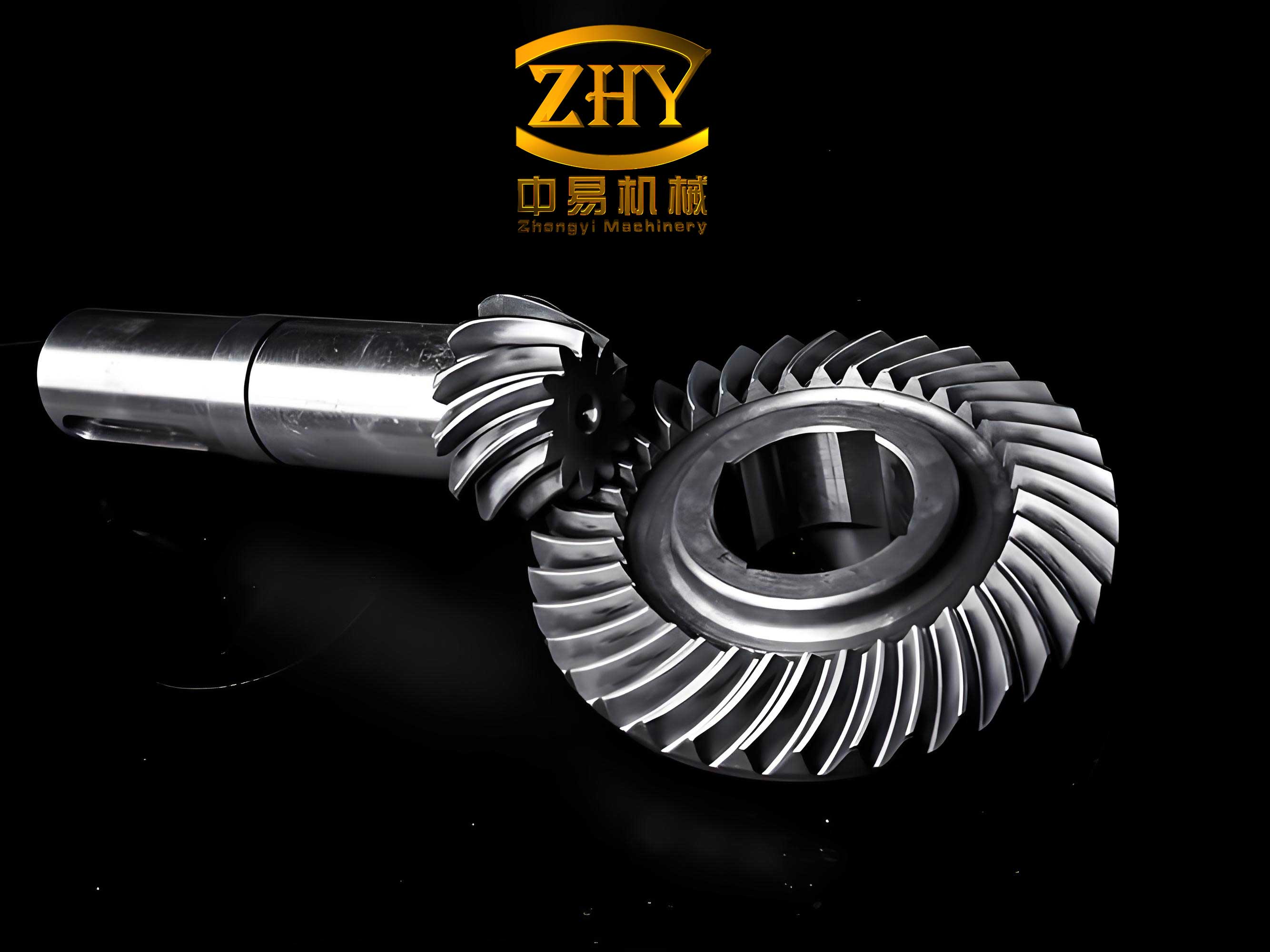
In the field of mechanical power transmission, spiral bevel gears play a critical role in transferring motion and power between intersecting or non-parallel shafts. Traditional manufacturing methods for spiral bevel gears, such as milling, suffer from low material utilization, high production costs, and reduced bending strength due to the cutting of metal fiber flow lines. Forging, as an advanced near-net-shape manufacturing technology, offers a promising alternative by enhancing material efficiency and mechanical properties. However, the durability of forging dies, particularly their wear resistance, significantly impacts production costs and process stability. In this study, I focus on predicting the service life of dies used in the hot forging of spiral bevel gears by integrating a modified Archard wear model with elastoplastic finite element analysis and orthogonal experimental design. The goal is to optimize process parameters and provide a reliable method for estimating die life in batch production.
The importance of spiral bevel gears in automotive, aerospace, and industrial applications cannot be overstated. Their complex geometry, characterized by curved teeth and varying cross-sections, presents challenges in forging. During hot forging, the die undergoes severe thermal and mechanical stresses, leading to wear at critical locations such as the tooth tip and flank areas. This wear not only affects the dimensional accuracy of the forged spiral bevel gear but also necessitates frequent die replacements, increasing downtime and costs. Therefore, developing a predictive model for die wear is essential for optimizing the forging process of spiral bevel gears. Previous research has primarily addressed forging工艺, deformation behavior, and die design for spiral bevel gears, but studies on die life prediction are scarce. This work aims to fill that gap by proposing a comprehensive approach based on simulation and experimentation.
The core of my methodology revolves around the Archard wear model, which is widely used in metal forming to estimate wear based on contact pressure, sliding velocity, and material properties. However, the classical Archard model assumes constant material hardness and properties, which is unrealistic in hot forging where die temperature fluctuates. To address this, I adopt a modified Archard theory that incorporates temperature-dependent functions for material characteristics and die hardness. The modified equation is expressed as:
$$ W = K(T) \frac{1}{H(T)} \int p v \, dt $$
where \( W \) is the wear depth, \( K(T) \) is a temperature-dependent material characteristic function, \( H(T) \) is the temperature-dependent die hardness function, \( p \) is the contact pressure at the die surface, \( v \) is the relative sliding velocity of the workpiece material, and \( T \) is the die temperature. The functions \( K(T) \) and \( H(T) \) are derived from experimental data and can be represented as:
$$ K(T) = (29.29 \ln T – 168.73) \times 10^{-6} $$
$$ H(T) = 9216.4 T^{-0.505} $$
In practice, for discrete simulation steps, the wear at a specific point \( i \) over a time interval \( \Delta t_j \) is calculated as:
$$ \Delta w_{ij} = K_{ij}(T) \frac{1}{H_{ij}(T)} p_{ij} v_{ij} \Delta t_j $$
The total wear at point \( i \) after \( n \) steps is:
$$ W_i = \sum_{j=1}^{n} K_{ij}(T) \frac{1}{H_{ij}(T)} p_{ij} v_{ij} \Delta t_j $$
To implement this in finite element simulations, I developed a custom subroutine for a commercial software, DEFORM-3D, to compute wear incrementally based on output data for pressure and velocity. This allows for accurate prediction of wear distribution on the die surface during the forging of spiral bevel gears.
For the finite element model, I considered a spiral bevel gear commonly used in automotive rear axles. The gear geometry parameters are summarized in Table 1. The material for the workpiece is 20CrMnTiH alloy steel, while the die material is H13 hot-work tool steel (equivalent to 4Cr5MoSiV1), known for its good toughness and thermal fatigue resistance. The chemical composition of H13 steel is provided in Table 2. The forging process for the spiral bevel gear involves multiple steps: upsetting, piercing, ring rolling, and finish forging. In this study, I focus on the finish forging stage, where the tooth profile is formed. A symmetric one-ninth model of the die and workpiece is used to reduce computational cost, as shown in the simulation setup. The process conditions for the finite element analysis are listed in Table 3.
| Parameter | Value |
|---|---|
| Number of Teeth | 39 |
| Module (mm) | 5.69 |
| Pressure Angle (°) | 22.5 |
| Spiral Angle (°) | 29.433 |
| Whole Tooth Height (mm) | 10.43 |
| Face Width (mm) | 32 |
| Pitch Cone Angle (°) | 77 |
| Face Cone Angle (°) | 78.617 |
| Root Cone Angle (°) | 72.85 |
| Tip Circle Diameter (mm) | 222.88 |
| Element | Content |
|---|---|
| C | 0.32–0.42 |
| Cr | 4.5–5.5 |
| Mo | 1.0–1.5 |
| Si | 0.8–1.2 |
| V | 0.8–1.1 |
| Parameter | Value |
|---|---|
| Friction Factor | 0.3 |
| Heat Transfer Coefficient (N/(s·mm·°C)) | 11 |
| Convection Coefficient (N/(s·mm·°C)) | 0.02 |
| Environment Temperature (°C) | 20 |
| Workpiece Heating Temperature (°C) | 980 |
To investigate the influence of process parameters on die wear and service life, I employed orthogonal experimental design, which efficiently explores multiple factors with a limited number of simulations. Four key factors were selected: addendum transition arc radius of the tooth die (A), die hardness (B), initial die temperature (C), and forging speed (D). Each factor was set at three levels, as shown in Table 4. A standard L9(3^4) orthogonal array was used, with the experimental layout and response variables—forging load and wear depth—presented in Table 5. The wear depth was measured at two critical points on the tooth tip region of the spiral bevel gear die, and the average value was taken as the response. Both responses are considered “smaller-is-better” characteristics, as lower forging loads reduce energy consumption, and lower wear extends die life.
| Level | A: Transition Arc Radius R (mm) | B: Die Hardness (HRC) | C: Initial Die Temperature (°C) | D: Forging Speed (mm/s) |
|---|---|---|---|---|
| 1 | 1.0 | 48 | 200 | 150 |
| 2 | 1.5 | 52 | 250 | 200 |
| 3 | 2.0 | 55 | 300 | 250 |
| Run No. | A | B | C | D | Forging Load f_i (kN) | Wear Depth W_i (nm) |
|---|---|---|---|---|---|---|
| 1 | 1 | 1 | 1 | 1 | 4690 | 21.2 |
| 2 | 1 | 2 | 2 | 2 | 4290 | 17.8 |
| 3 | 1 | 3 | 3 | 3 | 4250 | 15.4 |
| 4 | 2 | 1 | 2 | 3 | 3600 | 20.7 |
| 5 | 2 | 2 | 3 | 1 | 4890 | 17.3 |
| 6 | 2 | 3 | 1 | 2 | 4480 | 15.25 |
| 7 | 3 | 1 | 3 | 2 | 4050 | 19.0 |
| 8 | 3 | 2 | 1 | 3 | 3400 | 17.0 |
| 9 | 3 | 3 | 2 | 1 | 3570 | 14.8 |
From the simulation results, I observed that the maximum wear occurs at the tooth tip region near the large end of the spiral bevel gear die. This is attributed to prolonged contact with the hot workpiece, leading to temperature rise and hardness reduction in that area. The wear distribution pattern highlights the importance of focusing on critical points for life prediction. To analyze the orthogonal experiment, I performed both intuitive analysis and analysis of variance (ANOVA). The mean responses for each factor level are calculated and plotted in Figure 1 for forging load and wear depth. For forging load, the optimal combination is A3B3C2D3, while for wear depth, it is A3B3C3D2. Since die life is the primary concern, I weighted wear depth more heavily in decision-making.
The ANOVA results are summarized in Table 6. The sum of squares (S) and F-values indicate the significance of each factor. For forging load, factors A, C, and D are highly significant, while B is not significant. For wear depth, factor B (die hardness) is highly significant, factor A (transition arc radius) is moderately significant, and factors C and D are not significant. This underscores that die hardness and geometry are critical for controlling wear in spiral bevel gear forging. Based on this analysis, the optimal parameter combination for maximizing die life is determined as A3B3C2D3, i.e., transition arc radius of 2.0 mm, die hardness of 55 HRC, initial die temperature of 250°C, and forging speed of 250 mm/s.
| Variance Source | Sum of Squares S (Forging Load) | Sum of Squares S (Wear Depth) | Degrees of Freedom | Mean Square V (Forging Load) | Mean Square V (Wear Depth) | F-value (Forging Load) | F-value (Wear Depth) | Significance (Forging Load) | Significance (Wear Depth) |
|---|---|---|---|---|---|---|---|---|---|
| A | 972688.9 | 2.254 | 2 | 486344.45 | 1.127 | 63.621 | 7.488 | ** | * |
| B | 15288.9 | 40.04 | 2 | 7644.45 | 20.02 | 1.000 | 133.03 | ns | ** |
| C | 512155.6 | 0.627 | 2 | 256077.8 | 0.3235 | 33.499 | 2.083 | ** | ns |
| D | 687088.9 | 0.301 | 2 | 343544.45 | 0.1505 | 44.940 | 1.000 | ** | ns |
| Error | 15288.9 | 0.301 | 2 | 7644.45 | 0.1505 | – | – | – | – |
Note: ** denotes highly significant (F > F_{0.01}), * denotes moderately significant (F > F_{0.05}), ns denotes not significant. Critical F-values: F_{0.01}(2,2) = 99.01, F_{0.05}(2,2) = 19, F_{0.1}(2,2) = 9, F_{0.25}(2,2) = 3.
Using the optimal parameters, I conducted a final simulation to predict die wear and service life. The maximum forging load was 3310 kN for the symmetric model, corresponding to a total load of 29,790 kN for the full spiral bevel gear. The wear depths at the two measurement points were 14.5 nm and 14.8 nm per forging cycle. To define die life, I set a wear limit of 0.20 mm for the tooth surface, based on the allowable machining allowance after heat treatment. The predicted number of forging cycles before reaching this limit is calculated as:
$$ \text{Die Life} = \frac{\text{Wear Limit}}{\text{Average Wear per Cycle}} = \frac{0.20 \times 10^6 \, \text{nm}}{(14.5 + 14.8)/2 \, \text{nm}} \approx 13,793 \, \text{cycles} $$
This indicates that the die can produce approximately 13,793 spiral bevel gears before requiring replacement or reconditioning.
To validate the simulation-based predictions, I performed actual forging trials on a 2500-ton electric screw press. The die was manufactured from H13 steel, heat-treated to 55 HRC, and precision-machined on a high-speed milling center. The workpiece, made of 20CrMnTiH, was heated to 980°C in a medium-frequency furnace. Graphite-based lubricant was applied to reduce friction and wear. After forging about 2200 spiral bevel gears, the die was inspected. Visual examination showed significant wear at the tooth tip and adjacent flank areas on the large end, consistent with simulation predictions. The tooth root area still retained machining marks, indicating less wear. The maximum wear depth measured on the tooth surface was 0.033 mm, compared to the predicted value of 0.029 mm for 2200 cycles. The small discrepancy can be attributed to factors like material inhomogeneity, lubrication variations, and thermal cycles not fully captured in the simulation. Overall, the correlation between predicted and experimental wear is satisfactory, confirming the reliability of the modified Archard model for spiral bevel gear forging.
The effectiveness of this approach lies in its integration of theoretical modeling, numerical simulation, and statistical optimization. The modified Archard theory accounts for temperature effects, which are crucial in hot forging of spiral bevel gears. The finite element model provides detailed insights into pressure and velocity distributions, enabling accurate wear calculation. Orthogonal experimental design efficiently identifies key factors and optimal levels without exhaustive testing. This methodology not only predicts die life but also guides process optimization for batch production of spiral bevel gears. For instance, increasing die hardness and transition arc radius significantly reduces wear, while controlling die temperature and forging speed balances load and wear. These insights can help manufacturers extend die life, reduce costs, and improve product quality for spiral bevel gears.
In conclusion, this study demonstrates a practical framework for predicting die service life in the forging of spiral bevel gears. Based on the modified Archard theory, I developed a simulation tool that incorporates temperature-dependent material behavior. Through orthogonal experiments, I analyzed the effects of die geometry, hardness, temperature, and speed on wear. The optimal parameters were identified and validated with forging trials, showing good agreement between prediction and reality. The key findings are that die hardness and addendum transition arc radius are the most influential factors for wear resistance in spiral bevel gear forging. This method provides a viable solution for optimizing forging processes and estimating die life, contributing to the advancement of near-net-shape manufacturing for spiral bevel gears. Future work could explore additional factors like die coating, advanced materials, or multi-stage wear accumulation to further enhance prediction accuracy for complex spiral bevel gear applications.
To further elaborate on the theoretical background, the Archard wear model originates from adhesive wear theory, where wear volume is proportional to the normal load and sliding distance, and inversely proportional to the hardness of the softer material. In metal forming, this is adapted to wear depth by considering contact area. The modification for temperature dependence is essential because, during hot forging of spiral bevel gears, die surface temperature can vary from 200°C to over 500°C, affecting both the workpiece material flow stress and die hardness. The functions \( K(T) \) and \( H(T) \) are empirical, derived from pin-on-disk tests at elevated temperatures. Their incorporation into the finite element analysis via user-defined subroutines allows for dynamic updates per time step, capturing transient thermal-mechanical coupling. This is particularly important for spiral bevel gears due to their curved tooth contacts and non-uniform deformation.
Regarding finite element modeling, the elastoplastic formulation accounts for both elastic deformation of the die and plastic flow of the workpiece. The governing equations include equilibrium, constitutive relations, and thermal equations. For the workpiece material 20CrMnTiH, the flow stress is modeled as a function of strain, strain rate, and temperature, typically using the Arrhenius-type equation:
$$ \sigma = A (\varepsilon)^n (\dot{\varepsilon})^m \exp\left(\frac{Q}{RT}\right) $$
where \( \sigma \) is flow stress, \( \varepsilon \) is strain, \( \dot{\varepsilon} \) is strain rate, \( T \) is temperature, \( A \), \( n \), \( m \) are material constants, \( Q \) is activation energy, and \( R \) is the gas constant. This complexity necessitates iterative solving in implicit or explicit finite element codes. In my simulations, I used coupled thermal-mechanical analysis with tetrahedral elements for the workpiece and rigid elements for the die initially, but with elasticity considered for wear calculation. The contact algorithm handles sliding and heat generation, which feeds into the wear model.
The orthogonal experimental design is a powerful tool for parameter screening. The L9 array requires only 9 runs instead of 81 full factorial runs, saving computational resources. The analysis involves calculating main effects and interactions. For wear depth in spiral bevel gear forging, the main effect plots show that increasing die hardness from 48 to 55 HRC reduces wear by nearly 25%, while increasing transition arc radius from 1.0 to 2.0 mm reduces wear by about 10%. Die temperature has a non-linear effect: moderate temperatures (250°C) minimize wear, possibly due to balanced thermal stress and lubrication. Forging speed has minimal effect on wear but affects load significantly. These trends are summarized in Table 7, which extends the analysis to include interaction effects, though in L9 designs, interactions are confounded with main effects.
| Factor | Effect Trend on Wear | Physical Explanation |
|---|---|---|
| Addendum Transition Arc Radius (A) | Decreases with increasing radius | Larger radius reduces stress concentration and sliding distance at tooth tip. |
| Die Hardness (B) | Decreases with increasing hardness | Higher hardness resists abrasive and adhesive wear mechanisms. |
| Initial Die Temperature (C) | Minimum at 250°C | Optimal temperature balances thermal softening and lubrication effectiveness. |
| Forging Speed (D) | Slight decrease with increasing speed | Higher speed reduces contact time, but may increase strain rate effects. |
For die life calculation, the wear per cycle is assumed constant, which is a simplification. In reality, wear may accelerate due to surface roughness changes or micro-cracking. However, for the scope of this study on spiral bevel gears, the linear accumulation is acceptable up to the wear limit. The service life can also be expressed in terms of total sliding distance or energy dissipation. Using the modified Archard equation, the total wear after N cycles is:
$$ W_{\text{total}} = N \cdot \bar{w} $$
where \( \bar{w} \) is average wear per cycle. Setting \( W_{\text{total}} = 0.20 \) mm gives N ≈ 13,793 cycles. This translates to production of over 13,000 spiral bevel gears per die, which is economically favorable for batch production.
In the forging trials, the measured wear of 0.033 mm after 2200 cycles corresponds to an average wear rate of 15 nm/cycle, close to the predicted 14.65 nm/cycle. The slight overprediction in simulation could be due to conservative estimates of hardness reduction or pressure peaks. Nevertheless, the method provides a safe margin for die maintenance scheduling. The wear pattern on the actual die confirmed that the tooth tip region is most vulnerable, emphasizing the need for targeted cooling or coating in that area for spiral bevel gear dies.
From a broader perspective, this research contributes to the sustainable manufacturing of spiral bevel gears by reducing die consumption and waste. The methodology can be adapted to other gear types or forging processes. Future enhancements could include real-time monitoring of die temperature and wear, integration with machine learning for adaptive control, or exploration of advanced die materials like ceramic composites for spiral bevel gear forging. Additionally, the modified Archard model could be refined with more accurate temperature functions or coupled with fatigue models to predict combined wear-fatigue failure.
In summary, I have presented a comprehensive study on die life prediction for forging spiral bevel gears. The combination of modified Archard theory, finite element simulation, and orthogonal design offers a robust framework for optimizing process parameters and estimating service life. The validation through practical forging trials confirms its applicability. This work underscores the importance of considering thermal effects in wear analysis and provides a step toward intelligent manufacturing systems for spiral bevel gears. As industries demand higher efficiency and longer tool life, such predictive methods will become increasingly valuable in the production of critical components like spiral bevel gears.