
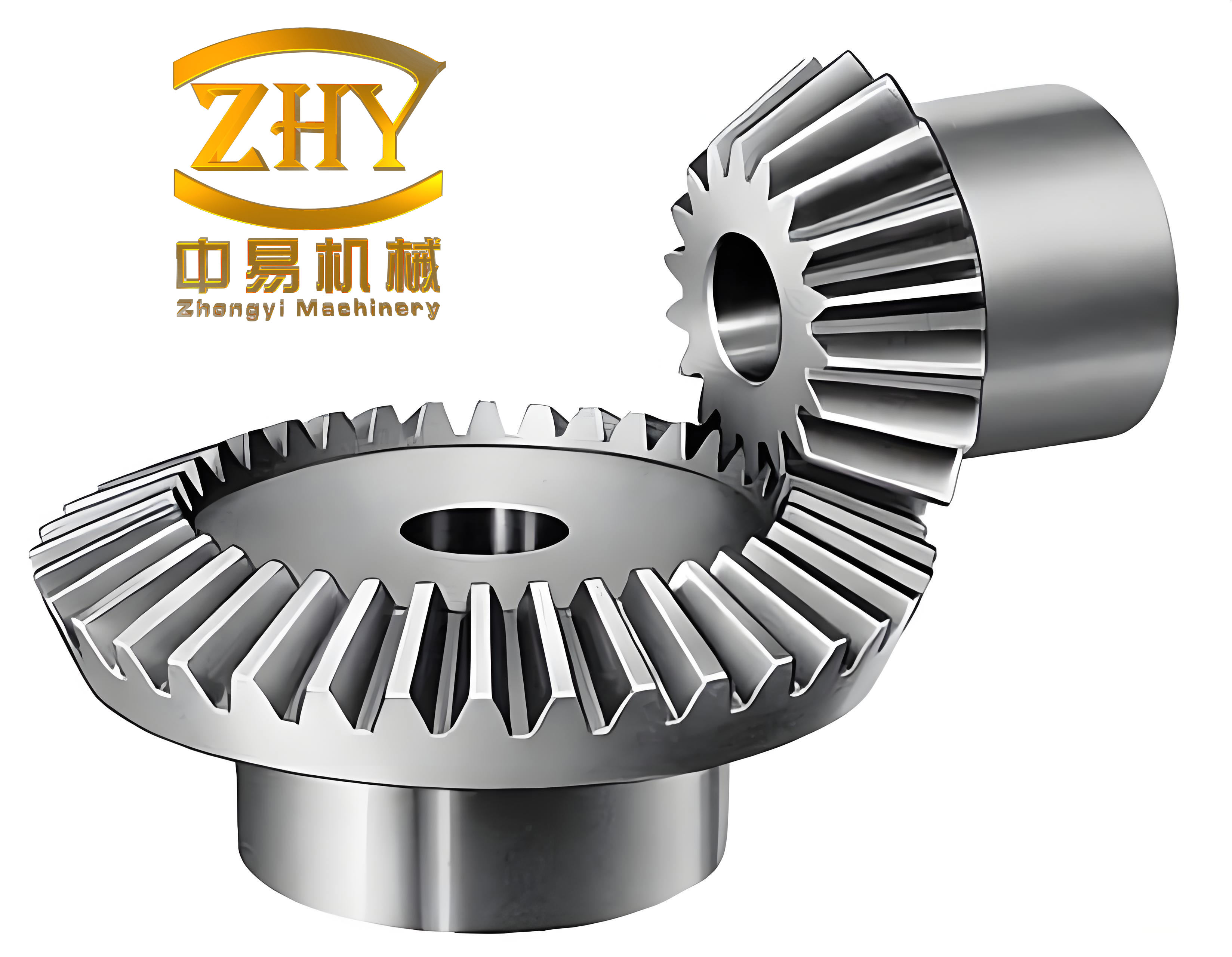
Straight bevel gears, while offering slightly lower load capacity compared to their spiral bevel counterparts, remain extensively utilized in medium- and low-power applications due to their lower manufacturing cost, simpler equipment requirements, and faster adaptability to design variations. Their significance extends even into heavy-duty transmission fields where large-scale machining equipment for spiral bevel gears is not always available. Among the various production methods, the double-tool generating planing process is a universal and widely adopted technique for manufacturing straight bevel gears. However, the conventional machining approach, which yields an approximately straight tooth profile, presents a significant challenge: the contact pattern is highly sensitive to manufacturing, installation errors, and deformations. This sensitivity makes it difficult to accurately determine the necessary corrections for machine setup parameters, ultimately compromising both final gear quality and production efficiency. Therefore, a systematic investigation into the forming principles, quality prediction, and control methodologies is not just beneficial but essential for advancing straight bevel gear manufacturing.
The successful application of computer-simulated gear generation and meshing analysis for the predictive control of contact and transmission quality in Gleason spiral bevel gears provides a powerful framework. This methodology serves as an effective means to assure quality and enhance productivity. Inspired by this, the following discussion adapts and extends these analytical foundations to straight bevel gears planed by the generating method. The core objective is to establish a predictive model that not only forecasts contact quality prior to actual cutting but, more importantly, guides the selection of optimal machine setup parameters.
Tooth Surface Generation in the Planing Process
The double-tool generating planing method operates on the principle of a “plane crown generating gear.” The cutting tools, mounted on the machine cradle, execute a reciprocating cutting motion. The trajectory of the tool’s cutting edge simulates the tooth surface of this plane crown generating gear. The workpiece, engaged in a generating roll motion with the cradle (carrying the tools), has its tooth flank enveloped by this moving family of tool surfaces.
Mathematical Model of the Generating Surface
To formulate the process mathematically, separate right-handed Cartesian coordinate systems are established for the gear (workpiece) and the generating mechanism. Let system $S_g(O_g-x_g, y_g, z_g)$ be fixed to the gear, and system $S_c(O_c-x_c, y_c, z_c)$ be attached to the cradle. The origin $O_c$ lies on the cradle axis. The plane $O_c y_c z_c$ coincides with the tool tip plane and is perpendicular to the cradle axis. The $y_c$-axis is within the cradle’s horizontal cross-section, pointing towards the cradle back, while the $z_c$-axis points towards the workpiece.
Any point on the generating surface can be defined by two location parameters: $u$, the distance along the tooth length direction from the gear’s mid-point, and $l$, the distance along the tooth height direction from the tool tip. The cradle rotation angle $\phi_c$ serves as the generating motion parameter. For a fixed $\phi_c$, the tool edge sweeps out a surface. As $\phi_c$ varies, a family of surfaces is formed, whose envelope constitutes the final machined tooth flank of the straight bevel gear.
The vector equation of the generating surface family in $S_c$ can be expressed as:
$$\mathbf{r}_c^{(c)}(u, l, \phi_c) = [x_c, y_c, z_c, 1]^T$$
The specific coordinate transformations incorporate key machine settings: the basic machine center to back $(X_B)$, the sliding base setting $(X_D)$, the machine root angle $(\gamma_m)$, the tool inclination angle $(\alpha_t)$, the cutter point width $(W)$, and the tool pressure angles $(\alpha_{tu}, \alpha_{tl})$ for the inner and outer blades. The equation accounts for the polar coordinate of the tool position $(\rho, \theta)$ on the cradle.
The general form, considering the generating roll, is:
$$\mathbf{r}_c(u, l, \phi_c) = \mathbf{M}_{cg}(\phi_c) \cdot \mathbf{r}_c^{(c)}(u, l)$$
where $\mathbf{M}_{cg}(\phi_c)$ is the transformation matrix from $S_c$ to a coordinate system fixed in space, incorporating the roll ratio $i_c = \frac{d\phi_g}{d\phi_c}$ (where $\phi_g$ is the gear rotation).
Formation of the Gear Tooth Surface
The generated tooth surface is the envelope of the generating surface family. According to the theory of gearing, for a point to be on the envelope (the gear surface), it must satisfy the equation of meshing between the generating surface and the gear:
$$ \mathbf{n}_c \cdot \mathbf{v}_c^{(cg)} = 0 $$
Here, $\mathbf{n}_c$ is the unit normal to the generating surface in $S_c$, and $\mathbf{v}_c^{(cg)}$ is the relative velocity vector between the cradle (tool) and the gear at the potential contact point, also represented in $S_c$.
Solving this equation simultaneously with the generating surface equation $\mathbf{r}_c(u, l, \phi_c)$ yields the mathematical description of the gear tooth surface as a function of two independent parameters (e.g., $u$ and $\phi_c$):
$$ \mathbf{r}_g(u, \phi_c) = \mathbf{M}_{gc}(\phi_c) \cdot \mathbf{r}_c(u, l(u, \phi_c), \phi_c) $$
This formulation is applied separately for the convex (drive) and concave (coast) flanks of the straight bevel gear, which are generated by the different blades.
Predictive Analysis of Meshing Quality
The primary indicators of machining quality for straight bevel gears are the contact pattern (or bearing contact) under load and the transmission error curve. Predicting these characteristics before physical cutting involves simulating the meshing of the theoretically generated pinion and gear tooth surfaces under specified assembly conditions, which may include misalignments.
Tooth Contact Analysis (TCA)
The core of prediction is a Tooth Contact Analysis algorithm. The basic steps are:
- Define the mathematically generated pinion and gear tooth surfaces $\mathbf{r}_p^{(p)}(u_p, \theta_p)$ and $\mathbf{r}_g^{(g)}(u_g, \theta_g)$ in their respective coordinate systems.
- Impose the assembly configuration, including shaft angle, axial positions, and potential offsets ($\Delta E$, $\Delta P$, $\Delta G$).
- Solve the system of equations enforcing continuous tangency (contact) between the two surfaces during rotation:
$$ \mathbf{r}_p^{(f)}(\phi_p) = \mathbf{r}_g^{(f)}(\phi_g) $$
$$ \mathbf{n}_p^{(f)}(\phi_p) = \mathbf{n}_g^{(f)}(\phi_g) $$
Here, the superscript $(f)$ denotes coordinates in a fixed global assembly frame. $\phi_p$ and $\phi_g$ are the rotation angles of the pinion and gear, related by the ratio of tooth numbers. - The solution provides: a) The transmission error, defined as $\Delta \phi_2 = \phi_2 – (N_1/N_2)\phi_1$, where $\phi_1, \phi_2$ are the actual rotations and $N_1, N_2$ are the tooth numbers. b) The path of contact points on both tooth surfaces, which maps directly to the predicted contact pattern.
The shape, size, and location of the contact ellipse at any instant can be calculated from the principal relative curvatures and directions of the two surfaces at the contact point.
Key Outputs: Contact Pattern and Transmission Error
The predictive model outputs crucial graphs. The contact pattern plot shows the imprint of the bearing contact on the pinion and gear tooth flanks, typically displayed on an unfolded tooth plane (length vs. height). The transmission error plot shows the functional relationship between gear rotation and the deviation from perfect conjugate motion. An ideal prediction allows for the evaluation and correction of setup parameters to achieve a centered, appropriately sized contact pattern and minimal transmission error variation, which is critical for the quiet operation of straight bevel gears.
| Parameter | Symbol | Pinion | Gear | Unit |
|---|---|---|---|---|
| Module | m | 4.0 | 4.0 | mm |
| Pressure Angle | α | 20.0 | 20.0 | ° |
| Number of Teeth | Z | 16 | 32 | – |
| Addendum | h_a | 5.12 | 2.08 | mm |
| Dedendum | h_f | 2.88 | 5.92 | mm |
| Pitch Diameter | d | 64.0 | 128.0 | mm |
| Pitch Apex to Crown | R | 71.55 | 71.55 | mm |
| Face Width | b | 18.0 | 18.0 | mm |
Control of Undercut and Pointing
A common technique to improve the load capacity and misalignment tolerance of straight bevel gears is to introduce a “crowned” or lengthwise-curved tooth form. This is achieved by employing a generating gear with a conical (plane crown) rather than a spherical reference surface, causing the pitch cones of generation and operation to be non-coincident. While beneficial for contact pattern stability, increasing crown can raise the risk of undercut on the pinion and excessive thinning (pointing) of the tooth tip.
Undercut Prediction
Undercut occurs when the tool removes material from the actively generated root area of the tooth. The condition for undercut can be derived from the singularity of the envelope-generation mapping. A boundary exists on the pinion tooth surface where the Jacobian of the transformation from generating parameters to gear surface coordinates becomes zero. This boundary curve is defined by solving:
$$ \frac{\partial \mathbf{r}_g}{\partial u} \times \frac{\partial \mathbf{r}_g}{\partial \phi_c} = \mathbf{0} $$
or an equivalent formulation involving the equation of meshing. By calculating this curve and projecting it onto the tooth, one can verify if it intrudes into the active tooth flank area. The crown coefficient (often related to the ratio of the cone apex offset to the pitch cone distance) and the addendum modification (x) are the primary parameters to adjust for avoiding undercut in straight bevel gears.
Tooth Topland (Pointing) Verification
To avoid undercut, a positive addendum modification is frequently applied to the pinion. However, an excessive modification can lead to an undesirably sharp (pointed) tooth at the heel (small end). This is assessed by calculating the tooth top land thickness at the small end. The coordinates of the tooth tip point on both the convex and concave flanks at the heel are determined by intersecting the tooth surface equations with the tip cone/plane equation. The chordal thickness $s_{a1}$ at this point is then computed. A practical design rule requires:
$$ s_{a1} \geq (0.25 \text{ to } 0.30) \cdot m $$
where $m$ is the module at the small end. The precise minimum acceptable value depends on the specific application and heat treatment of the straight bevel gears.
Computational Implementation and Case Study
Based on the derived mathematical models, a computer program (e.g., a dedicated software module) has been developed to perform the integrated tasks of surface generation, TCA, and undercut/pointing analysis for straight bevel gears. The workflow involves inputting design parameters, initial machine settings, and desired modifications. The program outputs predicted contact patterns, transmission error curves, and warnings for potential manufacturing defects.
| Setup Item | Pinion | Gear | Unit |
|---|---|---|---|
| Machine Center to Back, X_B | 0.00 | 0.00 | mm |
| Sliding Base, X_D | +0.50 | -0.50 | mm |
| Machine Root Angle, γ_m | 43.00° | 46.00° | ° |
| Tool Tilt Angle (Inner/Outer) | 13.00°/13.00° | 13.00°/13.00° | ° |
| Cutter Radial Setting (Inner/Outer) | +73.20/+73.20 | +73.20/+73.20 | mm |
| Roll Ratio, i_c | 1.2500 | 0.6250 | – |
Case A (With Moderate Crown): Using a crown coefficient $k = 0.15$, the TCA prediction shows a well-centered, elliptical contact pattern with a slight bias towards the toe on the drive side. The transmission error curve exhibits low amplitude. The undercut verification confirms the boundary lies safely outside the active flank area.
| Flank | Pattern Center (L/H) | Pattern Size (Length×Height) | Undercut Status |
|---|---|---|---|
| Drive Side (Convex) | Slightly Toe | ~70% × ~60% of Face | No undercut detected |
| Coast Side (Concave) | Centered | ~65% × ~55% of Face | No undercut detected |
Case B (Excessive Crown – Problematic): When the crown coefficient is increased to $k = 0.30$ while keeping other factors similar, the predictive analysis reveals a critical issue. Although the contact pattern might become more tolerant to misalignment, the undercut analysis shows that the root boundary curve intersects the active tooth flank of the pinion near the heel on the drive side, indicating severe undercut. This prediction would prevent the use of this setup, saving time and material.
Experimental Validation
To validate the predictive methodology, physical cutting trials were conducted on a standard bevel gear planing machine (e.g., model Y236). The test gear pair had the design parameters listed in Table 1.
Procedure: The machine was set up according to the parameters calculated for Case A (with $k=0.15$). After machining, the pinion and gear were assembled on a testing fixture with nominal alignment and run under a light load with marking compound.
Results: The observed contact pattern on the gear tooth flank closely matched the computer-predicted pattern in terms of location, shape, and orientation. The contact was centered slightly towards the toe, forming a clear ellipse within the tooth boundaries. This close correlation between the simulated and physical results confirms the accuracy and practical utility of the predictive model for straight bevel gears. A trial with the parameters for the problematic Case B was correctly avoided based on the undercut prediction.
Conclusion
The double-tool generating planing process is a fundamental and versatile method for producing straight bevel gears. By employing computer simulation based on rigorous gear generation and meshing theory, it is possible to predict and control the critical quality attributes—contact pattern and transmission error—prior to physical machining. This proactive approach significantly enhances first-pass success rates and final product quality.
The developed mathematical model and associated software provide a comprehensive tool for analyzing straight bevel gears. They enable the simulation of tooth surface generation, prediction of meshing performance under load, and crucial checks for manufacturing defects like undercut and tooth pointing. The introduction of controlled crown is a highly recommended practice to improve the insensitivity of straight bevel gears to errors and deformations. However, the predictive analysis is essential to balance the benefits of crown against the risks of undercut and excessive top land thinning, allowing for the determination of an optimal crown coefficient and addendum modification. The agreement between predicted and experimental results firmly establishes this methodology as a reliable and effective foundation for the advanced manufacturing and quality assurance of straight bevel gears.