
In precision transmission systems, the planetary roller screw assembly plays a critical role due to its high load capacity, compact design, and efficiency. To achieve bidirectional precision driving without backlash, preloading is essential. This study focuses on a pin-based double-nut planetary roller screw assembly, where preload is generated by the relative rotation of two nuts and maintained by pins. I develop a static model to analyze the preload mechanism, considering the elastic deformations and load distributions under both preload-only and external load conditions. The model incorporates the double-nut, double-roller, and screw interactions, and I propose methods to calculate forces and deformations. Validation is performed via finite element analysis, and the results demonstrate the relationship between initial preload, nut rotation, pin shear force, and thread load distribution. Key findings include that a small nut rotation yields a large initial preload, pin shear forces are significantly lower than preloads or external loads, and the external load causing preload loss in one nut far exceeds the initial preload. This research provides a foundation for the design and analysis of planetary roller screw assemblies in high-precision applications.
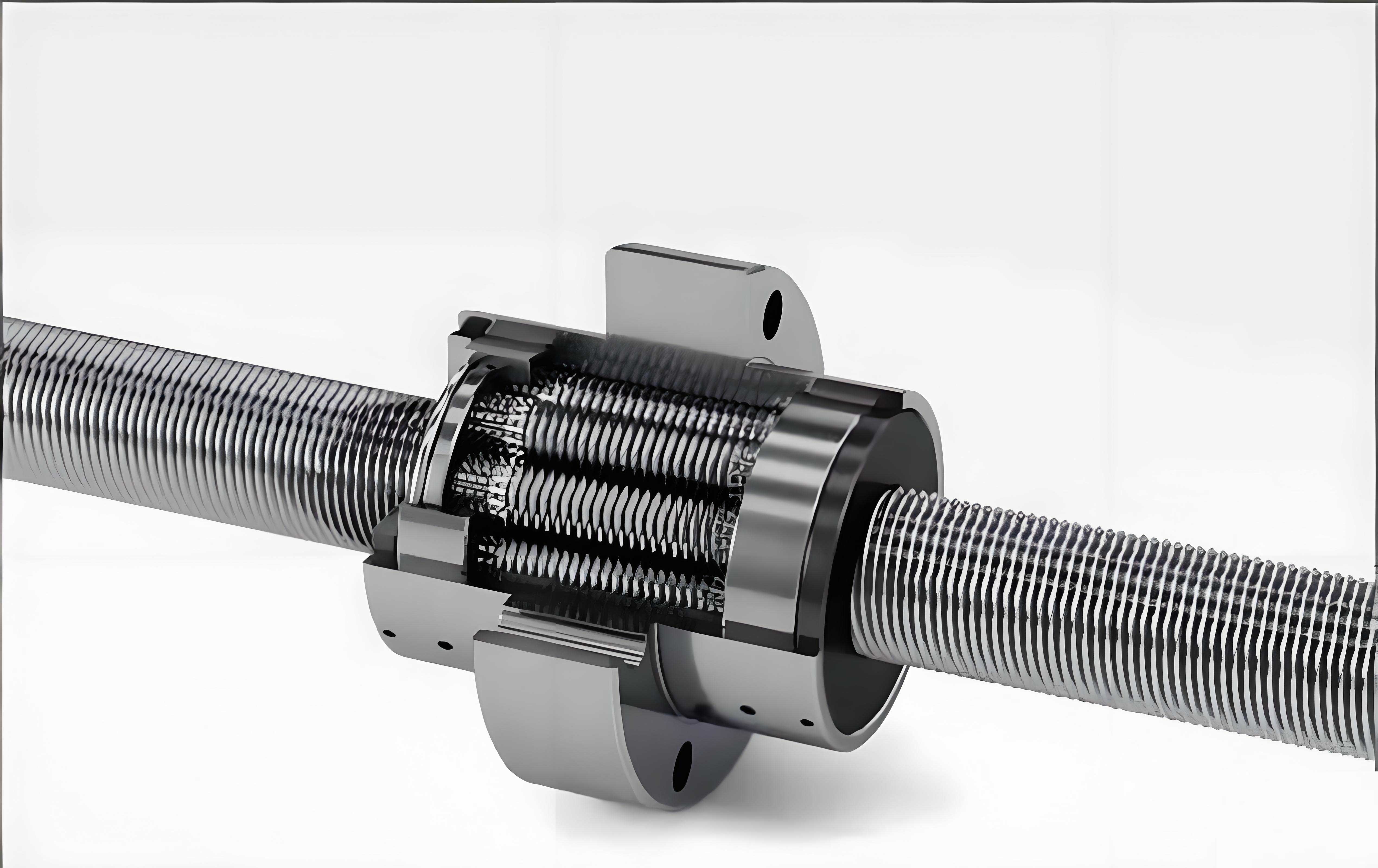
The planetary roller screw assembly is widely used in aerospace, robotics, and medical devices for its superior performance. However, backlash can compromise precision in reversible drives. To address this, preloaded configurations like the double-nut planetary roller screw assembly are employed. In this work, I investigate a pin-based double-nut design, where preload is applied by rotating one nut relative to the other and fixing the angle with pins. This eliminates clearance and enhances axial stiffness. The goal is to understand the preload mechanism through static modeling, focusing on load distribution and elastic deformations under various loading scenarios.
The structure of the pin-based double-nut planetary roller screw assembly consists of two nut sub-assemblies, each including a nut, rollers, a cage, and an internal ring. The screw passes through both sub-assemblies, and the nuts are in contact and connected by pins. For a right-hand thread, rotating nut #1 counterclockwise brings it closer to nut #2, generating preload. When the thread clearance is zero and the initial preload \(F_{pre0} = 0\), the relative angle \(\phi = 0^\circ\). As \(\phi\) increases, \(F_{pre0}\) rises, stretching the screw between the nuts. After achieving the desired preload, pins fix the relative angle to maintain preload. The coordinate system OXYZ is fixed with the Z-axis along the screw axis.
Under preload-only conditions, the forces on nut #1 and nut #2 are equal to \(F_{pre0}\), causing elastic displacements \(u_{N10}\) and \(u_{N20}\), respectively. The total elastic displacement \(\delta\) is given by:
$$ \delta = u_{N20} – u_{N10} $$
The relative angle \(\phi\) is related to \(\delta\) by the screw lead \(L_S\):
$$ \phi = \frac{2\pi}{L_S} \delta $$
The shear force on the pins, \(F_{pin}\), is derived from the torque balance, with \(r_{pin}\) as the distance from the pin axis to the screw axis:
$$ F_{pin} = \frac{F_{pre0} L_S}{2\pi r_{pin}} $$
When an external load \(F_N\) is applied to nut #2 along the negative Z-direction, with the screw left end fixed, the preloads change to \(F_{pre1}\) and \(F_{pre2}\) for nuts #1 and #2, respectively. Assuming an increase \(\Delta F\) in preload for nut #1 due to \(F_N\):
$$ F_{pre1} = F_{pre0} + \Delta F $$
$$ F_{pre2} = F_{pre0} + \Delta F – F_N $$
The elastic displacements \(u_{N1}\) and \(u_{N2}\) must satisfy the deformation compatibility condition:
$$ u_{N2} – u_{N1} = \delta $$
The pin shear force becomes:
$$ F_{pin} = \frac{(F_{pre0} + \Delta F) L_S}{2\pi r_{pin}} $$
To model the system, I develop a static model using spring and rigid body elements, representing the screw, rollers, and nuts as spring units with stiffnesses \(k_{ei}\) for \(i = S, N, R\) (screw, nut, roller). The stiffness is calculated as:
$$ k_{ei} = \frac{E_i A_{ei}}{L_{ei}} $$
where \(E_i\) is the elastic modulus, \(A_{ei}\) is the cross-sectional area, and \(L_{ei}\) is the element length. The nut element length equals the screw pitch \(P\), and the roller element length is \(P/2\). Contact stiffness between the nut and roller, \(k_{NRm,k}\), and between the screw and roller, \(k_{SRm,k}\), are derived from Hertzian contact theory. For the nut-roller contact at the k-th thread of roller m (m=1,2):
$$ k_{NRm,k} = \frac{F_{NRm,k}}{\delta_{NRm,k}} = \frac{16}{9} \cdot \frac{E_{NRm}^2 R_{NRm}^{1/3}}{\vartheta_{NRm}^{1/3} \cos \lambda_{NRm} \cos \beta_{NRm}} \cdot F_{NRm,k}^{1/3} $$
Similarly, for the screw-roller contact:
$$ k_{SRm,k} = \frac{F_{SRm,k}}{\delta_{SRm,k}} = \frac{16}{9} \cdot \frac{E_{SRm}^2 R_{SRm}^{1/3}}{\vartheta_{SRm}^{1/3} \cos \lambda_{SRm} \cos \beta_{SRm}} \cdot F_{SRm,k}^{1/3} $$
Here, \(E_{NRm}\) and \(E_{SRm}\) are equivalent elastic moduli, \(R_{NRm}\) and \(R_{SRm}\) are curvature radii, \(\vartheta_{NRm}\) and \(\vartheta_{SRm}\) are curvature ratios, \(\lambda_{NRm}\) and \(\lambda_{SRm}\) are helix angles, and \(\beta_{NRm}\) and \(\beta_{SRm}\) are thread flank angles.
The model discretizes the planetary roller screw assembly into nodes and elements. The transformation between node displacements and element deformations is expressed as:
$$ \boldsymbol{\delta} = \mathbf{A} \mathbf{u} $$
where \(\mathbf{A}\) is the transformation matrix, \(\mathbf{u}\) is the node displacement vector, and \(\boldsymbol{\delta}\) is the deformation vector. Considering boundary conditions, the reduced system is:
$$ \boldsymbol{\delta}’ = \mathbf{A}’ \mathbf{u}’ $$
The equilibrium equation is:
$$ \mathbf{F} = (\mathbf{A}’)^T \mathbf{F}_e $$
with \(\mathbf{F}_e = \mathbf{K} \mathbf{A}’ \mathbf{u}’\), where \(\mathbf{K}\) is the stiffness matrix. The non-constrained node displacements are solved as:
$$ \mathbf{u}’ = \left[ (\mathbf{A}’)^T \mathbf{K} \mathbf{A}’ \right]^{-1} \mathbf{F} $$
The axial forces on roller threads relate to \(\mathbf{F}_e\) by indices. For preload-only conditions, the calculation iterates until convergence, with initial guesses for contact forces. For external load conditions, nonlinear equations from equilibrium and compatibility are solved numerically.
The basic parameters of the planetary roller screw assembly are summarized in Table 1.
| Component | Screw | Roller | Nut |
|---|---|---|---|
| Pitch diameter \(d_i\) (mm) | 19.5 | 6.5 | 32.5 |
| Flank angle \(\beta_i\) (°) | 45 | 45 | 45 |
| Number of starts \(n\) | 5 | 1 | 5 |
| Pitch \(P\) (mm) | 2 | 2 | 2 |
| Rollers per nut \(n_{roller}\) | — | 6 | — |
| Threads per roller \(n_T\) | — | 15 | — |
To validate the model, I compare results with a finite element model built in ABAQUS. The FE model uses one-sixth symmetry of the planetary roller screw assembly, with contacts between nut-roller and screw-roller threads. Materials are GCr15 steel. For \(F_N = 0\), the initial preload \(F_{pre0} = 2380.1 \, \text{N}\) from FE analysis. Load distributions between nut-roller and screw-roller pairs show excellent agreement, with errors below 4%. Under external loads, the preload on nut #1 from the static model matches FE results within 2%, confirming the model’s accuracy.
Under preload-only conditions, the nut relative angle \(\phi\) and pin shear force \(F_{pin}\) vary with initial preload \(F_{pre0}\). As shown in Table 2, \(\phi\) increases nonlinearly with \(F_{pre0}\) due to the nonlinear contact stiffness, while \(F_{pin}\) increases linearly. A small \(\phi\) generates a large \(F_{pre0}\), and \(F_{pin}\) is much smaller than \(F_{pre0}\).
| \(F_{pre0}\) (N) | \(\phi\) (°) | \(F_{pin}\) (N) |
|---|---|---|
| 1000 | 0.25 | 13.3 |
| 2000 | 0.48 | 26.5 |
| 3000 | 0.70 | 39.8 |
| 4000 | 0.91 | 53.1 |
The load distribution on threads is symmetric for both nuts under preload-only. For nut #1 and roller #1, the load increases from left to right, while for nut #2 and roller #2, it decreases from left to right, due to proximity to the nut contact surface. The maximum load occurs on the screw-side threads near the nut interface, as seen in Table 3 for \(F_{pre0} = 3000 \, \text{N}\).
| Thread Index \(k\) | Nut #1-Roller #1 \(F_{NR1,k}\) (N) | Screw-Roller #1 \(F_{SR1,k}\) (N) | Nut #2-Roller #2 \(F_{NR2,k}\) (N) | Screw-Roller #2 \(F_{SR2,k}\) (N) |
|---|---|---|---|---|
| 1 | 180.2 | 195.4 | 195.4 | 180.2 |
| 2 | 185.6 | 200.1 | 200.1 | 185.6 |
| 3 | 190.3 | 204.5 | 204.5 | 190.3 |
| 4 | 194.8 | 208.7 | 208.7 | 194.8 |
| 5 | 199.1 | 212.8 | 212.8 | 199.1 |
| 6 | 203.2 | 216.7 | 216.7 | 203.2 |
| 7 | 207.2 | 220.5 | 220.5 | 207.2 |
| 8 | 211.1 | 224.2 | 224.2 | 211.1 |
| 9 | 214.8 | 227.7 | 227.7 | 214.8 |
| 10 | 218.4 | 231.2 | 231.2 | 218.4 |
| 11 | 221.9 | 234.5 | 234.5 | 221.9 |
| 12 | 225.3 | 237.7 | 237.7 | 225.3 |
| 13 | 228.6 | 240.8 | 240.8 | 228.6 |
| 14 | 231.8 | 243.8 | 243.8 | 231.8 |
| 15 | 234.9 | 246.7 | 246.7 | 234.9 |
Under external load \(F_N\), with \(F_{pre0} = 3000 \, \text{N}\), the preloads and pin shear force change as in Table 4. As \(F_N\) increases, \(F_{pre1}\) rises, \(F_{pre2}\) falls, and \(F_{pin}\) increases. When \(F_N = 8572 \, \text{N}\), \(F_{pre2} = 0\), meaning roller #2 no longer carries load. This external load is much higher than \(F_{pre0}\), due to nonlinear stiffness. The pin shear force remains small compared to \(F_N\).
| \(F_N\) (N) | \(F_{pre1}\) (N) | \(F_{pre2}\) (N) | \(F_{pin}\) (N) |
|---|---|---|---|
| 0 | 3000 | 3000 | 39.8 |
| 1000 | 3325 | 2325 | 44.1 |
| 2000 | 3650 | 1650 | 48.5 |
| 3000 | 3975 | 975 | 52.8 |
| 4000 | 4300 | 300 | 57.1 |
| 5000 | 4625 | -375 | 61.4 |
| 6000 | 4950 | -1050 | 65.7 |
| 7000 | 5275 | -1725 | 70.0 |
| 8000 | 5600 | -2400 | 74.4 |
| 8572 | 5822 | 0 | 77.3 |
The load distribution evolves with \(F_N\). For nut #1 and roller #1, the load on nut-side threads peaks at the rightmost thread, while on screw-side threads, the distribution shifts from low-high to high-low as \(F_N\) exceeds \(F_{pre0}\), with the maximum moving to the leftmost thread. For nut #2 and roller #2, loads decrease uniformly. Table 5 shows examples for \(F_N = 4000 \, \text{N}\).
| Thread Index \(k\) | Nut #1-Roller #1 \(F_{NR1,k}\) (N) | Screw-Roller #1 \(F_{SR1,k}\) (N) | Nut #2-Roller #2 \(F_{NR2,k}\) (N) | Screw-Roller #2 \(F_{SR2,k}\) (N) |
|---|---|---|---|---|
| 1 | 250.3 | 280.5 | 50.1 | 40.2 |
| 2 | 255.7 | 285.2 | 55.3 | 45.4 |
| 3 | 260.4 | 289.6 | 60.8 | 50.9 |
| 4 | 264.9 | 293.8 | 66.5 | 56.6 |
| 5 | 269.2 | 297.9 | 72.4 | 62.5 |
| 6 | 273.3 | 301.8 | 78.5 | 68.6 |
| 7 | 277.3 | 305.6 | 84.8 | 74.9 |
| 8 | 281.2 | 309.3 | 91.3 | 81.4 |
| 9 | 284.9 | 312.8 | 98.0 | 88.1 |
| 10 | 288.5 | 316.3 | 104.9 | 95.0 |
| 11 | 292.0 | 319.6 | 112.0 | 102.1 |
| 12 | 295.4 | 322.8 | 119.3 | 109.4 |
| 13 | 298.7 | 325.9 | 126.8 | 116.9 |
| 14 | 301.9 | 328.9 | 134.5 | 124.6 |
| 15 | 305.0 | 331.8 | 142.4 | 132.5 |
In conclusion, this study presents a comprehensive analysis of the preload mechanism in a pin-based double-nut planetary roller screw assembly. The static model effectively captures the elastic deformations and load distributions, validated by finite element analysis. Key insights include:
- The nut relative angle increases nonlinearly with initial preload, while pin shear force is linear and much smaller.
- Under preload-only conditions, load distributions are symmetric, with maximum loads on screw-side threads near the nut interface.
- With external loads, preload on nut #1 increases, preload on nut #2 decreases, and the external load causing preload loss is significantly larger than the initial preload due to nonlinear contact stiffness.
- Pin shear forces remain low, ensuring pin reliability.
These findings provide a foundation for designing and optimizing planetary roller screw assemblies for high-precision, backlash-free applications. Future work could extend to dynamic analysis, friction effects, and experimental validation. The planetary roller screw assembly continues to be a vital component in advanced mechanical systems, and understanding its preload mechanism enhances performance and reliability.