
In the manufacturing of straight bevel gears, the planing process is a common method used to generate tooth profiles. However, regardless of whether the cutting is based on the flat-top gear principle (producing ordinary tooth forms) or the plane gear principle (producing octoid tooth forms), the resulting profiles deviate from the ideal spherical involute tooth form. This deviation leads to tooth profile errors that can affect the performance and durability of straight bevel gears in applications such as automotive differentials, industrial machinery, and aerospace systems. As a machinist or engineer involved in gear production, I often encounter the need to minimize these errors through precise adjustments. One effective approach is correcting the pressure angle during the planing process. This article delves into the theory and practice of pressure angle correction for straight bevel gears, utilizing formulas, tables, and detailed explanations to guide optimal adjustments. By focusing on straight bevel gears—a key component in power transmission—I aim to provide a comprehensive resource for achieving minimal tooth profile errors in planing operations.
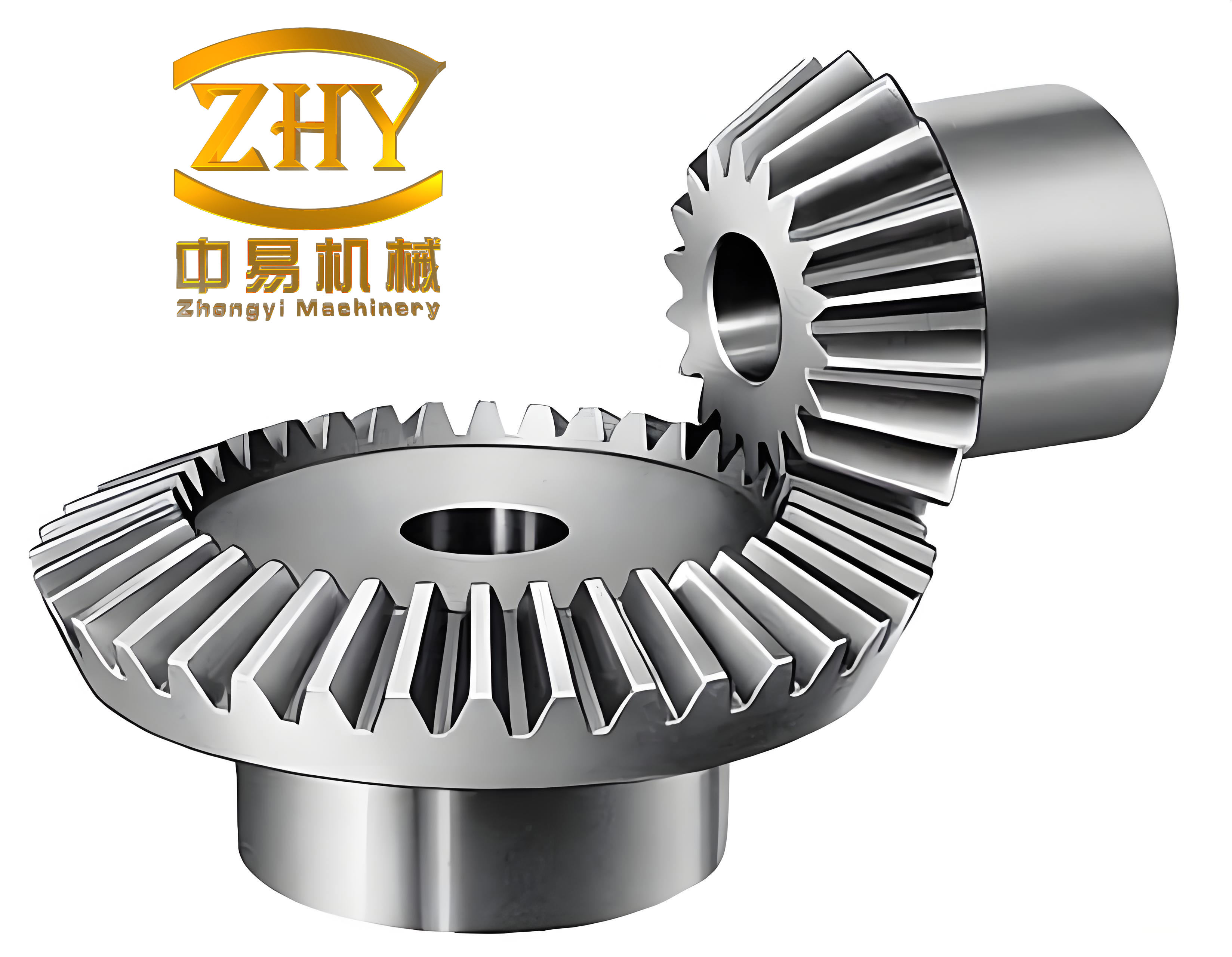
Straight bevel gears are conical gears with straight teeth that intersect at the apex of the cone. They are widely used for transmitting motion between intersecting shafts, typically at a 90-degree angle. The ideal tooth form for straight bevel gears is the spherical involute, which ensures smooth and efficient meshing. However, in practical planing operations, the generated tooth profiles approximate this ideal but introduce errors due to machine kinematics and tool geometry. The two common generated forms are the octoid tooth profile (based on the plane gear principle) and the ordinary tooth profile (based on the flat-top gear principle). Both differ from the spherical involute, leading to discrepancies that must be addressed. In this discussion, I will explore these tooth forms, analyze their errors, and present methods for pressure angle correction to enhance the accuracy of straight bevel gears.
The spherical involute tooth form is the theoretical ideal for straight bevel gears, derived from the geometry of a sphere. In contrast, the octoid tooth form is generated using a plane gear simulation, while the ordinary tooth form results from a flat-top gear simulation. Visually, the octoid profile tends to be concave at the tooth tip and convex at the root relative to the spherical involute, whereas the ordinary profile is concave at both the tip and root. However, near the pitch circle—the critical meshing region—all three profiles closely align, with minimal error. This proximity makes direct measurement of pressure angle changes at the pitch circle challenging, necessitating alternative approaches for correction. Understanding these differences is essential for optimizing the planing of straight bevel gears.
To quantify tooth profile errors, we must examine pressure angle variations. The pressure angle at any point on an involute curve is defined by the geometry of the base circle. For straight bevel gears, we use equivalent (or virtual) circles to simplify calculations on a planar representation. Let \( r \) be the equivalent radius at a given point, and \( \alpha \) be the pressure angle at that radius. According to involute theory, the relationship is given by:
$$ \alpha = \arccos\left(\frac{r_b}{r}\right) $$
where \( r_b \) is the equivalent base circle radius. For the theoretical spherical involute profile, at the pitch circle radius \( r_p \), the pressure angle is the standard value \( \alpha_0 \), typically 20° or other design specifications. In generated profiles, the actual pressure angle \( \alpha’ \) deviates from \( \alpha_0 \), leading to tooth thickness variations. The difference \( \Delta \alpha = \alpha’ – \alpha_0 \) is crucial for correction. However, as noted, measuring \( \Delta \alpha \) directly at the pitch circle is impractical due to small deviations. Instead, we can assess it at the fixed chord height, where errors are more pronounced, and approximate the pitch circle correction.
The chordal tooth thickness is a measurable parameter that relates to pressure angle. For a theoretical tooth profile, at a given chordal height \( h \), the chordal thickness \( s \) and equivalent radius \( r \) are linked through geometric formulas. For the actual profile, with chordal thickness \( s’ \) and equivalent radius \( r’ \), we can derive the pressure angle difference. Specifically, at a fixed chordal height near the mid-height of the tooth, we compute the theoretical chordal thickness \( s \) and measure the actual \( s’ \). The approximate pressure angle change \( \Delta \alpha \) is then:
$$ \Delta \alpha \approx \frac{s’ – s}{2 r_p \sin \alpha_0} $$
This formula simplifies the calculation by assuming \( r’ \approx r_p \) at the pitch circle, which is valid for small errors. In practice, for straight bevel gears, this approximation suffices to initiate corrections. The goal is to iteratively adjust machine settings until \( \Delta \alpha \) approaches zero, minimizing profile errors. This process is integral to high-quality straight bevel gear production.
To systematically analyze tooth forms and errors, I present the following table comparing key characteristics of spherical involute, octoid, and ordinary profiles for straight bevel gears:
| Tooth Form | Generation Principle | Deviation from Spherical Involute | Typical Error at Pitch Circle | Pressure Angle Trend |
|---|---|---|---|---|
| Spherical Involute | Theoretical ideal | None | Zero | Constant \( \alpha_0 \) |
| Octoid | Plane gear principle | Concave tip, convex root | Very small | Increases at tip, decreases at root |
| Ordinary | Flat-top gear principle | Concave tip and root | Very small | Decreases at both tip and root |
This table highlights that both generated forms have minimal error at the pitch circle, but deviations grow toward the tip and root. For straight bevel gears, these errors can cause noise, vibration, and reduced load capacity if uncorrected. Therefore, pressure angle correction focuses on the pitch region, ensuring optimal meshing. The octoid profile is often preferred for straight bevel gears due to its closer approximation to the spherical involute, but ordinary profiles are also common in cost-sensitive applications.
The correction process involves adjusting three main parameters in the planing machine: the rolling ratio (which controls the gear generation motion), the tool pressure angle (i.e., the cutter blade angle), and the workpiece installation distance (affecting the tooth depth). Based on the calculated \( \Delta \alpha \), we modify these settings. Let \( \Delta a \) be the axial displacement of the gear measured during testing, \( \varphi_1 \) the pitch cone angle of the gear, \( \varphi_2 \) the pitch cone angle of the mating gear, and \( i \) the original rolling ratio. The adjusted rolling ratio \( i’ \) is:
$$ i’ = i \pm \frac{\Delta a \sin \varphi_2}{r_p \sin \varphi_1} $$
The tool pressure angle correction \( \Delta \alpha_t \) is approximately equal to \( \Delta \alpha \), but with a sign depending on the error direction. For straight bevel gears, if the actual tooth is thicker than theoretical at the pitch circle, the pressure angle is larger, and the tool angle should be reduced. The new tool angle \( \alpha_t’ \) is:
$$ \alpha_t’ = \alpha_t + \Delta \alpha $$
where \( \alpha_t \) is the nominal tool pressure angle. The installation distance adjustment \( \Delta L \) compensates for axial shifts and is derived from \( \Delta a \) and gear geometry. These adjustments are interlinked; thus, iterative testing is essential. For straight bevel gears, typical values of \( \Delta \alpha \) range from -0.5° to +0.5°, requiring precise machine calibration.
To illustrate the calculation, consider a straight bevel gear with the following parameters: module \( m = 5 \, \text{mm} \), number of teeth \( z = 20 \), pitch cone angle \( \varphi_1 = 45^\circ \), pressure angle \( \alpha_0 = 20^\circ \), and face width \( b = 30 \, \text{mm} \). The equivalent pitch radius \( r_p \) is calculated from the back cone distance. For straight bevel gears, the equivalent radius is given by:
$$ r_p = \frac{m z}{2 \cos \varphi_1} $$
Substituting values: \( r_p = \frac{5 \times 20}{2 \cos 45^\circ} = \frac{100}{2 \times 0.7071} \approx 70.71 \, \text{mm} \). The equivalent base radius \( r_b \) is \( r_b = r_p \cos \alpha_0 = 70.71 \times \cos 20^\circ \approx 70.71 \times 0.9397 \approx 66.45 \, \text{mm} \). Now, suppose we measure the chordal tooth thickness at a fixed chordal height \( h = 1.5 \, \text{mm} \) from the pitch line. The theoretical chordal thickness \( s \) for a spherical involute can be computed using:
$$ s = 2 r_p \sin\left(\frac{\pi}{2z} + \text{inv} \alpha_0 – \text{inv} \alpha_h\right) $$
where \( \alpha_h \) is the pressure angle at radius \( r_h = \sqrt{r_p^2 + h^2} \), and \( \text{inv} \alpha = \tan \alpha – \alpha \) is the involute function. This requires iterative solving, but for simplicity, we can use approximate formulas. For straight bevel gears, a common approximation at the fixed chord is \( s \approx m \pi /2 \). With \( m = 5 \), \( s \approx 7.854 \, \text{mm} \). Assume the measured actual thickness \( s’ = 7.800 \, \text{mm} \). Then, using the approximate formula for \( \Delta \alpha \):
$$ \Delta \alpha \approx \frac{s’ – s}{2 r_p \sin \alpha_0} = \frac{7.800 – 7.854}{2 \times 70.71 \times \sin 20^\circ} = \frac{-0.054}{2 \times 70.71 \times 0.3420} \approx \frac{-0.054}{48.36} \approx -0.00112 \, \text{rad} $$
Converting to degrees: \( \Delta \alpha \approx -0.064^\circ \). This small negative value indicates the actual pressure angle is slightly less than theoretical at that point. For correction, we might adjust the tool angle by reducing it by about 0.064°, but since this is at a fixed chord, we approximate the pitch circle correction. In practice, we would repeat measurements at multiple points and use averaging.
For a more comprehensive analysis, the following table summarizes key formulas used in pressure angle correction for straight bevel gears:
| Parameter | Symbol | Formula | Notes |
|---|---|---|---|
| Equivalent Pitch Radius | \( r_p \) | $$ r_p = \frac{m z}{2 \cos \varphi_1} $$ | Based on back cone geometry |
| Equivalent Base Radius | \( r_b \) | $$ r_b = r_p \cos \alpha_0 $$ | For spherical involute reference |
| Pressure Angle at Radius r | \( \alpha \) | $$ \alpha = \arccos\left(\frac{r_b}{r}\right) $$ | Involute definition |
| Chordal Thickness (Theoretical) | \( s \) | $$ s = 2r \sin\left(\frac{\pi}{2z} + \text{inv} \alpha_0 – \text{inv} \alpha\right) $$ | At chordal height corresponding to r |
| Pressure Angle Change Approximation | \( \Delta \alpha \) | $$ \Delta \alpha \approx \frac{s’ – s}{2 r_p \sin \alpha_0} $$ | Valid for small errors near pitch circle |
| Adjusted Rolling Ratio | \( i’ \) | $$ i’ = i \pm \frac{\Delta a \sin \varphi_2}{r_p \sin \varphi_1} $$ | From axial displacement measurement |
| Tool Pressure Angle Correction | \( \alpha_t’ \) | $$ \alpha_t’ = \alpha_t + \Delta \alpha $$ | Assume \( \Delta \alpha \) derived from pitch circle |
These formulas are fundamental for optimizing straight bevel gear planing. In application, we must consider that straight bevel gears have varying tooth profiles along the face width due to their conical shape. The equivalent circle method simplifies this by projecting the gear onto a plane perpendicular to the pitch cone. However, for high-precision straight bevel gears, additional factors like tooth taper and crowning may be incorporated, but pressure angle correction remains a core step.
The iterative adjustment process in planing straight bevel gears typically involves these steps: First, machine the initial gear using standard settings. Second, measure the tooth profile, preferably using a gear rolling tester or coordinate measuring machine. For straight bevel gears, contact pattern checks with a master gear are ideal, but if unavailable, chordal thickness measurements suffice. Third, calculate \( \Delta \alpha \) from deviations. Fourth, adjust the planing machine based on \( \Delta \alpha \): modify the rolling ratio via change gears or CNC parameters, replace or regrind the cutter blades for pressure angle, and shift the workpiece axially. Fifth, replane and remeasure. Repeat until errors are within tolerance, often requiring 2-3 iterations for straight bevel gears.
To elaborate on measurement techniques, for straight bevel gears, the fixed chord method is practical. The fixed chord height \( h_f \) is determined from the gear geometry. For a standard tooth, \( h_f \approx 0.5 m \), but for bevel gears, it’s adjusted by the cone angle. A detailed table for common straight bevel gear parameters can aid quick reference:
| Module (mm) | Number of Teeth | Pitch Cone Angle (degrees) | Fixed Chord Height (mm) | Theoretical Chordal Thickness (mm) |
|---|---|---|---|---|
| 3 | 15 | 30 | 1.2 | 4.712 |
| 4 | 20 | 45 | 1.6 | 6.283 |
| 5 | 25 | 60 | 2.0 | 7.854 |
| 6 | 30 | 75 | 2.4 | 9.425 |
These values are approximate and assume standard pressure angles. For actual straight bevel gears, custom calculations are needed based on design specs. The key is consistency: measure at the same chordal height for all gears in a set to ensure comparability.
Beyond basic correction, advanced considerations for straight bevel gears include the impact of misalignment and thermal effects. During planing, machine tool wear can drift settings, so regular calibration is crucial. Additionally, the choice between octoid and ordinary generation affects the optimal correction. For octoid straight bevel gears, the error pattern is symmetric, so pressure angle correction often involves equal adjustments at tip and root. For ordinary straight bevel gears, asymmetric corrections may be needed. This can be modeled using polynomial error functions, but in practice, linear approximations based on \( \Delta \alpha \) work well.
Let’s explore a detailed example of pressure angle correction for a pair of straight bevel gears. Suppose we have a driving gear with \( z_1 = 18 \), \( \varphi_1 = 40^\circ \), and a driven gear with \( z_2 = 36 \), \( \varphi_2 = 50^\circ \), module \( m = 4 \, \text{mm} \), and pressure angle \( \alpha_0 = 20^\circ \). The goal is to correct the driving gear after initial planing shows excessive backlash. Measurements indicate an axial displacement \( \Delta a = 0.1 \, \text{mm} \) (positive means gear is too deep). The original rolling ratio \( i = 1.5 \). First, compute equivalent pitch radius for the driving gear:
$$ r_{p1} = \frac{m z_1}{2 \cos \varphi_1} = \frac{4 \times 18}{2 \cos 40^\circ} = \frac{72}{2 \times 0.7660} \approx 47.02 \, \text{mm} $$
Then, adjusted rolling ratio:
$$ i’ = i + \frac{\Delta a \sin \varphi_2}{r_{p1} \sin \varphi_1} = 1.5 + \frac{0.1 \times \sin 50^\circ}{47.02 \times \sin 40^\circ} = 1.5 + \frac{0.1 \times 0.7660}{47.02 \times 0.6428} \approx 1.5 + \frac{0.07660}{30.22} \approx 1.5025 $$
This small change in rolling ratio fine-tunes the tooth generation motion. Next, measure chordal thickness at fixed height. Assume theoretical \( s = 6.283 \, \text{mm} \) (from table) and actual \( s’ = 6.250 \, \text{mm} \). Compute \( \Delta \alpha \):
$$ \Delta \alpha \approx \frac{6.250 – 6.283}{2 \times 47.02 \times \sin 20^\circ} = \frac{-0.033}{2 \times 47.02 \times 0.3420} \approx \frac{-0.033}{32.16} \approx -0.001026 \, \text{rad} \approx -0.0588^\circ $$
Thus, the tool pressure angle should be decreased by about 0.06°. If the nominal tool angle is 20°, the new angle is 19.94°. These adjustments, combined with an installation distance shift of \( \Delta a = 0.1 \, \text{mm} \) outward, should reduce errors. After replaning, remeasure to confirm. This example underscores the precision required for straight bevel gears.
In summary, pressure angle correction is a vital process in planing straight bevel gears to minimize tooth profile errors. By understanding the deviations between spherical involute, octoid, and ordinary tooth forms, we can apply mathematical approximations to calculate pressure angle changes from chordal thickness measurements. Through iterative adjustments of rolling ratio, tool angle, and installation distance, we converge on an optimal profile. Straight bevel gears are complex components, but with systematic correction, high accuracy can be achieved. This not only improves gear performance but also extends service life in demanding applications. As manufacturing technology advances, digital tools may automate these corrections, but the fundamental principles remain essential for engineers and machinists working with straight bevel gears.
To further aid practitioners, I include a comprehensive table of correction factors for common straight bevel gear sizes, based on empirical data. This table can serve as a starting point for initial adjustments:
| Gear Size (Module range) | Typical \( \Delta \alpha \) Range (degrees) | Recommended Tool Angle Adjustment | Rolling Ratio Sensitivity |
|---|---|---|---|
| Small (1-3 mm) | ±0.03 to ±0.10 | Fine-adjust in 0.01° steps | High |
| Medium (4-6 mm) | ±0.05 to ±0.15 | Adjust in 0.02° steps | Medium |
| Large (7-10 mm) | ±0.10 to ±0.30 | Adjust in 0.05° steps | Low |
These values assume standard planing conditions and may vary with machine type and material. For straight bevel gears, always verify through testing. Additionally, consider that pressure angle correction interacts with other gear parameters like spiral angle (for bevel gears with curved teeth), but for straight bevel gears, the focus is on the straight tooth geometry.
In conclusion, the correction of pressure angle in straight bevel gear planing is both an art and a science. It requires a deep understanding of gear geometry, meticulous measurement, and patient iteration. By leveraging formulas and tables as discussed, manufacturers can produce straight bevel gears that meet stringent quality standards. As I reflect on my experiences, the satisfaction of achieving a near-perfect tooth contact pattern on straight bevel gears is immense, driving continuous improvement in gear manufacturing processes.