
In the manufacturing of spiral bevel and hypoid gears, achieving the desired contact pattern—its shape, size, and position—is paramount for ensuring high-quality meshing and quiet operation. This is accomplished through the precise determination and control of the gear generation parameters. This article elucidates the fundamental principles of a method for calculating these machine settings, known as the Point Contact Analysis Method. For a given hypoid gear pair with specified dimensions and transmission requirements, a computational program based on these principles can be developed to output the necessary machining adjustment parameters using a computer.
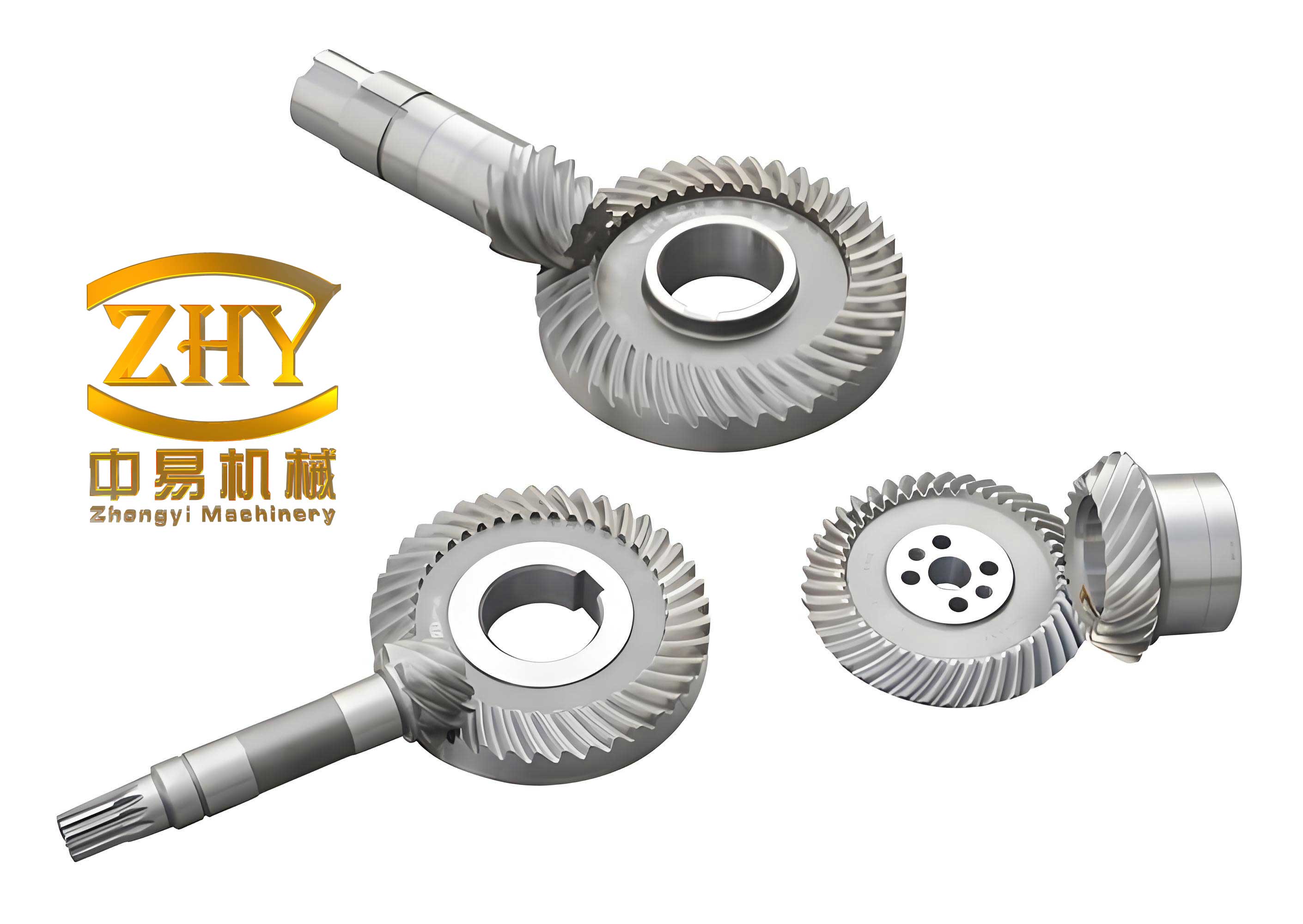
The quality of the meshing action in hypoid gears is critically dependent on the fine-tuning of the tooth surfaces during the finishing cut of the pinion. The parameters governing the generation motion are broad in scope. They include the cutter diameter and blade pressure angles, the installed cutter spiral angle, the horizontal and vertical offsets of the workpiece and cutter, the generating ratio, and the generating gear root angle. Any alteration in these parameters influences the local geometry of the pinion tooth surface, thereby affecting the contact characteristics. The foundation for determining these settings lies in the accurate calculation of key geometrical elements of the mating surfaces, such as pressure angle, spiral angle, the coefficient of modification, tooth trace curvature, and tooth profile curvature. The correct adjustment of the generation parameters is essentially the control of the interrelationship between these elements on the two conjugate surfaces.
Elements of Tooth Surface Geometry
Let \( P \) be an arbitrary point on the pinion tooth surface \( \Sigma \). A coordinate cone is constructed with its axis coinciding with the pinion axis and its apex coinciding with the pinion root cone apex, passing through point \( P \). The cone’s half-apex angle \( \phi_p \) is the coordinate cone angle, and the distance \( r_p \) from \( P \) to the apex is the coordinate cone distance.
At point \( P \), we establish a local orthogonal coordinate system defined by three unit vectors: \( \mathbf{e}_r \) along the coordinate cone’s generatrix (radial direction), \( \mathbf{e}_t \) tangent to the coordinate cone’s surface and perpendicular to \( \mathbf{e}_r \) (circumferential direction), and \( \mathbf{e}_z = \mathbf{e}_r \times \mathbf{e}_t \) (axial direction, following the right-hand rule).
Let \( \mathbf{n} \) be the unit normal vector to the tooth surface at \( P \), directed from the metal to the space. Decomposing \( \mathbf{n} \) into components along \( \mathbf{e}_r \), \( \mathbf{e}_t \), and \( \mathbf{e}_z \), the local surface structure at \( P \) is described by five key elements:
- Normal Pressure Angle (\( \alpha \)): The angle between the surface normal \( \mathbf{n} \) and the \( \mathbf{e}_z-\mathbf{e}_t \) plane. It is a primary factor influencing the load distribution across the tooth face width and height.
- Spiral Angle (\( \beta \)): The angle between the projection of the surface normal onto the \( \mathbf{e}_r-\mathbf{e}_t \) plane and the \( \mathbf{e}_t \) direction. This governs the direction of the contact path along the tooth.
- Coefficient of Modification (\( m \)): A measure of the non-orthogonality between the lines of curvature of the surface. It affects the inclination of the contact ellipse relative to the tooth trace.
- Tooth Trace Curvature (\( k_t \)): The curvature of the tooth line (the intersection of the tooth surface with the developed coordinate cone) at point \( P \). This influences the length of the contact pattern.
- Tooth Profile Curvature (\( k_p \)): The geodesic curvature of the tooth profile curve (the intersection of the tooth surface with a sphere centered at the cone apex and passing through \( P \)) at point \( P \). This influences the width of the contact pattern.
These elements are mathematically derived from the components of the normal vector and their rates of change. Let \( n_r \) and \( n_t \) be the projections of \( \mathbf{n} \) onto \( \mathbf{e}_r \) and \( \mathbf{e}_t \), respectively. Then:
$$ \tan \alpha = \pm \frac{n_r}{\sqrt{n_t^2 + n_z^2}}, \quad \sin \beta = \frac{n_z}{\sqrt{n_t^2 + n_z^2}} $$
The signs depend on whether the concave or convex side of the tooth is being considered. The transverse pressure angle \( \alpha’ \) is related by:
$$ \tan \alpha’ = \frac{\tan \alpha}{\cos \beta} $$
The coefficient of modification \( m \) is derived from the derivative of the normal vector components with respect to the cone distance \( r_p \):
$$ m = \frac{1}{n_t} \frac{d n_r}{d r_p} – \frac{n_r}{n_t^2} \frac{d n_t}{d r_p} $$
The tooth trace curvature \( k_t \) is found through differential geometry, considering the surface as a function of the cone angle \( \phi_p \) and the rotation angle \( \theta_p \). Its formula, involving derivatives of the normal vector, is:
$$ k_t = \frac{1}{n_t \cos \beta} \left( \frac{\partial n_z}{\partial \theta_p} – m \frac{\partial n_r}{\partial \theta_p} \right) $$
Similarly, the tooth profile curvature \( k_p \) is derived from the geodesic curvature of the profile curve on the sphere:
$$ k_p = \frac{1}{r_p \cos \alpha} \left( \frac{\partial n_t}{\partial \phi_p} + n_r \tan \phi_p + \frac{\partial n_r}{\partial \phi_p} \tan \alpha \right) $$
Therefore, for any point on the pinion tooth surface, if one can compute \( n_r, n_t, n_z \) and their derivatives with respect to \( r_p \) and \( \theta_p \), all five structural elements can be determined. This forms the analytical basis for controlling the contact pattern in hypoid gears.
| Surface Element | Symbol | Primary Influence on Contact Pattern |
|---|---|---|
| Normal Pressure Angle | \( \alpha \) | Position along the tooth height (root to top) |
| Spiral Angle | \( \beta \) | Position along the tooth length (toe to heel) |
| Coefficient of Modification | \( m \) | Inclination of the contact ellipse |
| Tooth Trace Curvature | \( k_t \) | Length of the contact ellipse |
| Tooth Profile Curvature | \( k_p \) | Width of the contact ellipse |
Determination of the Desired Pinion Tooth Surface
In production, the gear (driven member) tooth surface is often generated first, sometimes using a formate (non-generated) process for high ratio hypoid gears. The pinion surface is then generated to mate correctly with this existing gear surface. The theoretical pinion surface is defined as the envelope of the gear surface during their prescribed relative motion (mounting position and speed ratio).
While this theoretical surface is mathematically definable, it is often impractical to manufacture exactly. Furthermore, to account for manufacturing errors, assembly misalignments, and deflections under load, a localized bearing contact is preferred over theoretical line contact. Therefore, the theoretical surface is intentionally modified in a controlled manner. A specific point on the pinion tooth surface, known as the Modification Center Point \( M \), is chosen. At this point, the theoretical surface’s geometry (pressure angle, spiral angle) is preserved, but its curvatures (\( k_t, k_p \)) are slightly altered. The surface is “eased off” or “crowned” around \( M \), creating a small elliptical contact area under load.
The cone passing through \( M \) and the pinion apex is called the Reference Cone, with angle \( \phi_m \) and mean cone distance \( r_m \). For optimal performance, \( M \) is typically located near the middle of the working tooth depth and slightly offset towards one end (e.g., the toe). The desired structural elements at \( M \) are therefore:
– Target pressure angle \( \alpha_m \) and spiral angle \( \beta_m \) (from theoretical conjugate action).
– Target coefficient of modification \( m_m \) (often chosen).
– Modified tooth trace curvature \( K_t = k_{t\_theo} + \Delta k_t \).
– Modified tooth profile curvature \( K_p = k_{p\_theo} + \Delta k_p \).
The deviations \( \Delta k_t \) and \( \Delta k_p \) are small, predetermined values that control the size of the contact ellipse.
Machine Settings for Pinion Finishing: The Cutter Tilt Method
The Cutter Tilt Method provides a systematic way to achieve the desired pinion surface geometry at point \( M \). It introduces additional degrees of freedom by allowing the cutter axis to be tilted relative to the conventional machine plane. The key generation parameters are illustrated conceptually and can be categorized as follows:
A. Selected (Free) Parameters:
- Cutter Mean Spiral Angle (\( \beta_{c0} \)): The nominal setting.
- Initial Cutter Tilt Angle (\( i_0 \)): A starting value for the overall tilt.
- Cutter Blade Pressure Angle (\( \alpha_0 \)): The angle on the cutting blade.
B. Calculated Parameters (Dependent Variables):
- Machine Center to Back (\( \Delta X \)): Horizontal offset.
- Sliding Base (\( \Delta X_B \)): Workpiece offset.
- Blank Offset (\( E \)): Vertical offset (hypoid offset).
- Basic Cradle Angle (\( q \)): Related to the root angle.
- Generated Gear Ratio (\( i_g \)): Ratio of pinion to cradle rotation during cut.
- Cutter Point Radius (\( R_t \)): Radius of the blade cutting edge.
- Cutter Tilt Angle (\( i \)) & Swivel Angle (\( j \)): Final tilt orientation.
- Machine Root Angle (\( \gamma_m \)): Final setup angle.
- Formation Position Angle (\( \theta_{m0} \)): The rotational position of the pinion blank when point \( M \) is generated.
- Installed Cutter Spiral Angle (\( \beta_c \)): The effective spiral angle on the machine.
The core principle is to set up a system of equations based on the following conditions, which must be satisfied simultaneously:
- Coordinate Matching: The coordinates of the cutting point on the cutter surface and the target point on the pinion surface must coincide at the instant of generation.
- Surface Tangency (Contact Condition): The relative velocity vector between the cutter and the pinion at the contact point must be perpendicular to the common surface normal. This ensures the cutter is generating the envelope surface.
- Geometry Matching at \( M \): The pinion surface generated must have the predetermined structural elements (\( \alpha_m, \beta_m, m_m, K_t, K_p \)) at the modification center point \( M \).
Mathematical Formulation of the Generation Process
The derivation involves establishing multiple coordinate systems: a fixed machine coordinate system \( O_m(x, y, z) \), a system attached to the pinion, and a system attached to the tilted cutter. The vectorial relationships between these systems, along with the kinematics of the generating motion, yield the governing equations.
1. Pinion Surface Point: A point on the pinion’s coordinate cone is expressed in the machine coordinate system as a function of its cone distance \( r_p \), cone angle \( \phi_p \), and rotational position \( \theta_p \). For the modification point \( M \), we have \( r_p = r_m \), \( \phi_p = \phi_m \), and \( \theta_p = \theta_{m0} \).
$$ \begin{bmatrix} x_p \\ y_p \\ z_p \end{bmatrix} = \mathbf{T}_p(r_m, \phi_m, \theta_{m0}; \Delta X_B, E, \gamma_m) $$
2. Cutter Surface Point: A point on the cutter blade surface (a conical surface) is expressed in its own system, then transformed through tilt rotations (\( i, j \)) and the cradle rotation (\( \psi \)) into the machine system. For the point that generates \( M \), let its parameter on the cutter be defined such that it contacts \( M \) when the cradle angle is \( \psi = 0 \).
$$ \begin{bmatrix} x_c \\ y_c \\ z_c \end{bmatrix} = \mathbf{T}_c(R_t, \alpha_0, \beta_c, i, j, \psi; \Delta X, q) $$
3. System of Equations: The three conditions lead to a system of equations. The coordinate matching at the generation instant (\( \psi=0 \)) for point \( M \) gives three scalar equations:
$$ x_c(0) = x_p, \quad y_c(0) = y_p, \quad z_c(0) = z_p $$
The contact condition provides a fourth equation involving the relative velocity \( \mathbf{v}^{(12)} \) and surface normal \( \mathbf{n} \):
$$ \mathbf{v}^{(12)} \cdot \mathbf{n} = 0 $$
This equation ultimately determines the generating ratio \( i_g \)**:
$$ i_g = \frac{\omega_{\text{pinion}}}{\omega_{\text{cradle}}} = f(\alpha_m, \beta_m, \phi_m, \gamma_m, r_m, \ldots) $$
Finally, the requirement to match the surface structural elements yields three more equations derived from the expressions for \( m, K_t, K_p \). These equations involve the derivatives of the normal vector components, which themselves are functions of the machine settings.
$$ m_m = F_1\left( \frac{\partial n_r}{\partial r_p}, \frac{\partial n_t}{\partial r_p}, \ldots \right) $$
$$ K_t = F_2\left( \frac{\partial n_z}{\partial \theta_p}, \frac{\partial n_r}{\partial \theta_p}, \ldots \right) $$
$$ K_p = F_3\left( \frac{\partial n_t}{\partial \phi_p}, \frac{\partial n_r}{\partial \phi_p}, \ldots \right) $$
The derivatives \( \frac{\partial n}{\partial r_p}, \frac{\partial n}{\partial \theta_p}, \frac{\partial n}{\partial \phi_p} \) are obtained by differentiating the composite function \( \mathbf{n}(\text{machine settings}, r_p, \theta_p) \). Substituting the conditions for point \( M \) into these derivative expressions results in a set of equations where the unknowns are the key machine adjustment parameters \( (\Delta X, \Delta X_B, E, i, j, R_t, \beta_c, \theta_{m0}, \ldots) \).
| Condition | Mathematical Expression | Purpose / Determines |
|---|---|---|
| Position of M | \( \mathbf{r}_c = \mathbf{r}_p \) | Locates contact point in space |
| Surface Normal at M | \( \mathbf{n}_c = \mathbf{n}_p \) | Ensures pressure/spiral angle (\( \alpha_m, \beta_m \)) |
| Contact (Conjugacy) | \( \mathbf{v}^{(12)} \cdot \mathbf{n} = 0 \) | Determines generating ratio \( i_g \) |
| Rate of Normal Change | Derivatives of \( \mathbf{n} \) | Determines \( m_m, K_t, K_p \) and thus settings like \( \Delta X, E, i, j, R_t \) |
Control of Tooth Depth and Cutter Geometry
The solution from the above equations ensures the correct tooth surface geometry at \( M \). However, an additional practical requirement is that the cut must produce the specified tooth depth at both the toe and the heel of the pinion. This is controlled by the Cutter Point Radius (\( R_t \))** and the Blade Edge Lowering (\( \delta \))** (or blade point width).
The nominal cutter radius \( R_0 \) and pressure angle \( \alpha_0 \) define a basic cone. The actual cutting point is offset from this cone by \( \delta \). The final cutter point radius is:
$$ R_t = R_0 \pm \delta \sin \alpha_0 $$
(where \( + \) is for the outer blade, \( – \) for the inner blade).
The condition for correct depth is enforced by requiring that the cutter blade edge passes through predefined points \( T \) (toe) and \( H \) (heel) on the pinion root cone. This leads to two separate equations for \( \delta \)—one from the toe condition and one from the heel condition:
$$ \delta_{\text{toe}} = f_{\text{toe}}(R_0, \alpha_0, \phi_m, \text{root angle}, r_{\text{toe}}, \text{settings}…) $$
$$ \delta_{\text{heel}} = f_{\text{heel}}(R_0, \alpha_0, \phi_m, \text{root angle}, r_{\text{heel}}, \text{settings}…) $$
For a valid setup, we must have \( \delta_{\text{toe}} \approx \delta_{\text{heel}} \). The parameter that primarily influences this equality is the Machine Root Angle (\( \gamma_m \)) or the related Cutter Tilt Orientation. In the calculation procedure, \( \gamma_m \) (often initiated from an estimated value) is iteratively adjusted until \( |\delta_{\text{toe}} – \delta_{\text{heel}}| \) is within a negligible tolerance (e.g., 0.01 mm). Once convergence is achieved, the final \( R_t \) is computed, and all machine settings are consistent with both the localized contact geometry and the full tooth depth requirement.
Influence of Selected Parameters and Practical Considerations
The Cutter Tilt Method offers flexibility. For the same hypoid gear pair, different combinations of the selected parameters (\( \beta_{c0}, i_0, \alpha_0 \)) will yield different sets of calculated machine settings, all theoretically capable of producing the desired contact pattern at \( M \). This allows the process engineer to choose a combination that best suits the available tooling and machine limits.
The Critical Pressure Angle (\( \alpha_{cr} \))** is a useful reference. It is the blade angle required if point \( M \) were generated at its natural position (\( \theta_{m0}=0 \)) and without final cutter tilt (\( i=0 \)):
$$ \tan \alpha_{cr} = \frac{\sin \phi_m \tan \beta_m \cos \gamma_m \pm \cos \phi_m \sin \gamma_m}{\cos \phi_m \cos \gamma_m \mp \sin \phi_m \tan \beta_m \sin \gamma_m} $$
The actual chosen \( \alpha_0 \) will typically be close to \( \alpha_{cr} \). Adjusting \( \alpha_0, \beta_{c0}, i_0 \) allows for shifting the calculated machine centers (\( \Delta X, E \)) and tilt angles to stay within the physical limits of the gear generator and available cutter bodies. The general influence trends are summarized below:
| Change in Selected Parameter | Effect on Machine Center \( \Delta X \) | Effect on Blank Offset \( E \) | Effect on Cutter Tilt \( i \) |
|---|---|---|---|
| Increase \( \beta_{c0} \) | Increases | Decreases (Pinion Concave) / Increases (Convex) | Decreases |
| Increase \( i_0 \) | Decreases | Increases (Pinion Concave) / Decreases (Convex) | Increases |
| Increase \( \alpha_0 \) | Decreases | Little effect | Little effect |
The final check for any set of calculated parameters is their feasibility on the specific hypoid gear generator (e.g., Gleason Phoenix, Oerlikon Spiroflex). Parameters like the tilt distance \( S_r \), machine centers, and angular settings must fall within the machine’s admissible ranges. If not, the selected parameters (\( \beta_{c0}, i_0, \alpha_0 \)) are adjusted following the influence trends, and the entire calculation is repeated.
Conclusion
The point contact analysis method for determining hypoid gear machine settings, particularly within the framework of the cutter tilt method, provides a rigorous and systematic approach. By mathematically modeling the generation process as a problem of coordinate transformation, surface tangency, and prescribed local geometry, it allows for the precise calculation of all necessary adjustment parameters. This methodology ensures that the finished pinion, when meshed with its gear, will exhibit a controlled, localized contact pattern with the desired position, size, and orientation. Furthermore, by incorporating the tooth depth control condition and iterating on initial settings, the method guarantees a manufacturable solution that meets both functional and geometric specifications. The ability to compute these parameters via computer program makes this an efficient and powerful tool for the design and manufacture of high-performance hypoid gears, enabling optimization for noise, strength, and durability.