
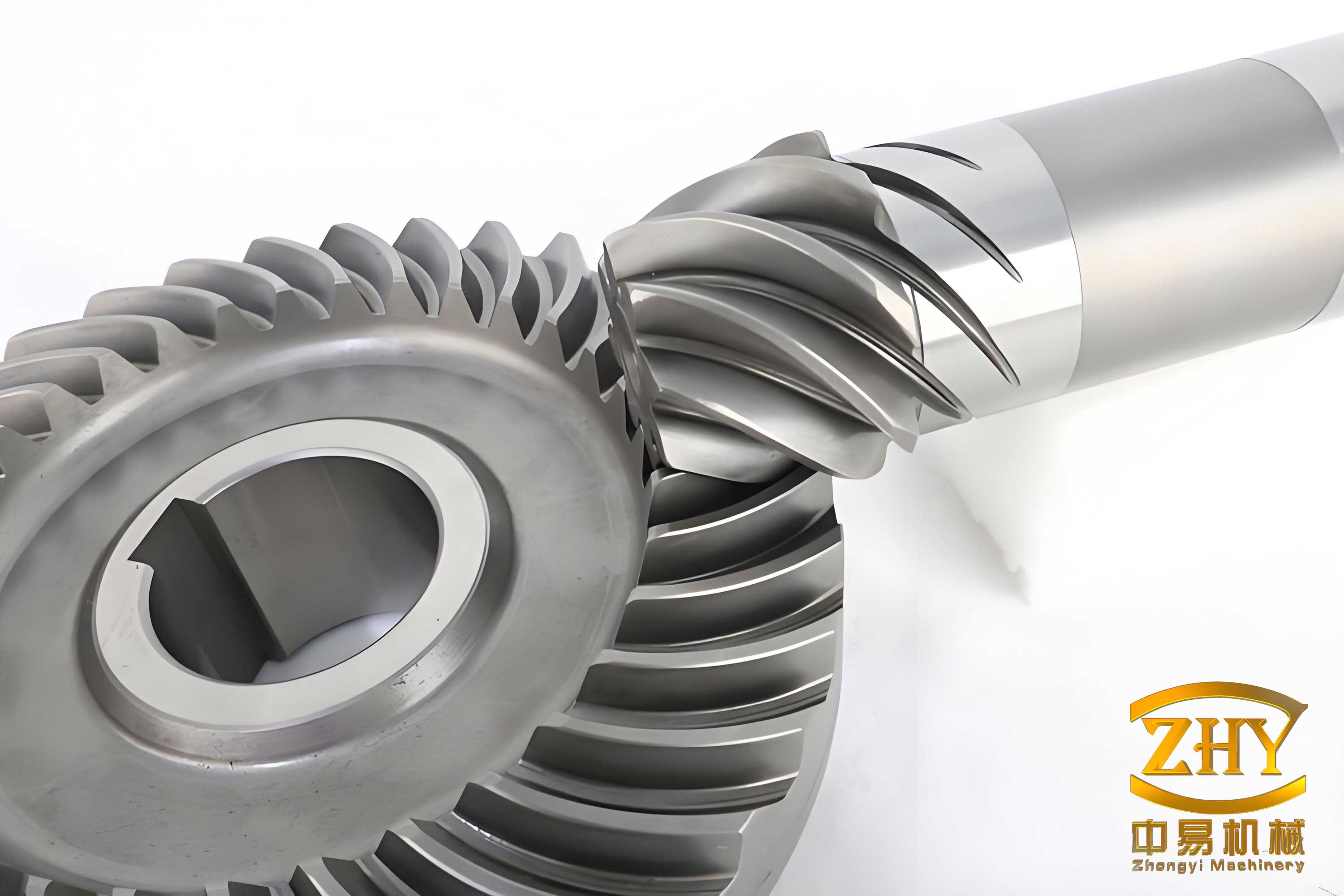
The analysis of meshing contact in spiral bevel gears is a cornerstone of ensuring performance, longevity, and quiet operation in power transmission systems, particularly in demanding applications like aerospace, automotive differentials, and heavy machinery. Traditional Tooth Contact Analysis (TCA) is a powerful deterministic tool for predicting the contact pattern (bearing) and transmission error (TE) under idealized, nominal assembly conditions. However, real-world spiral bevel gear systems operate in an environment saturated with uncertainties. Parameters such as transmitted load, operating speed, support stiffness, and manufacturing tolerances are not fixed values but exhibit inherent variability. This randomness causes the actual relative position of the mating gears to deviate from the designed nominal setting, leading to stochastic fluctuations in the contact characteristics. A purely deterministic TCA may fail to predict phenomena like intermittent edge contact or may overestimate the consistency of performance. Therefore, a probabilistic framework is essential to quantify the influence of these random variables, describe the statistical nature of the contact, and ultimately assess the reliability of the gearset under operational conditions. This article delves into a comprehensive probabilistic methodology for analyzing the contact behavior of spiral bevel gears, integrating system dynamics, probability theory, and conventional TCA.
1. Sources of Uncertainty and System Dynamics
The path to probabilistic contact analysis begins with identifying the fundamental random variables influencing the system. For a spiral bevel gear transmission, such as one found in an aero-engine, key sources of uncertainty include:
- Transmitted Power (P): Fluctuations in operational demand.
- Rotational Speed (N): Variations in engine or drive speed.
- Rotor Unbalance (U): Inherent and operational mass imbalances.
- Bearing/Bearing Support Stiffness (K): Variations due to manufacturing, wear, and thermal effects.
These variables are best treated as random variables with associated probability distributions. Often, a normal (Gaussian) distribution is a reasonable assumption for many of these parameters, characterized by a mean ($\mu$) and a standard deviation ($\sigma$) or variance ($\sigma^2$).
The combined effect of these random inputs manifests as random dynamic responses at the critical points where the gears are mounted. To capture this, a dynamic model of the entire transmission system is required. A lumped-mass model, as conceptually shown below, is an effective approach. The system is discretized into nodes representing inertias, shaft segments, bearings, and the gear mesh.
The steady-state dynamic response (displacements and rotations) at any node, particularly at the pinion and gear mounting points, can be determined using methods like the Transfer Matrix Method or Finite Element Analysis. The responses at the mounting points—let’s denote them for the pinion as $\delta_{x1}, \delta_{y1}, \theta_1$ and for the gear as $\delta_{x2}, \delta_{y2}, \theta_2$—are functions of the basic random variables:
$$
\mathbf{R} = \mathbf{F}(P, N, U, K)
$$
where $\mathbf{R} = [\delta_{x1}, \delta_{y1}, \theta_1, \delta_{x2}, \delta_{y2}, \theta_2]^T$ is the response vector and $\mathbf{F}$ is a complex vector-valued function derived from the dynamic system model.
2. Probabilistic Dynamic Analysis Using the Taylor Expansion Method
Directly propagating full probability distributions through the complex function $\mathbf{F}$ can be computationally intensive. A efficient and commonly used alternative for estimating the mean and variance of the output responses is the First-Order Second-Moment (FOSM) method, based on a first-order Taylor series expansion around the mean values of the input variables.
Assuming the input variables are statistically independent, the mean and variance of a response component $r_i$ (e.g., $\delta_{x1}$) are approximated as:
$$
E[r_i] \approx f_i(\mu_P, \mu_N, \mu_U, \mu_K)
$$
$$
Var[r_i] \approx \left( \frac{\partial f_i}{\partial P} \right)^2_{\mu} \sigma_P^2 + \left( \frac{\partial f_i}{\partial N} \right)^2_{\mu} \sigma_N^2 + \left( \frac{\partial f_i}{\partial U} \right)^2_{\mu} \sigma_U^2 + \left( \frac{\partial f_i}{\partial K} \right)^2_{\mu} \sigma_K^2
$$
where the partial derivatives (sensitivities) are evaluated at the mean values of the inputs. This method requires the calculation of these sensitivity coefficients, which can be obtained numerically from the dynamic model. Applying these formulas to the pinion and gear mounting point responses yields their statistical descriptors (mean and variance).
3. From Dynamic Response to Probabilistic Gear Mesh Misalignment
The random displacements and rotations of the mounting bases are equivalent to random assembly misalignments in the context of spiral bevel gear TCA. These misalignments, often called “changes in mounting distance” or “errors,” are critical inputs for contact analysis. They can be defined as:
- $\Delta H$: Linear misalignment along the pinion axis direction (related to gear lateral shift).
- $\Delta V$: Linear misalignment in the vertical plane (separation of gear and pinion axes).
- $\Delta J$: Linear misalignment along the gear axis direction.
- $\Delta \Gamma$: Angular misalignment (change in the nominal shaft angle $\Sigma$).
These are derived from the dynamic responses:
$$\Delta H = \delta_{x2}, \quad \Delta V = \delta_{y1} – \delta_{y2}, \quad \Delta J = \delta_{x1}, \quad \Delta \Gamma = \theta_2 – \theta_1$$
Using the rules for expectation and variance of linear combinations of random variables, their means and variances are:
$$E[\Delta H] = E[\delta_{x2}], \quad E[\Delta V] = E[\delta_{y1}] – E[\delta_{y2}], \quad E[\Delta J] = E[\delta_{x1}], \quad E[\Delta \Gamma] = E[\theta_2] – E[\theta_1]$$
$$Var[\Delta H] = Var[\delta_{x2}], \quad Var[\Delta V] = Var[\delta_{y1}] + Var[\delta_{y2}], \quad Var[\Delta J] = Var[\delta_{x1}], \quad Var[\Delta \Gamma] = Var[\theta_2] + Var[\theta_1]$$
Thus, we have transformed the physical random vibrations into the probabilistic language of gear assembly errors.
4. Integration with Tooth Contact Analysis (TCA)
Conventional deterministic TCA solves for the contact condition by requiring the position and normal vectors of potential contact points on both spiral bevel gear tooth surfaces to coincide when transformed into a fixed coordinate system. The solution satisfies a set of equations conditioned on the nominal assembly settings $H_0, V_0, J_0, \Sigma$.
To perform a probabilistic TCA, we must incorporate the random misalignments. The conditioning equations become:
$$|H – (H_0 + \Delta H)| = 0$$
$$|V – (V_0 + \Delta V)| = 0$$
$$|J – (J_0 + \Delta J)| = 0$$
Furthermore, the shaft angle used in the coordinate transformations is now the random variable $(\Sigma + \Delta \Gamma)$.
The core of probabilistic TCA involves solving this system while treating the misalignments as random variables with known distributions. The outputs of interest become random variables themselves:
- Contact Point Location: The coordinates of the instantaneous contact point on the tooth surface vary randomly. Their statistical parameters (mean, variance) can be estimated using the Taylor expansion method again, where the TCA equations act as the function $\mathbf{F}$ mapping misalignments to location.
- Contact Ellipse Parameters: At each contact point, the contact ellipse dimensions (semi-major axis $a$, semi-minor axis $b$) are governed by Hertzian contact theory, which depends on the applied load $W$ and the local principal relative curvatures $\kappa_1, \kappa_2$:
$$a, b = \mathcal{H}(W, \kappa_1, \kappa_2)$$
Since the load $W$ is a function of power and speed (random variables), and the curvatures $\kappa_i$ are functions of the random contact point location, the ellipse axes $a$ and $b$ are also random. Their statistics can be derived through propagation of uncertainty. - Transmission Error (TE): TE is the deviation of the gear’s angular position from its ideal, conjugate position. It arises from tooth deflections and deliberate mismatch (ease-off) in the spiral bevel gear pair. It is highly sensitive to misalignment. Therefore, random misalignments induce a random transmission error function $\epsilon(\phi)$, where $\phi$ is the pinion roll angle. The mean TE curve and, more importantly, its variance (fluctuation band) can be computed probabilistically.
5. Reliability Assessment for Stable Contact
A primary goal in spiral bevel gear design is to ensure “stable contact,” meaning the contact pattern remains within a desired area on the tooth flank and avoids the edges throughout the mesh cycle under operating conditions. Edge contact leads to high stress concentrations, increased noise, and potential failure.
We can formulate reliability metrics based on the probabilistic outputs. Let’s define an “ideal contact zone” on the gear tooth surface with a reference area $S$. From the probabilistic TCA, for a given operational instant (or over a cycle), we obtain:
- $S_1$: The area of the actual contact ellipse that lies inside the ideal zone.
- $S_2$: The area of the actual contact ellipse that lies outside the ideal zone.
- $\epsilon_{max}$: The peak-to-peak transmission error (or a critical value thereof).
These are now random variables with known (or estimated) distributions. Common criteria for stable contact are:
- The encroachment should be limited: $S_2 / S_1 < \rho$ (e.g., $\rho = 0.25$).
- The coverage should be sufficient: $S_1 / S > \gamma$ (e.g., $\gamma = 0.5$).
- The transmission error should be below a threshold: $\epsilon_{max} < \epsilon_{allowable}$.
The reliability of stable contact, $R_{sc}$, is the probability that all these conditions are met simultaneously:
$$R_{sc} = P\left( \left\{ \frac{S_2}{S_1} < \rho \right\} \cap \left\{ \frac{S_1}{S} > \gamma \right\} \cap \left\{ \epsilon_{max} < \epsilon_{allowable} \right\} \right)$$
If $S_1$, $S_2$, and $\epsilon_{max}$ can be assumed to follow approximately normal distributions, this probability can be calculated using the joint normal distribution and the defined limit state functions.
6. Illustrative Example and Numerical Results
Consider a spiral bevel gear pair from an aero-engine transmission. The basic random variables are assigned the following distribution parameters (assumed normal and independent):
| Parameter | Symbol | Mean ($\mu$) | Standard Dev. ($\sigma$) |
|---|---|---|---|
| Power | $P$ | 300.0 kW | 5.0 kW |
| Speed | $N$ | 15500 rpm | ~541 rpm |
| Unbalance | $U$ | 1.0e-4 kg·m | 3.33e-5 kg·m |
| Support Stiffness | $K$ | 1.5e8 N/m | 1.0e7 N/m |
Performing the dynamic probability analysis and subsequent probabilistic TCA for the spiral bevel gear yields the following statistical descriptors for the contact characteristics. The ideal contact zone area $S$ has a mean of 31.4 mm² with a small standard deviation of 0.05 mm².
| Contact Characteristic | Symbol | Mean ($\mu$) | Standard Dev. ($\sigma$) |
|---|---|---|---|
| Internal Contact Area | $S_1$ | 26.93 mm² | 0.036 mm² |
| External Contact Area | $S_2$ | 6.64 mm² | 0.0083 mm² |
| Transmission Error (pk-pk) | $\epsilon_{max}$ | -3.18e-4 rad | 6.71e-6 rad |
Assuming the criteria $\rho=0.25$ and $\gamma=0.5$, and noting that the mean $\epsilon_{max}$ is negative (often defined favorably), we can assess the reliability. Calculating the probabilities for each event:
$$P_1 = P(S_2/S_1 < 0.25) \approx 0.829$$
$$P_2 = P(S_1/S > 0.5) \approx 1.00$$
$$P_3 = P(\epsilon_{max} < 0) \approx 1.00$$
The overall reliability for stable contact in this spiral bevel gear is therefore:
$$R_{sc} = P_1 \cdot P_2 \cdot P_3 \approx 0.829$$
This indicates an 82.9% probability that the gear operates with stable contact under the defined random conditions, highlighting a non-negligible 17.1% risk of encountering undesirable edge contact or poor pattern coverage.
7. Conclusions and Engineering Implications
The probabilistic analysis of spiral bevel gear contact characteristics provides a powerful and realistic framework for design and assessment. Key conclusions are:
- Quantifying Randomness: The actual contact pattern and transmission error in a spiral bevel gear are stochastic, not deterministic. Probability analysis quantifies this, explaining elusive phenomena like sporadic edge contact that deterministic TCA might miss.
- Informed Design for Reliability: The method allows for the direct computation of stability and performance reliability, moving beyond safety factors to a probabilistic risk assessment. For critical applications like aerospace spiral bevel gears, this is indispensable.
- Sensitivity Insight: The Taylor expansion method identifies which input random variables (e.g., support stiffness vs. unbalance) contribute most to output variance. This guides efforts to tighten tolerances or control specific parameters for maximum benefit.
- Robustness Optimization: The probabilistic model can be used to optimize the ease-off topography (micro-geometry) of the spiral bevel gear to be less sensitive to expected ranges of misalignment, thereby maximizing the reliability $R_{sc}$.
In summary, integrating probability theory with traditional system dynamics and TCA transforms the analysis of spiral bevel gears from a deterministic check into a predictive science for performance under uncertainty. It is a crucial step towards designing more reliable, robust, and efficient gear transmissions for advanced engineering systems.