
In my experience with mechanical engineering components, the bevel gear housing stands out as a critical part in various transmission systems, particularly in applications like concrete pump trucks where it serves as a mounting for bevel gears in guide wheel assemblies. The bevel gear housing is a classic example of a cross-bore component, featuring intersecting holes that must maintain high precision to ensure proper meshing and function of the bevel gears. This analysis delves into the manufacturing process of the bevel gear housing, focusing on overcoming machining challenges to achieve the required accuracy. The importance of the bevel gear in such systems cannot be overstated, as it directly impacts transmission efficiency and durability.
The primary challenge in machining the bevel gear housing lies in the spatial dimensions of the Φ52mm and Φ90mm holes, which are difficult to measure during processing, thereby complicating the assurance of dimensional accuracy. Additionally, the centerlines of these two intersecting holes must coincide within the same reference plane to guarantee optimal bevel gear engagement. To address these issues, a thorough process analysis is essential, leading to the development of effective machining strategies. This involves selecting appropriate materials, designing the blank, planning sequential operations, and implementing quality control measures—all centered around the bevel gear housing’s functionality.
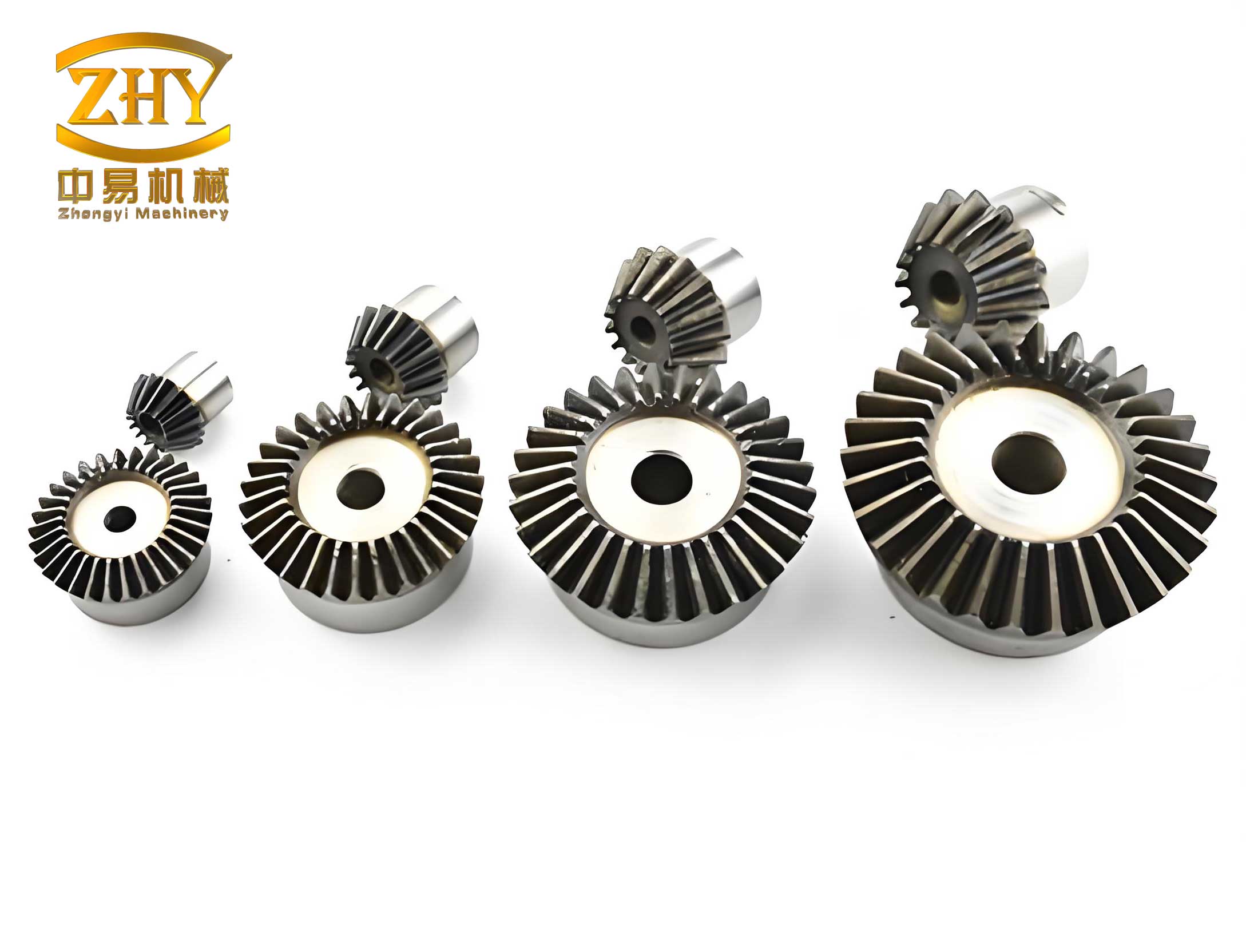
From my perspective, the material choice for the bevel gear housing is crucial. Gray cast iron, HT200, is typically selected due to its excellent castability, good machinability, and adequate strength for such applications. The material’s properties help in achieving the desired precision for the bevel gear mounting surfaces. After casting, artificial aging is performed to relieve residual stresses, which is vital for dimensional stability during machining. The bevel gear housing’s design revolves around two main reference surfaces: the Φ90mm hole and the Φ52mm hole, which serve as primary datums for machining. These datums ensure that all features are processed relative to a consistent framework, minimizing errors that could affect bevel gear performance.
In analyzing the bevel gear housing, I consider the geometric relationships between the holes. The perpendicularity between the centerlines of the Φ52mm and Φ90mm holes is specified as 0.012 mm, which can be expressed mathematically as the angle between two vectors representing the axes. If we define vectors along the hole centerlines, the deviation from perpendicularity should satisfy:
$$ \theta = 90^\circ \pm \Delta \theta $$
where $$ \Delta \theta = \arctan\left(\frac{0.012}{L}\right) $$
with \( L \) being the distance between reference points. This tight tolerance underscores the precision required for bevel gear alignment. Moreover, the distance from the Φ52mm hole end face to the Φ90mm hole centerline is 119 mm, a critical dimension that influences the positioning of the bevel gear.
When designing the blank for the bevel gear housing, I follow standard casting practices to determine size tolerances and machining allowances. Based on the part dimensions ranging from 150 to 170 mm, the casting tolerance grade is IT 10, and the machining allowance grade is G. This can be summarized using the following relationships for key features:
| Feature | Part Dimension (mm) | Total Allowance (mm) | Blank Dimension (mm) |
|---|---|---|---|
| Overall Length (End Faces) | 164 | 6 | 170 |
| Φ52mm End Face Distance | 119 | 6 | 125 |
| Φ52mm Hole Diameter | 52 | 6 | 46 |
| Φ73mm Hole Diameter | 73 | 3 | 70 |
These values ensure sufficient material for machining while minimizing waste. The allowance calculation can be generalized as:
$$ D_{\text{blank}} = D_{\text{part}} + 2 \times MA $$
where \( D_{\text{blank}} \) is the blank diameter, \( D_{\text{part}} \) is the part diameter, and \( MA \) is the machining allowance per side, derived from the G-grade tables. For the bevel gear housing, this approach helps in achieving the final dimensions after processing.
The process planning for the bevel gear housing adheres to fundamental principles such as “datum first,” “rough before finish,” “primary before secondary,” and “faces before holes.” I outline a detailed sequence of operations to ensure the bevel gear mounting surfaces are machined accurately. Below is an expanded process route table that includes additional parameters like cutting speeds and feeds, which are critical for optimizing the machining of bevel gear components.
| Operation No. | Operation Content | Equipment/Tools | Cutting Parameters (Example) |
|---|---|---|---|
| 01 | Casting | Foundry equipment | N/A |
| 02 | Aging, hardness HBS187–220 | Heat treatment furnace | Temperature: 500°C, Time: 2 hours |
| 03 | Rough turn lower face, rough bore Φ73, Φ90, Φ120 holes | Face turning tool, boring bar, blind hole tool, caliper | Speed: 200 rpm, Feed: 0.2 mm/rev |
| 04 | Rough turn upper face, rough turn Φ100 outer surface, rough bore Φ80 hole | External turning tool, face tool, blind hole tool, caliper | Speed: 250 rpm, Feed: 0.15 mm/rev |
| 05 | Semi-finish bore Φ90 hole, cut 3×0.5 relief groove | Blind hole tool, grooving tool, caliper | Speed: 300 rpm, Feed: 0.1 mm/rev |
| 06 | Semi-finish turn Φ100 outer surface, cut 3×1 relief groove | Face tool, grooving tool, caliper | Speed: 350 rpm, Feed: 0.12 mm/rev |
| 07 | Rough mill right end face | Face milling cutter, caliper | Speed: 1000 rpm, Feed: 0.05 mm/tooth |
| 08 | Expand—rough ream—finish ream Φ52 hole | Expanding drill, reamer, caliper, plug gauge | Speed: 150 rpm (reaming), Feed: 0.05 mm/rev |
| 09 | Drill 4–M8 tap holes, tap 4–M8 threads | Φ6.7 twist drill, M8 tap, caliper, thread gauge | Speed: 500 rpm (drilling), 50 rpm (tapping) |
| 10 | Drill 4–M5 tap holes, tap 4–M5 threads | Φ4 twist drill, M5 tap, caliper, thread gauge | Speed: 600 rpm (drilling), 60 rpm (tapping) |
| 11 | Drill 3–M6 tap holes, tap 3–M6 threads | Φ5 twist drill, M6 tap, caliper, thread gauge | Speed: 550 rpm (drilling), 55 rpm (tapping) |
| 12 | Drill M3 tap hole, Φ2 through hole | Φ2 twist drill, M3 tap | Speed: 800 rpm (drilling), 70 rpm (tapping) |
| 13 | Deburr | Hand tools | N/A |
| 14 | Grind Φ90 hole | Grinding wheel, internal micrometer | Speed: 2000 rpm, Feed: 0.005 mm/pass |
| 15 | Grind Φ100 outer surface | Grinding wheel, external micrometer | Speed: 1800 rpm, Feed: 0.004 mm/pass |
| 16 | Grind Φ52 hole | Grinding wheel, internal micrometer | Speed: 2200 rpm, Feed: 0.003 mm/pass |
| 17 | Final inspection | Measuring instruments | N/A |
This process ensures that the bevel gear housing meets all specifications for the bevel gear installation. Each operation is designed to progressively refine the surfaces, with grinding as the final step to achieve high precision on the critical holes for the bevel gear.
To delve deeper into the machining of the bevel gear housing, I consider the mathematical models for tool wear and dimensional accuracy. The relationship between cutting parameters and surface finish can be expressed using empirical formulas. For instance, the surface roughness \( R_a \) in turning can be estimated as:
$$ R_a = k \cdot \frac{f^2}{r} $$
where \( f \) is the feed rate, \( r \) is the tool nose radius, and \( k \) is a material constant. For HT200, \( k \) is approximately 0.032. This formula helps in optimizing feeds for the bevel gear housing’s machined surfaces to ensure smooth operation with the bevel gear. Additionally, the perpendicularity error between holes can be analyzed using vector dot products. If \( \vec{A} \) and \( \vec{B} \) are unit vectors along the Φ90mm and Φ52mm hole axes, the perpendicularity deviation \( \delta \) is given by:
$$ \delta = |\vec{A} \cdot \vec{B}| \cdot L $$
where \( L \) is a characteristic length. For a deviation of 0.012 mm over a typical length, this imposes tight controls on machining setups.
Another aspect is the calculation of machining allowances based on casting shrinkage. For the bevel gear housing, the linear shrinkage rate \( S \) for HT200 is about 1%. Thus, the pattern dimensions \( D_{\text{pattern}} \) can be derived from:
$$ D_{\text{pattern}} = \frac{D_{\text{blank}}}{1 – S} $$
For example, for a blank diameter of 46 mm for the Φ52mm hole, the pattern diameter would be approximately 46.46 mm. This ensures the casting accommodates both shrinkage and machining allowances for the bevel gear housing.
In terms of quality assurance for the bevel gear housing, statistical process control (SPC) methods can be applied. The critical dimensions, such as the Φ52mm and Φ90mm hole diameters, should be monitored using control charts. The process capability index \( C_p \) can be calculated as:
$$ C_p = \frac{USL – LSL}{6\sigma} $$
where \( USL \) and \( LSL \) are the upper and lower specification limits, and \( \sigma \) is the standard deviation of the process. For the bevel gear housing, a \( C_p \) greater than 1.33 is desirable to ensure consistent quality for bevel gear fitting. Moreover, the alignment of the holes can be verified using coordinate measuring machines (CMMs), with data analyzed through least-squares fitting to determine the centerline intersections.
The grinding operations for the bevel gear housing are particularly important to achieve the final accuracy. The material removal rate (MRR) in grinding can be modeled as:
$$ MRR = v_w \cdot a_p \cdot v_f $$
where \( v_w \) is the workpiece speed, \( a_p \) is the depth of cut, and \( v_f \) is the feed rate. For the Φ90mm hole, with a grinding wheel of diameter \( D_g \), the equivalent chip thickness \( h_{eq} \) is:
$$ h_{eq} = \sqrt{\frac{v_f \cdot a_p}{v_w \cdot D_g}} $$
This parameter influences surface integrity, which is crucial for the bevel gear housing’s longevity when assembled with bevel gears.
Furthermore, the threading operations for the bevel gear housing involve tap selection based on hole dimensions. The tap drill size \( D_{\text{drill}} \) for metric threads can be computed as:
$$ D_{\text{drill}} = D_{\text{major}} – P $$
where \( D_{\text{major}} \) is the major diameter and \( P \) is the pitch. For M8 threads with a pitch of 1.25 mm, the drill size is 6.75 mm, which aligns with the Φ6.7 mm drill used in the process. This ensures proper thread engagement for fasteners in the bevel gear assembly.
To optimize the overall process for the bevel gear housing, I consider lean manufacturing principles. Value stream mapping can be applied to eliminate non-value-added steps, reducing cycle time while maintaining precision for the bevel gear. For instance, combining roughing and semi-finishing operations where possible can enhance efficiency. Additionally, the use of fixture design with modular elements can improve setup accuracy for the cross-bore features of the bevel gear housing.
In conclusion, the manufacturing of the bevel gear housing requires a meticulous approach to process planning, from material selection to final inspection. By focusing on datum establishment, sequential machining, and precision grinding, the challenges of spatial dimensions and hole alignment can be overcome. The bevel gear housing serves as a testament to the integration of mechanical design and manufacturing engineering, ensuring reliable performance in applications involving bevel gears. Continuous improvement through data analysis and parameter optimization will further enhance the quality and efficiency of producing such critical components for bevel gear systems.
Finally, I emphasize that the success of the bevel gear housing machining hinges on a holistic view of the process chain. Every step, from casting aging to final grinding, contributes to the dimensional stability and accuracy required for the bevel gear. By leveraging mathematical models, empirical formulas, and advanced metrology, manufacturers can achieve the tight tolerances necessary for optimal bevel gear operation. The bevel gear housing, though a single component, plays a pivotal role in the broader mechanical system, underscoring the importance of thorough process analysis in mechanical engineering.