
In the small-batch production of a wind turbine gearbox sun gear, we encountered a critical quality issue where the grinding allowance and surface hardness of the gear teeth were non-uniform after heat treatment. This led to minor steps at the tooth root ends and unground black spots in the middle of the tooth width after grinding, resulting in out-of-tolerance normal chords (W4) and, in severe cases, scrap parts. This problem significantly reduced product yield, delayed deliveries, and increased production costs. Analysis indicated that such distortion causes uneven grinding allowances, leading to non-uniform effective case depth and surface hardness after grinding, which ultimately compromises contact strength, load capacity, fatigue strength, and service life of the gear. Therefore, we focused on developing a process improvement utilizing gear hobbing modification to compensate for heat treatment distortion, thereby enhancing product quality and lifespan.
The sun gear in question is made from 18CrNiMo7-6 steel, with a module mn = 15 mm, number of teeth Z = 24, pressure angle α = 25°, tooth width B = 388 mm, and a normal chord specification W4 of 163.468–163.546 mm. The carburizing and quenching requirements include a tooth surface hardness of 58–62 HRC and an effective case depth of 2.5–3.0 mm. The original process route involved forging, rough turning, ultrasonic testing, semi-finish turning, gear hobbing, heat treatment, finish turning, deep hole drilling, outer diameter grinding, spline rolling, and finally gear grinding. In the gear hobbing stage, the normal chord was set to W4 = 164.16 mm, leaving a grinding allowance of ΔW = 0.66 mm, using a convex relief hob to avoid grinding steps. However, post-heat treatment measurements revealed significant distortion patterns.
We conducted extensive data collection by measuring the normal chord at multiple points along the tooth width (every 15 mm from the top, with three points per circumference). The results are summarized in Table 1, showing that the gear exhibited expansion near the shaft end (up to 65 mm) and contraction in the middle regions, with a maximum single-side difference of approximately 0.26 mm. This distortion resulted in uneven grinding allowances, as evidenced by pre-grinding alignment checks shown in Table 2, where the middle section had insufficient material, leading to unground surfaces.
| Measurement Position | Circumferential Point 1 | Circumferential Point 2 | Circumferential Point 3 |
|---|---|---|---|
| 15 mm from end | 164.35 | 164.34 | 164.35 |
| 65 mm from end | 164.20 | 164.22 | 164.23 |
| 115 mm from end | 164.04 | 164.04 | 164.04 |
| 165 mm from end | 163.94 | 163.93 | 163.91 |
| 215 mm from end | 163.89 | 163.88 | 163.84 |
| 265 mm from end | 163.95 | 163.92 | 163.90 |
| 315 mm from end | 164.05 | 164.03 | 164.00 |
| 365 mm from end | 164.14 | 164.11 | 164.10 |
The root cause of this distortion lies in heat treatment stresses, primarily driven by phase transformation and thermal gradients. For shaft-like components such as sun gears, organizational stress dominates due to the smaller cross-sectional area, leading to a saddle-shaped deformation model where the middle contracts and the ends expand slightly. This can be expressed through stress analysis formulas. The thermal stress σ_thermal and organizational stress σ_organizational contribute to total distortion δ_total, which for a cylindrical gear can be approximated as:
$$ \delta_{\text{total}} = \int_{0}^{L} \left( \alpha \Delta T(x) + \beta \Delta V(x) \right) dx $$
where α is the thermal expansion coefficient, ΔT is the temperature gradient, β is the phase transformation volume change coefficient, and ΔV is the volume change due to martensitic transformation. In our case, the ends experience more martensite formation due to lower heat capacity, causing expansion, while the middle contracts. This distortion directly impacts grinding uniformity, as shown by hardness gradient data (Figure 2), where hardness varied from 680 HV (59.2 HRC) at 0.1 mm depth to 57 HRC at 0.6 mm depth, indicating non-uniformity after grinding.
To address this, we evaluated several improvement schemes: (1) adding process extensions at the gear ends to increase heat capacity, (2) increasing the pre-grinding allowance uniformly, and (3) implementing gear hobbing modification—specifically, adding a crowning profile during gear hobbing to counteract the distortion. After analysis, we opted for the third scheme as it leverages advanced CNC gear hobbing capabilities without additional material or post-processing costs, ensuring uniform grinding allowances and improved product life.
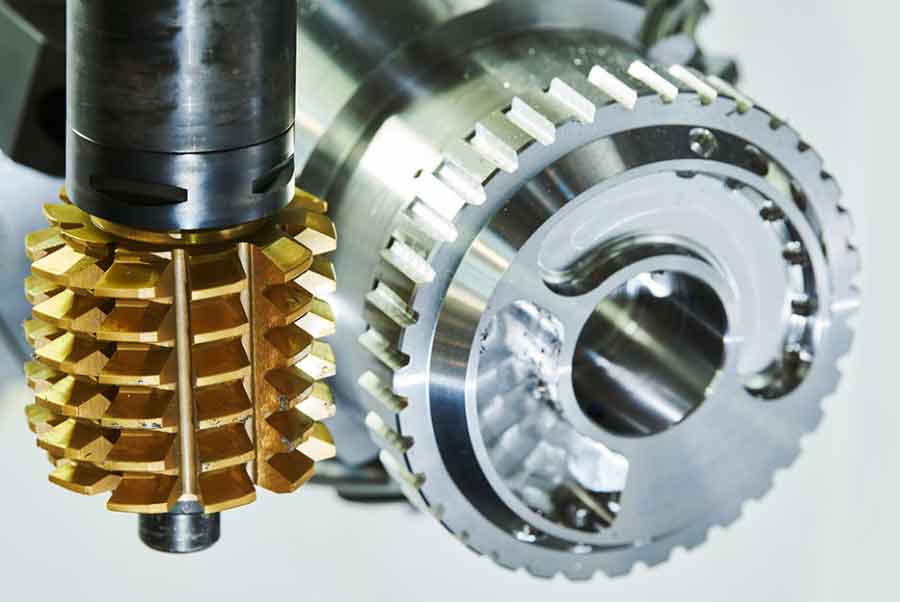
Gear hobbing is a critical process in gear manufacturing, and by utilizing CNC gear hobbing machines, we can introduce precise modifications to the tooth profile. For this sun gear, based on distortion data, the maximum contraction occurred at 215 mm from the end, with a single-side reduction of about 0.15 mm, while the ends expanded by approximately 0.10 mm. To compensate, we designed a symmetric crowning profile with a total crowning amount of 0.15 mm over an effective tooth width of 430 mm (to account for symmetry in machine programming). The crowning profile follows a parabolic curve, described by:
$$ C(x) = C_{\text{max}} \left(1 – \left(\frac{2x}{L}\right)^2\right) $$
where C_max is the maximum crowning (0.15 mm), x is the position along the tooth width, and L is the effective tooth width (430 mm). During gear hobbing, we adjusted the CNC program to incorporate this profile, ensuring that the hob path deviated accordingly. This approach in gear hobbing allowed us to pre-distort the gear teeth inversely to the expected heat treatment distortion.
After implementing the modified gear hobbing process, we measured the normal chord before heat treatment, as shown in Table 3. The data confirms the crowning effect, with larger values in the middle and tapering towards the ends. Post-heat treatment measurements (Table 4) demonstrate a significant reduction in distortion, with the normal chord becoming more uniform along the tooth width. The maximum single-side difference decreased to about 0.07 mm, compared to 0.26 mm previously.
| Measurement Position | Circumferential Point 1 | Circumferential Point 2 | Circumferential Point 3 |
|---|---|---|---|
| 15 mm from end | 164.19 | 164.20 | 164.19 |
| 65 mm from end | 164.22 | 164.23 | 164.23 |
| 115 mm from end | 164.26 | 164.26 | 164.25 |
| 165 mm from end | 164.29 | 164.29 | 164.29 |
| 215 mm from end | 164.33 | 164.33 | 164.33 |
| 265 mm from end | 164.28 | 164.29 | 164.29 |
| 315 mm from end | 164.24 | 164.24 | 164.24 |
| 365 mm from end | 164.19 | 164.20 | 164.20 |
| Measurement Position | Circumferential Point 1 | Circumferential Point 2 | Circumferential Point 3 |
|---|---|---|---|
| 15 mm from end | 164.14 | 164.17 | 164.18 |
| 65 mm from end | 164.12 | 164.15 | 164.14 |
| 115 mm from end | 164.08 | 164.13 | 164.12 |
| 165 mm from end | 164.07 | 164.11 | 164.10 |
| 215 mm from end | 164.05 | 164.10 | 164.07 |
| 265 mm from end | 164.04 | 164.09 | 164.06 |
| 315 mm from end | 164.06 | 164.10 | 164.08 |
| 365 mm from end | 164.08 | 164.10 | 164.09 |
The pre-grinding alignment checks after the improvement (Table 5) show much more uniform allowances across the tooth width, with no unground areas or root steps observed after grinding. This uniformity translates to consistent effective case depth and surface hardness. From the hardness gradient, the hardness at 0.15 mm depth was 666 HV (58.5 HRC) and at 0.3 mm depth was 660 HV (58.2 HRC), meeting design specifications and ensuring enhanced gear performance.
| Alignment Position | Tooth 1 Left | Tooth 1 Right | Tooth 2 Left | Tooth 2 Right | Tooth 3 Left | Tooth 3 Right | Tooth 4 Left | Tooth 4 Right |
|---|---|---|---|---|---|---|---|---|
| Top Inner | 36 | 24 | 35 | 40 | 39 | 40 | 41 | 22 |
| Top Middle | 37 | 26 | 34 | 38 | 37 | 35 | 38 | 26 |
| Top Outer | 36 | 27 | 35 | 36 | 38 | 30 | 36 | 30 |
| Middle Inner | 33 | 32 | 31 | 33 | 33 | 26 | 25 | 28 |
| Middle Middle | 25 | 25 | 21 | 27 | 20 | 20 | 18 | 16 |
| Middle Outer | 22 | 21 | 16 | 24 | 18 | 16 | 17 | 20 |
| Bottom Inner | 28 | 31 | 23 | 32 | 28 | 33 | 28 | 29 |
| Bottom Middle | 28 | 27 | 18 | 30 | 22 | 29 | 21 | 28 |
| Bottom Outer | 25 | 22 | 20 | 28 | 19 | 23 | 18 | 25 |
The implementation of gear hobbing modification has yielded substantial benefits. Firstly, the grinding allowances became uniform, with a variation of only about 0.1 mm, eliminating root steps and unground surfaces. This uniformity ensures consistent effective case depth after grinding. Secondly, the surface hardness is now even across the tooth width, as confirmed by hardness tests, which directly improves contact strength, load capacity, and fatigue resistance. Thirdly, grinding efficiency increased significantly—the grinding time reduced from 3.6 hours to 2.6 hours, a 38% improvement, due to the balanced material removal. This process enhancement in gear hobbing has proven effective for compensating thermal distortion in heat treatment.
Furthermore, the principles of gear hobbing modification can be extended to other shaft-like gears, especially long shafts with tooth widths exceeding 300 mm. By adjusting the crowning profile based on distortion data, we can pre-compensate for specific heat treatment behaviors. The gear hobbing process allows for precise control over tooth geometry, and when combined with CNC technology, it becomes a powerful tool for distortion management. We have successfully applied this method to multiple gear types, achieving higher product quality and reliability.
In conclusion, through detailed analysis of distortion data and strategic process adjustments, we have demonstrated that gear hobbing modification is an effective solution for compensating heat treatment-induced distortions in sun gears. By incorporating a crowning profile during gear hobbing, we counteract the saddle-shaped deformation, resulting in uniform grinding allowances, consistent hardness, and improved gear performance. This approach not only enhances product lifespan but also boosts production efficiency, making it a valuable technique in advanced gear manufacturing. The success of this method underscores the importance of integrating gear hobbing innovations into process design to address complex engineering challenges.