
In the field of mechanical transmission, spiral bevel gears play a critical role due to their high load-bearing capacity and smooth operation. They are extensively used in automotive, aerospace, mining machinery, and precision instruments. The adoption of near-net shape precision forging for manufacturing spiral bevel gears not only reduces production costs but also enhances the bending strength of the gear teeth by optimizing the metal flow lines along the tooth profile. The tooth die, as a key component of the forging mold, directly influences the accuracy of the forged spiral bevel gears. Traditional methods for manufacturing tooth dies, such as engraving, reverse imprinting, and electrolytic polishing, often face challenges in precision and efficiency. With advancements in computer numerical control (CNC) technology, utilizing machining centers for processing spiral bevel gear dies has become a promising approach. This article explores the methodology for processing precision forging dies of spiral bevel gears based on CNC machining centers, focusing on tooth surface modeling, grid point calculation, three-dimensional solid modeling, and die machining strategies.
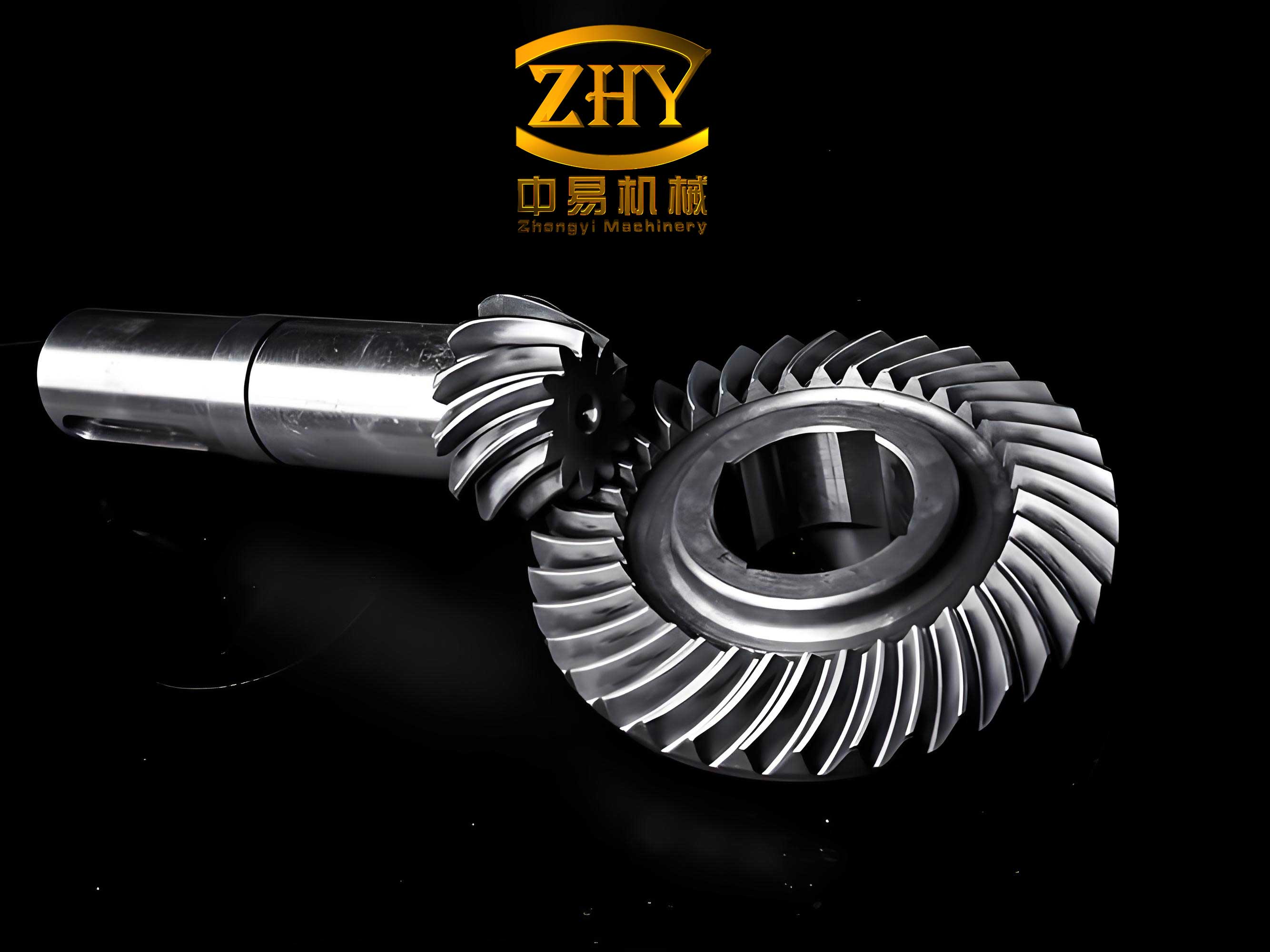
The foundation of processing spiral bevel gear dies lies in accurate tooth surface modeling. Based on the generating principle of spiral bevel gear milling, a universal coordinate system model for the gear milling machine is established. This model includes fixed and moving coordinate systems attached to the machine tool, cradle, cutter head, and workpiece. The cutter head, typically equipped with straight-edge tools having a conical profile, is used to generate the convex and concave surfaces of the spiral bevel gear. For the driven gear, the cutting cone surface and its normal vector in the cutter coordinate system \( S_t (x_t, y_t, z_t) \) are represented as follows:
$$ \mathbf{r}_t = \begin{bmatrix} (r_t – u_t \sin \alpha) \cos \theta_t \\ (r_t – u_t \sin \alpha) \sin \theta_t \\ -u_t \cos \alpha \end{bmatrix} $$
$$ \mathbf{n}_t = \begin{bmatrix} -\cos \alpha \cos \theta_t \\ \cos \alpha \sin \theta_t \\ -\sin \alpha \end{bmatrix} $$
where \( u_t \) and \( \theta_t \) are surface coordinates of the cutting cone, \( \alpha \) is the tool profile angle (negative for concave surfaces and positive for convex surfaces), and \( r_t \) is the cutter radius. Through coordinate transformations, the tooth surface equation and normal vector in the workpiece coordinate system \( S_w \) are derived:
$$ \mathbf{r}_w (u_t, \theta_t, \phi_e, \phi_w) = \mathbf{M}_{wt} (\phi_w, \phi_e) \mathbf{r}_t (u_t, \theta_t) $$
$$ \mathbf{n}_w (\theta_t, \phi_e, \phi_w) = \mathbf{L}_{wt} (\phi_e, \phi_w) \mathbf{n}_t (\theta_t) $$
Here, \( \phi_e \) and \( \phi_w \) represent the rotation angles of the cradle and workpiece, respectively. The matrices \( \mathbf{M}_{wt} \) and \( \mathbf{L}_{wt} \) are transformation matrices derived from a series of coordinate system rotations and translations. According to gear meshing theory, the condition for continuous contact between the cutter surface and the gear tooth surface is given by the meshing equation in the fixed coordinate system \( S_n \):
$$ \mathbf{n}_n \cdot \mathbf{v}_n^{(tw)} = 0 $$
where \( \mathbf{n}_n \) is the normal vector and \( \mathbf{v}_n^{(tw)} \) is the relative velocity vector. For modified generating methods, the roll ratio varies during processing, expressed as:
$$ \phi_w = R_n (\phi_e – A \phi_e^2 – B \phi_e^3) $$
with \( R_n \) as the basic roll ratio, and \( A \) and \( B \) as second- and third-order modification coefficients. For non-modified methods, \( A = B = 0 \). By solving these equations simultaneously, the tooth surface coordinates and normals are determined as functions of \( \theta_t \) and \( \phi_e \):
$$ \mathbf{r}_w = \mathbf{r}_w (\theta_t, \phi_e), \quad \mathbf{n}_w = \mathbf{n}_w (\theta_t, \phi_e) $$
This modeling approach ensures accurate representation of spiral bevel gear tooth surfaces, which is essential for subsequent die processing.
To facilitate digital modeling and CNC machining, the tooth surface of a spiral bevel gear is discretized into a grid of points. The surface region is divided into a 5-row × 9-column grid, totaling 45 points, which covers the active contact area during gear meshing. The grid is projected onto the axial cross-section, where the tooth profile boundaries are defined by the face cone, root cone, and small- and large-end lines. Let the gear geometric parameters include face width \( B \), pitch angle \( \delta_w \), face angle \( \delta_a \), root angle \( \delta_f \), large-end addendum \( h_a \), large-end dedendum \( h_f \), and tip clearance \( h_{ae} \). The coordinates of boundary points A, B, C, and D in the axial plane are calculated as:
$$ x_A = x_B – B \cos \delta_a / \cos(\delta_a – \delta_w), \quad y_A = y_B – B \cos \delta_a / \cos(\delta_a – \delta_w) $$
$$ x_C = x_D – B \cos \delta_f / \cos(\delta_f – \delta_w), \quad y_C = y_D – B \cos \delta_f / \cos(\delta_f – \delta_w) $$
$$ x_B = R \cos \delta_w – h_a \sin \delta_w, \quad y_B = R \sin \delta_w – h_a \cos \delta_w $$
$$ x_D = R \cos \delta_w – (h_f – h_{ae}) \sin \delta_w, \quad y_D = R \sin \delta_w – (h_f – h_{ae}) \cos \delta_w $$
Here, \( R \) is the pitch cone distance. The grid points are indexed by row \( k = 1, 2, \ldots, 5 \) and column \( l = 1, 2, \ldots, 9 \). The coordinates of any grid point \( M \) in the axial plane are given by:
$$ x_{kl} = \frac{y_{1l} – y_{k1} – a x_{1l} + b x_{k1}}{b – a}, \quad y_{kl} = y_{k1} + b (x_{kl} – x_{k1}) $$
where \( a = (y_{ml} – y_{1l}) / (x_{ml} – x_{1l}) \) and \( b = (y_{kn} – y_{k1}) / (x_{kn} – x_{k1}) \), with \( m = 5 \) and \( n = 9 \). Transforming these to the workpiece coordinate system \( S_w \), the spatial coordinates \( (x, y, z) \) satisfy:
$$ x(\theta_t, \phi_e) = x_{kl}, \quad \sqrt{y(\theta_t, \phi_e)^2 + z(\theta_t, \phi_e)^2} = y_{kl} $$
Solving this nonlinear system yields the parameters \( \theta_t \) and \( \phi_e \) for each grid point, which are then substituted into the tooth surface equations to obtain precise spatial coordinates and normal vectors. This discretization process is critical for accurate three-dimensional reconstruction of spiral bevel gears.
The three-dimensional solid modeling of spiral bevel gears involves fitting the discrete grid points into a continuous surface. A non-uniform bicubic B-spline curve is employed for surface interpolation, ensuring high precision when the grid is dense. The reference point, typically at the midpoint of the working tooth height and face width, is positioned at the center of the grid (row 3, column 5) to optimize iterative calculations. Additionally, the tooth root fillet is designed based on the non-interference principle, ensuring that during gear operation, the tip and root do not collide. The maximum fillet radius \( r_{max} \) depends on the side clearance and tip clearance, and it is determined to enhance bending strength. Using CAD software like UG, the tooth surface points are fitted, and the root fillet is applied to create a complete three-dimensional model of the spiral bevel gear pair.
As an example, consider a spiral bevel gear pair from a vehicle drive axle with the following geometric parameters:
| Parameter | Pinion | Gear |
|---|---|---|
| Number of Teeth | 9 | 39 |
| Module (mm) | 5.69 | |
| Mean Pressure Angle (°) | 22.5 | |
| Midpoint Spiral Angle (°) | 29.4333 | 29.4333 |
| Hand of Spiral | Left | Right |
| Face Width (mm) | 32 | 32 |
| Pitch Diameter (mm) | 51.21 | 221.91 |
| Outer Diameter (mm) | 65.29 | 222.28 |
| Theoretical Whole Depth (mm) | 10.42 | 10.42 |
| Face Angle (°) | 17.15 | 78.617 |
| Pitch Angle (°) | 13 | 77 |
| Root Angle (°) | 11.383 | 72.85 |
| Outer Cone Distance (mm) | 113.87 | |
| Side Clearance (mm) | 0.2–0.3 | |
| Crown To Back (mm) | 115.1 | 70 |
The machine settings for generating these spiral bevel gears are calculated using tooth contact analysis (TCA):
| Parameter | Gear (Concave) | Gear (Convex) | Pinion (Concave) | Pinion (Convex) |
|---|---|---|---|---|
| Cutter Diameter (mm) | 190.5 | 190.5 | 192.8 | 187.98 |
| Cutter Profile Angle (°) | 20.5 | 24.5 | 14 | 31 |
| Cutter Point Width (mm) | 3.25 | 3.25 | 1.97 | 1.97 |
| Workpiece Installation Angle (°) | 72.85 | 72.85 | 348.6 | 348.6 |
| Radial Distance (mm) | 97.29 | 97.29 | 89.028 | 108.19 |
| Angular Distance (°) | 58.5 | −62.488 | −54.7935 | −54.7935 |
| Horizontal Offset (mm) | −3.9 | −3.9 | 6.23 | 6.23 |
| Vertical Offset (mm) | −8.147 | −8.147 | 9.918 | 9.918 |
| Machine Center to Back (mm) | 0.756 | 0.756 | −1.208 | −1.208 |
| Roll Ratio | 1.023864 | 1.023864 | 4.095636 | 4.903278 |
The grid point coordinates for the pinion and gear tooth surfaces are computed accordingly. For the pinion concave surface, a subset of points is shown below (all coordinates in mm):
| x | y | z |
|---|---|---|
| 78.741523 | 20.787065 | 9.573372 |
| 78.949626 | 19.704052 | 9.748822 |
| 79.157728 | 18.650737 | 9.828698 |
| … | … | … |
| 110.205573 | −0.425123 | −30.499344 |
| 110.594709 | 0.419621 | −28.849353 |
| 110.983846 | 0.900922 | −25.464038 |
Similarly, for the gear convex surface:
| x | y | z |
|---|---|---|
| 16.875334 | 2.621183 | 80.085655 |
| 18.630126 | 3.293263 | 79.655538 |
| 20.384917 | 3.926733 | 79.221377 |
| … | … | … |
| 28.155366 | 15.279940 | −109.303623 |
| 30.694649 | 14.223491 | −108.855167 |
| 33.233932 | 13.212234 | −108.392229 |
These points are used to construct the three-dimensional models of the spiral bevel gear pair, which serve as the basis for die machining.
The machining strategy for spiral bevel gear tooth dies depends on the pitch angle of the gear. For driven gears with a pitch angle greater than 70°, the die can be directly milled on a three-axis CNC machining center. This is feasible because the normal vectors at all points on the tooth surface form an angle with the workpiece axis that is less than the complement of the cutter cone angle, allowing full access with a standard end mill. For driven gears with a pitch angle less than 70° and for all pinion dies, direct milling is challenging due to tool interference; thus, an electrode is first milled on a CNC machining center and then used to machine the die via electrical discharge machining (EDM). This hybrid approach leverages the precision of CNC milling and the capability of EDM for complex geometries.
For direct milling on a machining center, tool selection is critical. The cutter diameter must be smaller than the minimum width of the tooth slot and the root fillet radius to avoid gouging. Using CAD software, the minimum radius in the tooth slot, typically at the small end, is analyzed to determine the maximum allowable tool diameter. The tool path planning follows three principles: climb milling to reduce cutting forces and improve surface finish, minimizing retraction movements to enhance efficiency, and maintaining uniform machining allowances for consistent tool wear. Rough machining leaves an allowance of 0.3–0.5 mm for gears with outer diameters under 250 mm and 0.5–0.8 mm for larger gears, accounting for heat treatment deformation. The roughing path is typically layer-by-layer, either from inside-out for dies with central holes or outside-in for dies with central punches.
Finishing operations aim to achieve the required dimensional accuracy and surface roughness for the tooth slot, face cone, root cone, and fillets. A smaller tool diameter than that used in roughing is employed, ideally matching the minimum root fillet radius. Two common finishing strategies are contour parallel milling (layer milling along the tooth slot) and projection machining (radial machining along the tooth height). Projection machining is often preferred for better surface quality, where the tool moves from the outer to inner regions along the tooth height, with turning points placed outside the active tooth surface to avoid marks. The cutting parameters, such as spindle speed, feed rate, and depth of cut, are optimized based on tool material, workpiece hardness, and machine capability.
For gears requiring EDM, the electrode is fabricated on a four-axis CNC machining center. The electrode material, typically copper or graphite, is milled to the negative shape of the tooth die. The accuracy of the electrode directly affects the die quality; hence, the same grid-based modeling and tool path strategies are applied. During EDM, the electrode is submerged in dielectric fluid, and controlled electrical discharges erode the die material to form the tooth cavity. Key EDM parameters include pulse current, voltage, pulse duration, and flushing pressure, which are tuned to minimize tool wear and achieve fine surface finishes. The use of EDM allows for machining hard materials and complex shapes that are difficult with conventional milling.
In practice, the processing of spiral bevel gear dies involves iterative verification. The machined dies are inspected using coordinate measuring machines (CMM) to ensure conformity with the designed tooth geometry. Adjustments to tool paths or EDM parameters may be made based on inspection results. Additionally, simulation software can predict machining errors and optimize processes before actual production, reducing trial-and-error costs.
The integration of CNC machining centers into spiral bevel gear die manufacturing offers significant advantages in precision, efficiency, and flexibility. By combining advanced modeling techniques with tailored machining strategies, high-quality dies for precision forging of spiral bevel gears can be consistently produced. This approach not only supports the automotive and aerospace industries but also promotes the adoption of near-net shape manufacturing for other gear types.
In conclusion, the processing of precision forging dies for spiral bevel gears using CNC machining centers is a multifaceted process that begins with accurate tooth surface modeling based on generating principles. The tooth surface is discretized into a grid of points, which are calculated and fitted to create a three-dimensional solid model, incorporating appropriate root fillets. The machining method for the die is determined by the pitch angle: direct milling on CNC centers for gears with pitch angles above 70°, and electrode milling followed by EDM for others. This methodology enhances the manufacturing of spiral bevel gear dies, contributing to the production of high-performance forged gears. Future work may explore additive manufacturing for die fabrication or AI-driven optimization of machining parameters to further advance spiral bevel gear technology.