
In my extensive experience within the mechanical repair and manufacturing sector, the challenge of producing accurate gear profiles, especially for non-standard components, is a constant. Among these, the machining of straight bevel gears presents unique difficulties. While standardized gear cutting machines and dedicated tooling exist, they are often not available or economical for small-batch production, custom designs, or repair work in a typical workshop setting. This is where the method of using universal templates with a form-cutting or copying machine becomes invaluable. This article details the underlying principles, necessary adjustments, and critical calculations required to successfully machine non-standard straight bevel gears using such universal templates.
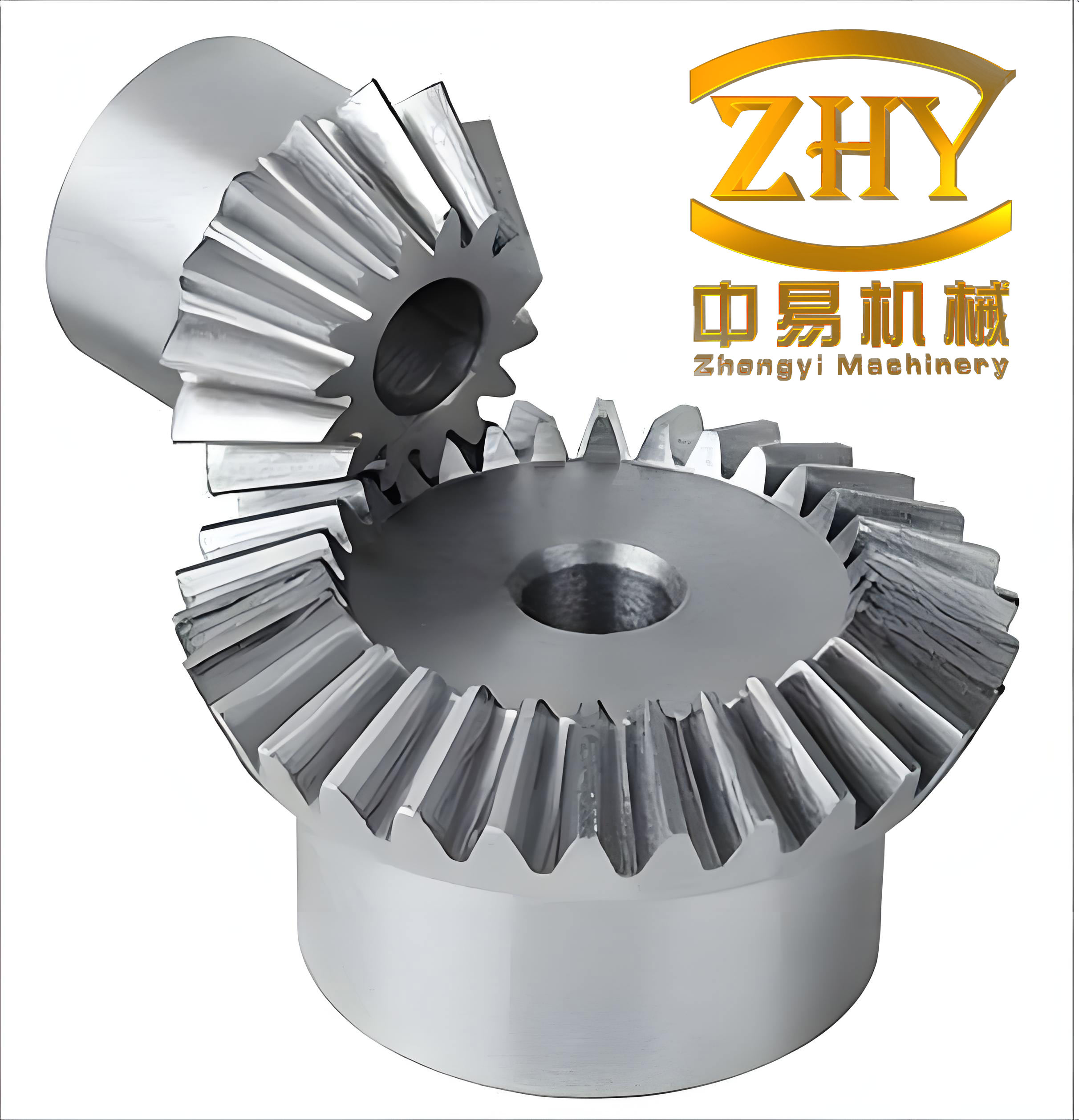
The fundamental premise of template-based machining for straight bevel gears is the simplification of a complex three-dimensional tooth form into a two-dimensional profile. The true tooth form of a straight bevel gear lies on a spherical surface and is described by a spherical involute. For practical manufacturing, this spherical profile is projected onto the back cone of the gear, creating a simplified planar approximation. A universal template is precisely this: a planar, magnified involute curve that corresponds to the tooth profile as it appears on the developed back cone of a theoretical standard straight bevel gear. The core idea is that if the scaled base circle radius of the template matches the scaled base circle radius derived from the gear’s back cone development, the template will generate a correct (or acceptably approximate) tooth form on the workpiece.
For a standard straight bevel gear with a pressure angle of 20°, the process is relatively straightforward. The universal template is selected based on the gear’s pitch cone angle. After sharpening the cutting tool and setting it up at the machine’s required mounting height and length, the template roller is aligned. The critical setup step is to position the cutter tip correctly when the template roller’s center coincides with the template’s theoretical “center point” (the intersection of the template’s pitch circle and its involute curve). For a standard gear, this distance from the cutter tip to the gear’s outer (face) cone must equal the gear’s module. This setup ensures the tool will trace the correct profile relative to the gear blank.
The universality of the template stems from its design based on the magnified back cone geometry. The template’s base circle radius $r_{b_t}$ is a constant determined by the specific copying machine’s geometry (magnified pitch cone length $L_m$) and its design standard pressure angle $\alpha_0$ (typically 20°).
The formula governing the template’s base circle is:
$$ r_{b_t} = L_m \cdot \cos \delta_0 \cdot \cos \alpha_0 $$
Where:
- $L_m$: Magnified pitch cone length (a machine/template constant)
- $\delta_0$: Pitch cone angle for which the template is catalogued (e.g., for a standard 20° pressure angle gear).
- $\alpha_0$: Design pressure angle of the universal template (e.g., 20°).
When machining a standard straight bevel gear with matching pressure angle, the gear’s own parameters yield a matching scaled base circle radius on its back cone development:
$$ r’_{b_g} = L_m \cdot \cos \delta \cdot \cos \alpha $$
For a standard gear, $\alpha = \alpha_0 = 20°$, and $\delta$ is chosen such that $r’_{b_g} \approx r_{b_t}$, allowing the use of that specific template.
The significant complication arises when we need to machine a non-standard straight bevel gear. This typically means one of two things, or both:
- The gear has a pressure angle $\alpha$ different from the template’s design pressure angle $\alpha_0$ (e.g., 14.5° or 25°).
- The gear has profile shift or modification (positive or negative addendum modification).
If one attempts to machine a straight bevel gear with a non-standard pressure angle $\alpha \neq \alpha_0$ by simply selecting a template based on the gear’s actual pitch cone angle $\delta$, the resulting tooth form error will be substantial. This is because the template’s involute curve is generated from a base circle calculated using $\alpha_0$, while the gear requires an involute generated from a base circle calculated using $\alpha$. The principle of “equal base circles yield equal involutes” must be enforced. Therefore, to use a universal (20°) template for a gear with pressure angle $\alpha$, we must select a different virtual pitch cone angle $\delta’$ for template selection. This virtual angle $\delta’$ is calculated to make the template’s base circle equal to the gear’s scaled base circle.
Setting $r_{b_t} = r’_{b_g}$:
$$ L_m \cdot \cos \delta’ \cdot \cos \alpha_0 = L_m \cdot \cos \delta \cdot \cos \alpha $$
Simplifying, we get the crucial selection rule:
$$ \cos \delta’ = \frac{\cos \delta \cdot \cos \alpha}{\cos \alpha_0} $$
Thus, you do not select the template using the gear’s real pitch cone angle $\delta$. Instead, you compute $\delta’$ using the formula above and choose the template catalogued for that $\delta’$ value. This adjustment ensures the base circles match, and therefore the involute profiles match.
| Gear Parameter | Symbol | Standard Gear Case | Non-Standard Pressure Angle Case |
|---|---|---|---|
| Gear Pressure Angle | $\alpha$ | $\alpha = \alpha_0$ (e.g., 20°) | $\alpha \neq \alpha_0$ (e.g., 14.5°) |
| Gear Pitch Cone Angle | $\delta$ | 25° | 25° |
| Template Design Pressure Angle | $\alpha_0$ | 20° | 20° |
| Template Selection Angle | $\delta’$ | Use $\delta$ = 25° | Calculate: $\cos \delta’ = \cos 25° \cdot \cos 14.5° / \cos 20°$ $\delta’ \approx 23.2°$ |
| Key Principle | Select template based on $\delta’$ to ensure $r_{b_t} = r’_{b_g}$. | ||
This change in template selection necessitates a critical adjustment in the machine setup: the cutter positioning. For a standard gear, the cutter tip is set at the gear’s face cone when the roller is centered. For a non-standard pressure angle gear, the cutter tip must be positioned on the line corresponding to the circle on the back cone where the involute pressure angle equals the template’s design pressure angle $\alpha_0$.
Let $r_{\alpha_0}$ be the radius to this point on the gear’s back cone development:
$$ r_{\alpha_0} = \frac{r’_{b_g}}{\cos \alpha_0} = \frac{L_m \cdot \cos \delta \cdot \cos \alpha}{\cos \alpha_0} $$
The required distance $X$ from the cutter tip to the gear’s face cone (outer radius $r_a’$ on the back cone development) becomes:
$$ X = r_a’ – r_{\alpha_0} $$
Where $r_a’ = L_m / \cos \delta + h_a m$, with $h_a$ being the addendum coefficient and $m$ the module. Therefore:
$$ X = \left( \frac{L_m}{\cos \delta} + h_a m \right) – \left( \frac{L_m \cdot \cos \delta \cdot \cos \alpha}{\cos \alpha_0} \right) $$
Only with this corrected “X” dimension will the tool generate the correct tooth profile depth and location for the non-standard straight bevel gear.
Another vital consideration is the effective length of the template’s profile curve. The universal template has a finite working involute profile. For standard gears, its length is designed to cover the tooth depth from the face cone to the root cone on the developed back cone. When machining gears with profile shift (addendum modification), the active part of the tooth profile shifts along the template’s curve. A significant profile shift can move the required profile segment outside the usable length of the template, leading to an incomplete or erroneous tooth form. This must be checked computationally.
The required effective length on the template spans from the equivalent “gear tip” radius to the equivalent “gear root” radius on the magnified back cone system.
For a modified straight bevel gear:
- Modified Addendum: $h_a m = (h_a^* + x)m$
- Modified Dedendum: $h_f m = (h_f^* – x)m$ (where $x$ is the profile shift coefficient, positive for outward shift).
The corresponding radii on the magnified back cone are:
$$ R_{a’} = \frac{L_m}{\cos \delta} + (h_a^* + x)m $$
$$ R_{f’} = \frac{L_m}{\cos \delta} – (h_f^* – x)m $$
The template must have a profile that physically extends from a radius equal to $R_{f’}$ to $R_{a’}$ after accounting for its own mounting and the roller diameter. The template’s own tip radius $R_{t_a}$ and root radius $R_{t_f}$ must satisfy:
$$ R_{t_f} \leq R_{f’} \quad \text{and} \quad R_{t_a} \geq R_{a’} $$
If this condition is not met, that particular universal template cannot be used to fully machine the specified modified straight bevel gear.
| Step | Action | Formula/Check | Purpose |
|---|---|---|---|
| 1. Data Acquisition | Obtain gear parameters: $m, z, \alpha, \delta, h_a^*, h_f^*, x$. | – | Define the target non-standard gear. |
| 2. Template Selection | Calculate virtual selection angle $\delta’$. | $$ \cos \delta’ = \frac{\cos \delta \cdot \cos \alpha}{\cos \alpha_0} $$ | Ensure matching of base circle radii between gear and template. |
| 3. Cutter Position (X) | Calculate the cutter offset from the face cone. | $$ X = \left( \frac{L_m}{\cos \delta} + h_a m \right) – \left( \frac{L_m \cdot \cos \delta \cdot \cos \alpha}{\cos \alpha_0} \right) $$ | Position the tool on the correct pressure angle line of the gear. |
| 4. Template Length Check | Verify template profile covers the shifted tooth depth. | Ensure: $R_{t_f} \leq R_{f’}$ and $R_{t_a} \geq R_{a’}$ where $R_{f’}, R_{a’}$ are calculated using $x$. |
Prevent incomplete tooth profile generation. |
| 5. Machine Setup | Set template tilt angle, mounting height, and tool length per machine manual for the selected template. | Follow machine-specific instructions for the template chosen via $\delta’$. | Correct spatial orientation of the copying mechanism. |
| 6. Alignment | Align template roller center with template center, then set cutter tip at distance X from gear blank face cone. | Physical setup and measurement. | Execute the calculated geometry on the machine. |
The practical application of these principles allows for a remarkable degree of flexibility. In a workshop environment, a limited set of universal templates can be used to produce a wide variety of straight bevel gears, including replacement parts for obsolete machinery where original specifications may use outdated pressure angles or unique modifications. The economic advantage is clear, as investing in a full set of dedicated templates or special cutters for every non-standard gear is often impractical.
However, it is crucial to acknowledge the inherent limitations of the method. The initial approximation—replacing the spherical involute with a planar involute on the back cone—introduces a theoretical error. This error is generally acceptable for coarse- and medium-pitch gears, especially in the context of industrial repair and non-critical drives. The adjustments for pressure angle and profile shift described here correct for the major errors introduced by using a standard template, but they do not transform the process into a perfect generation method. For high-precision, high-speed applications, generated straight bevel gears produced on dedicated gear generators (like Gleason or Klingelnberg machines) are irreplaceable.
Furthermore, the calculations assume accurate knowledge of the machine constant $L_m$ and the precise geometry of the template mounting system. These values are specific to the make and model of the copying or profiling machine being used. The craftsman must have access to this machine data. The setup also demands careful measurement and skill in aligning the tool and template roller. The diameter of the template roller itself is factored into the template’s manufactured profile (as an equidistant curve offset from its theoretical involute), so using the correct, specified roller is mandatory.
In conclusion, the machining of non-standard straight bevel gears using universal templates is a powerful and economical technique rooted in solid geometric principles. Its successful execution hinges on understanding the relationship between the gear’s true parameters and the template’s design basis. The two most critical adjustments are:
- Selecting the template based on a recalculated virtual pitch cone angle $\delta’$ to align base circles.
- Recalculating the cutter setting distance $X$ to position the tool on the correct starting point of the gear’s involute.
A final check for template profile length sufficiency, especially for modified gears, prevents runtime failures. By rigorously applying these formulas and checks, a machinist can reliably produce functionally correct straight bevel gears for a vast array of non-standard applications, extending the capability of a general-purpose workshop far beyond the limits of standard off-the-shelf tooling.