
In modern manufacturing, the demand for high-precision and complex components, such as irregular involute gear shafts, has driven the adoption of advanced multi-tasking machines. As a researcher in the field, I have extensively utilized the HT665 turning-milling composite center to address the challenges associated with machining these intricate gear shafts. This equipment integrates turning, milling, and drilling capabilities, enabling the completion of multiple operations in a single setup. The irregular involute gear shaft, characterized by its high accuracy requirements and complex geometry, exemplifies the need for such sophisticated machinery. By leveraging the HT665’s dual-turret and dual-spindle configuration, I have achieved significant improvements in efficiency and precision, reducing the need for repeated clamping and minimizing positional errors. This article delves into the comprehensive process, from initial analysis to final execution, highlighting the methodologies and parameters essential for successful gear shaft production.
The irregular involute gear shaft typically features elements like involute helical gears, keyways, tapered surfaces, and end-face transmission gears. One of the primary challenges in machining this gear shaft is maintaining tight tolerances, such as a coaxiality of 0.01 mm and a runout of 0.005 mm between the involute helical gear and the end-face gear. Traditional machining methods often lead to inaccuracies due to multiple setups, but the HT665 center mitigates this through its integrated approach. For instance, the B-axis tilting functionality allows for precise angular positioning to machine keyways and holes on tapered surfaces, which would be difficult on conventional equipment. In my experience, the gear shaft’s complexity necessitates a holistic strategy, encompassing material selection, toolpath optimization, and real-time monitoring to ensure dimensional stability and surface quality.
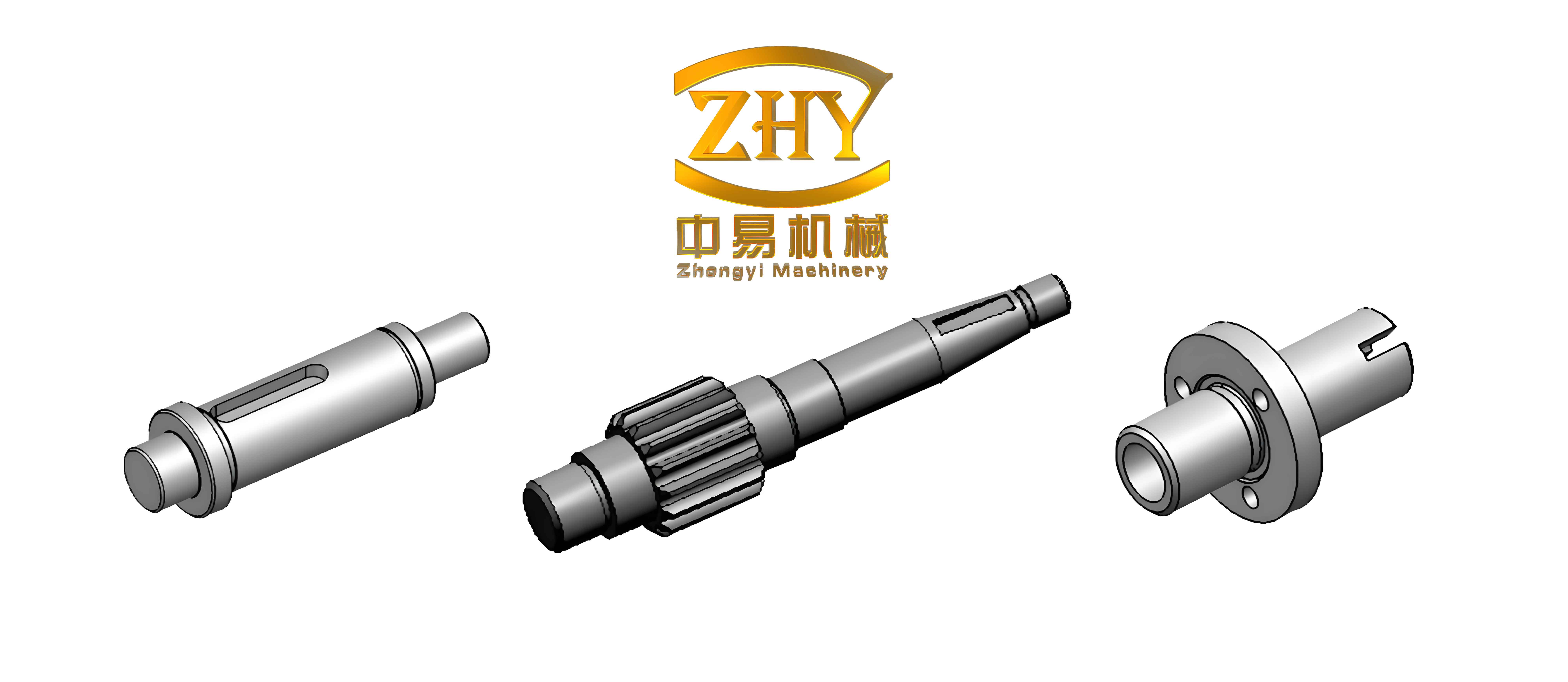
When planning the machining process for an irregular involute gear shaft, I begin with a detailed analysis of the component’s geometry and technical specifications. The gear shaft often requires operations on both ends, which the HT665 handles efficiently using its main and sub-spindles. Initially, the workpiece is clamped in the sub-spindle for left-side features, including facing, external contour turning, and internal hole drilling. This is followed by an automatic transfer to the main spindle for right-side operations, such as milling keyways and gears, utilizing the B-axis for angular adjustments. The four-axis联动 capability is crucial for machining the involute helical gear, as it involves synchronized movements between the spindle and turret. To quantify the machining parameters, I rely on formulas like the cutting speed calculation: $$ v_c = \frac{\pi \cdot d \cdot n}{1000} $$ where \( v_c \) is the cutting speed in m/min, \( d \) is the tool diameter in mm, and \( n \) is the spindle speed in rpm. This ensures optimal tool life and surface finish for the gear shaft. Additionally, the material removal rate (MRR) for milling operations can be expressed as: $$ \text{MRR} = a_e \cdot a_p \cdot f_z \cdot n \cdot z $$ where \( a_e \) is the radial depth of cut, \( a_p \) is the axial depth of cut, \( f_z \) is the feed per tooth, and \( z \) is the number of teeth. These equations guide the selection of cutting conditions to avoid excessive tool wear or deformation of the gear shaft.
Tool selection is paramount in achieving the desired accuracy for the gear shaft. Based on my experiments, I use a combination of turning and milling tools tailored to the aluminum 2A12 material, which offers good machinability. For rough turning, I prefer inserts with smaller rake angles and larger nose radii to withstand high material removal rates, while fine-tuning operations employ higher rake angles for better surface integrity. In milling, larger-diameter tools are chosen for roughing to enhance productivity, and shorter flute lengths are used for finishing to maintain rigidity. The table below summarizes the tools and cutting parameters I commonly apply for machining the irregular involute gear shaft on the HT665 center. This data is derived from iterative testing and ensures consistent results across multiple production runs.
| Tool Name | Spindle Speed (rpm) | Feed Rate (mm/min) | Depth of Cut (mm) |
|---|---|---|---|
| 45° Facing Tool | 1000–1500 | 100–150 | 0.5 |
| 90° Rough Turning Tool | 500–800 | 150–200 | 2.0 |
| 90° Finish Turning Tool | 1200–1600 | 100–150 | 0.2–0.4 |
| Grooving Tool (4 mm width) | 300–400 | 60–100 | 0.5 |
| φ3.8 Twist Drill | 1000–1200 | 40–60 | – |
| φ5.8 Twist Drill | 800–1000 | 50–80 | – |
| φ4H7 Reamer | 80–100 | 30–50 | – |
| φ6H7 Reamer | 50–80 | 30–50 | – |
| φ20 Twist Drill | 500–700 | 50–100 | – |
| φ6 Hard Alloy End Mill | 1600–2000 | 150–200 | 0.3–0.5 |
| φ8 Hard Alloy End Mill | 1400–1800 | 150–200 | 0.5–0.8 |
| φ10 Hard Alloy End Mill | 1200–1500 | 200–300 | 0.8–1.2 |
Three-dimensional modeling plays a critical role in the preparation phase for machining the gear shaft. I employ SolidWorks to create a median-value model, which accounts for tolerance ranges by using the midpoint of dimensional limits. For example, a dimension of φ10 with tolerances from 10.01 to 10.02 mm is modeled as 10.015 mm. This approach minimizes errors in toolpath generation and ensures that the final gear shaft meets specifications. The involute profile of the gear shaft can be described mathematically using the involute equations: $$ x = r_b (\cos \theta + \theta \sin \theta) $$ and $$ y = r_b (\sin \theta – \theta \cos \theta) $$ where \( r_b \) is the base circle radius and \( \theta \) is the roll angle. These equations are essential for generating accurate CAD models that reflect the true geometry of the involute gear shaft. Once the model is complete, I import it into Esprit CAM software to develop toolpaths. The software’s strategies, such as wrapped pocket milling and contour machining, enable efficient material removal while maintaining precision. For instance, the toolpath for the involute helical gear involves four-axis interpolation, which I simulate to prevent collisions and optimize cycle times. The resulting G-code is then verified through simulation software before actual machining, reducing the risk of errors on the HT665 center.
In the machining sequence for the gear shaft, I start with the sub-spindle operations. First, I use a 45° facing tool to square the left end, followed by rough and finish turning with a 90° external tool to achieve the required contours. Drilling and internal turning are performed to create the bore, ensuring concentricity with the gear shaft’s axis. The end-face gear is milled using a φ6 end mill, with careful attention to feed and speed to avoid burrs. After these steps, the sub-spindle automatically transfers the workpiece to the main spindle for right-side processing. Here, I employ simultaneous turning with both turrets to reduce cycle times, a feature known as follow-on machining. The B-axis is then engaged to mill the tapered surfaces and keyways at precise angles. For the involute helical gear, I implement four-axis联动 milling, where the spindle rotates synchronously with the tool movement to generate the complex profile. Throughout this process, I monitor parameters like cutting forces and temperatures, as they can affect the gear shaft’s integrity. The formula for thermal expansion, $$ \Delta L = \alpha \cdot L \cdot \Delta T $$ where \( \alpha \) is the coefficient of thermal expansion, \( L \) is the initial length, and \( \Delta T \) is the temperature change, helps in anticipating dimensional shifts and applying compensations.
Quality assurance for the gear shaft involves post-machining inspection using coordinate measuring machines (CMMs). I focus on verifying critical dimensions, such as the involute tooth profile and keyway positions, to ensure they fall within the specified tolerances. The gear shaft’s performance relies heavily on the accuracy of these features, so I often use statistical process control to track variations over multiple batches. Additionally, the surface roughness of the gear shaft is evaluated using parameters like Ra and Rz, which are influenced by tool geometry and cutting conditions. The empirical relationship for surface roughness in turning can be approximated as: $$ R_a = \frac{f^2}{8r} $$ where \( f \) is the feed rate and \( r \) is the tool nose radius. This guides my selection of finishing parameters to achieve the desired surface quality for the gear shaft. In one instance, after optimizing the toolpaths and parameters, I successfully machined an irregular involute gear shaft in approximately six hours, with all dimensions conforming to the design requirements. This outcome underscores the effectiveness of the HT665 center in handling such complex components.
Beyond the technical aspects, I have observed that the integration of digital twins and IoT sensors on the HT665 center enhances the predictability and efficiency of gear shaft production. By collecting real-time data on tool wear and machine vibrations, I can implement predictive maintenance strategies, reducing downtime and improving consistency. The gear shaft’s lifecycle, from design to disposal, benefits from this digital thread, enabling continuous improvement in manufacturing processes. Furthermore, the use of adaptive control systems allows for dynamic adjustments during machining, compensating for material inhomogeneities or tool deflection. This is particularly important for the gear shaft, as any deviation can lead to premature failure in applications like aerospace or automotive systems. In summary, the HT665 turning-milling composite center, combined with rigorous process planning and advanced software tools, provides a robust solution for producing high-quality irregular involute gear shafts. My ongoing research aims to further optimize these methodologies, exploring areas like additive-hybrid machining and AI-driven parameter optimization to push the boundaries of gear shaft manufacturing.
In conclusion, the machining of irregular involute gear shafts on the HT665 center represents a significant advancement in multi-tasking technology. Through careful planning, tool selection, and process control, I have achieved remarkable precision and efficiency in producing these complex components. The gear shaft’s unique demands highlight the importance of integrated machining strategies, and the HT665’s capabilities make it an indispensable asset in modern manufacturing. As industries continue to evolve, the lessons learned from machining such gear shafts will inform future innovations, driving progress in precision engineering. The iterative nature of this work—combining theoretical models with practical experimentation—ensures that each gear shaft produced meets the highest standards of quality and performance.