
In modern machinery and instrumentation, spur gears play a pivotal role in transmitting power smoothly and uniformly from one shaft to another. The stability and precision of these spur gears are critical, especially in aviation applications where they operate under extreme conditions such as high speeds and heavy loads. As a researcher in this field, I have focused on the quality control of spur gears through precision measurement, aiming to address the challenges in comprehensively evaluating gear quality during specific manufacturing processes. This article delves into the theoretical models and testing standards for spur gears, emphasizing the measurement of key parameters like single-flank testing accuracy, cumulative pitch error, contact accuracy, and tooth thickness error. By controlling detection errors, we can assess whether the dimensional accuracy, motion accuracy, and contact accuracy of spur gears meet the required specifications, thereby reducing trial-and-error costs and enhancing overall manufacturing quality.
Spur gears are commonly designed as straight-toothed cylindrical gears in aviation due to their suitability for harsh environments, stress conditions, and fatigue resistance. These spur gears undergo processes like carburizing and quenching to achieve a hard surface and soft core, ensuring wear resistance, impact strength, and anti-fatigue properties. Typically, high-quality carburizing alloy steels are used, with rough machining via hobbing or shaping before heat treatment, followed by precision grinding to maintain accuracy. Post-grinding, spur gears often achieve a grade 6 or higher according to standards like GB/T 10095.1-2022, with errors such as profile deviation and helix deviation controlled within tight limits, for instance, 0.008 mm for a module 3 mm gear, and surface roughness between Ra 0.4 and Ra 0.8 μm. The evaluation of spur gears involves 26 precision items, but I prioritize four that significantly impact performance: single-flank testing accuracy, cumulative pitch error, contact accuracy, and tooth thickness error. These are assessed through a combination of single-item and comprehensive inspections, with a focus on minimizing detection errors to provide reliable feedback for manufacturing adjustments.
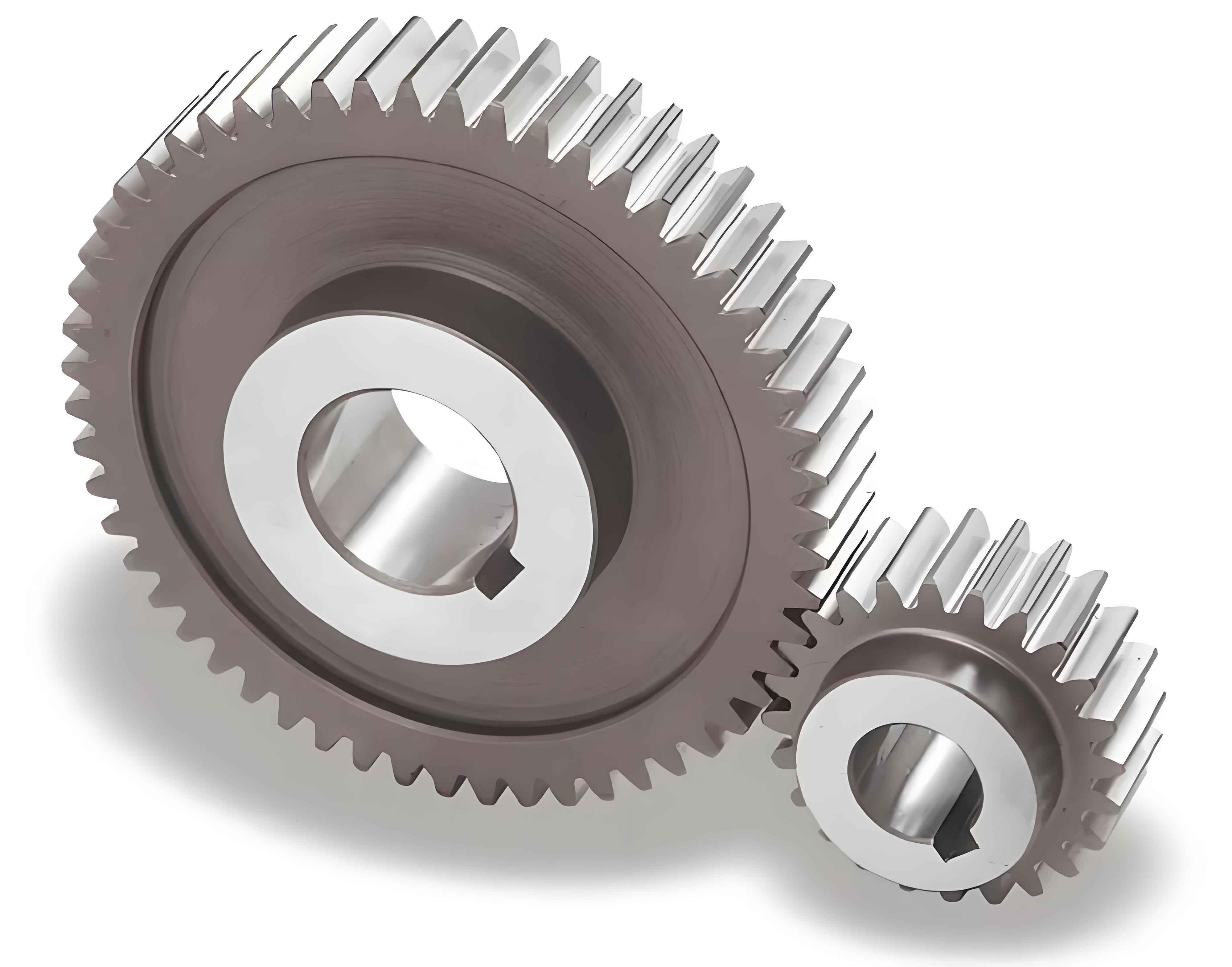
The precision characteristics of spur gears primarily revolve around motion accuracy, contact accuracy, and smoothness. Motion accuracy refers to the deviation between the actual and theoretical transmission ratios during operation. In aviation systems, high motion accuracy is essential for stability and reliability, as deviations can lead to uneven wear, increased vibration, and noise, ultimately compromising system performance. Contact accuracy, on the other hand, involves the contact conditions between gear teeth, including contact area, pressure, and form. Proper contact accuracy ensures uniform load distribution and higher load-bearing capacity, extending the service life of spur gears. Smoothness pertains to the impact and vibration during meshing, influenced by factors like pitch deviation, profile error, and base pitch deviation. Improving smoothness reduces vibrations and noise, enhancing system reliability and comfort. To evaluate these aspects, I rely on specific metrics, as summarized in the table below, which outlines the key evaluation items for spur gears, their impacts, and control measures.
| Evaluation Item | Primary Aspects | Main Impacts | Control Measures | Field Measurement Methods |
|---|---|---|---|---|
| Single-Flank Testing Accuracy | Profile deviation and adjacent pitch error | Smoothness of gear transmission | Control of profile error and adjacent pitch difference | Profile error measured with instruments; adjacent pitch difference via base pitch gauge |
| Cumulative Pitch Error | Pitch spacing and deviation from rotational reference | Transmission stability | Radial runout and indexing error control | Radial runout and base tangent length variation |
| Contact Accuracy | Tooth surface contact during meshing | Gear strength and lifespan | Helix and profile deviation, surface roughness | Helix and profile deviation measured with instruments |
| Tooth Thickness Error | Meshing clearance in gear pairs | Meshing gap in gear assemblies | Base tangent length or pin diameter dimensions | Variation in base tangent length across teeth |
In spur gears, the meshing occurs as point contact along the tooth height, evaluated through profile error, and as line contact along the tooth length, assessed via helix deviation. Single-flank testing accuracy, for instance, determines the smoothness of instantaneous contact in gear pairs, which often have significant backlash leading to floating-type engagement. This is measured using profile error and adjacent pitch difference. If these errors are excessive, they cause fluctuating contact stresses and impact during meshing. In practical settings, profile error is analyzed with specialized instruments, while adjacent pitch difference is indirectly measured using base pitch deviation, as base pitch equality is fundamental for proper meshing. The base pitch \( P_b \) can be calculated using the formula:
$$ P_b = \pi M \cos \alpha $$
where \( P_b \) is the base pitch, \( M \) is the module, and \( \alpha \) is the pressure angle. This equation shows that for spur gears with the same module, base pitch depends solely on the pressure angle, meaning pressure angle errors directly affect base pitch values. Base pitch measurement is conveniently done with a base pitch gauge, facilitating the assessment of adjacent pitch differences in spur gears.
Cumulative pitch error evaluation focuses on deviations during rotation, ensuring control over radial runout and indexing errors. Contact accuracy assessment examines the tooth surface contact during meshing; for spur gears, this is primarily line contact along the tooth length, so helix deviation is critical. By controlling helix deviation, we can effectively meet the contact accuracy requirements for spur gear transmissions. Tooth thickness evaluation, typically through base tangent length or pin diameter measurements, aims to maintain proper meshing clearance. This clearance is influenced by fixed center distances, tooth thickness, and radial runout, with the latter measured using dial indicators on a platform. During manufacturing, pitch deviations also affect base tangent length variations, which are used to assess cumulative pitch error and ensure rotational accuracy.
Error analysis in spur gear precision measurement is vital, as manufacturing involves specialized processes like cold machining, heat treatment, and surface treatments. In final inspections, to avoid damage, gear parameters are not checked, necessitating 100% verification during grinding. I, as an inspector, focus on single-item assessments and provide feedback to operators. Key detection items include profile and helix errors, surface roughness, radial runout, base pitch variation, and base tangent length variation. For example, profile and helix errors are measured with dedicated instruments, surface roughness with standard methods, radial runout using two-center clamping, base pitch variation with comparative gauges, and base tangent length variation with micrometers. The table below summarizes the main error sources and solutions for these measurements in spur gears.
| Detection Item | Main Influencing Factors | Conventional Solutions |
|---|---|---|
| Profile and Helix Error | Periodic speed variations from machine transmission systems; excessive axial play in spindles; radial runout in spindles and tool axes; poor tool sharpening and installation | Enhance wheel rigidity and installation accuracy; improve indexing motion precision; eliminate axial play and eccentric errors in worktables |
| Surface Roughness | Poor mechanical rigidity or external vibrations; non-uniform material; dull wheels or improper cutting speeds causing built-up edges; sudden changes in wheel-workpiece position; unstable workshop environments | Reduce vibration sources; improve wheel quality and rigidity; ensure stable clamping; control feed rates; maintain cooling lubrication; apply suitable heat treatment; select optimal cutting parameters; monitor tool wear; maintain constant temperature (20°±5°C) and humidity (70-80%) |
| Radial Runout | Improper workpiece clamping; misalignment after clamping; contamination in fixtures and machine centers | Verify clamping and fixture setup before machining; prevent human errors through careful inspection |
| Base Pitch Variation | Machine accuracy degradation; untimely wheel dressing and balancing; large tooth count differences between standards and parts | Compare base pitch with previous parts; control machine stability and wheel dressing frequency; use standards with similar tooth counts |
| Base Tangent Length Variation | Indexing errors in machines; untimely wheel dressing and balancing | Stop machining if variation exceeds 0.03 mm; inspect machine components like indexing plates and spindles |
In practical detection, especially during pre-heat treatment processes like hobbing and shaping, accuracy is largely machine- and tool-dependent, with limited adjustment scope. Thus, I emphasize first-article inspection and ensure fixture and tool stability, along with controlled feed rates. However, in grinding operations—whether form or worm grinding—the wheel profile is shaped by operators using diamond dressers, making factors like dressing quality, machine stability, workshop conditions, and part clamping critical. During on-site inspections, if anomalies arise, I guide operators to adjust machines, redress wheels, and optimize cutting parameters. For spur gears, specific attention is given to the following aspects:
First, in initial part processing, I monitor surface roughness in real-time, ensuring uniform and clear texture on gear teeth. After grinding, precision error tests, low-temperature tempering, and burn checks are conducted. If deviations occur, I analyze issues from profile charts, helix diagrams, tooth thickness errors, and base pitch variations to implement corrections. Second, base pitch inspection requires comparing with standard parts of similar tooth counts, as large differences can amplify errors due to varying measurement points. Each tooth must be checked; if base pitch variation exceeds 0.005 mm between consecutive spur gears, it indicates machine issues or excessive wheel wear, prompting immediate stoppage and troubleshooting. Third, tooth thickness control, typically via base tangent length measurement, uses specialized gauges in batch production to reduce inspection workload. Measurements should cover at least four points, and gauge tightness must be monitored to detect anomalies early. Fourth, profile and helix errors are checked simultaneously, as part misalignment may minimally affect profile but significantly impact helix. According to standards like GB/T 10095.1-2022, profile error definitions may not fully account for positional and shape effects, so negative deviations at the tip and root are sometimes necessary to avoid tip contact and mid-concavity in meshing.
Through this research on precision measurement and quality control for spur gears, I have derived valuable insights. First, selecting appropriate measurement techniques and methods is crucial, as different approaches vary in applicability and accuracy. For spur gears, defining single-item inspections according to technical requirements and aligning them with standardized schemes ensures result reliability. Second, strengthening error analysis and control is essential; for instance, excessive errors in profile, helix, roughness, waviness, base tangent length, or radial runout can interact and amplify issues. Therefore, a holistic approach is needed to identify and mitigate dominant errors. Third, enhancing inspector competency through training and education improves measurement accuracy and reliability, as human factors significantly influence outcomes. In summary, by focusing on error sources and maintaining them within acceptable limits, we can ensure spur gears meet design specifications, thereby boosting product quality, reducing costs, and supporting lean production. The formula for base pitch, $$ P_b = \pi M \cos \alpha $$, reiterates the importance of pressure angle control in spur gears, underscoring the need for precision in every manufacturing step.
In conclusion, the precision measurement of spur gears is a multifaceted process that demands attention to detail, robust error management, and skilled personnel. By implementing these strategies, manufacturers can achieve higher quality spur gears, ultimately contributing to safer and more efficient aviation systems. The continuous improvement in measurement technologies and methodologies will further enhance the reliability of spur gears in demanding applications.