
In hydraulic systems, gear pumps are ubiquitous components, prized for their simplicity and efficiency. However, a persistent issue with conventional gear pumps is the presence of unbalanced radial forces. These forces accelerate bearing wear, reduce service life, and ultimately limit the maximum operational pressure and reliability of the pump. Throughout my research and engineering practice, I have focused on innovative transmission technologies to overcome such limitations. This article presents a comprehensive analysis of a novel pump design: the harmonic drive gear pump. By integrating the principles of harmonic drive gear transmission with an internal gear pump architecture, this design promises to eliminate radial force imbalance. I will delve into the working principle, provide a detailed mathematical derivation of the radial forces acting on its key components—the flexspline and the circular spline—and demonstrate how equilibrium is achieved. The harmonic drive gear, with its unique wave-generator mechanism, is central to this solution, and its incorporation fundamentally alters the force dynamics within the pump.
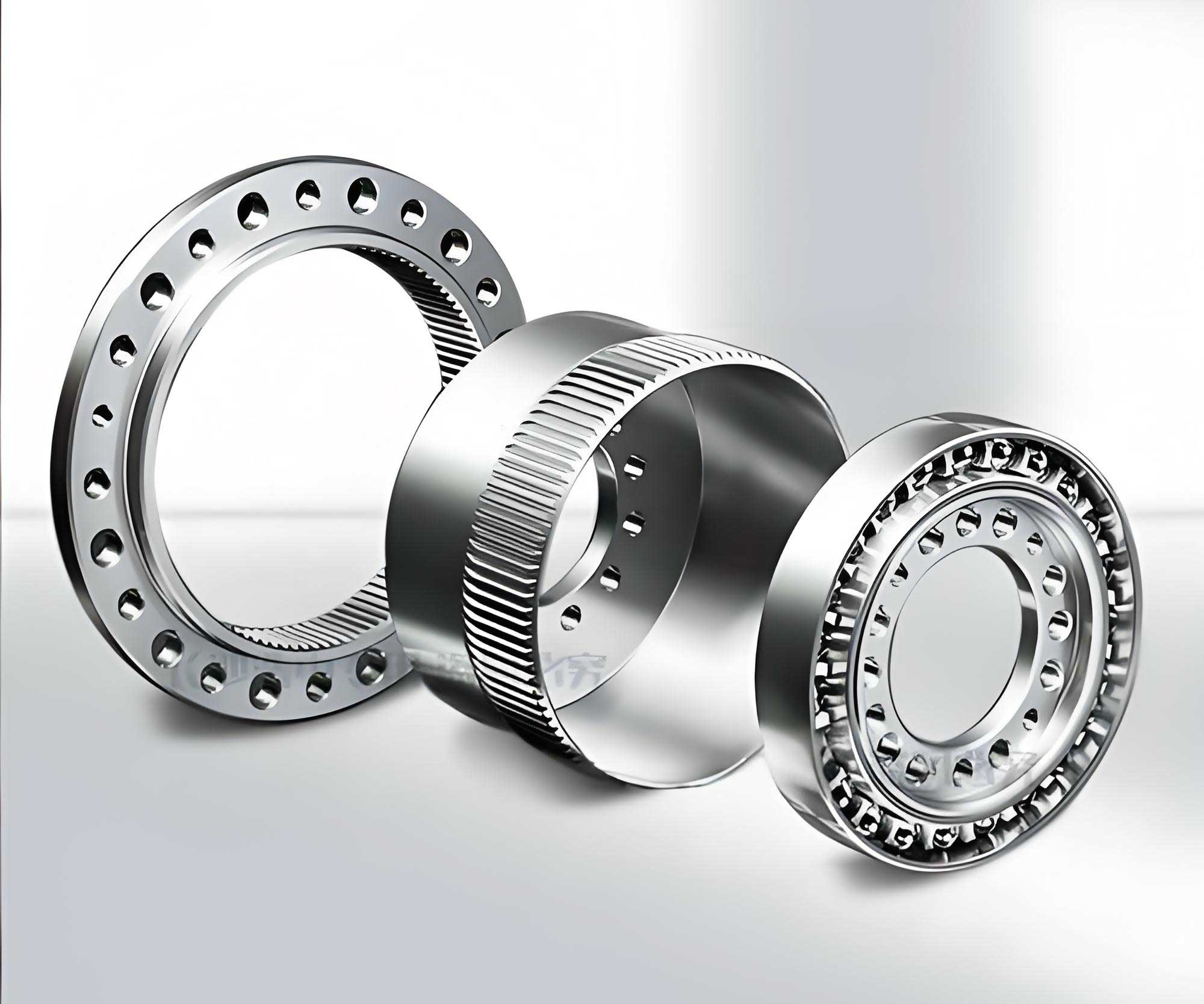
The core innovation lies in replacing the standard internal gear pair with a harmonic drive gear set. A harmonic drive gear system typically consists of three primary elements: a wave generator, a flexspline (a thin-walled, flexible external gear), and a circular spline (a rigid internal gear). In the context of a pump, this arrangement is ingeniously repurposed. The wave generator, often an elliptical cam bearing assembly, is held stationary. The circular spline acts as the driving input element, while the flexspline becomes the driven output element. A crescent-shaped partition, or月牙板, is inserted between the flexspline and circular spline, dividing the annular space into four distinct sealed chambers. When the circular spline rotates, it engages with the flexspline via the deforming action of the stationary wave generator. This engagement is not a simple one- or two-tooth contact; due to the properties of the harmonic drive gear, multiple teeth are in simultaneous contact across opposing sides of the generator’s major axis. This multi-tooth engagement is a hallmark of harmonic drive gear systems and contributes directly to their high torque capacity and precision. The rotation causes the volume of two diametrically opposite chambers to increase (suction chambers), while the volume of the other two chambers decreases (discharge chambers). This symmetrical creation of vacuum and pressure zones around the circumference is the first critical step toward radial force balance. The fluid is drawn in through symmetrically placed suction ports and expelled through equally symmetric discharge ports. This symmetric porting, made possible by the dual-chamber action of the harmonic drive gear, is fundamentally different from the single suction and discharge zones in a standard gear pump and is key to the force analysis that follows.
To quantify the radial force balance, I will analyze the forces acting on both the flexspline and the circular spline. The total radial force on each component is the vector sum of two primary contributions: the radial force generated by the hydraulic fluid pressure distributed around the gear’s circumference (\(F_p\)), and the radial force arising from the gear meshing action itself (\(F_T\)). The analysis requires several simplifying assumptions to make the complex, time-varying pressure and engagement fields tractable while preserving physical accuracy. I assume that all hydraulic pressures act on the addendum circle of the gears, that the angular extents of the pressure zones are constant, and that the pressure transitions linearly between the low-pressure (\(p_d\)) and high-pressure (\(p_g\)) regions. The pressure difference is defined as \(\Delta p = p_g – p_d\).
Let’s begin with the radial force analysis on the flexspline, a core element of any harmonic drive gear system. The coordinate systems are set up symmetrically. For the left-side fluid chambers (using coordinate system \(x_1O y_1\)), the pressure distribution as a function of angle \(\beta\) is:
$$
p(\beta) =
\begin{cases}
p_d, & 0 \leq \beta \leq \beta’ \\
p_d + \frac{\Delta p}{\beta” – \beta’} (\beta – \beta’), & \beta’ \leq \beta \leq \beta” \\
p_g, & \beta” \leq \beta \leq \pi
\end{cases}
$$
where \(\beta’\) and \(\beta”\) define the angular boundaries of the low-pressure and transition zones, respectively. Due to symmetry in the harmonic drive gear pump, the right-side chambers (coordinate system \(x_2O y_2\)) have an identical pressure profile. The infinitesimal force on an area element \(dA = B R_a d\beta\) (where \(B\) is gear width and \(R_a\) is flexspline addendum radius) is \(dF_p = p(\beta) B R_a d\beta\). Resolving this into \(x\) and \(y\) components and integrating over the respective angular intervals yields the total hydraulic radial force components for the left side, \(F_{p1x}\) and \(F_{p1y}\). A similar process gives the components for the right side, \(F_{p2x}\) and \(F_{p2y}\). Under the condition of symmetric porting (\(\beta’ = \pi – \beta”\)), which is inherent in the four-chamber design of this harmonic drive gear pump, the trigonometric simplifications \(\cos \beta’ = -\cos \beta”\) and \(\sin \beta’ = \sin \beta”\) apply. The resulting force components are:
| Force Component | Expression for Left Side | Expression for Right Side |
|---|---|---|
| \(F_{px}\) | \(B R_a (p_d + p_g)\) | \(B R_a (p_d + p_g)\) |
| \(F_{py}\) | \(-B R_a \Delta p \left( \frac{2 \cos \beta’}{\pi – 2\beta’} \right)\) | \(-B R_a \Delta p \left( \frac{2 \cos \beta’}{\pi – 2\beta’} \right)\) |
The net hydraulic radial force on the flexspline is the vector sum of the forces from both sides:
$$
\Sigma \vec{F}_p = (F_{p1x} – F_{p2x})\hat{i} + (F_{p1y} – F_{p2y})\hat{j} = 0\hat{i} + 0\hat{j}.
$$
Thus, \(\Sigma F_p = 0\). The symmetric pressure distribution engineered by the harmonic drive gear layout ensures the fluid pressure forces are self-equilibrating.
The second force component is the meshing force \(F_T\). In a pump, the hydraulic torque acting on the gears must be transmitted through the tooth contacts. The flexspline, as the driven element in this harmonic drive gear configuration, experiences a hydraulic torque \(M_2\). This torque is related to the pressure difference and the geometry of the flexspline. The magnitude of the meshing force at the contact point can be expressed as:
$$
F_T = \frac{M_2}{R_j} = \frac{1}{2 R_j} B \Delta p (R_a^2 – R^2)
$$
where \(R_j\) is the effective moment arm (approximately the pitch radius \(R\) for estimation), and \(R\) is the flexspline pitch radius. The harmonic drive gear mechanism ensures that there are two primary meshing zones located approximately \(180^\circ\) apart, corresponding to the major axis of the wave generator. Therefore, two meshing forces, \(F_{T1}\) and \(F_{T2}\), act on the flexspline. Their directions are along the respective lines of action, which are symmetric about the center. If \(\alpha\) is the pressure angle, the components of these forces in the symmetric coordinate systems are:
| Meshing Force Component | Left Side (\(F_{T1}\)) | Right Side (\(F_{T2}\)) |
|---|---|---|
| \(F_{Tx}\) | \(\frac{1}{2 R_j} B \Delta p (R_a^2 – R^2) \cos \alpha\) | \(\frac{1}{2 R_j} B \Delta p (R_a^2 – R^2) \cos \alpha\) |
| \(F_{Ty}\) | \(\frac{1}{2 R_j} B \Delta p (R_a^2 – R^2) \sin \alpha\) | \(\frac{1}{2 R_j} B \Delta p (R_a^2 – R^2) \sin \alpha\) |
Given the symmetry enforced by the harmonic drive gear kinematics, these components are equal in magnitude but opposite in direction when projected onto a common global coordinate system. Consequently, the net meshing force on the flexspline is also zero:
$$
\Sigma \vec{F}_T = 0.
$$
Since both contributing radial force systems independently sum to zero, the total radial force on the flexspline of the harmonic drive gear pump is perfectly balanced:
$$
\vec{F}_{\text{total, flexspline}} = \Sigma \vec{F}_p + \Sigma \vec{F}_T = 0.
$$
This result is significant. The multi-tooth engagement characteristic of the harmonic drive gear distributes the meshing load, while the symmetric chamber design balances the fluid forces.
The analysis for the circular spline, the other key gear in the harmonic drive gear pair, follows an identical logical and mathematical framework due to the action-reaction principle and system symmetry. The circular spline is the driving element, so the hydraulic torque \(M_1\) acts directly on it. However, it also receives the reaction meshing forces from the flexspline. The fluid pressure distribution around the circular spline’s addendum circle is the mirror image of that on the flexspline. Performing the same integration over the angular zones for the circular spline yields hydraulic force components \(F_{p3x}, F_{p3y}\) for the left and \(F_{p4x}, F_{p4y}\) for the right. Under symmetric conditions:
$$
F_{p3x} = F_{p4x}, \quad F_{p3y} = F_{p4y} \Rightarrow \Sigma \vec{F}_p^{(circular)} = 0.
$$
Similarly, the meshing forces on the circular spline, \(F_{T3}\) and \(F_{T4}\), are the reaction forces to \(F_{T1}\) and \(F_{T2}\). They are equal in magnitude, opposite in direction, and symmetrically applied. Therefore:
$$
\Sigma \vec{F}_T^{(circular)} = 0.
$$
The total radial force on the circular spline is therefore also balanced:
$$
\vec{F}_{\text{total, circular spline}} = 0.
$$
This dual balance for both rotating elements is the definitive advantage of the harmonic drive gear pump over conventional designs. The following table summarizes the force balance outcome and contrasts it with a standard external gear pump.
| Pump Type | Radial Force on Driving Gear | Radial Force on Driven Gear | Primary Cause of Imbalance | Impact on Bearings & Pressure Limit |
|---|---|---|---|---|
| Standard External Gear Pump | Large, Unbalanced | Large, Unbalanced | Asymmetric pressure zone (one suction, one discharge) | High wear, limits maximum pressure |
| Harmonic Drive Gear Pump | Balanced (\(\Sigma F = 0\)) | Balanced (\(\Sigma F = 0\)) | Symmetric pressure & meshing (four chambers, dual engagement) | Minimal wear, allows higher pressure |
The mathematical derivation above relies on several geometric and operational parameters of the harmonic drive gear pump. To provide a more concrete understanding, let’s explore the relationship between the pump’s performance metrics and its radial force state. The volumetric displacement \(D\) of the pump is a function of the harmonic drive gear geometry. For an internal gear pump, displacement is related to the difference in the number of teeth between the circular spline and flexspline. In a harmonic drive gear set, the tooth difference is typically two (\(N_c – N_f = 2\)), which provides a high reduction ratio in transmission applications. In the pump context, this small difference ensures a large number of teeth in simultaneous contact. The theoretical displacement per revolution can be approximated by the volume swept by the teeth engagement. A more precise expression considering the harmonic drive gear’s wave generator profile and the crescent partition geometry is complex, but a simplified form is:
$$
D \approx \pi B (R_{a,f}^2 – R_{a,c}^2) \cdot K_{hg}
$$
where \(R_{a,f}\) and \(R_{a,c}\) are the addendum radii of the flexspline and circular spline respectively, and \(K_{hg}\) is a correction factor accounting for the unique tooth engagement kinematics of the harmonic drive gear. This factor is less than 1 due to the continuous multi-tooth contact which reduces the effective volume swept per tooth compared to a standard gear pair. The flow ripple, a critical parameter related to noise and vibration, is also greatly reduced in a harmonic drive gear pump. The simultaneous engagement of multiple teeth in a harmonic drive gear smoothens the flow transition between chambers. The flow ripple amplitude can be estimated as a percentage of the average flow and is generally lower than in conventional gear pumps. This is another beneficial side-effect of employing harmonic drive gear principles.
Furthermore, the radial force balance has direct implications for the bearing design and system pressure capability. In a standard pump, bearing load \(F_b\) is roughly proportional to the product of discharge pressure and a geometric factor: \(F_b \propto \Delta p \cdot B \cdot D\). In the harmonic drive gear pump, the theoretical net radial load is zero. In practice, due to manufacturing tolerances, pressure pulsations, and slight asymmetries, a small residual force may exist. However, its magnitude is orders of magnitude smaller. This allows for the use of smaller, less robust bearings or significantly extends bearing life. More importantly, it removes the primary barrier to increasing system pressure. The maximum pressure rating \(p_{g,max}\) is no longer constrained by radial bearing load but by other factors such as axial balance, housing strength, and seal integrity. This opens the door for harmonic drive gear pumps to be used in high-pressure hydraulic applications previously dominated by piston pumps.
The advantages of the harmonic drive gear pump extend beyond radial force balance. The inherent characteristics of harmonic drive gear transmissions contribute additional benefits. The high torque density and multi-tooth contact of harmonic drive gears translate to exceptional resistance to shock loads and overloads within the pump. The precision and low backlash of harmonic drive gears ensure minimal internal leakage across the tooth flanks, potentially leading to higher volumetric efficiency, especially at high pressures. The compactness of harmonic drive gear assemblies results in a pump with a very high power-to-weight and power-to-volume ratio. These attributes make the harmonic drive gear pump an attractive candidate for mobile hydraulics, aerospace applications, and precision machine tools where space, weight, and reliability are at a premium.
To put the theoretical analysis into a more applied context, let’s consider the design parameters for a hypothetical harmonic drive gear pump. Assume a target displacement of 10 cm³/rev and a maximum operating pressure of 30 MPa. Key design choices involve selecting the number of teeth, module, and width. For a harmonic drive gear set, common tooth counts for the circular spline (\(N_c\)) and flexspline (\(N_f\)) might be 100 and 98, respectively, maintaining the difference of 2. Using a standard module \(m\), the pitch diameters are \(D_c = m N_c\) and \(D_f = m N_f\). The addendum radii are \(R_{a,c} = m(N_c + 2)/2\) and \(R_{a,f} = m(N_f – 2 + 2 \cdot \text{addendum coefficient})/2\). The gear width \(B\) is then calculated from the displacement formula. The wave generator’s major axis length must be precisely controlled to ensure proper meshing without interference. The radial forces can be numerically verified using the derived formulas. For instance, with \(B=20\) mm, \(R_{a,f}=50\) mm, \(\Delta p=30\) MPa, \(\beta’=30^\circ\), the hydraulic radial force component magnitude before cancellation for one side is:
$$
|F_{p1}| = \sqrt{[B R_a (p_d+p_g)]^2 + \left[-B R_a \Delta p \left( \frac{2 \cos \beta’}{\pi – 2\beta’}\right)\right]^2 }.
$$
Substituting values (assuming \(p_d \approx 0.5\) MPa gauge, so \(p_d+p_g \approx 30.5\) MPa):
$$
|F_{p1}| \approx \sqrt{(20 \times 50 \times 30.5)^2 + \left[-20 \times 50 \times 30 \times \left( \frac{2 \cos 30^\circ}{\pi – 60^\circ \text{ in rad}}\right)\right]^2 } \text{ N}.
$$
This single-side force is substantial (on the order of tens of kN), highlighting how critical the symmetric cancellation is. The harmonic drive gear design ensures an equal and opposite force exists.
Potential challenges in realizing a practical harmonic drive gear pump include the manufacturing complexity of the flexible flexspline, ensuring its fatigue life under continuous cyclic deformation from the wave generator, and managing the heat generation from the elastic hysteresis of the flexspline material. However, advances in materials science, such as high-strength alloy steels and composite materials, along with precise machining techniques like wire electrical discharge machining (EDM), are mitigating these challenges. The stationary wave generator design simplifies the sealing and bearing arrangements for the rotating shafts compared to a setup where the generator rotates. Furthermore, the elimination of large radial loads means that the bearings supporting the circular spline shaft primarily handle only the transmitted torque and minor axial forces, leading to a simpler and more reliable mechanical design.
In conclusion, the integration of harmonic drive gear technology into an internal gear pump architecture yields a transformative solution to the chronic problem of radial force imbalance. My detailed analysis shows that by virtue of symmetric dual suction and discharge chambers—a direct consequence of the harmonic drive gear’s wave generator action—the hydraulic pressure forces on both the flexspline and circular spline sum to zero. Additionally, the symmetric dual-path load transmission inherent in the harmonic drive gear mesh ensures the tooth contact forces are also balanced. This comprehensive radial force equilibrium promises dramatically reduced bearing wear, extended pump service life, and the potential for operation at significantly higher pressures. The harmonic drive gear pump thus represents a significant leap forward in gear pump technology, leveraging the unique kinematics of harmonic drive gears to achieve a level of performance and reliability that was previously unattainable. Future work should focus on optimizing the harmonic drive gear profiles specifically for pumping action, experimental validation of the force balance under dynamic conditions, and exploring the integration of this pump design into advanced hydraulic systems for robotics, renewable energy, and industrial automation. The harmonic drive gear, with its exceptional mechanical properties, continues to inspire innovative engineering solutions across diverse fields, and its application in hydraulic pumps is a particularly compelling example of cross-domain technological synergy.