
The relentless pursuit of higher performance in aerospace, defense, and heavy machinery demands power transmission components that are simultaneously robust, precise, and efficient. The planetary roller screw assembly represents a pinnacle in this evolution, offering distinct advantages over traditional ball screws. However, the manufacturing of large-diameter variants for heavy-load applications presents a significant technical and economic bottleneck. This article explores a transformative manufacturing approach: the application of radial forging for the plastic forming of large-diameter, heavy-duty planetary roller screw assemblies.
A planetary roller screw assembly is a sophisticated mechanical actuator that converts rotary motion into linear thrust. Its core components include a central screw, a surrounding nut, and multiple threaded rollers arranged in a planetary configuration. These rollers mesh with both the screw and the nut threads. During operation, as the screw (or nut) rotates, the rollers orbit, causing a relative linear displacement. This design distributes the load across numerous contact points along the threads of the multiple rollers, as opposed to a limited number of ball contacts in a ball screw. This fundamental difference grants the planetary roller screw assembly its superior characteristics.
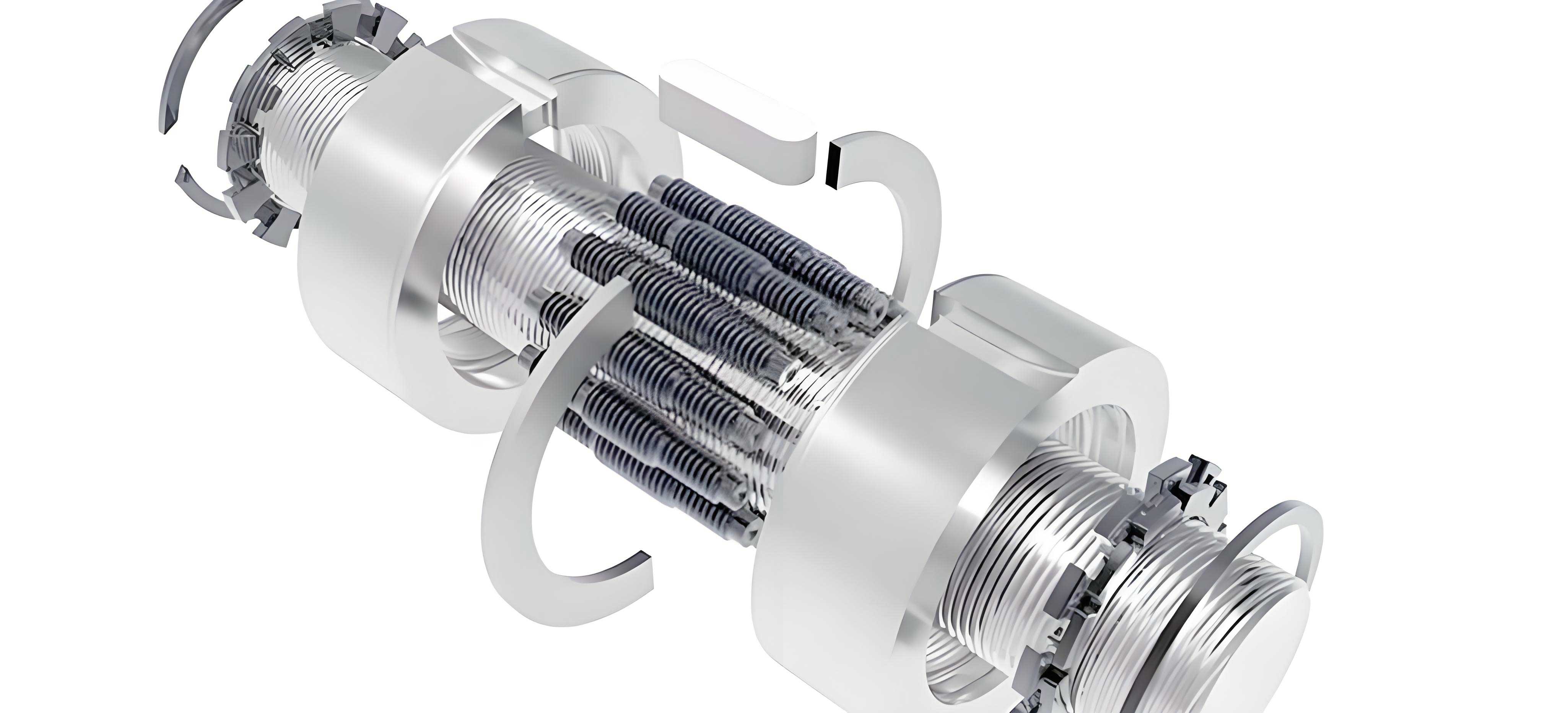
The benefits are substantial. The large load-bearing area results in a dramatically higher static and dynamic load capacity. The multi-point contact also leads to a longer fatigue life. Furthermore, the planetary roller screw assembly can achieve very small leads (high resolution) and operate at higher rotational speeds and accelerations without the risk of ball recirculation issues like skidding or jamming. This makes it ideally suited for applications requiring high force, high speed, high precision, and reliability under demanding conditions, such as aircraft flight control actuators, missile steering systems, and large industrial presses.
Despite its advantages, the widespread adoption of the large-diameter planetary roller screw assembly is hindered by traditional manufacturing methods. Currently, these components are predominantly manufactured via subtractive machining processes—turning, milling, and grinding. This approach is fraught with drawbacks for large-scale, high-performance production:
- Material Inefficiency: A significant volume of expensive, high-strength alloy steel is converted into chips, leading to waste often exceeding 50% of the initial billet.
- Compromised Mechanical Properties: Machining severs the natural grain flow of the metal. This can create stress concentration points and reduce fatigue strength, which is critical for a cyclically loaded component like a planetary roller screw assembly.
- Low Production Efficiency: Machining deep, precise threads on a large-diameter, long shaft is a time-consuming process, limiting output and increasing cost.
- Surface Integrity: Machined surfaces may have microscopic tears or altered microstructure, potentially serving as initiation sites for wear and fatigue cracks.
In contrast, metal forming processes, particularly plastic deformation techniques, offer a compelling alternative. They provide near-net-shape manufacturing, drastically reducing material waste. More importantly, the process of plastic deformation work-hardens the material, refines the grain structure, and creates continuous fiber lines that follow the contour of the thread. This results in components with superior mechanical properties, including enhanced strength, toughness, and fatigue resistance—attributes paramount for a reliable planetary roller screw assembly. While processes like thread rolling are well-established for smaller screws, they are not feasible for the large diameters (often >100mm) required for heavy-duty applications. This gap necessitates an innovative forming strategy.
State of the Art and the Need for Advanced Forming
The planetary roller screw assembly concept has been commercially developed and dominated by a few Western manufacturers. While academic research has extensively covered its kinematics, efficiency, and contact mechanics, detailed literature on the high-volume manufacturing of large-diameter screws is scarce and often proprietary. Existing commercial literature indicates that cold rolling is used for planetary roller screw assemblies with screw diameters typically below 45 mm. For larger diameters, the forming forces and machine rigidity required make rolling impractical, forcing a retreat to machining. Therefore, developing a viable plastic forming process for large-diameter screws is a critical, unmet technological need that can democratize access to high-performance actuators.
Radial forging emerges as a highly promising candidate. It is an incremental forming process where multiple dies (hammers) symmetrically placed around a workpiece strike it in a rapid, radial sequence. The workpiece is simultaneously rotated and/or axially fed. This local, progressive deformation requires significantly lower instantaneous force than full-contact rolling or extrusion, making it suitable for large cross-sections. It is commonly used for producing stepped shafts, gun barrels, and hollow tubes. Adapting this technology to form the intricate thread profile of a planetary roller screw assembly requires a meticulous design of the process kinematics and die geometry.
Radial Forging Process Concepts for Screw Forming
We propose and analyze two distinct radial forging strategies for forming the threaded section of a large-diameter planetary roller screw assembly. Both strategies employ a set of forging dies whose inner surfaces collectively describe the negative (female) thread profile of the desired screw.
Concept 1: Continuous Feed Radial Forging (CFRF)
In this process, the workpiece undergoes a continuous, synchronized motion during the forging sequence. The cycle for one hammer blow is as follows:
- Forging Phase: All N forging dies synchronously strike the rotating and axially advancing workpiece.
- Retraction & Advancement Phase: The dies retract radially. During this brief non-forging interval, the workpiece continues to both rotate by a small angle $\theta_c$ and advance axially by a corresponding distance $l_c$.
- The cycle repeats from step 1.
The core challenge is to perfectly synchronize the axial feed and rotation so that the incremental thread impressions made by the dies connect seamlessly to form a continuous helix. The fundamental relationship governing this synchronization is derived from the geometry of the thread. For the thread profile to be continuous, the axial advance per incremental rotation must match the thread’s lead.
Let $P$ be the lead of the planetary roller screw assembly thread (axial advance per one full revolution). If the workpiece rotates by an angle $\theta_c$ (in radians) between hammer blows, the required axial advance $l_c$ to stay on the helix is:
$$ l_c = \frac{\theta_c}{2\pi} P $$
Furthermore, if the workpiece rotates with an angular velocity $\omega$ during the forging phase and advances axially with velocity $v$, the continuous relationship is:
$$ v = \frac{P \cdot \omega}{2\pi} $$
The choice of the incremental rotation angle $\theta_c$ is crucial. To avoid leaving an un-forged “shadow” on the workpiece circumference due to the discrete number of dies $N$, $\theta_c$ should not be an integer multiple of the angular sector covered by one die. A common practical range is:
$$ 0 < \theta_c < \frac{2\pi}{N} $$
For example, with a 4-die ($N=4$) setup, $\theta_c$ should be less than 90° ($\pi/2$ radians). This ensures the dies progressively forge the entire circumference over several blow cycles. The process requires a very precise motion control system to maintain the $l_c/\theta_c = P/(2\pi)$ ratio consistently. The length of the threaded section that can be formed in one setup is limited by the stroke of the axial feed mechanism and the need to re-clamp the workpiece.
Concept 2: Intermittent Feed Radial Forging (IFRF)
This process decouples the forging and positioning motions into distinct phases, simplifying control at the potential cost of cycle time.
- Forging Phase: The workpiece is rotated about its axis but is held stationary axially. The N dies synchronously strike the workpiece. The rotation continues until a specific rotation angle $\theta_i$ is achieved, ensuring the entire circumferential segment under the dies is fully formed.
- Repositioning Phase: The dies fully retract. The workpiece is then rapidly advanced axially by a distance $l_i$ and may also be rotated by a compensatory angle $\phi$ to phase the thread correctly for the next forging zone. No forging occurs during this move.
- The cycle repeats from step 1 for the new zone.
The key geometrical constraints for IFRF are different. First, the axial jump $l_i$ must be less than or equal to the effective threaded length $l_a$ of the forging dies to ensure overlap and continuity:
$$ l_i \le l_a $$
Second, to ensure thread continuity between the forged zone A and the next zone B, the axial repositioning $l_i$ must be accompanied by a precise rotational phasing $\phi$. If the workpiece were only moved axially, the thread start point in zone B would be misaligned with the thread end point in zone A by exactly the amount of rotation that corresponds to $l_i$ along the helix. Therefore, during or after the axial feed, the workpiece must be rotated by:
$$ \phi = l_i \cdot \frac{2\pi}{P} $$
Third, the rotation angle $\theta_i$ during the forging phase must be chosen to ensure complete circumferential coverage. If the screw has $n$ number of thread starts (a multi-start thread), the forging rotation must cover at least the angular pitch between identical points on adjacent thread starts:
$$ \theta_i = \frac{2\pi}{n} $$
However, $\theta_i$ must also avoid being an integer divisor of the circle related to the number of dies to prevent forging shadows. Therefore, it must also satisfy:
$$ \theta_i \ne \frac{2\pi}{N} $$
For instance, forging a single-start ($n=1$) screw with 4 dies ($N=4$) requires $\theta_i = 360^\circ$. This would violate the condition above as $2\pi/N = 90^\circ$, and 360° is a multiple of 90°. This would mean the dies strike the same four spots every revolution, leaving the rest unformed. Therefore, IFRF is more readily applicable to multi-start threads where $n$ and $N$ have no simple integer relationship, or where $\theta_i$ can be a non-integer multiple of $2\pi/N$.
Comparative Analysis of Process Parameters and Performance
The following tables summarize the governing equations and constraints for the two radial forging processes for a planetary roller screw assembly.
| Parameter | Symbol | Governing Equation/Constraint | Description |
|---|---|---|---|
| Axial Advance per Cycle | $l_c$ | $l_c = \frac{\theta_c}{2\pi}P$ | Must match helix progression. |
| Rotation per Cycle | $\theta_c$ | $0 < \theta_c < \frac{2\pi}{N}$ | Ensures progressive circumferential coverage. |
| Continuous Speed Relation | $v, \omega$ | $v = \frac{P \cdot \omega}{2\pi}$ | Relationship during forging impact. |
| Die Thread Length | $l_a$ | $l_a > l_c$ (typical) | Die profile length; can be relatively short. |
| Thread Start Compatibility | – | Universally compatible | Suitable for single- and multi-start threads. |
| Parameter | Symbol | Governing Equation/Constraint | Description |
|---|---|---|---|
| Axial Jump Distance | $l_i$ | $l_i \le l_a$ | Limited by die length. |
| Repositioning Rotation | $\phi$ | $\phi = l_i \cdot \frac{2\pi}{P}$ | Required for thread phasing between zones. |
| Forging Rotation | $\theta_i$ | $\theta_i = \frac{2\pi}{n}$ | Must cover angular thread pitch. |
| Die Shadow Avoidance | – | $\theta_i \ne \frac{2\pi}{N}$ | Prevents un-forged circumferential zones. |
| Thread Start Compatibility | – | Conditional | May be restricted based on $n$ and $N$ relationship. |
| Aspect | Continuous Feed Radial Forging (CFRF) | Intermittent Feed Radial Forging (IFRF) |
|---|---|---|
| Process Dynamics | Simultaneous rotation & feed during forging. Continuous, incremental deformation. | Sequential forging (rotation only) and repositioning (feed ± rotation). Discrete zone-based deformation. |
| Forming Forces | Relatively lower. Deformation zone is small at any instant (only the incremental advance $l_c$). | Significantly higher. Deformation zone encompasses the entire die length $l_a$ during forging. |
| Machine Stiffness & Power | Requires high-precision motion control but lower instantaneous forging power. | Requires a machine with very high rigidity and power capacity to handle large forming forces. |
| Production Efficiency | Potentially lower due to slower, continuous motion and the need for extreme synchronization. | Potentially higher cycle rate for long screws, as rapid repositioning can be faster than slow, precise continuous feed. |
| Geometric Flexibility | High. Can form single- or multi-start threads of various leads easily by adjusting the $v/\omega$ ratio. | Limited. The relationship between thread starts ($n$) and die count ($N$) imposes restrictions to avoid forging shadows. |
| Control Complexity | Very high. Requires real-time, closed-loop synchronization of rotation and axial feed during dynamic forging impacts. | Moderate. Motion is separated into simpler, discrete steps: forge, retract, reposition. |
| Die Design & Cost | Dies can have a shorter threaded section ($l_a$), potentially reducing cost and complexity. | Dies require a longer threaded section ($l_a \ge l_i$), increasing cost, complexity, and wear surface. |
Die Design and Material Considerations
The success of both radial forging processes for a planetary roller screw assembly hinges on the design and manufacturing of the forging dies (hammers). The dies must have an internal profile that is the conjugate of the final screw thread, including the correct flank angles, root, and crest dimensions. For a multi-die setup, the profiles on all $N$ dies must be perfectly aligned axially and circumferentially to create a continuous internal thread when closed. Any misalignment will be imprinted onto the workpiece. The dies are subject to extreme cyclic mechanical and thermal stresses. Therefore, they are typically fabricated from high-grade hot-work tool steels (e.g., H13), often with advanced coatings (e.g., TiAlN, CrN) to enhance wear resistance and reduce friction. Preheating the dies is common in hot forging applications to reduce thermal shock. For forming high-strength, low-ductility materials for a planetary roller screw assembly, integrating medium- or high-frequency induction heating directly into the process line is advantageous. Localized heating of the workpiece billet just ahead of the forging zone can significantly lower the flow stress of the material, reducing required forging loads and enabling the forming of “hard-to-forge” alloys that are essential for high-performance applications.
Conclusion and Future Outlook
The radial forging process presents a viable and innovative pathway for the plastic forming of large-diameter planetary roller screw assemblies, directly addressing the shortcomings of traditional machining. The two proposed methodologies—Continuous Feed and Intermittent Feed radial forging—offer different trade-offs between forming force, process complexity, geometric flexibility, and production efficiency. CFRF offers lower forces and greater design flexibility but demands exquisite motion control. IFRF simplifies control and may offer faster cycle times for suitable thread geometries but requires a more robust machine and has inherent limitations regarding thread starts.
The potential benefits of adopting such a forming technology for the planetary roller screw assembly are substantial:
- Enhanced Mechanical Performance: Improved fatigue life and static strength due to wrought microstructure and continuous grain flow.
- Material and Energy Savings: Significant reduction in waste through near-net-shape forming.
- Production Scalability: Potentially higher production rates for large components compared to machining.
Future research and development should focus on several key areas: high-fidelity finite element modeling to simulate the complex, incremental forming process and predict defects; advanced die material and lubrication science to extend tool life; the design of hybrid machines capable of both CFRF and IFRF modes; and the integration of in-process sensing for real-time quality control. Successfully maturing this technology will not only benefit the manufacturing of planetary roller screw assemblies but also pave the way for the radial forging of other large, high-value threaded components like heavy-duty power screws and large lead screws, marking a significant advancement in green, high-performance manufacturing.