
Harmonic drive gear transmission technology, often referred to as strain wave gearing, emerged in the late 1950s as a revolutionary advancement in mechanical engineering, particularly driven by the demands of aerospace applications. This technology utilizes the elastic deformation of a flexible gear, known as the flexspline, to transmit motion and torque through a wave generator that induces controlled deflection. The unique operating principle of harmonic drive gears confers several superior characteristics compared to conventional gear systems, such as high positional accuracy, zero backlash, compactness, and the ability to achieve high reduction ratios in a single stage. These attributes have made harmonic drive gears indispensable in precision fields including satellite attitude control, robotic joint actuation, medical devices, and optical instrumentation. However, despite their advantages, precision harmonic drive gears sometimes exhibit inadequate output torsional stiffness, which can lead to reduced dynamic performance, vibration issues, and positioning errors in sensitive applications. Identifying the root causes of this stiffness deficiency is crucial for improving gear design and reliability. Among various potential factors, the radial stiffness of the wave generator assembly has been hypothesized to influence the overall torsional stiffness. This study focuses on empirically assessing the relationship between radial stiffness and output torsional stiffness in precision harmonic drive gears through the development and implementation of a high-precision radial stiffness testing system.
The fundamental operation of a harmonic drive gear involves three primary components: the wave generator, which is typically an elliptical cam or a set of rollers; the flexspline, a thin-walled cylindrical gear with external teeth that undergoes elastic deformation; and the circular spline, a rigid internal gear with slightly more teeth than the flexspline. The wave generator is inserted into the flexspline, causing it to assume an elliptical shape. As the wave generator rotates, the points of engagement between the flexspline and circular spline travel around the circumference, resulting in a relative rotation between the flexspline and circular spline. The transmission ratio \( i \) is given by:
$$ i = \frac{N_f – N_c}{N_f} $$
where \( N_f \) is the number of teeth on the flexspline and \( N_c \) is the number of teeth on the circular spline. For typical harmonic drive gears, \( N_f \) is slightly less than \( N_c \), leading to high reduction ratios.
The output torsional stiffness \( K_{out} \) of a harmonic drive gear can be modeled as a series combination of stiffness contributions from the flexspline \( K_f \), the output shaft \( K_s \), and the wave generator \( K_h \):
$$ \frac{1}{K_{out}} = \frac{1}{K_f} + \frac{1}{K_s} + \frac{1}{K_h} $$
The wave generator stiffness \( K_h \) is related to its radial stiffness \( K_G \) through the geometric and kinematic parameters of the harmonic drive gear. As derived in prior research, the relationship is expressed as:
$$ K_h = \frac{K_G}{k_r} \times \frac{2 d_i U w_0 i_k}{\pi} $$
In this equation, \( K_G \) represents the radial stiffness of the wave generator, defined as the ratio of radial force applied to the radial deformation of the flexspline-wave generator assembly. The parameter \( U \) denotes the wave number, which is typically 2 for standard harmonic drive gears. The inner diameter of the flexspline is \( d_i \), and \( w_0 \) is the wave generator’s amplitude, equivalent to the difference between the major and minor axes of the elliptical deformation. The transmission ratio is \( i_k \), and \( k_r \) is a load transfer coefficient that accounts for the distribution of forces between the flexspline and wave generator; for common cam-type wave generators, \( k_r \approx 0.35 \).
To evaluate the impact of radial stiffness on output torsional stiffness, it is necessary to measure \( K_G \) accurately under various loading conditions and then compute \( K_h \) using Equation (3). By comparing \( K_h \) with the measured overall output torsional stiffness, one can determine whether radial stiffness is a limiting factor.
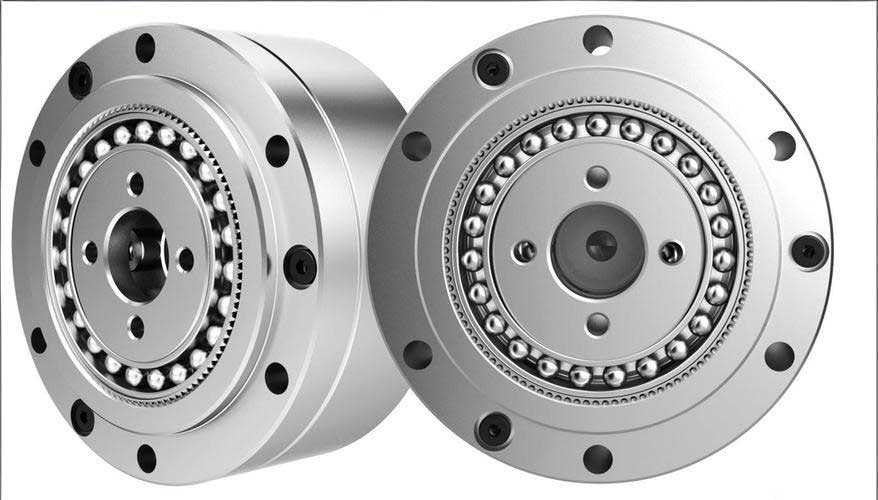
The stiffness modeling of harmonic drive gears is complex due to the nonlinear elasticity of the flexspline and the contact mechanics between gears. Various researchers have proposed analytical and finite element methods to predict stiffness. For instance, the flexspline can be treated as a cylindrical shell with variable thickness, and its stiffness can be derived from shell theory. The wave generator stiffness, as considered here, is often approximated as a linear spring in the radial direction, but in reality, it may exhibit nonlinear behavior due to contact deformation and material plasticity. Our experimental approach bypasses these complexities by directly measuring the force-deformation response.
Accurate measurement of radial stiffness in harmonic drive gears requires a test setup that minimizes external influences and provides precise force and displacement data. We designed a specialized radial stiffness testing apparatus that integrates mechanical loading, force sensing, and high-resolution deformation measurement. The core of the apparatus is a loading mechanism that applies radial force to the flexspline-wave generator assembly while allowing free deformation in the radial direction. The harmonic drive gear sample is mounted on a rigid base using a vertical fixation shaft that clamps the input side (wave generator input shaft) to prevent rotation, simulating a fixed input condition. A loading lever, constructed as a parallelogram linkage, is positioned on a support base equipped with an array of miniature ball bearings to reduce sliding friction to negligible levels. The loading lever contacts the flexspline through a pressure block that distributes the force evenly across the flexspline’s outer surface. A finely threaded loading screw is used to apply controlled radial force by advancing against the loading lever. The applied force is transmitted through the pressure block to the flexspline and measured in real-time by a precision force sensor placed between the pressure block and the loading lever. The force sensor is calibrated to ensure accuracy across the intended load range.
For deformation measurement, the entire apparatus is placed on the bed of a coordinate measuring machine (CMM). The CMM used in this study is a Brown & Sharpe Global Mistral model, offering a large measurement volume and a resolution of 1 μm. The CMM’s probe is programmed to measure the positions of two diametrically opposite points on the inner surface of the flexspline. By comparing these positions before and after load application, the radial deformation can be computed with high precision. The combination of force sensor and CMM provides a comprehensive data acquisition system for radial stiffness determination.
The testing procedure follows a structured protocol. First, the harmonic drive gear is installed in the apparatus, and the CMM is used to establish a reference measurement of the flexspline’s inner diameter under no load. This involves touching the probe to multiple points around the circumference to account for any initial out-of-roundness, but for radial stiffness, the diametral measurement suffices. Next, radial force is applied in incremental steps using the loading screw. At each step, after allowing time for stabilization (typically 10-15 seconds to damp any transient vibrations), the force value is recorded from the sensor’s digital indicator, and the CMM measures the deformed diameter. The process is repeated over a range of forces from zero to a maximum value that corresponds to the operational limits of the harmonic drive gear. To capture nonlinear behavior at low loads and linear behavior at higher loads, an uneven loading sequence is employed: small force increments in the low-force region and larger increments in the high-force region.
Before testing, the force sensor was calibrated using standard weights traceable to national standards. The calibration curve was linear with a correlation coefficient of 0.9999, ensuring measurement accuracy. The CMM was also verified using gauge blocks to confirm its volumetric accuracy. Environmental conditions, such as temperature and humidity, were monitored and controlled to within ±1°C and ±10% RH to minimize thermal expansion effects on the gear and apparatus.
We tested a precision harmonic drive gear designed for aerospace applications, with specifications including a flexspline inner diameter of 80 mm, a pressure angle of 20 degrees, and a maximum torque rating of 80 N·m. The loading sequence was as follows: from 0 to 49 N, increments of 1.96 N; from 49 to 98 N, increments of 4.9 N; and from 98 to 490 N, increments of 9.8 N. This sequence allows detailed observation of the initial deformation regime where stiffness may vary significantly.
The raw data collected includes applied radial force \( F \) and corresponding radial deformation \( \delta \). Radial stiffness \( K_G \) at each load point is calculated as \( K_G = F / \delta \). However, since deformation is not instantaneous and may exhibit hysteresis, we conducted both loading and unloading cycles to assess repeatability and elastic recovery. For brevity, Table 1 presents a subset of the data at key load points.
| Radial Force F (N) | Radial Deformation δ (mm) | Radial Stiffness K_G (N/mm) |
|---|---|---|
| 9.8 | 0.012 | 816.7 |
| 49.0 | 0.045 | 1088.9 |
| 98.0 | 0.078 | 1256.4 |
| 196.0 | 0.145 | 1351.7 |
| 294.0 | 0.210 | 1400.0 |
| 392.0 | 0.275 | 1425.5 |
| 490.0 | 0.340 | 1441.2 |
The data show that radial stiffness increases with applied force, approaching an asymptotic value at higher loads. This behavior is typical of elastic systems with initial settling or preload effects. To relate radial stiffness to torsional stiffness, we use the conversion formula derived earlier. First, the radial force corresponding to a given torque is calculated using:
$$ N_t = \frac{T}{d} \tan \alpha $$
For the tested harmonic drive gear, \( d = 0.08 \, \text{m} \) and \( \alpha = 20^\circ \), so \( \tan \alpha \approx 0.3640 \). Thus, \( N_t = T / 0.08 \times 0.3640 = 4.55 T \), where \( T \) is in N·m and \( N_t \) in N. For torque values of 8 N·m (10% of max), 40 N·m (50%), and 80 N·m (100%), the corresponding radial forces are 36.4 N, 182 N, and 364 N, respectively.
From the test data, we interpolate the radial stiffness at these force levels. Using Equation (3), we compute the equivalent torsional stiffness \( K_h \). The results are consolidated in Table 2.
| Parameter | 10% Load | 50% Load | 100% Load |
|---|---|---|---|
| Torque T (N·m) | 8 | 40 | 80 |
| Radial Force F (N) | 36.4 | 182 | 364 |
| Radial Deformation δ (mm) | 0.0237 | 0.0502 | 0.0713 |
| Radial Stiffness K_G (N/mm) | 1535 | 3627 | 5107 |
| Converted Torsional Stiffness K_h (N·m/rad) | 0.715 | 1.70 | 2.378 |
The converted torsional stiffness values are significantly higher than the measured output torsional stiffness of the harmonic drive gear, which is typically in the range of 0.1 to 0.5 N·m/rad for similar precision units. This indicates that the wave generator’s radial stiffness contributes only a small fraction to the overall output torsional stiffness. In fact, the series stiffness model suggests that the flexspline stiffness \( K_f \) is likely the dominant limiting factor, as it is much lower than \( K_h \).
To further analyze the stiffness behavior, we fitted the radial force-deformation data to a polynomial model. The deformation \( \delta \) as a function of force \( F \) can be expressed as:
$$ \delta = a F^2 + b F + c $$
where \( a \), \( b \), and \( c \) are coefficients determined by regression. This quadratic model captures the initial nonlinearity, with stiffness \( K_G = dF/d\delta \) being approximately \( 1/(2a F + b) \). For our data, the fit yielded \( a = 1.2 \times 10^{-6} \, \text{mm/N}^2 \), \( b = 0.0015 \, \text{mm/N} \), and \( c = 0.001 \, \text{mm} \). The stiffness thus increases with force, consistent with the observed hardening spring behavior.
The results demonstrate that radial stiffness, while measurable and non-negligible, is not the primary cause of insufficient output torsional stiffness in precision harmonic drive gears. Several factors may explain this finding. First, the wave generator in harmonic drive gears is often designed with high radial stiffness to maintain precise deformation profiles and minimize energy losses. Second, the conversion from radial to torsional stiffness involves geometric multipliers that amplify the effective stiffness, as seen in Equation (3). Third, the flexspline, being a thin-walled elastic component, undergoes complex deformation under load, leading to lower torsional stiffness than predicted by simple models. Additionally, manufacturing tolerances, assembly preload, and material properties can all influence the actual stiffness behavior.
Our testing system proved effective for radial stiffness measurement, with the CMM providing micron-level resolution and the force sensor ensuring accurate load monitoring. However, potential error sources include friction in the loading lever mechanism, although minimized by ball bearings, and thermal effects on the force sensor. We conducted repeatability tests to estimate measurement uncertainty, which was found to be within ±2% for force and ±5 μm for deformation, resulting in a stiffness uncertainty of approximately ±3%.
Comparing our findings with existing literature, prior studies have often focused on theoretical modeling of harmonic drive gear stiffness, but experimental validation at high precision is limited. Our work provides empirical data that can refine these models, particularly for aerospace-grade harmonic drive gears where performance requirements are stringent.
In conclusion, this study investigated the radial stiffness of precision harmonic drive gears and its impact on output torsional stiffness. We developed a dedicated test system combining a coordinate measuring machine and a precision force sensor to measure radial deformation under controlled loading. Testing of a representative harmonic drive gear revealed that radial stiffness, when converted to equivalent torsional stiffness, is substantially higher than the actual output torsional stiffness. Therefore, radial stiffness is not a major contributor to the stiffness deficiency observed in these gears. Future research should target other components, such as optimizing flexspline geometry or material selection, to enhance torsional performance. Moreover, the testing methodology established here can be applied to quality control and design validation for harmonic drive gears in critical applications.