
In my extensive experience with gear manufacturing, particularly in milling spiral gears, I have encountered numerous challenges related to efficiency and precision. Spiral gears, with their helical teeth, require meticulous attention during machining to maintain proper tooth alignment and avoid errors. One persistent issue in older gear hobbling machines, especially those without differential mechanisms, is the inability to perform a rapid return of the tool without causing tooth misalignment. This not only slows down production but also increases the risk of scrapped parts. Through years of practice and analysis, I have developed and refined a rapid return method that allows for quick tool retraction while preserving the exact positional relationship between the hob and the workpiece. This technique is especially valuable for machining spiral gears on machines lacking differential chains, such as the semi-automatic spline shaft milling machines I have operated. In this article, I will delve into the principles behind this method, provide detailed formulas and tables, and explain its implementation step by step, all from my firsthand perspective as an engineer working with spiral gears daily.
The foundation of this approach lies in the differential-less adjustment method for machining spiral gears. On gear hobbling machines with differential chains, the relationship between the hob’s rotation and the workpiece’s rotation is governed by the need to account for the helical lead. However, when a differential mechanism is absent, we can simulate the required motion by adjusting the gear ratios. For spiral gears, the key insight is that machining a helical gear with a certain number of teeth is equivalent to machining a spur gear with a modified tooth count. Specifically, the motion equation can be expressed as follows:
$$ \frac{n_t}{n_w} = z \pm \frac{f_a}{P_h} $$
Where \( n_t \) is the rotational speed of the hob, \( n_w \) is the rotational speed of the workpiece, \( z \) is the number of teeth on the spiral gear, \( f_a \) is the axial feed per revolution of the workpiece table, and \( P_h \) is the helical lead of the gear. The sign in the equation depends on the milling direction and the hand of the helix: a “+” sign is used for up-milling when the hob and workpiece helix directions are the same, or for down-milling when they are opposite, while a “-” sign applies for up-milling with opposite helix directions or down-milling with the same directions. This equation shows that by substituting \( z’ = z \pm \frac{f_a}{P_h} \) into the gear ratio formula for spur gears, we can achieve the correct kinematics for spiral gears without a differential. This principle is crucial for understanding how to set up machines for spiral gear machining and forms the basis for the rapid return technique.
To apply this in practice, we need to relate the helical lead to other gear parameters. For a spiral gear, the helical lead \( P_h \) is connected to the normal module \( m_n \), the number of teeth \( z \), and the helix angle \( \beta \) at the pitch circle. The relationship is given by:
$$ P_h = \frac{\pi \cdot m_n \cdot z}{\sin \beta} $$
This formula highlights how the geometry of spiral gears influences the machining process. Incorporating the machine’s transmission chain constants, the gear ratio formula for the differential-less method becomes:
$$ \frac{n_t}{n_w} = \frac{K}{m_n \cdot \sin \beta} \cdot \left( z \pm \frac{f_a}{P_h} \right) $$
Where \( K \) is the machine’s indexing constant. This adjustment allows for precise control over the hob and workpiece movements, ensuring accurate tooth generation for spiral gears. In my work, I have used this setup on machines like semi-automatic spline shaft millers, which inherently lack differential mechanisms. These machines typically require slow, reversed rotations for tool return to avoid tooth misalignment, significantly reducing productivity. The rapid return method I developed addresses this inefficiency by enabling fast retraction without compromising alignment.
The core idea of the rapid return method is to move the milling head by an integer multiple of the axial pitch of the spiral gear while keeping both the hob and workpiece stationary. After the hob completes its cutting stroke and the machine is stopped, the hob tooth’s highest point aligns precisely with the lowest point of the workpiece tooth space. If the milling head is then moved backward by a distance equal to an integer multiple of the axial pitch \( p_a \), this alignment remains intact, allowing for rapid return without disturbing the tooth relationship. The axial pitch \( p_a \) is calculated from the gear’s helical parameters:
$$ p_a = \frac{P_h}{z} = \frac{\pi \cdot m_n}{\sin \beta} $$
To determine the exact distance for retraction, we consider the gear width \( B \) and the axial pitch. The milling head should move by a distance \( L \) given by:
$$ L = \left( \lfloor \frac{B}{p_a} \rfloor + 1 \right) \cdot p_a $$
Where \( \lfloor \cdot \rfloor \) denotes the floor function, ensuring that \( L \) is the smallest multiple of \( p_a \) that exceeds the gear width, plus one additional pitch to account for entry and exit distances. This ensures that the cut-in and cut-out points are approximately equal, maintaining consistency. Controlling this distance precisely requires relating it to the lead screw’s parameters. If the lead screw has a lead \( L_s \), then the number of rotations \( N_s \) needed for the milling head movement is:
$$ N_s = \frac{L}{L_s} $$
In practice, to achieve high precision, we can manually rotate the lead screw through an angle \( \theta \) in degrees:
$$ \theta = N_s \cdot 360 = \frac{L}{L_s} \cdot 360 $$
By controlling this angle to within a degree or less, we can achieve milling head displacements on the order of micrometers, which is sufficiently accurate for spiral gear machining. The following table summarizes key parameters and calculations for implementing this method on a typical setup for spiral gears:
| Parameter Name | Symbol | Relationship or Value | Example for Spiral Gear |
|---|---|---|---|
| Normal Module | \( m_n \) | Given design parameter | 2 mm |
| Helix Angle | \( \beta \) | Given design parameter | 15° |
| Number of Teeth | \( z \) | Given design parameter | 30 |
| Axial Pitch | \( p_a \) | \( p_a = \frac{\pi \cdot m_n}{\sin \beta} \) | \( p_a = \frac{\pi \cdot 2}{\sin 15°} \approx 24.2 \, \text{mm} \) |
| Gear Width | \( B \) | Given design parameter | 50 mm |
| Integer Multiple | \( k = \lfloor B / p_a \rfloor \) | \( k = \lfloor 50 / 24.2 \rfloor = 2 \) | 2 |
| Retraction Distance | \( L \) | \( L = (k + 1) \cdot p_a \) | \( L = 3 \cdot 24.2 = 72.6 \, \text{mm} \) |
| Lead Screw Lead | \( L_s \) | Machine parameter | 6 mm |
| Lead Screw Rotations | \( N_s \) | \( N_s = L / L_s \) | \( N_s = 72.6 / 6 = 12.1 \) |
| Rotation Angle | \( \theta \) | \( \theta = N_s \cdot 360 \) | \( \theta = 12.1 \cdot 360 = 4356° \) |
| Precision Control | \( \Delta L \) | Adjustable via manual rotation | ±0.01 mm |
This table illustrates how to compute the necessary movements for rapid return in spiral gear milling. It is essential to note that if the actual helix angle deviates from the design value, the calculations must be based on the measured helix angle to ensure accuracy. In my experience, this method has proven reliable for various spiral gear configurations, from small precision components to larger industrial gears.
Implementing the rapid return method requires careful setup on the machine. For instance, on a horizontal semi-automatic milling machine, the lead screw is typically oriented horizontally at a convenient height for manual operation. To allow the lead screw to rotate independently while the hob and workpiece are stationary, an overrunning clutch must be incorporated between the lead screw and the feed transmission chain. Otherwise, the self-locking nature of worm gears in the system would prevent manual rotation. Once the clutch is engaged, after cutting is complete and the machine is stopped, I first eliminate any backlash in the lead screw nuts by briefly running the machine in reverse to move the milling head a small distance (e.g., 0.1 mm) backward. This step ensures that subsequent manual rotations are based on a true zero position, avoiding cumulative errors. Then, using a handwheel attached to the lead screw—often by removing a bearing cap at the free end—I rotate it precisely by the calculated angle \( \theta \) to achieve the desired retraction distance \( L \). This manual control allows for fine adjustments down to degree-level accuracy, corresponding to micrometer-level displacements in the milling head, which is critical for maintaining tooth alignment in spiral gears.
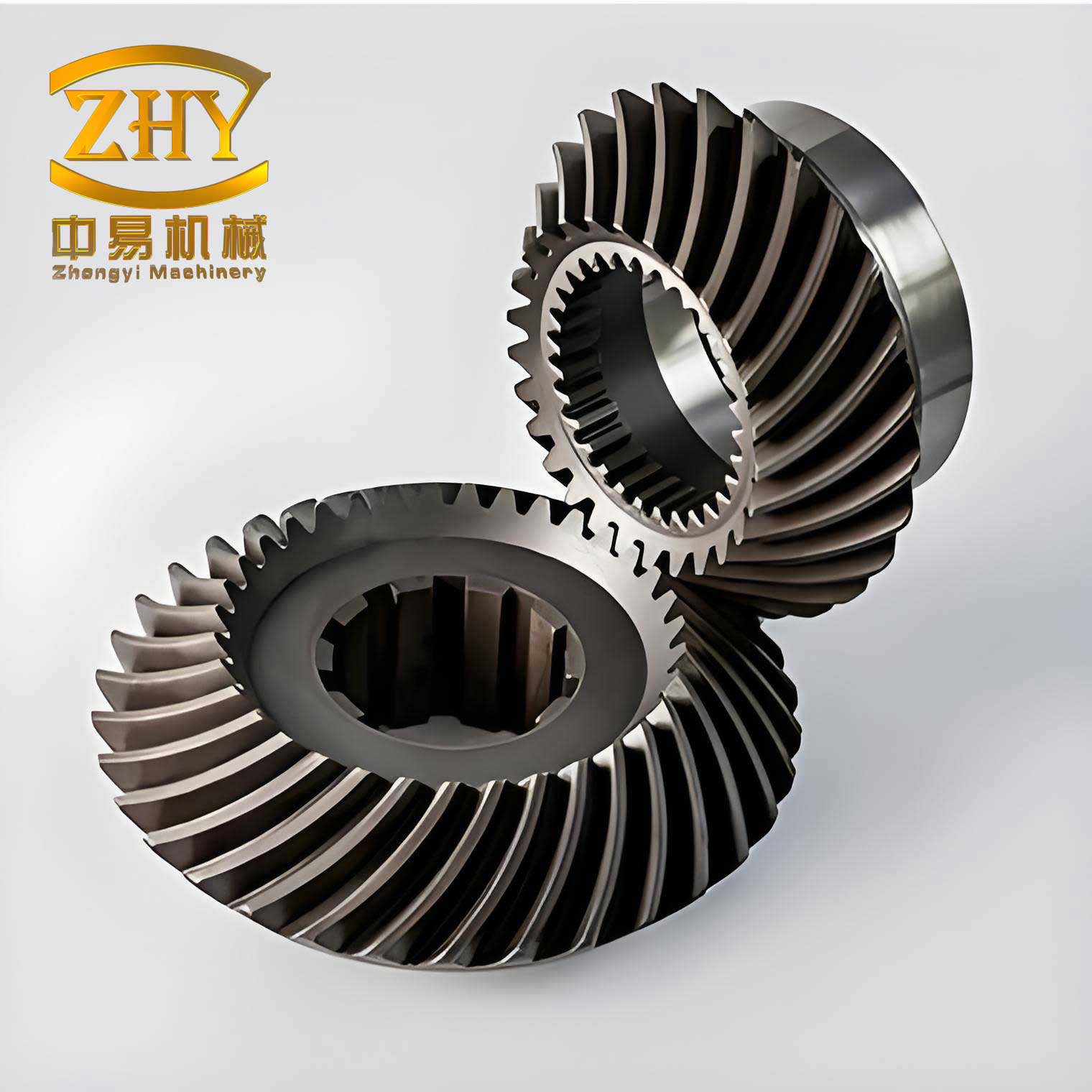
The image above provides a visual reference for spiral gears, highlighting their helical tooth structure that necessitates precise machining techniques like the rapid return method. In practice, this method offers several advantages for milling spiral gears. First, it significantly improves productivity by reducing non-cutting time; compared to the traditional reverse-rotation return, which can triple the total machining time, rapid return cuts cycle times dramatically. Second, it maximizes the utilization of existing equipment, especially older machines without differential capabilities, extending their applicability to modern spiral gear production. Third, it enhances operational flexibility, allowing for quicker setup changes between different spiral gear batches. However, challenges such as lead screw backlash must be managed proactively. In my setup, I use a primary and secondary nut arrangement to minimize backlash to around 0.05 mm, and the initial reverse movement eliminates residual errors. Additionally, ensuring that the overrunning clutch engages smoothly is crucial to prevent jerky motions that could affect surface finish on spiral gears.
To further optimize this process for spiral gears, I have explored variations in cutting parameters. For example, the axial feed rate \( f_a \) can be adjusted based on the gear’s material and helix angle to balance tool life and machining speed. The relationship between feed rate, hob speed, and gear geometry is given by:
$$ f_a = \frac{n_w \cdot p_a}{z} $$
Substituting into the earlier motion equation, we can derive optimal settings for different spiral gear types. Moreover, when machining multiple spiral gears in sequence, I pre-compute the retraction distances for each gear and use a dial indicator on the lead screw to ensure repeatability. This is particularly useful for high-volume production of spiral gears, where consistency is paramount. Another consideration is tool wear; since the rapid return method relies on precise positional alignment, any deviation in hob geometry due to wear must be compensated by recalibrating the retraction distance. Regular checks using gear measurement instruments help maintain accuracy over long runs.
From a theoretical perspective, the rapid return method aligns with fundamental principles of gear machining. The condition for tooth alignment after retraction can be expressed as:
$$ \Delta \phi = \frac{L}{p_a} \cdot 2\pi $$
Where \( \Delta \phi \) is the phase shift between the hob and workpiece; for alignment, this must be an integer multiple of \( 2\pi \), meaning \( L \) must be an integer multiple of \( p_a \), as enforced in the method. This mathematical assurance underpins the reliability of the technique for spiral gears. In broader applications, similar principles can be adapted to other gear types, such as double-helical or bevel gears, though adjustments for their specific geometries would be necessary. For spiral gears, however, the method remains straightforward and effective.
In conclusion, the rapid return method for milling spiral gears represents a practical solution to a long-standing inefficiency in gear manufacturing. By leveraging the differential-less adjustment principle and precise control of lead screw movements, it enables fast tool retraction without disturbing tooth alignment, thereby boosting productivity and equipment versatility. Throughout my career, I have applied this method to numerous spiral gear projects, achieving time savings of up to 60% compared to traditional approaches. Key takeaways include the importance of accurate parameter calculations, backlash management, and manual precision control. As spiral gears continue to be integral in industries like automotive, aerospace, and robotics, techniques like this will remain valuable for optimizing manufacturing processes. I encourage fellow engineers to experiment with this method on their spiral gear setups, adapting it to their specific machine configurations and gear designs for enhanced performance.
Looking ahead, advancements in CNC technology may automate aspects of this process, but the core ideas—such as integer-multiple retraction and backlash compensation—will persist. For now, in workshops equipped with legacy machines, this rapid return method offers a low-cost, high-impact upgrade for spiral gear milling. I continue to refine it in my work, exploring integrations with digital readouts or servo controls for even greater accuracy. Ultimately, the goal is to make spiral gear machining faster, more precise, and more accessible, driving innovation in gear-driven systems worldwide.