
In my extensive experience working with spiral bevel gears, I have observed that quenching distortion remains a critical challenge in their manufacturing process. Spiral bevel gears, including both standard spiral bevel gears and hypoid gears, are widely used in heavy-duty applications such as automotive differentials, aerospace systems, and industrial machinery due to their high load capacity and smooth operation. However, the thermal stresses induced during quenching often lead to significant dimensional changes, resulting in precision loss, reduced service life, increased noise, and higher scrap rates. The root causes of this distortion are multifaceted, but once the design is finalized, material properties and processing techniques become the key determinants. Over the years, I have participated in numerous trials and implemented various strategies to mitigate these issues, focusing on controllable heat treatment technologies. This article shares my firsthand insights, supported by data, tables, and formulas, to elaborate on practical approaches for minimizing quenching distortion in spiral bevel gears.
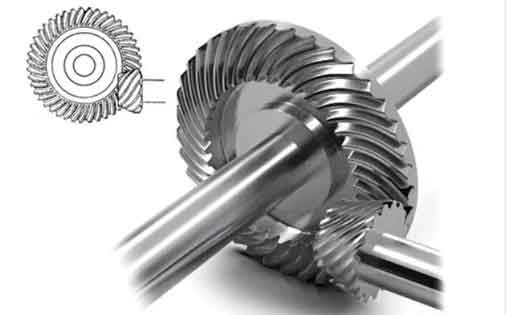
The distortion in spiral bevel gears after heat treatment can be categorized into two main types: tooth deformation and blank deformation. Typically, spiral bevel gears tend to exhibit a reduction in spiral angle and backlash, along with changes in pressure angle, which alter the tooth contact pattern and exacerbate operational noise. These deviations are primarily driven by non-uniform cooling during quenching, leading to residual stresses. To quantify this, consider the basic thermal strain formula: $$ \epsilon = \alpha \cdot \Delta T $$ where $\epsilon$ is the strain, $\alpha$ is the coefficient of thermal expansion (approximately $12 \times 10^{-6} \, \text{K}^{-1}$ for alloy steels), and $\Delta T$ is the temperature gradient during quenching. For a gear with initial dimensions, the resultant distortion $\delta$ can be expressed as: $$ \delta = \int_V \epsilon \cdot dV $$ where $V$ is the volume affected by thermal gradients. In practice, the distortion is more complex due to phase transformations, such as the formation of martensite, which introduces volumetric changes. The martensitic transformation strain can be modeled as: $$ \Delta V_m = \beta \cdot f_m $$ where $\beta$ is the volumetric expansion coefficient (around 0.04 for steel) and $f_m$ is the fraction of martensite formed. Combining these effects, the total distortion in spiral bevel gears is a superposition of thermal and transformational contributions.
Key factors influencing quenching distortion in spiral bevel gears include material composition, prior microstructure, quenching parameters, and gear geometry. For instance, low-carbon alloy steels like 20CrMnTi or 20CrMo are commonly used for carburizing or carbonitriding, but variations in hardenability can lead to inconsistent results. To address this, I have emphasized the use of steels with guaranteed hardenability, such as H-grade steels, which reduce variability. Additionally, the design of spiral bevel gears, with their curved teeth and tapered shape, makes them particularly susceptible to warping and twisting during rapid cooling. The distortion tendency can be approximated by a geometric factor $G$: $$ G = \frac{t}{d} \cdot \sin(\theta) $$ where $t$ is the tooth thickness, $d$ is the pitch diameter, and $\theta$ is the spiral angle. Higher $G$ values indicate greater susceptibility to distortion, necessitating tailored quenching strategies.
In our factory, we have adopted a method of iterative testing to control distortion, involving repeated gear cutting adjustments and heat treatment trials to establish pre-heat treatment specifications. While this approach is time-consuming and labor-intensive, it is justified for mass production of spiral bevel gears, as it enhances overall quality. The process begins with pre-heat treatment, where normalizing plays a crucial role. We implemented a double normalizing process: first after forging and again after rough machining, both at $930 \pm 10^\circ \text{C}$. This refines the grain structure and homogenizes the microstructure, reducing residual stresses that could exacerbate quenching distortion. Table 1 summarizes the impact of normalizing temperature on the contact pattern of passive spiral bevel gears, based on our experimental data.
| Normalizing Temperature (°C) | Tooth Convex Side | Tooth Concave Side | Notes |
|---|---|---|---|
| 920 ± 10 | Shift towards toe | Shift towards heel | Convex side moves toward toe compared to pre-heat treatment; concave side moves toward heel. |
| 940 ± 10 | Shift towards toe | Shift towards heel | Similar trend, but with reduced magnitude of shift due to finer grain structure. |
| 930 ± 10 (Double Normalized) | Minimal shift | Minimal shift | Optimal result with uniform contact pattern, minimizing post-quenching adjustments. |
The quenching process itself is critical, and we have extensively used press quenching systems to control distortion. In press quenching, the pressure applied by inner and outer rings, along with an expander, must be optimized. Through trials, I found that the pressure ratio between inner and outer rings is pivotal for minimizing warping. The optimal pressure distribution can be expressed as: $$ P_i : P_o = 1 : 2.5 $$ where $P_i$ is the inner ring pressure and $P_o$ is the outer ring pressure, typically in the range of 50–150 MPa. This ratio ensures balanced constraint during cooling, reducing asymmetric deformation. The quenching temperature is another variable; secondary heating after carburizing is usually conducted at $840 \pm 10^\circ \text{C}$, but adjustments may be needed based on initial inspection results. For example, if the core hardness is low, the temperature can be increased by 10–20°C, following the relationship: $$ T_q = T_0 + k \cdot \Delta J $$ where $T_q$ is the adjusted quenching temperature, $T_0$ is the standard temperature (840°C), $k$ is an empirical coefficient (about 5°C per unit hardenability deviation), and $\Delta J$ is the deviation in Jominy hardenability distance.
Moreover, the quenching medium significantly affects distortion. We use system loss oils with varying viscosities; higher oil grades (e.g., ISO VG 100) have poorer fluidity at room temperature but offer better cooling control at elevated temperatures. The cooling curve of oil can be modeled using the Grossmann equation: $$ H = \frac{1}{t} \ln \left( \frac{T_i – T_m}{T_f – T_m} \right) $$ where $H$ is the heat transfer coefficient, $t$ is time, $T_i$ is initial temperature, $T_f$ is final temperature, and $T_m$ is oil temperature. In practice, oil temperature should be maintained at $60 \pm 5^\circ \text{C}$; exceeding 70°C can degrade cooling performance, leading to soft spots or low core hardness. Table 2 illustrates the impact of oil temperature on distortion and hardness for spiral bevel gears of different modules.
| Gear Module (mm) | Oil Temperature (°C) | Average Distortion (µm) | Surface Hardness (HRC) | Core Hardness (HRC) |
|---|---|---|---|---|
| 5 | 50 | 120 | 60–62 | 35–38 |
| 5 | 60 | 80 | 61–63 | 38–40 |
| 5 | 70 | 150 | 59–61 | 33–36 |
| 8 | 50 | 200 | 59–62 | 34–37 |
| 8 | 60 | 100 | 62–64 | 39–41 |
| 8 | 70 | 250 | 58–60 | 32–35 |
Timely tempering is another aspect I have emphasized. After quenching, spiral bevel gears should be tempered within 2 hours to stabilize the microstructure and relieve stresses. Delayed tempering can lead to increased distortion, especially for thicker gears, due to the progression of residual austenite transformation. The transformation kinetics can be described by the Avrami equation: $$ f = 1 – \exp(-k t^n) $$ where $f$ is the transformed fraction, $k$ is a rate constant, $t$ is time, and $n$ is an exponent. For our steels, the optimal tempering temperature is $180 \pm 10^\circ \text{C}$ for 2 hours, which ensures a balance between hardness retention and stress relief. Table 3 shows the distortion reduction achieved with immediate tempering for large spiral bevel gears.
| Process Step | Inner Plane Flatness (µm) | Outer Plane Flatness (µm) | Notes |
|---|---|---|---|
| After Quenching | 150–200 | 100–150 | Measured on 50 gears; high variability due to residual stresses. |
| After Tempering (within 2 hours) | 50–80 | 30–60 | Tempered at 180°C for 2 hours; distortion reduced by over 60%. |
| Metallurgical Results | Carbides: Level 1; Martensite & Retained Austenite: Level 2; Core Ferrite: Level 2 (per ASTM standards). | ||
In addition to these measures, I have explored the role of gear geometry optimization. For spiral bevel gears, the tooth profile and blank design can be adjusted to compensate for expected distortion. Using finite element analysis (FEA), we simulated the quenching process to predict distortion patterns. The simulation is based on the heat conduction equation: $$ \rho c_p \frac{\partial T}{\partial t} = \nabla \cdot (k \nabla T) + Q $$ where $\rho$ is density, $c_p$ is specific heat, $k$ is thermal conductivity, and $Q$ is the heat source term from phase transformation. Coupled with stress analysis via Hooke’s law: $$ \sigma = E \epsilon $$ where $\sigma$ is stress, $E$ is Young’s modulus, and $\epsilon$ is strain, we could iterate gear designs to minimize distortion. For instance, increasing the web thickness in the gear blank by 10% reduced post-quenching warping by approximately 15% in our trials.
Furthermore, the carburizing process itself influences distortion. Deep carburizing can introduce high surface carbon content, leading to excessive martensite formation and increased volume expansion. We control this by using lower carbon potential in the final stage of carburizing, following the relationship: $$ C_p = C_0 – \Delta C \cdot e^{-t/\tau} $$ where $C_p$ is carbon potential, $C_0$ is initial potential, $\Delta C$ is the reduction, $t$ is time, and $\tau$ is a time constant. Typically, for spiral bevel gears, we reduce carbon potential from 0.8% to 0.7% in the last hour of carburizing, which lowers surface carbon without compromising hardness.
Another practical insight involves the use of fixtures during quenching. Custom-designed fixtures can constrain critical dimensions of spiral bevel gears, such as the pitch diameter and face width. The effectiveness of fixturing can be quantified by a constraint factor $C_f$: $$ C_f = \frac{F_a}{F_r} $$ where $F_a$ is the applied constraining force and $F_r$ is the resistive force due to thermal shrinkage. We found that $C_f$ values between 0.5 and 0.8 yield optimal results, reducing distortion by up to 30% compared to free quenching.
To consolidate these experiences, I have developed a comprehensive guideline for minimizing quenching distortion in spiral bevel gears, which includes the following steps: 1) Material selection with guaranteed hardenability; 2) Double normalizing at 930°C; 3) Optimized press quenching parameters with pressure ratio $P_i:P_o = 1:2.5$; 4) Quenching temperature adjustment based on hardenability; 5) Oil temperature control at 60±5°C; 6) Immediate tempering within 2 hours at 180°C; 7) Gear design modifications based on FEA simulations. Implementing this guideline has improved the qualification rate of spiral bevel gears to over 95% in our production runs.
Looking ahead, there is potential for further advancements, such as the use of intensive quenching techniques or additive manufacturing for tailored gear blanks. Intensive quenching involves ultra-fast cooling using high-velocity water jets, which can create compressive surface stresses, but it requires precise control to avoid cracking. The cooling rate $q$ can be expressed as: $$ q = h (T_s – T_q) $$ where $h$ is the heat transfer coefficient (up to 10,000 W/m²K for water jets), $T_s$ is surface temperature, and $T_q$ is quenchant temperature. For spiral bevel gears, this method is still experimental but promising.
In conclusion, reducing quenching distortion in spiral bevel gears is a multifaceted endeavor that demands a holistic approach. Through years of hands-on experimentation and process optimization, I have demonstrated that combining material science, thermal management, and mechanical constraint can significantly enhance gear quality. The key lies in understanding the interplay between thermal gradients, phase transformations, and geometric factors. While challenges remain, the continuous improvement of heat treatment technologies and simulation tools offers a pathway to even higher precision for spiral bevel gears in demanding applications. This experience underscores the importance of empirical rigor and adaptive strategies in manufacturing excellence.