
In modern navigation systems, ship lifters play a critical role in facilitating vessel transit across elevation changes in waterways. The reliability of these systems, particularly those utilizing rack and pinion gear mechanisms, directly impacts operational efficiency and safety. Based on operational data from the initial trial navigation period of a rack and pinion type ship lifter, this study focuses on analyzing equipment reliability to enhance overall performance. The rack and pinion design is central to the drive mechanism, providing precise control and stability during lifting operations. Reliability theory forms the foundation for assessing system performance, where reliability is defined as the probability of completing specified functions under given conditions and timeframes. This analysis employs reliability models to evaluate the rack and pinion ship lifter’s operational dependability, identifying key failure points and proposing improvements to bolster reliability.
The reliability of a system is quantitatively measured by its reliability function, denoted as \( R(t) \), which represents the probability that the system operates without failure up to time \( t \). The failure rate function, \( \lambda(t) \), is integral to this calculation, and the reliability can be expressed as:
$$ R(t) = \exp\left[-\int_0^t \lambda(\tau) \, d\tau\right] $$
Additionally, availability, which incorporates maintainability, is defined as the steady-state probability that the system is operational when needed. The availability \( A \) is given by:
$$ A = \frac{\text{MUT}}{\text{MUT} + \text{MDT}} $$
where MUT is the mean uptime and MDT is the mean downtime. For complex systems like the rack and pinion ship lifter, understanding the reliability of individual components is essential. In a series system, where the failure of any single component leads to system failure, the overall reliability \( R_S(t) \) is the product of the reliabilities of all \( n \) components:
$$ R_S(t) = \prod_{i=1}^n R_i(t) $$
Conversely, in a parallel system with redundancy, the reliability is calculated as:
$$ R_S(t) = 1 – \prod_{i=1}^n (1 – R_i(t)) $$
The rack and pinion ship lifter is predominantly a series system, as its operational workflow requires all components to function sequentially without failure. This study models the lifter’s reliability based on this series structure, focusing on the rack and pinion gear drive as a critical element.
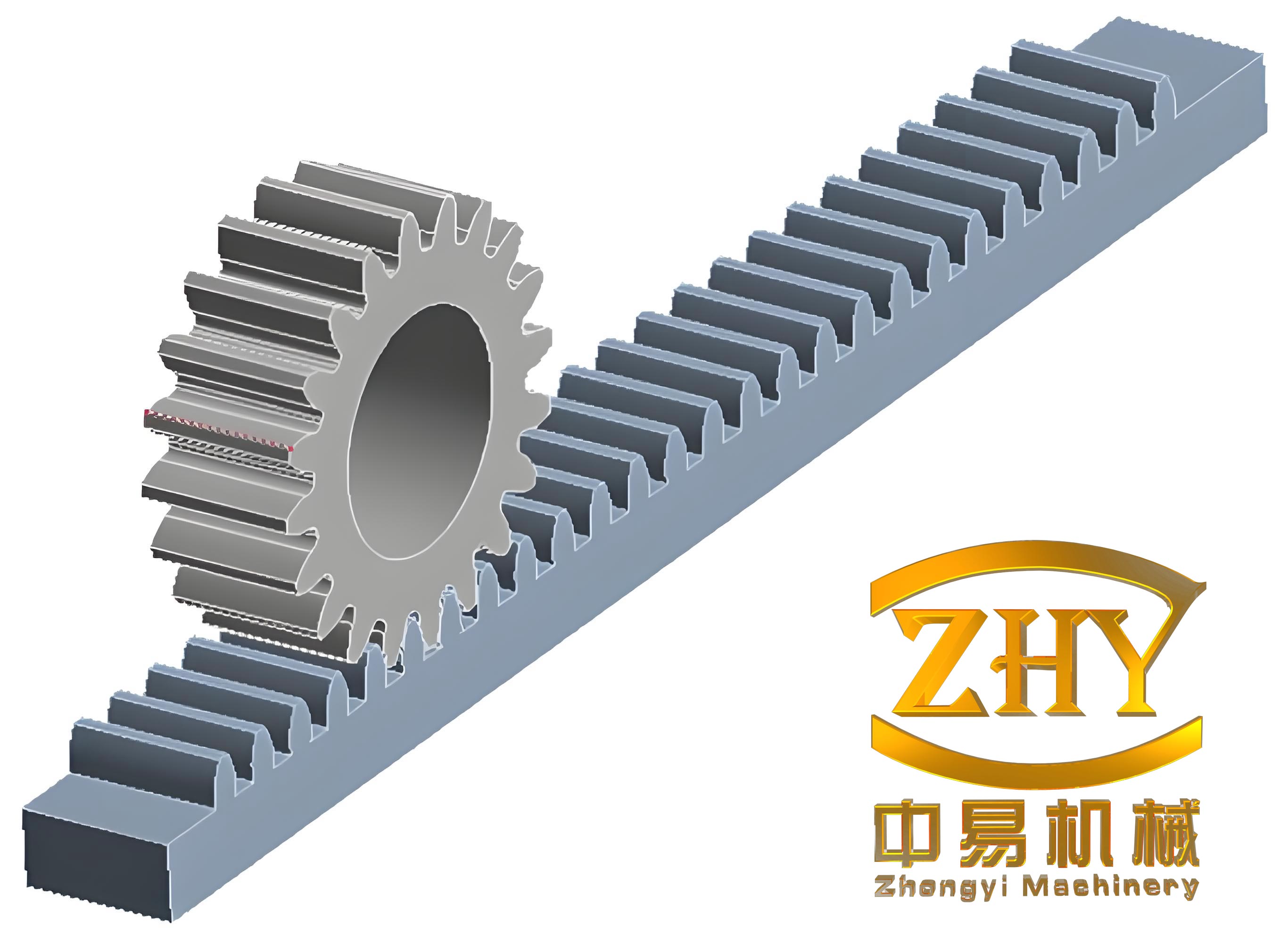
The rack and pinion type ship lifter comprises multiple subsystems that work in tandem to ensure smooth vessel transit. Key components include the upstream and downstream ship chamber doors, seal frames, drainage systems, anti-collision devices, and the drive mechanism based on rack and pinion gear. The drive mechanism, which utilizes rack and pinion technology, is responsible for vertical movement of the ship chamber and is a focal point for reliability analysis due to its high failure incidence. Other components, such as sensors and hydraulic systems, support the rack and pinion operation by providing control and stability. The lifter’s operation involves a series of steps, such as vessel entry, door sealing, water level adjustment, and lifting via the rack and pinion drive, each dependent on the previous step. A summary of the subsystems and their functions is presented in Table 1, highlighting the integral role of the rack and pinion in the drive system.
| Subsystem Number | Subsystem Name | Function | Operation Sequence |
|---|---|---|---|
| 0 | Downstream Navigation Signal Light | Signals vessel entry into chamber | N1 |
| 1 | Downstream Ship Chamber Door | Blocks water downstream | N2 |
| 2 | Downstream Sector Gate | Blocks downstream channel water | N3 |
| 3 | Downstream Gap Drainage System | Manages water gaps between door and gate | N4 |
| 4 | Downstream Seal Frame | Seals chamber to gate downstream | N5 |
| 5 | Downstream Anti-Collision Device | Prevents vessel collisions downstream | N6 |
| 6 | Longitudinal and Transverse Guidance | Supports chamber alignment | N7 |
| 7 | Drive Mechanism (Rack and Pinion Gear) | Lifts and lowers chamber | N8 |
| 8 | Docking Lock Mechanism | Secures chamber vertically | N9 |
| 9 | Upstream Seal Frame | Seals chamber to gate upstream | N10 |
| 10 | Upstream Gap Drainage System | Manages water gaps upstream | N11 |
| 11 | Upstream Anti-Collision Device | Prevents vessel collisions upstream | N12 |
| 0 | Upstream Chamber Signal Light | Signals vessel exit from chamber | N13 |
| 12 | Upstream Ship Chamber Door | Blocks water upstream | N14 |
| 13 | Upstream Sector Gate | Blocks upstream channel water | N15 |
Operational data from the trial navigation period, spanning several years, indicates that the rack and pinion ship lifter experienced varying levels of performance. The average time between operational cycles was approximately 59.6 minutes, with trends showing a decrease in vessel transit times and an increase in daily operations over the years. However, equipment failures, particularly in the rack and pinion drive, led to significant downtime. For instance, the drive mechanism, which relies on rack and pinion gear, accounted for a substantial portion of failures, highlighting the need for targeted reliability improvements. The overall reliability of the lifter is modeled as a series system, excluding highly reliable components like signal lights, which can be assumed to have a reliability near 1. Thus, the system reliability \( R_S(t) \) is calculated as the product of the reliabilities of 13 key subsystems:
$$ R_S(t) = R_1(t) \cdot R_2(t) \cdot R_3(t) \cdot R_4(t) \cdot R_5(t) \cdot R_6(t) \cdot R_7(t) \cdot R_8(t) \cdot R_9(t) \cdot R_{10}(t) \cdot R_{11}(t) \cdot R_{12}(t) \cdot R_{13}(t) $$
To compute the reliability of individual subsystems, such as the downstream ship chamber door, a detailed analysis of their components is necessary. Each subsystem typically consists of mechanical, hydraulic, and electrical control systems, all of which must function correctly for the subsystem to operate reliably. The reliability of a subsystem is derived from the reliabilities of its constituent parts, modeled as a series of components. For example, the downstream ship chamber door includes mechanical elements like the door body and seals, hydraulic components like cylinders and pumps, and electrical systems like motors and sensors. The reliability logic diagram for this subsystem shows a series relationship, and its reliability \( R_1(t) \) is given by:
$$ R_1(t) = \prod_{i=1}^3 R_{A_i}(t) = \prod_{i=1}^9 R_{B_i}(t) $$
where \( R_{A_i}(t) \) represents the reliability of major systems (mechanical, hydraulic, electrical), and \( R_{B_i}(t) \) is the reliability of individual components. The failure probability of a component, \( \overline{R}_{B_i}(t) \), is calculated based on operational data, including the number of failure incidents and equivalent downtime cycles. The failure probability is:
$$ \overline{R}_{B_i}(t) = \frac{n_c + n_j}{N + n_c + n_j} \times 100\% $$
where \( n_c \) is the number of failure incidents, \( n_j \) is the equivalent number of downtime cycles derived from repair time, and \( N \) is the number of normal operations. The component reliability is then \( R_{B_i}(t) = 1 – \overline{R}_{B_i}(t) \). This approach allows for a granular assessment of each subsystem’s reliability, focusing on the rack and pinion components.
Using operational data, the reliability of each subsystem was computed, as summarized in Table 2. The results show that the drive mechanism, which employs rack and pinion gear, has the lowest reliability among all subsystems, significantly impacting the overall system performance. Sensors and detection devices also exhibit high failure rates, underscoring the vulnerability of control systems in the rack and pinion ship lifter.
| Subsystem Number | Subsystem Name | Reliability (%) |
|---|---|---|
| 1 | Downstream Ship Chamber Door | 99.66 |
| 2 | Downstream Sector Gate | 97.13 |
| 3 | Downstream Gap Drainage System | 99.69 |
| 4 | Downstream Seal Frame | 99.39 |
| 5 | Downstream Anti-Collision Device | 99.66 |
| 6 | Longitudinal and Transverse Guidance | 99.50 |
| 7 | Drive Mechanism (Rack and Pinion Gear) | 96.96 |
| 8 | Docking Lock Mechanism | 99.61 |
| 9 | Upstream Seal Frame | 99.76 |
| 10 | Upstream Gap Drainage System | 98.21 |
| 11 | Upstream Anti-Collision Device | 99.46 |
| 12 | Upstream Ship Chamber Door | 99.73 |
| 13 | Upstream Sector Gate | 99.04 |
The overall reliability of the rack and pinion ship lifter is calculated by multiplying the reliabilities of all 13 subsystems:
$$ R_S(t) = 0.9966 \times 0.9713 \times 0.9969 \times 0.9939 \times 0.9966 \times 0.9950 \times 0.9696 \times 0.9961 \times 0.9976 \times 0.9821 \times 0.9946 \times 0.9973 \times 0.9904 \approx 0.8841 $$
This yields an overall reliability of approximately 88.41%, indicating an 11.59% probability of failure during operations. The low reliability is primarily attributed to the drive mechanism’s performance, where the rack and pinion gear is subject to high stress and wear. Additionally, sensor-related failures are frequent, suggesting that control systems need enhancement. The disparity in reliability between upstream and downstream components, such as seals and doors, may reflect environmental factors like water flow and sediment, which affect the rack and pinion mechanism differently.
To improve the reliability of the rack and pinion ship lifter, several measures are proposed. First, optimizing maintenance schedules for the rack and pinion drive can reduce unexpected failures; preventive maintenance based on failure data can balance repair times and minimize downtime. Second, incorporating redundancy in critical components, such as dual motors or backup control systems, can enhance reliability through parallel configurations. For example, adding redundant sensors or servers in the electrical system can mitigate failures. Third, design improvements in the rack and pinion gear, such as using more durable materials or better lubrication, can address wear issues. Furthermore, analyzing environmental impacts on components can lead to tailored solutions, like protective coatings for downstream elements. By focusing on the rack and pinion mechanism and its supporting systems, the overall reliability can be significantly boosted, ensuring smoother navigation operations.
In conclusion, the reliability analysis of the rack and pinion type ship lifter reveals that while the system is functional, there is substantial room for improvement. The drive mechanism, based on rack and pinion gear, is the weakest link, and sensor systems are prone to failures. Through targeted interventions, such as preventive maintenance and redundancy, the reliability of the rack and pinion ship lifter can be enhanced, leading to greater operational efficiency and safety in waterway navigation.