
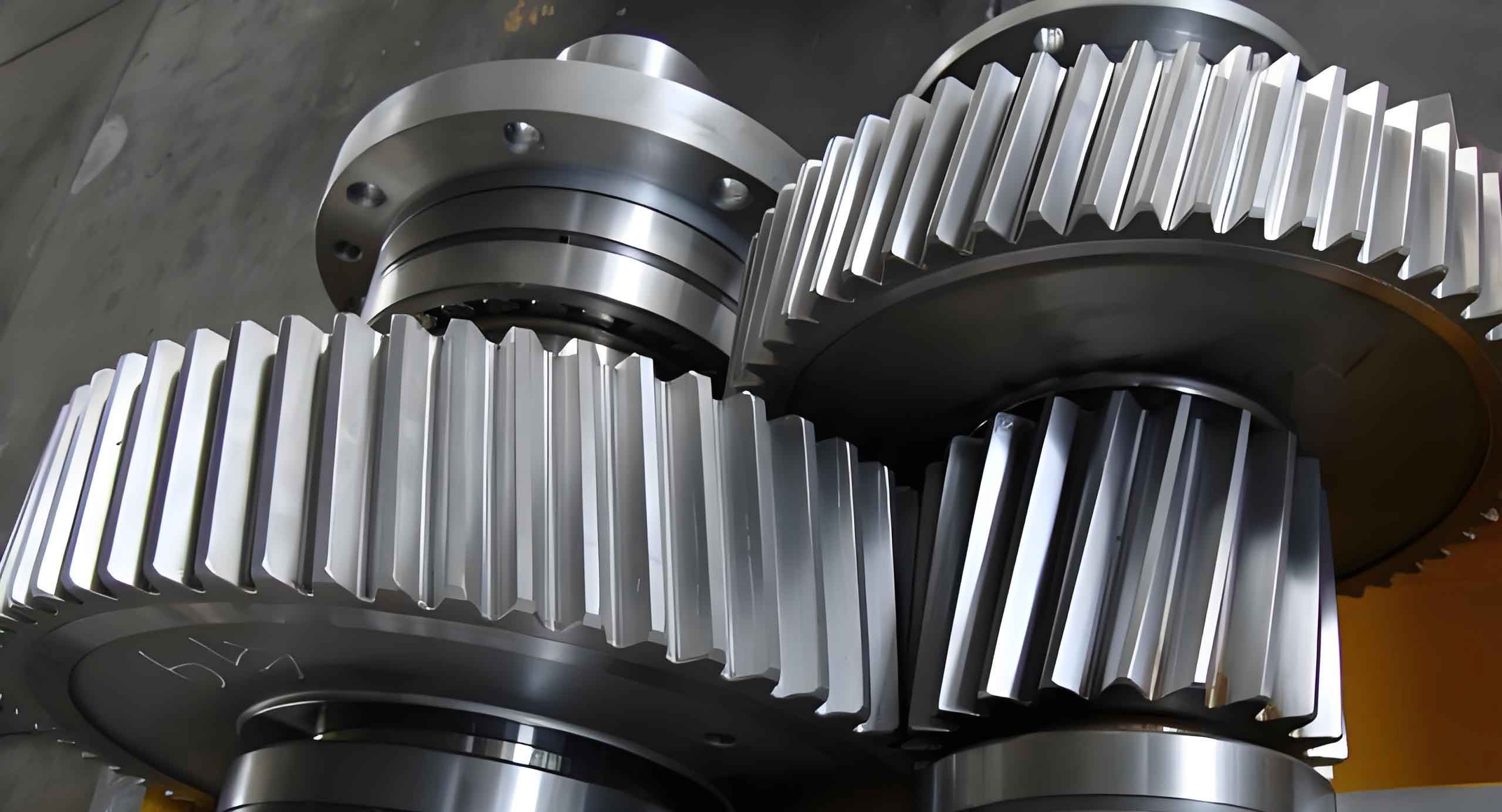
In modern mechanical power transmission systems, helical gears are a cornerstone due to their superior performance characteristics. The defining feature of helical gears is the helix angle, which allows for gradual tooth engagement. During meshing, contact begins at one end of the tooth and progressively extends across the face width until disengagement. This results in smoother power transfer, reduced impact loads, and lower noise and vibration compared to spur gears, making them indispensable for high-speed and high-load applications such as automotive transmissions, industrial gearboxes, and aerospace drive systems. The pursuit of energy efficiency and sustainability in engineering design places a premium on optimizing transmission losses. For gear systems, the total power loss comprises various components, with the meshing power loss being predominant. This loss is primarily attributed to sliding and rolling friction between the contacting tooth flanks, with sliding friction constituting the major share. Consequently, the meshing efficiency of helical gears is a critical performance metric, directly influencing the overall energy consumption and thermal performance of a drivetrain. While significant research has been devoted to analyzing the influence of design parameters on the mean or nominal meshing efficiency, the inherent randomness in manufacturing tolerances, material properties, and assembly conditions introduces variability. This variability means the actual instantaneous efficiency is a random variable fluctuating around its design mean. Therefore, a reliability-based analysis, which quantifies the probability that the efficiency meets a specified performance threshold under uncertain conditions, is essential for robust design. This article establishes a reliability model for the random meshing efficiency of helical gears using the Monte Carlo simulation method, focusing on key geometric parameters as random inputs to assess their individual influence on efficiency reliability.
The analytical foundation for estimating the power loss during the meshing of helical gears is well-established. The methodology outlined in standards such as AGMA/ISO provides a practical framework. The calculation begins with the input torque on the pinion, given by:
$$T_1 = 9 549 \frac{P}{n_1}$$
where $P$ is the transmitted power in kilowatts and $n_1$ is the pinion rotational speed in revolutions per minute. The load intensity factor $K$, representing the load per unit face width and unit diameter, is calculated as:
$$K = \frac{1000 T_1 (z_1 + z_2)^2}{b {r_{w1}}^2 z_2}$$
Here, $z_1$ and $z_2$ are the numbers of teeth on the pinion and gear, respectively, $b$ is the face width, and $r_{w1}$ is the operating pitch radius of the pinion. An empirical formula for the meshing friction coefficient $f_m$, which depends on operating conditions and lubricant properties, is often used:
$$f_m = 3.239 \frac{v^{-0.223} K^{-0.4}}{V^{0.7}}$$
where $v$ is the kinematic viscosity of the lubricant and $V$ is the pitch line velocity. The geometric aspects of sliding are captured by the specific sliding ratios at the start (approach) and end (recess) of meshing:
$$H_s = (u + 1) \left[ \sqrt{ \left( \frac{r_{o2}}{r_{w2}} \right)^2 – \cos^2 \alpha_w } – \sin \alpha_w \right]$$
$$H_t = \frac{u + 1}{u} \left[ \sqrt{ \left( \frac{r_{o1}}{r_{w1}} \right)^2 – \cos^2 \alpha_w } – \sin \alpha_w \right]$$
In these equations, $u = z_2/z_1$ is the gear ratio, $r_{o1}$ and $r_{o2}$ are the tip radii, $r_{w2}$ is the operating pitch radius of the gear, and $\alpha_w$ is the operating transverse pressure angle. The mechanical advantage of the meshing cycle $M$ is derived from these sliding ratios:
$$M = \frac{2 \cos \alpha_w (H_s + H_t)}{{H_s}^2 + {H_t}^2}$$
Finally, the power loss $P_{Ml}$ due to meshing friction for helical gears is:
$$P_{Ml} = \frac{f_m T_1 n_1 \cos^2 \beta}{9 549 M}$$
where $\beta$ is the helix angle. The nominal meshing efficiency $\eta$ is then:
$$\eta = 1 – \frac{P_{Ml}}{P}$$
The design and manufacture of helical gears involve numerous uncertainties. These can be categorized as aleatory (inherent randomness) and epistemic (lack of knowledge). In structural and mechanical reliability analysis, the focus is often on treating key parameters as random variables. The performance of a system is described by a limit state function or performance function $Z$, defined in terms of the basic random variables $x_i$:
$$Z = g(x_1, x_2, …, x_n)$$
The event $Z > 0$ denotes the safe or reliable state, $Z < 0$ denotes the failure state, and $Z = 0$ defines the limit state surface. The probability of reliability $P_r$ and probability of failure $P_f$ are complementary:
$$P_r = P[Z > 0], \quad P_f = P[Z < 0], \quad P_r + P_f = 1$$
For complex, non-linear functions $g(\cdot)$ common in gear engineering, analytical solutions for these probabilities are often intractable. The Monte Carlo simulation (MCS) method provides a robust numerical alternative. The core idea is to perform a large number of random experiments based on the statistical distributions of the input variables. For each simulation run $j$, a set of random samples $x_{ij}$ is drawn, and the corresponding performance function value $Z_j$ is computed. If $N_f$ out of $N$ total simulations result in $Z_j < 0$, an unbiased estimate of the failure probability is:
$$P_f \approx \frac{N_f}{N}$$
The accuracy of the MCS improves with the number of simulations, making it a powerful tool for reliability analysis of helical gears, even with highly non-linear models for efficiency.
To analyze the reliability of helical gear meshing efficiency, a performance function must be constructed that accounts for the deviation of instantaneous efficiency from its nominal design value. The nominal efficiency $\bar{\eta}$ is calculated using the mean values of all input parameters. In practice, parameters such as the normal module $m_n$, normal pressure angle $\alpha_n$, helix angle $\beta$, addendum coefficient $h_{a}^*$, and face width $b$ are subject to manufacturing variations and can be modeled as independent normal random variables. Their mean values $\mu_{x_i}$ are the design targets, and their standard deviations $\sigma_{x_i}$ are derived from manufacturing tolerances (e.g., corresponding to a specific gear quality grade like ISO 6). When these parameters vary randomly, the calculated efficiency $\eta_j$ for the $j$-th simulation will deviate from $\bar{\eta}$. A threshold $\epsilon$, defined as a multiple of the standard deviation of the absolute deviation (e.g., $\epsilon = 4\sigma_{|\eta – \bar{\eta}|}$), establishes an allowable fluctuation band. The limit state function for reliability of meshing efficiency is then defined as:
$$Z_j = \epsilon – | \eta_j – \bar{\eta} |$$
If $Z_j > 0$, the fluctuation is within the acceptable limit, and the state is reliable for that simulation. The reliability $P_r$ is the proportion of simulations where this condition holds. The computational procedure is as follows:
- Define the mean $\mu_{x_i}$ and standard deviation $\sigma_{x_i}$ for each random parameter $x_i$.
- Calculate the nominal meshing efficiency $\bar{\eta}$ using all mean values.
- Determine the threshold $\epsilon$ by performing a preliminary MCS on one parameter (e.g., $m_n$), calculating the standard deviation of $|\eta_j – \bar{\eta}|$, and setting $\epsilon = 4\sigma$.
- For the full reliability analysis of a parameter, run $N$ simulations (e.g., $N=200,000$). In each run:
- Sample all other random parameters from their normal distributions, but for the parameter under study, use its mean value (to isolate its effect) or allow all to vary (for system analysis). The described method isolates each parameter.
- Calculate the instantaneous efficiency $\eta_j$.
- Compute $Z_j = \epsilon – | \eta_j – \bar{\eta} |$.
- Count the number of runs $N_r$ where $Z_j > 0$.
- Estimate the reliability for that parameter’s influence: $P_r \approx N_r / N$.
Consider a pair of helical gears with the following nominal design parameters:
| Design Parameter | Symbol | Value |
|---|---|---|
| Pinion Teeth | $z_1$ | 37 |
| Gear Teeth | $z_2$ | 74 |
| Normal Pressure Angle | $\alpha_n$ | 20° |
| Normal Module | $m_n$ | 2 mm |
| Addendum Coefficient | $h_{a}^*$ | 1 |
| Face Width | $b$ | 30 mm |
| Helix Angle | $\beta$ | 10° |
Assuming an ISO quality grade 6, the statistical characteristics of the selected random variables are assigned as follows:
| Random Variable | Mean ($\mu$) | Standard Deviation ($\sigma$) | Distribution |
|---|---|---|---|
| Normal Pressure Angle, $\alpha_n$ | 20° | $(2/3) \times 10^{-2}$° | Normal |
| Normal Module, $m_n$ | 2 mm | $(2/3) \times 10^{-3}$ mm | Normal |
| Addendum Coefficient, $h_{a}^*$ | 1 | $(1/3) \times 10^{-3}$ | Normal |
| Face Width, $b$ | 30 mm | $1 \times 10^{-2}$ mm | Normal |
| Helix Angle, $\beta$ | 10° | $(1/3) \times 10^{-2}$° | Normal |
A preliminary MCS for the normal module $m_n$ with 200,000 samples was conducted to establish the fluctuation threshold $\epsilon$. The standard deviation $\sigma_{|\eta – \bar{\eta}|}$ was calculated, and $\epsilon$ was set to $4\sigma$. The average value from multiple such calculations was found to be $\epsilon \approx 6.4610 \times 10^{-8}$. Using this threshold, the reliability analysis was performed for each random parameter individually. The computed reliability values $P_r$ from 20 independent runs (with outliers removed) for each parameter are summarized below, along with their average.
| Parameter | Average Reliability ($P_r$) | Ranking (Highest to Lowest Reliability) |
|---|---|---|
| Normal Module, $m_n$ | 0.9841 | 1 |
| Helix Angle, $\beta$ | 0.9798 | 2 |
| Face Width, $b$ | 0.4535 | 3 |
| Normal Pressure Angle, $\alpha_n$ | 0.3046 | 4 |
| Addendum Coefficient, $h_{a}^*$ | 0.2096 | 5 |
The results provide clear insight into the sensitivity of helical gear meshing efficiency reliability to variations in different design parameters. A higher reliability value $P_r$ indicates that random variations in that parameter are less likely to cause the efficiency to deviate beyond the acceptable threshold $\epsilon$. Therefore, the parameter with the highest $P_r$ has the least influence on efficiency variability. The analysis reveals that the normal module $m_n$ and the helix angle $\beta$ have the highest reliability, meaning their manufacturing variations have the smallest impact on the fluctuation of the meshing efficiency in helical gears. Their influence is very similar, with $m_n$ being marginally less influential. The face width $b$ has a moderate influence, showing significantly lower reliability. The normal pressure angle $\alpha_n$ has a more substantial influence, and the addendum coefficient $h_{a}^*$ exhibits the lowest reliability, indicating that even small random variations in this parameter cause the largest relative fluctuations in the calculated efficiency of helical gears. This ranking has direct implications for the design and manufacturing of helical gear systems where consistent efficiency is a critical objective. To minimize the impact of random manufacturing errors on the system’s meshing efficiency, designers have more freedom to adjust the normal module and helix angle—key parameters for optimizing contact strength, bending strength, and load capacity—without significantly compromising efficiency stability. Tightening tolerances on the addendum coefficient and, to a lesser extent, the normal pressure angle, would be more beneficial for controlling efficiency variability in helical gears, although this must be balanced against increased manufacturing cost.
This study demonstrates the application of the Monte Carlo simulation method for the reliability analysis of helical gear meshing efficiency under parameter uncertainty. By modeling key geometric parameters as normally distributed random variables and constructing a limit state function based on efficiency deviation, the probabilistic influence of each parameter was quantified. The analysis of a specific gear pair indicates a distinct ranking of parameter sensitivity: normal module and helix angle variations have the least effect on efficiency reliability, followed by face width, then normal pressure angle, with the addendum coefficient having the greatest effect. This finding provides valuable guidance for the robust design of helical gears. When aiming for high and stable meshing efficiency, the design can prioritize the optimization of the normal module and helix angle to achieve desired strength and durability targets, as their inherent manufacturing variations pose the least risk to efficiency consistency. Conversely, stricter control over the addendum coefficient and pressure angle during manufacturing may be warranted to suppress efficiency fluctuations in high-performance helical gear transmissions. The Monte Carlo-based reliability framework offers a powerful and generalizable approach for assessing the impact of uncertainties on the performance of helical gears, extending beyond efficiency to other critical metrics like stress, vibration, and fatigue life.