
In the field of mechanical engineering, the reliability of transmission systems is paramount for ensuring the longevity and safety of machinery. Among these systems, spur gear transmissions are widely utilized due to their simplicity and efficiency in power transfer. However, traditional reliability analysis methods often fall short when applied to spur gear systems because they treat these systems as simple series or parallel configurations without accounting for their dynamic, time-dependent nature. In this article, I explore the unique characteristics of spur gear transmission systems from a reliability perspective, introduce the concept of time-dependent series systems, and develop comprehensive reliability models that reflect the actual behavior of spur gears under various loading conditions. The focus is on spur gear systems, and the term ‘spur gear’ will be emphasized throughout to underscore its relevance. I will use mathematical formulations, tables, and examples to elucidate these concepts, aiming to provide a thorough understanding that exceeds 8000 tokens in content depth.
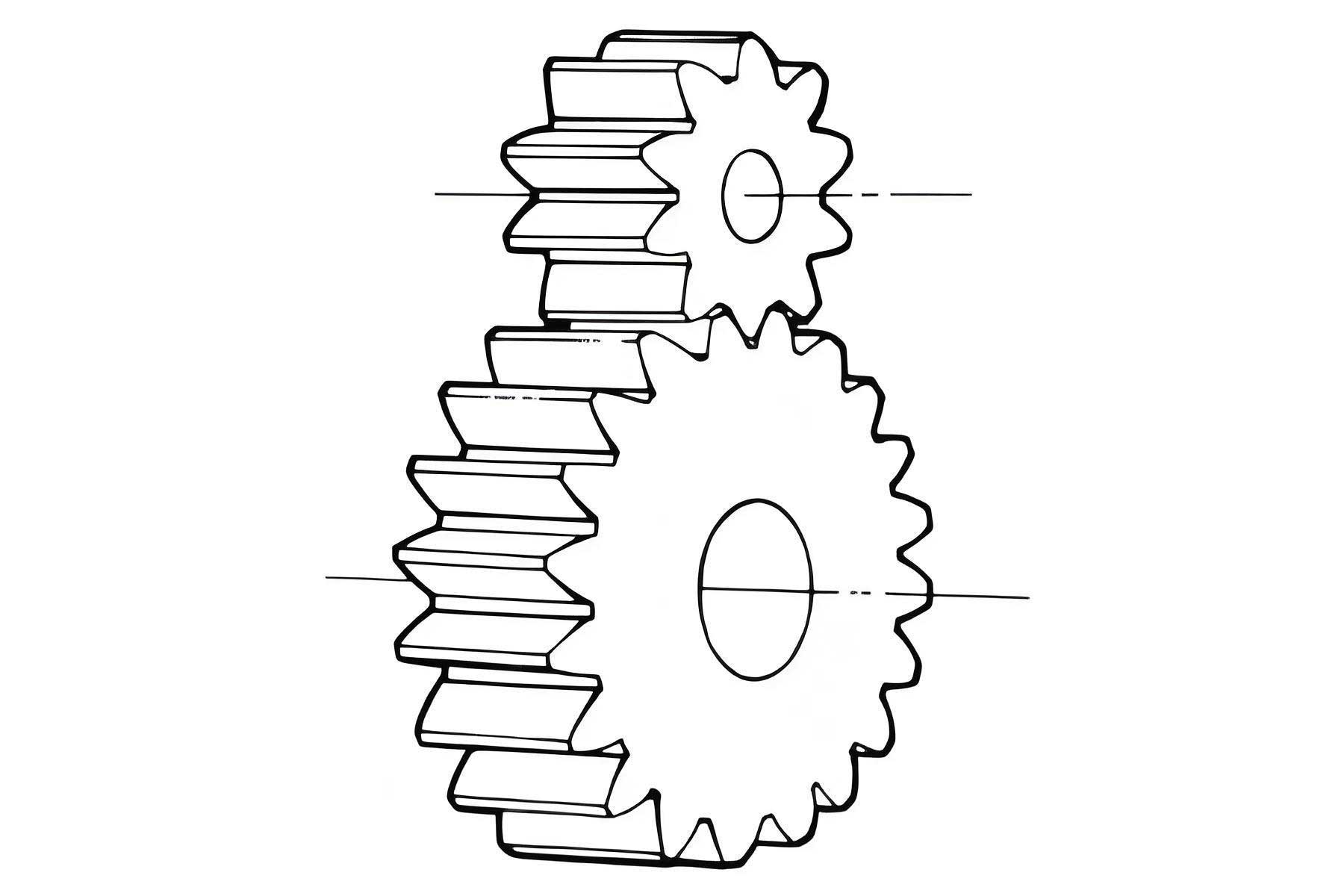
Spur gear transmission systems are fundamental components in many mechanical devices, from automotive applications to industrial machinery. Their reliability is critical, as failure can lead to costly downtime or catastrophic accidents. Traditional reliability theory, developed primarily for electrical and control systems, often assumes static configurations where all components experience loads simultaneously. However, a spur gear system operates differently: it consists of multiple teeth on each gear that engage sequentially over time, making it a dynamic or time-varying system. This means that at any given moment, only specific teeth are in contact and承受载荷, and the system’s configuration changes as different tooth pairs engage. This time-dependent nature challenges conventional reliability models, which typically treat a spur gear as a single component or a simple series system. In reality, a spur gear transmission is better described as a time-domain series system, where failure events are correlated due to shared loading histories and sequential engagement patterns. Ignoring these aspects can lead to inaccurate reliability estimates, either overestimating or underestimating system performance. Therefore, there is a need for specialized reliability analysis methods tailored to spur gear systems. This article delves into these intricacies, starting with a detailed characteristic analysis, followed by the development of reliability models for both constant and variable amplitude loading, and concluding with comparisons to traditional approaches. Throughout, I will highlight the importance of considering the spur gear’s unique attributes, such as tooth count variations, load distribution, and statistical dependencies between teeth.
The classification of mechanical systems for reliability analysis requires refinement to capture the nuances of spur gear transmissions. Traditionally, systems are categorized as series, parallel, or redundant configurations based on static spatial relationships. However, a spur gear system exhibits a hybrid nature: it is a series system in the sense that the failure of any single tooth can lead to system failure, but unlike a simple spatial series system (e.g., a chain under tension), the teeth do not all carry the load simultaneously. Instead, they engage in a sequential manner over time. I propose to classify such systems as time-domain series systems or varying-configuration series systems. In a spur gear pair, each gear has multiple teeth (e.g., gear A with teeth A1, A2, …, An and gear B with teeth B1, B2, …, Bm), and during operation, different tooth pairs (e.g., A1-B1, A2-B2, etc.) come into contact cyclically. This results in a system where the functional relationship between components changes with time, and the load is applied to different subsets of teeth at different instances. For reliability modeling, this implies that the system’s reliability depends not only on the number of teeth but also on the sequence of engagement and the statistical properties of the loads experienced by each tooth. The following table summarizes the key differences between traditional series systems and spur gear time-domain series systems:
| Aspect | Traditional Spatial Series System | Spur Gear Time-Domain Series System |
|---|---|---|
| Configuration | Static and unchanging | Dynamic and time-varying |
| Load Application | All components bear the same load simultaneously | Load is applied sequentially to different tooth pairs |
| Failure Independence | Often assumed independent | Failures are correlated due to shared loads and sequential engagement |
| Time Dependency | Reliability may be time-invariant for static loads | Reliability evolves with number of load cycles and engagement history |
| Example | Chain under tension | Spur gear pair in transmission |
To model the reliability of a spur gear system accurately, we must first understand the reliability of individual teeth and then aggregate these considering the system’s dynamics. Let the bending strength of a spur gear tooth be denoted by a random variable \(X\), with probability density function \(f_{\text{tooth}}(x)\). The stress experienced by the tooth during meshing is another random variable \(Y\), with probability density function \(g_{\text{tooth}}(y)\). For a single tooth subjected to one load cycle, the reliability \(R(1)\) is the probability that the strength exceeds the stress:
$$ R(1) = \int_{0}^{\infty} g_{\text{tooth}}(y) \left[ \int_{y}^{\infty} f_{\text{tooth}}(x) \, dx \right] dy $$
Alternatively, it can be expressed as the probability that the stress is less than the strength:
$$ R(1) = \int_{0}^{\infty} f_{\text{tooth}}(x) \left[ \int_{0}^{x} g_{\text{tooth}}(y) \, dy \right] dx $$
For a spur gear tooth subjected to \(n\) load cycles, the reliability \(R(n)\) is the probability that the strength exceeds the maximum stress over those cycles. If the loads are independent and identically distributed, this involves the maximum order statistic of the stress. Let \(G_{\text{tooth}}(y)\) be the cumulative distribution function of the stress. Then, the probability density function of the maximum stress over \(n\) cycles is:
$$ g_{\text{tooth}}^{(n)}(y) = n [G_{\text{tooth}}(y)]^{n-1} g_{\text{tooth}}(y) $$
Thus, the reliability for \(n\) cycles is:
$$ R(n) = \int_{0}^{\infty} f_{\text{tooth}}(x) \left[ \int_{0}^{x} g_{\text{tooth}}^{(n)}(y) \, dy \right] dx = \int_{0}^{\infty} f_{\text{tooth}}(x) [G_{\text{tooth}}(x)]^n \, dx $$
Now, consider a spur gear with \(m\) teeth. In operation, each tooth engages periodically, and over a total of \(N\) load cycles on the gear, each tooth experiences approximately \(n = N/m\) cycles (assuming integer values for simplicity). The spur gear as a system fails if any tooth fails. However, since the teeth are not all loaded simultaneously, and the loads on different teeth may be statistically independent, the gear’s reliability is the product of the reliabilities of each tooth for their respective load cycles:
$$ R_{\text{gear}}(N) = \left[ R_{\text{tooth}}(n) \right]^m = \left[ \int_{0}^{\infty} f_{\text{tooth}}(x) [G_{\text{tooth}}(x)]^n \, dx \right]^m $$
This formulation assumes that the teeth fail independently, which may not hold in practice due to correlations from shared load histories or sequential engagement. For a spur gear transmission system consisting of two gears, the situation becomes more complex. Let gear 1 have \(G_1\) teeth and gear 2 have \(G_2\) teeth. The system’s reliability depends on the pairing of teeth during meshing, the number of load cycles, and the statistical relationship between the stresses on mating teeth. In a spur gear pair, when two teeth engage, they experience the same contact load, but the resulting bending stresses may differ due to geometric factors. Let \(Y\) be the contact load, with probability density function \(h(y)\). For gear 1, the bending stress is \(Y_1 = k_1 Y\), and for gear 2, \(Y_2 = k_2 Y\), where \(k_1\) and \(k_2\) are stress factors. The conditional reliability of the system for a given load \(y\) is:
$$ R_s(y) = \left[ \int_{Y_1(y)}^{\infty} f_{t1}(x) \, dx \right]^{G_1} \left[ \int_{Y_2(y)}^{\infty} f_{t2}(x) \, dx \right]^{G_2} $$
where \(f_{t1}(x)\) and \(f_{t2}(x)\) are the strength distributions for teeth on gear 1 and gear 2, respectively. To account for random load amplitudes across different spur gear systems, we integrate over the load distribution:
$$ R_s = \int_{0}^{\infty} h(y) \left[ \int_{Y_1(y)}^{\infty} f_{t1}(x) \, dx \right]^{G_1} \left[ \int_{Y_2(y)}^{\infty} f_{t2}(x) \, dx \right]^{G_2} dy $$
For constant amplitude loading, the load \(y\) is fixed, and the system reliability is time-invariant after the first cycle, as each tooth either survives or fails initially. However, for variable amplitude loading, the reliability decreases with the number of cycles due to the increasing maximum stress. In such cases, the spur gear system exhibits time-dependent reliability, and modeling must consider the sequence of tooth engagements and the posterior strength distributions of teeth that have survived previous loads.
To illustrate the impact of variable amplitude loading, consider a spur gear system where the contact load \(Y\) follows a Weibull distribution, \(Y \sim W(\alpha, \beta, \gamma)\), and the bending stresses are linear functions of \(Y\). The reliability after \(N\) cycles requires evaluating the maximum stress over all engagements. For a spur gear pair with equal tooth counts \(G_1 = G_2 = m\), and assuming a one-to-one tooth pairing sequence (e.g., tooth 1 of gear 1 meshes with tooth 1 of gear 2, then tooth 2 with tooth 2, etc.), the system reliability for a specific load history \(i\) with stress distribution \(g_i(y)\) is:
$$ R_s^i(N) = \left[ \int_{0}^{\infty} g_i^{(n)}(y) \left( \int_{Y_1(y)}^{\infty} f_{t1}(x) \, dx \int_{Y_2(y)}^{\infty} f_{t2}(x) \, dx \right) dy \right]^m $$
where \(n = N/m\) is the number of cycles per tooth pair. This model accounts for the correlation between mating teeth because they share the same load \(y\) during meshing. For spur gear pairs with different tooth counts, the engagement sequence becomes more complex. Suppose gear 1 has \(m\) teeth and gear 2 has \(2m\) teeth. The tooth pairs cycle through combinations such as 1-1, 2-2, …, m-m, 1-(m+1), 2-(m+2), …, m-2m. In this case, teeth on gear 1 engage twice as often as those on gear 2. The reliability modeling must consider the posterior strength distribution of teeth after surviving previous cycles. For example, after tooth pair 1-1 survives \(n\) cycles, the strength distribution of tooth 1 on gear 1 is updated to reflect that it has withstood certain stress levels. This posterior distribution, denoted \(f_{t1}'(x | \text{survival})\), is given by:
$$ f_{t1}'(x | \text{survival}) = \frac{f_{t1}(x)}{\int_{z_{n,1}}^{\infty} f_{t1}(x) \, dx} \quad \text{for } x > z_{n,1} $$
where \(z_{n,1}\) is the maximum stress experienced by that tooth over \(n\) cycles. Similar updates apply to other teeth. The system reliability then involves products of conditional reliabilities for each tooth pair, incorporating these posterior distributions. For a general spur gear system with tooth counts \(G_1\) and \(G_2\), let \(K\) be the least common multiple of \(G_1\) and \(G_2\). The number of unique tooth pair combinations is \(K\), and each pair engages \(N/K\) times over \(N\) cycles on the system. The system reliability can be expressed as a product over these pairs, with appropriate conditioning on survival histories:
$$ R_s(N) = \prod_{j=1}^{K} R_{j}(N/K | \text{survival of previous pairs}) $$
This formulation captures the time-varying configuration and statistical dependencies inherent in spur gear transmissions. To compute this in practice, Monte Carlo simulations or advanced numerical integration may be employed, especially for complex load spectra.
In contrast, traditional reliability models often assume independent failures among all teeth or treat each spur gear as a single component. Under the independent failure assumption, the system reliability for a spur gear pair is simply the product of all tooth reliabilities:
$$ R_s^{\text{ind}}(N) = \left[ \int_{0}^{\infty} g^{(n_1)}(y) \int_{Y_1(y)}^{\infty} f_{t1}(x) \, dx \, dy \right]^{G_1} \left[ \int_{0}^{\infty} g^{(n_2)}(y) \int_{Y_2(y)}^{\infty} f_{t2}(x) \, dx \, dy \right]^{G_2} $$
where \(n_1 = N/G_1\) and \(n_2 = N/G_2\). If each spur gear is treated as a single component, the reliability is further simplified to:
$$ R_s^{\text{comp}}(N) = \left[ \int_{0}^{\infty} g^{(N)}(y) \int_{Y_1(y)}^{\infty} f_{t1}(x) \, dx \, dy \right] \left[ \int_{0}^{\infty} g^{(N)}(y) \int_{Y_2(y)}^{\infty} f_{t2}(x) \, dx \, dy \right] $$
These traditional models can lead to significant inaccuracies. The independent failure model tends to underestimate system reliability because it ignores the positive correlation between mating teeth (i.e., if one tooth survives a high load, its mate is also likely to survive). The component model overestimates reliability by neglecting the strength variability among teeth on the same spur gear. To quantify these differences, consider two numerical examples focused on spur gear systems. In both examples, the contact load \(Y\) follows a Weibull distribution with parameters \(Y \sim W(0, 2, 200)\), meaning shape parameter 2, scale parameter 200, and location parameter 0. The bending stresses are \(Y_1 = 1.0Y\) for gear 1 and \(Y_2 = 1.1Y\) for gear 2. The tooth strengths are normally distributed: \(X_1 \sim N(900, 50^2)\) for gear 1 and \(X_2 \sim N(1000, 50^2)\) for gear 2. The stress distribution, maximum stress over 10,000 cycles, and strength distribution for a spur gear tooth are illustrated conceptually, but here we focus on the reliability calculations.
For the first example, both spur gears have 12 teeth (\(G_1 = G_2 = 12\)). The system reliability as a function of the number of load cycles \(N\) is computed using the proposed time-domain series model (accounting for correlations) and the two traditional models. The results are summarized in the table below for selected cycle counts:
| Number of Cycles \(N\) | Proposed Model Reliability | Traditional Independent Model Reliability | Traditional Component Model Reliability |
|---|---|---|---|
| 100 | 0.9987 | 0.9975 | 0.9995 |
| 1,000 | 0.9874 | 0.9842 | 0.9948 |
| 10,000 | 0.9123 | 0.9011 | 0.9536 |
| 100,000 | 0.6547 | 0.6325 | 0.7821 |
For the second example, gear 1 has 12 teeth and gear 2 has 24 teeth (\(G_1 = 12, G_2 = 24\)). The engagement pattern is more complex, and the reliability values differ:
| Number of Cycles \(N\) | Proposed Model Reliability | Traditional Independent Model Reliability | Traditional Component Model Reliability |
|---|---|---|---|
| 100 | 0.9982 | 0.9968 | 0.9993 |
| 1,000 | 0.9845 | 0.9801 | 0.9932 |
| 10,000 | 0.8941 | 0.8824 | 0.9457 |
| 100,000 | 0.6012 | 0.5789 | 0.7543 |
These results show that the proposed model yields reliability estimates that lie between the two traditional models. The traditional independent model consistently underestimates reliability because it assumes failures are independent, ignoring the correlation between mating spur gear teeth that share loads. The traditional component model overestimates reliability by treating each spur gear as a single entity, thereby smearing out the strength variability across teeth. The proposed time-domain series model provides a more accurate representation by incorporating the sequential loading, posterior strength updates, and statistical dependencies. The differences become more pronounced as the number of cycles increases, highlighting the importance of proper modeling for long-term reliability assessment of spur gear systems.
The reliability of spur gear systems is also influenced by factors such as misalignment, lubrication conditions, and manufacturing imperfections, but these are beyond the scope of this article, which focuses on static strength reliability under bending stresses. However, the principles established here can be extended to include other failure modes like pitting or wear by adapting the strength and stress distributions. For instance, if fatigue is considered, the strength distribution \(f_{\text{tooth}}(x)\) could be replaced with a fatigue strength distribution that degrades with cycles, and the stress distribution \(g_{\text{tooth}}(y)\) could include spectrum loading effects. The time-domain series approach remains applicable, as the core idea is to track the state of each spur gear tooth over time.
In conclusion, spur gear transmission systems exhibit unique characteristics that necessitate specialized reliability models. Unlike traditional spatial series systems, spur gear systems operate as time-domain series systems with varying configurations, where teeth engage sequentially and failure events are correlated. This article has presented a detailed analysis of these characteristics and developed reliability models for spur gear systems under both constant and variable amplitude loading. The models account for the dynamic nature of tooth engagements, posterior strength distributions, and statistical dependencies between mating teeth. Through numerical examples, I have demonstrated that the proposed models differ significantly from traditional approaches, providing more accurate reliability estimates. For engineers and researchers working with spur gear transmissions, adopting these time-domain series models can lead to better design decisions, maintenance planning, and risk assessment. Future work could explore extensions to multi-stage spur gear systems, incorporate dynamic effects like vibrations, or integrate real-time monitoring data for predictive reliability analysis. Ultimately, understanding and modeling the reliability of spur gear systems is crucial for advancing mechanical engineering practices and ensuring the robust performance of machinery across industries.