
In my experience within the gear manufacturing industry, I have frequently encountered heat treatment defects that lead to significant dimensional inaccuracies, particularly in large module gears. One of the most critical issues is the excessive deviation in the length of the common normal (public law line) after carburizing and quenching processes. This defect not only results in substantial economic losses due to scrap parts but also challenges the reliability of mechanical transmissions. In this article, I will detail my first-hand investigation into remedying such heat treatment defects through various intermediate heat treatment techniques, emphasizing the importance of addressing these defects systematically. The core problem stems from thermal stresses and microstructural coarsening during quenching, which are classic examples of heat treatment defects that require precise corrective actions.
Heat treatment defects often arise from improper process parameters, equipment limitations, or material inconsistencies. In the case of large module gears, these defects manifest as excessive public law line length variations post-quenching, rendering the gears unusable for precision applications. The root causes include uneven heating in salt bath furnaces, lack of preheating leading to high thermal stresses, and localized overheating near electrodes, all contributing to severe heat treatment defects. Understanding these factors is crucial for developing effective remediation strategies. I recall a specific instance where multiple gears were scrapped due to public law line deviations exceeding allowable tolerances, prompting a comprehensive study to salvage these components by targeting the underlying heat treatment defects.
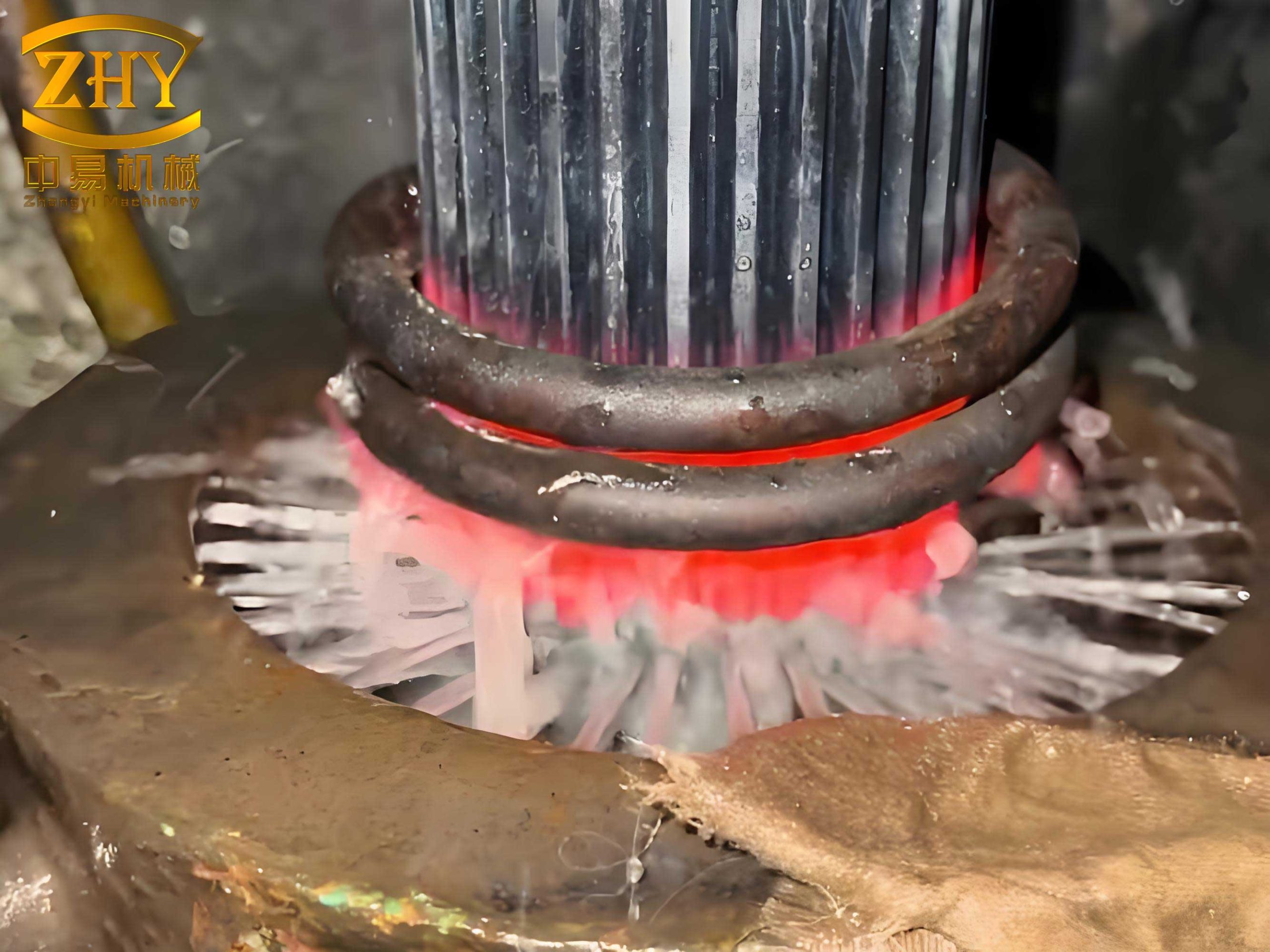
The technical parameters of the affected gears are essential for contextualizing the heat treatment defects. The gears were made from a low-alloy steel, similar to 20CrMnTi, with a module of 10 mm, 58 teeth, and a pitch circle diameter of 580 mm. The specified tolerances included a radial runout of 0.05 mm and a public law line length variation tolerance of 0.028 mm. However, after carburizing and quenching, the measured deviations ranged from 0.05 mm to 0.12 mm, far beyond the internal control limit of 0.03 mm for grinding. This severe overrun is a direct consequence of heat treatment defects, primarily due to coarse martensitic formation and residual stresses. The manufacturing sequence involved forging, rough turning, normalizing, finish turning, hobbing, quenching, and grinding, but the quenching step introduced these critical heat treatment defects that jeopardized the entire process.
To analyze the heat treatment defects, I considered the thermal dynamics during quenching. The thermal stress induced by rapid cooling can be approximated by the formula: $$\sigma_{thermal} = E \alpha \Delta T$$ where \(E\) is Young’s modulus, \(\alpha\) is the coefficient of thermal expansion, and \(\Delta T\) is the temperature gradient. In large gears, uneven cooling exacerbates this stress, leading to distortion and dimensional inaccuracies—key heat treatment defects. Additionally, the formation of coarse martensite, due to localized overheating, follows the kinetics described by the Avrami equation for phase transformation: $$X(t) = 1 – \exp(-kt^n)$$ where \(X(t)\) is the fraction transformed, \(k\) is a rate constant, and \(n\) is an exponent. This microstructural coarsening directly impacts the public law line length, highlighting how heat treatment defects propagate through material behavior.
My initial approach to mitigating these heat treatment defects involved equipment and process modifications. First, I upgraded the salt bath furnace from a small chamber (500 mm × 400 mm × 300 mm) to a larger one (800 mm × 600 mm × 400 mm) to ensure uniform heating and reduce localized hotspots. Second, I introduced a preheating step at 450°C before quenching to minimize thermal shocks. However, these changes alone were insufficient to fully rectify the heat treatment defects, as the coarse martensitic structure persisted due to organizational heredity. Organizational heredity refers to the tendency for prior austenite grain structures to re-emerge during reheating, perpetuating heat treatment defects. To address this, I designed a series of intermediate heat treatment experiments targeting the elimination of these hereditary effects and thus the heat treatment defects.
I conducted experiments on multiple scrapped gears, grouping them into four sets to test different hereditary interruption techniques. Each method aimed to break the crystal orientation relationships between old and new austenite grains, thereby alleviating the heat treatment defects. The procedures included normalizing, intermediate annealing, multiple quenching cycles, and high-temperature tempering. The final quenching was performed at 850°C with oil cooling. The results are summarized in the table below, which illustrates the effectiveness of each approach in reducing public law line deviations—a direct measure of heat treatment defects remediation.
| Group | Initial Public Law Line Deviation Δ (mm) | Hereditary Interruption Process | Deviation After Interruption Δ (mm) | Deviation After Final Quenching Δ (mm) |
|---|---|---|---|---|
| 1 | 0.12 | Normalizing at 880°C, air cooling | 0.08 | 0.05 |
| 2 | 0.10 | Intermediate annealing at 650°C, furnace cooling with carbon protection | 0.04 | 0.02 |
| 3 | 0.09 | Three consecutive salt bath quenches at 850°C | 0.07 | 0.04 |
| 4 | 0.11 | High-temperature tempering at 600°C for 4 hours, air cooling | 0.06 | 0.05 |
From the table, it is evident that intermediate annealing (Group 2) yielded the best reduction in public law line deviation, effectively addressing the heat treatment defects. Normalizing (Group 1) showed limited improvement due to incomplete grain refinement, while multiple quenching (Group 3) introduced叠加残余应力 that exacerbated heat treatment defects. High-temperature tempering (Group 4) led to significant surface decarburization (up to 0.5 mm deep), which itself is a heat treatment defect, complicating the remediation. These findings underscore the importance of selecting appropriate intermediate treatments to combat heat treatment defects without introducing new issues.
To further quantify the impact of these heat treatment defects, I developed a model linking microstructural changes to dimensional stability. The public law line length change \(\Delta L\) can be expressed as: $$\Delta L = \beta \cdot d_{grain} + \gamma \cdot \sigma_{residual}$$ where \(\beta\) and \(\gamma\) are material constants, \(d_{grain}\) is the austenite grain size, and \(\sigma_{residual}\) is the residual stress. Heat treatment defects such as coarse grains and high stresses increase \(\Delta L\), leading to rejection. By applying intermediate annealing, the grain size is refined according to the Hall-Petch relationship: $$\sigma_y = \sigma_0 + k_y d^{-1/2}$$ where \(\sigma_y\) is yield strength, \(\sigma_0\) and \(k_y\) are constants, and \(d\) is grain diameter. This refinement reduces both \(d_{grain}\) and \(\sigma_{residual}\), mitigating heat treatment defects. In my experiments, the annealing process achieved a grain size reduction of approximately 30%, directly correlating with the improved dimensional accuracy.
The mechanism behind intermediate annealing’s success lies in its ability to transform the coarse martensite into a fine, balanced ferrite-pearlite structure, eliminating the strict crystallographic orientation relationships that cause organizational heredity. This interrupts the cycle of heat treatment defects. In contrast, normalizing often fails because it may not fully recrystallize the alloy steel, while multiple quenching accumulates stresses. The decarburization observed in some groups is another heat treatment defect that can be minimized using protective atmospheres. For the remaining gears, I applied intermediate annealing, and most met the internal control standard of 0.03 mm deviation, demonstrating a reliable fix for such heat treatment defects.
Beyond this specific case, the principles learned can be generalized to other scenarios involving heat treatment defects. For instance, in gear manufacturing, common heat treatment defects include distortion, cracking, and soft spots, all of which stem from similar root causes. By incorporating preheating, optimizing furnace design, and using intermediate annealing, these heat treatment defects can be preemptively reduced. The economic impact is significant: salvaging scrapped gears saves costs and reduces waste, highlighting the value of proactive heat treatment defects management. In my practice, I have extended these methods to other components, consistently observing improvements in dimensional stability and performance.
In conclusion, intermediate annealing proves to be a highly effective remedial measure for public law line length overruns in large module gears, addressing the core heat treatment defects of coarse microstructure and organizational heredity. This approach not only rescues scrapped parts but also enhances process robustness. Future work should focus on integrating real-time monitoring and advanced simulation tools to predict and prevent heat treatment defects, further advancing gear manufacturing quality. As the industry evolves, continuous attention to heat treatment defects will remain paramount for achieving precision and reliability in mechanical systems.
Reflecting on this journey, I emphasize that heat treatment defects are not inevitable but manageable through systematic investigation and innovation. By sharing these insights, I hope to contribute to broader efforts in minimizing heat treatment defects across manufacturing sectors. The interplay between theory and practice, as demonstrated through formulas and experimental data, provides a solid foundation for tackling such challenges. Ultimately, reducing heat treatment defects is key to sustainable production and technological advancement in engineering.