
In my experience working with high-precision gear grinding equipment, I have encountered numerous challenges related to the maintenance and repair of imported gear grinding machines. These machines, particularly the NILES gear profile grinding models, play a critical role in the final finishing of gears, where any deviation can lead to significant quality issues such as grinding cracks and surface imperfections. The gear grinding process is essential for achieving the desired tooth profile and surface finish, but over time, components like the rotary locking cylinders in the B-axis can degrade, causing problems like waviness and pressure angle deviations. This not only affects the gear grinding accuracy but also increases the risk of grinding cracks due to inconsistent clamping forces. In this article, I will share a detailed account of how my team and I addressed these issues through a comprehensive repair and debugging process, focusing on the B-axis locking cylinders. We will explore the structural analysis, repair methodology, and the integration of formulas and tables to summarize key aspects, all while emphasizing the importance of gear grinding and gear profile grinding in maintaining machine integrity.
The B-axis in NILES gear grinding machines is responsible for adjusting the tooth profile angle during gear profile grinding operations. It relies on five locking cylinders to secure the axis in position, each comprising seals, disc springs, and threaded connectors. Prolonged use leads to seal aging and spring fatigue, resulting in hydraulic leaks, reduced locking pressure, and ultimately, anomalies in the B-axis locking mechanism. This directly impacts the gear grinding process, causing deviations in gear geometry and increasing the likelihood of grinding cracks. To address this, we began by analyzing the B-axis structure. The locking cylinders are distributed with three accessible at the rear and two in narrow spaces along the guide rails, making inspection and replacement complex. We developed a systematic plan to tackle this, which involved forming a dedicated team, studying electrical and hydraulic diagrams, and preparing for the disassembly of over 100 lines and oil pipes, along with 200 small components. This approach ensured that we could handle the intricacies of gear grinding machinery without relying on external support, thereby avoiding prolonged downtime and high costs.
During the repair process, we encountered several critical steps that required precise execution. For instance, the disassembly of the B-axis assembly involved removing cooling oil, marking components, and carefully extracting parts like the protective doors and top fan plates to avoid deformation. We measured gaps and recorded parameters to ensure reassembly accuracy. A key aspect was the use of torque wrenches to maintain consistent installation forces, which we documented in tables for reference. Below is a table summarizing the disassembly and reassembly steps for the B-axis locking cylinders, highlighting the tools and measurements involved:
| Step | Action | Tools Used | Measurements/Parameters |
|---|---|---|---|
| 1 | Drain cooling oil and position machine | Drainage tools, marking instruments | Initial position records |
| 2 | Disassemble protective doors and fan plates | Screwdrivers, wrenches | Door alignment checks |
| 3 | Remove center assembly and limit connections | Sealing bags, measuring tapes | Limit switch positions |
| 4 | Disassemble X-axis guards and record parameters | Depth gauges, calipers | X-axis compensation values (e.g., 34090) |
| 5 | Measure B-axis gaps and remove lubrication pipes | Torque wrenches, gap sensors | Gap measurements in mm |
| 6 | Disassemble ball screw and motor | Torque wrench (60 Nm setting) | Motor bolt torque values |
| 7 | Extract B-axis assembly and replace cylinders | Hoists, torque wrenches | Installation torque for new cylinders |
| 8 | Reassemble and calibrate axes | Calibration tools, software | B-axis zero position correction |
In gear grinding, the occurrence of grinding cracks is often linked to thermal and mechanical stresses during the process. To understand this better, we can model the stress using the following formula for thermal stress in gear profile grinding: $$\sigma_t = \alpha E \Delta T$$ where \(\sigma_t\) is the thermal stress, \(\alpha\) is the coefficient of thermal expansion, \(E\) is the modulus of elasticity, and \(\Delta T\) is the temperature change during grinding. This formula highlights how improper locking in the B-axis can lead to localized heating and increased \(\Delta T\), exacerbating grinding cracks. Additionally, the locking force \(F_l\) of the cylinders can be expressed as: $$F_l = k \cdot x$$ where \(k\) is the spring constant of the disc springs and \(x\) is the displacement. Over time, wear reduces \(k\), leading to insufficient \(F_l\) and potential issues in gear grinding accuracy. By monitoring these parameters, we can preemptively address factors that contribute to grinding cracks.
The repair and debugging phase involved meticulous steps to ensure the machine’s performance was restored. After draining the cooling oil and securing the machine, we disassembled components like the protective doors and center assembly, taking care to bag connections to prevent contamination. The X-axis guards were removed, and we recorded critical parameters, such as the X-axis compensation value, to facilitate accurate reassembly. During the disassembly of the B-axis assembly, we used hoists and torque wrenches to handle the heavy parts, and we replaced the locking cylinders with new ones, applying the same torque values measured during disassembly. This attention to detail is crucial in gear profile grinding to maintain alignment and prevent grinding cracks. Below is another table summarizing the key parameters and their values during the repair process:
| Parameter | Value | Description |
|---|---|---|
| X-axis compensation | 34090 | Compensation parameter for axis alignment |
| Motor bolt torque | 60 Nm | Torque setting for X-axis motor bolts |
| B-axis gap tolerance | ±0.02 mm | Allowable gap for proper locking |
| Locking cylinder torque | Recorded during disassembly | Installation torque for new cylinders |
| Thermal stress limit | Calculated using \(\sigma_t\) formula | Maximum stress to avoid grinding cracks |
Throughout the repair, we emphasized safety and precision. For example, when working in elevated areas, we ensured stable footing to avoid damaging machine parts. All disassembly steps were photographed, and components were labeled to streamline reassembly. After reinstalling the B-axis assembly, we performed a comprehensive calibration, including resetting the B-axis rotary zero position and running axis movements to check for interference. We also conducted a thermal run-in for at least an hour and tested the machine with scrap parts to verify that gear grinding operations were free of issues like waviness and grinding cracks. The success of this repair not only resolved the oil leaks and restored gear grinding accuracy but also enhanced our team’s skills in handling complex gear profile grinding machines.
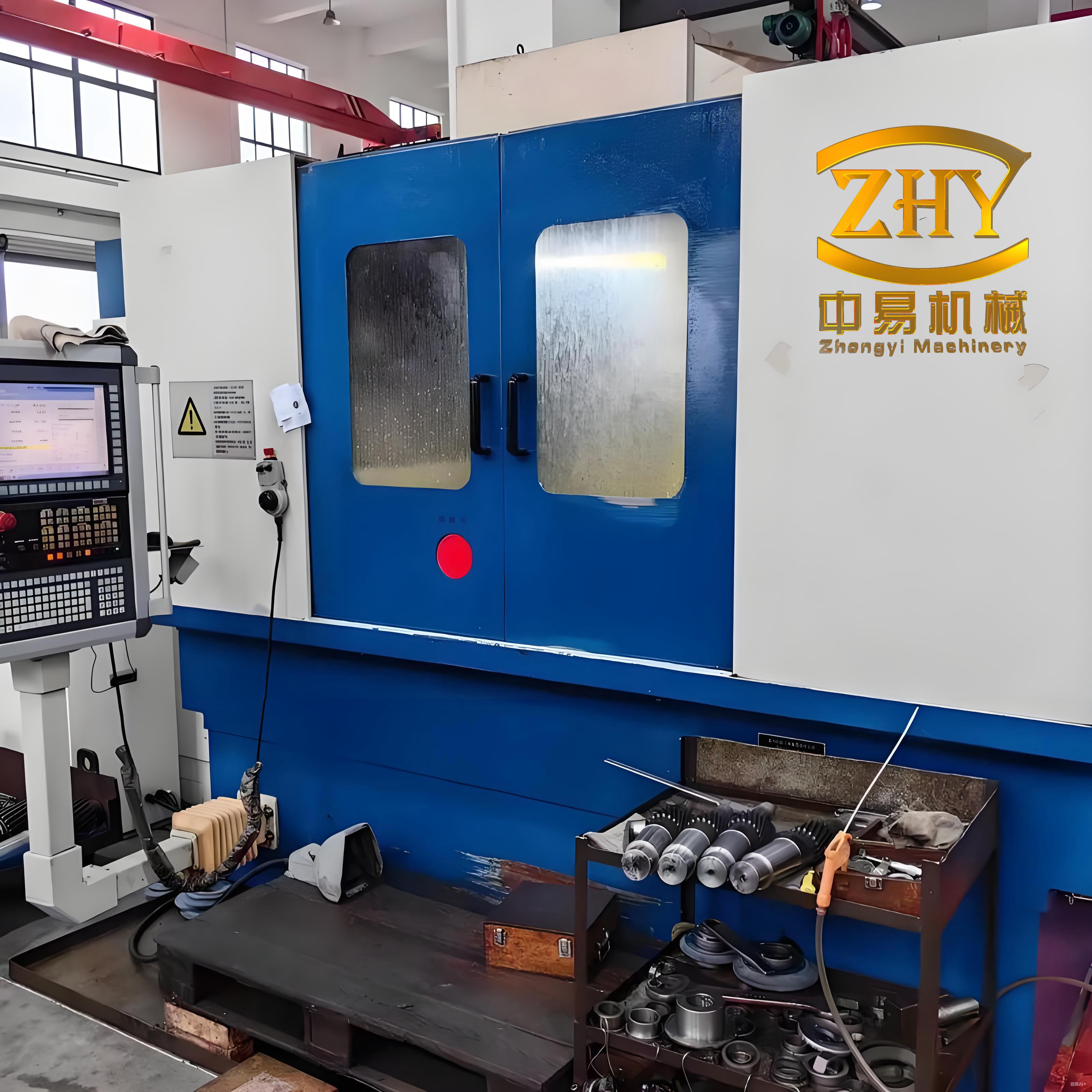
The benefits of this autonomous repair were substantial. Firstly, the oil leakage from the locking cylinders was completely eliminated, ensuring consistent performance during gear grinding cycles. Secondly, the machine’s加工精度 was restored, reducing the incidence of grinding cracks and pressure angle deviations in gear profile grinding. We also conducted a full precision re-inspection of the machine, which provided valuable insights into the overall health of similar equipment. By reducing dependency on external services, we cut downtime by 60% and saved significant costs—equivalent to over 120,000 currency units per repair cycle—while building in-house expertise for future gear grinding maintenance. In conclusion, this repair demonstrates the importance of mastering core technologies in imported gear grinding machines. By understanding the intricacies of the B-axis locking mechanism and integrating systematic approaches, we can overcome technical monopolies and ensure reliable gear profile grinding operations. This experience has paved the way for handling similar faults across multiple machines, reinforcing the critical role of gear grinding in industrial applications and the need to mitigate grinding cracks through proactive maintenance.
In summary, the repair of rotary locking cylinders in gear grinding machines is a complex but manageable task that requires a deep understanding of mechanical structures, hydraulic systems, and the gear grinding process. By employing formulas like the thermal stress equation and using tables to organize steps and parameters, we can effectively address issues that lead to grinding cracks and inaccuracies in gear profile grinding. This hands-on approach not only enhances machine reliability but also empowers maintenance teams to tackle challenges independently, ensuring long-term efficiency in gear manufacturing. As the industry evolves, continuous improvement in these areas will be vital for sustaining high-quality gear grinding outcomes and minimizing the risks associated with grinding cracks.