
In my extensive experience as a welding engineer, I have encountered numerous challenges in maintaining and repairing critical industrial components, particularly herringbone gears. These gears are integral to heavy machinery, such as mechanical presses, where they transmit significant torque under demanding conditions. The unique double-helical design of herringbone gears minimizes axial thrust, but it also introduces complex stress distributions that can lead to failures like cracking in welded joints. This article delves into a comprehensive case study involving the repair of a large herringbone gear, focusing on surfacing techniques, crack analysis, and advanced welding methodologies. I will share insights from firsthand applications, emphasizing the importance of precise process control to ensure durability and performance. Throughout this discussion, I will highlight key aspects of herringbone gears, as their geometry and material properties play a pivotal role in welding decisions.
Herringbone gears are commonly fabricated from medium-carbon steels like 35 steel or low-carbon steels like Q235-A, which are joined through welding processes. However, improper welding can result in defects such as cracks, especially in high-stress areas like the junction between the gear hub and web. In one instance, a 630t mechanical press herringbone gear exhibited extensive cracking during installation, traced to inadequate preheating during initial manufacturing. This underscores the sensitivity of herringbone gears to thermal stresses, necessitating rigorous repair protocols. The following sections outline the surfacing process used for gear restoration, including parameters, heat treatment, and mechanical finishing, all tailored to address the specific needs of herringbone gears.
The surfacing process for herringbone gears involves depositing weld metal onto worn or damaged surfaces to restore dimensions and enhance hardness. Based on my practice, I employ a two-layer approach: a transition layer and a working layer, each with distinct materials and parameters. The transition layer serves to bond the base metal with the working layer, mitigating dilution and stress concentrations. For herringbone gears, this is critical due to their complex load-bearing requirements. The table below summarizes the surfacing parameters I typically use, derived from successful repairs.
| Surfacing Layer | Wire and Diameter (mm) | Flux | Current (A) | Voltage (V) | Interpass Temperature (°C) |
|---|---|---|---|---|---|
| Transition Layer | H08Mn2SiA, 4.0 | HJ431 | 400-450 | 30-35 | 200 ± 20 |
| Working Layer | H1Cr13, 4.0 | SJ111 | 400-450 | 30-35 | 200 ± 20 |
These parameters ensure a stable arc and minimal defects. The current range of 400-450 A provides sufficient heat input for fusion without excessive dilution, while the voltage of 30-35 V controls the arc length for consistent bead geometry. Maintaining an interpass temperature of 200 ± 20°C is crucial for herringbone gears to prevent thermal shock and reduce residual stresses. In my work, I monitor this closely using infrared thermometers, as deviations can lead to cracking or distortion in the delicate helical teeth of herringbone gears.
Post-weld heat treatment (PWHT) is essential to relieve residual stresses from surfacing, especially for herringbone gears where stress concentrations can accelerate fatigue. I follow a specific curve: heating at a rate not exceeding 30°C/h to 500 ± 10°C, holding for a calculated time based on thickness, and then furnace cooling to room temperature. This process can be modeled using the formula for thermal stress relief:
$$ \sigma_r = \sigma_0 \cdot e^{-\frac{Q}{RT}} $$
where $\sigma_r$ is the residual stress after treatment, $\sigma_0$ is the initial stress, $Q$ is the activation energy for stress relaxation, $R$ is the gas constant, and $T$ is the absolute temperature in Kelvin. For herringbone gears, I often extend the holding time to account for their bulkier sections, ensuring uniform stress distribution. The cooling rate is controlled to avoid re-introducing stresses, which is vital for the long-term performance of herringbone gears in dynamic applications.
After PWHT, mechanical machining is performed to achieve the final dimensions and surface finish. I typically use the left end of the gear as a reference, as per drawing requirements, to maintain alignment of the herringbone gear teeth. The surface roughness is checked against specifications, and hardness testing is conducted to verify uniformity. In one repair, the hardness ranged from 37 to 42 HRC, with a uniformity within 3 HRC, meeting the stringent demands for herringbone gears in press operations. This consistency is achieved through precise control of the surfacing and heat treatment processes, highlighting the importance of integrated quality checks for herringbone gears.
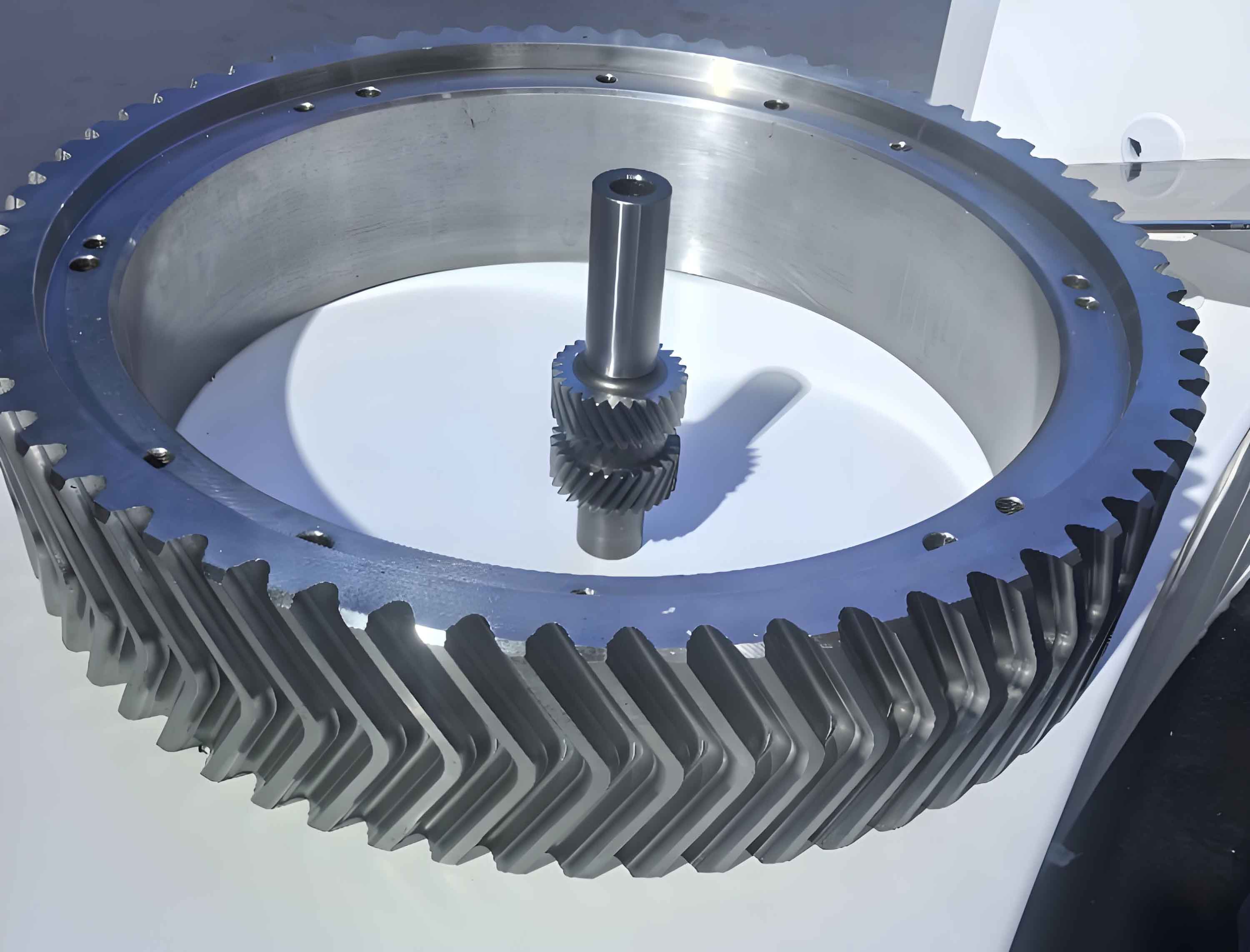
Crack analysis in herringbone gears often reveals underlying issues related to welding procedures. In the case mentioned, cracks originated at the root of a 15 mm fillet weld between the 35 steel hub and Q235-A web, extending over half the circumference. Through metallurgical examination, I identified these as delayed toe cracks, caused by a combination of high residual stress and hardened microstructures from insufficient preheating. The carbon content of the hub was at the upper limit of 0.40%, increasing susceptibility to quench cracking. The stress intensity factor $K_I$ for such cracks can be estimated using:
$$ K_I = Y \sigma \sqrt{\pi a} $$
where $Y$ is a geometry factor (influenced by the herringbone gear’s helical angle), $\sigma$ is the applied stress, and $a$ is the crack depth. For herringbone gears, the helical design complicates stress fields, requiring careful analysis to prevent propagation. The cracks exhibited metallic luster, indicating brittle fracture under superimposed operational loads and residual stresses. This experience underscores the need for proper preheating in welding herringbone gears, especially when using carbon steels.
To repair such cracks in herringbone gears without inducing excessive distortion, I developed a cold welding technique. This method minimizes heat input, crucial for preserving the accuracy of herringbone gear teeth. The process begins with thorough preparation: drilling stop-holes at crack ends, gouging out the defect using arc methods, and grinding the groove to a smooth finish. I use a dial indicator to monitor deformation, limiting it to 1.5 mm during operations to maintain the herringbone gear’s integrity. The welding sequence involves a transition layer with A302 stainless steel electrodes (3.2 mm diameter, DC reverse polarity, 110 A) to dilute carbon content and reduce hardening. This is followed by filling with J507 low-hydrogen electrodes (3.2 mm, 120 A) and capping with 4.0 mm J507 electrodes at 160 A. Each pass is cooled to touch before proceeding, and peening is applied to relieve stress. The table below summarizes the cold welding parameters for herringbone gear repair.
| Welding Step | Electrode Type and Diameter (mm) | Current (A) | Polarity | Technique |
|---|---|---|---|---|
| Transition Layer | A302, 3.2 | 110 | DC Reverse | Horizontal weaving |
| Filling | J507, 3.2 | 120 | DC Reverse | Continuous |
| Capping | J507, 4.0 | 160 | DC Reverse | Cover pass |
This approach successfully restored the herringbone gear with only 7 mm of shrinkage deformation, which was acceptable for operation. The use of austenitic stainless steel for the transition layer mitigates carbon migration and cracking tendencies, a key consideration for herringbone gears made from medium-carbon steels. Post-repair inspections confirmed no new cracks, and the gear performed reliably for over a year, validating the cold welding method for field repairs of herringbone gears where preheating is impractical.
Beyond carbon steels, herringbone gears in corrosive environments may utilize stainless steels like 00Cr14Ni14Si4 (C4 steel), designed for concentrated nitric acid service. Welding C4 steel presents unique challenges due to its high silicon content (around 4%), which increases hot cracking susceptibility. In my work with herringbone gears for chemical equipment, I have addressed this by analyzing the weldability issues. The chemical composition of C4 steel includes approximately 14% Cr, 14% Ni, and 4% Si, which enhances corrosion resistance but promotes formation of low-melting eutectics with elements like sulfur and phosphorus. The cracking tendency can be quantified using the hot cracking index $HCI$:
$$ HCI = \frac{Si + Ni}{P + S} $$
where higher values indicate greater risk. For herringbone gears fabricated from C4 steel, I implement strict controls to prevent cracks. The welding process combines manual TIG for root passes and SMAW for fill and cap layers, using dedicated parameters. Shielding gas purity of 99.99% argon is maintained to avoid contamination. The heat input is kept low to minimize segregation, critical for the intricate profiles of herringbone gears. Preheating is generally avoided to reduce thermal cycles, but interpass temperature is controlled below 100°C. The table below outlines the welding parameters for C4 steel in herringbone gear applications.
| Welding Method | Electrode/Wire | Current (A) | Voltage (V) | Shielding Gas |
|---|---|---|---|---|
| TIG Root | ErNiCrMo-3 | 90-110 | 10-12 | Argon |
| SMAW Fill | E309L | 100-130 | 22-26 | N/A |
These measures have proven effective in producing crack-free welds for herringbone gears exposed to aggressive media. The key is balancing corrosion resistance with mechanical integrity, ensuring that the herringbone gear’s helical teeth remain durable under operational stresses. Regular non-destructive testing, such as dye penetrant inspection, is employed to verify weld quality, particularly at the tooth roots of herringbone gears where stress concentrations are highest.
In conclusion, the repair and welding of herringbone gears demand a multifaceted approach that integrates surfacing, heat treatment, crack analysis, and specialized welding techniques. From my perspective, the success hinges on understanding the material behaviors and geometric complexities of herringbone gears. The surfacing process with controlled parameters restores hardness and dimensions, while PWHT alleviates residual stresses. Cold welding offers a viable solution for field repairs of cracked herringbone gears, minimizing distortion through low heat input. For stainless steel variants like C4 steel, careful parameter selection prevents hot cracking. Throughout these processes, herringbone gears require meticulous attention due to their critical role in machinery. The lessons learned from these experiences underscore the importance of adaptive welding strategies, ensuring that herringbone gears continue to operate reliably in demanding industrial settings. As technology advances, further research into optimized filler materials and automated processes may enhance the longevity of herringbone gears, but the fundamentals of precise control remain paramount.