
In my professional experience, the failure of critical components like a gear shaft in industrial machinery can lead to significant downtime and financial losses. I encountered a scenario where a 37SiMn2MoV steel gear shaft in a ball mill减速机 fractured, necessitating an urgent repair. The gear shaft, a vital part of the system, had to be restored promptly to resume operations. Given the high cost of replacement and lack of spare parts, I opted for a combined welding repair technique. This method involved an interference fit between a newly machined shaft head and the existing shaft body, complemented by shielded metal arc welding (SMAW) with a U-groove lock-in butt joint design. Throughout this process, I focused on addressing the welding challenges of 37SiMn2MoV steel, which is known for its high strength and low alloy composition, to ensure a durable repair.
The gear shaft fracture occurred at a critical section, and my initial assessment revealed that a conventional repair would be insufficient due to the material’s properties. I designed a repair joint that incorporated an interference fit with precise machining, followed by welding to restore structural integrity. The interference fit provided initial alignment and load distribution, while the welding ensured a permanent bond. This combination was essential to handle the operational stresses on the gear shaft, which transmits torque and withstands dynamic loads. Below, I detail the welding analysis,工艺 parameters, and execution, emphasizing the importance of material selection and process control.
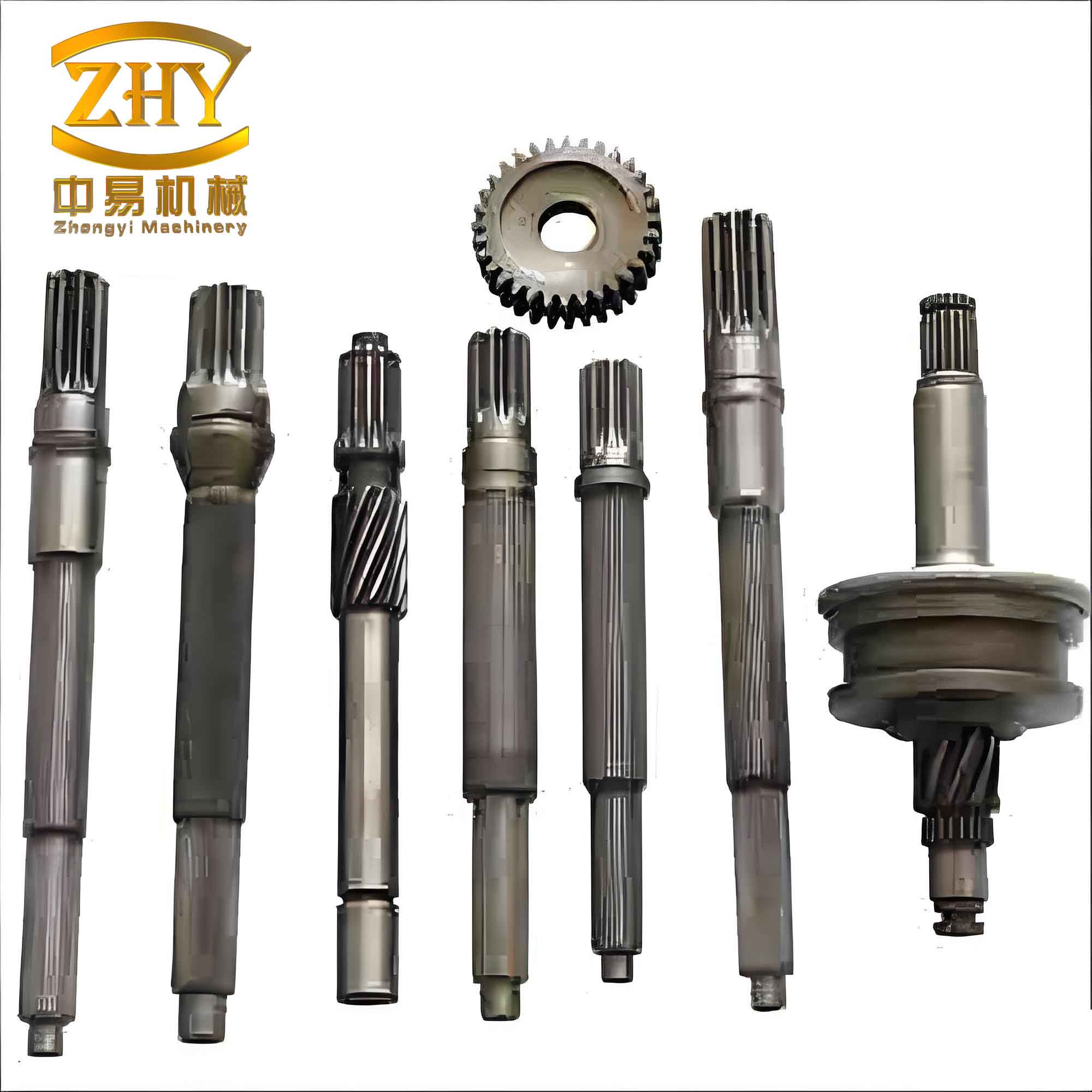
Welding 37SiMn2MoV steel presents significant difficulties due to its high carbon and alloy content, which affect its weldability. I began by evaluating the carbon equivalent (CE) to quantify the risk of cracking and brittleness. The formula for CE, based on the American Bureau of Shipping (ABS) method for high-strength low-alloy steels, is given by:
$$ CE = C + \frac{Mn + Si}{6} + \frac{Cr + Mo + V}{5} + \frac{Ni + Cu}{15} $$
For 37SiMn2MoV steel, the typical composition ranges are: C 0.33-0.39%, Si 0.60-0.90%, Mn 1.60-1.90%, Cr ≤0.30%, Ni ≤0.30%, Cu ≤0.30%, V 0.05-0.12%, and Mo 0.40-0.50%. Substituting these values, the CE calculates to approximately 0.853% to 1.064%. A CE exceeding 0.49% indicates high susceptibility to welding defects, such as hydrogen-induced cold cracking and heat-affected zone (HAZ) embrittlement. This high CE is primarily due to the elevated carbon content, which promotes the formation of hard martensitic structures upon rapid cooling. In my analysis, I identified three main issues: HAZ embrittlement and softening, cold cracking from hydrogen diffusion, and thermal cracking during solidification. The martensite in the HAZ has a low Ms point, reducing self-tempering and increasing brittleness. Additionally, the wide solidification temperature range exacerbates segregation and hot cracking risks. To mitigate these, I emphasized the need for controlled heat input, proper preheating, and post-weld heat treatment.
In preparing for the weld repair of the gear shaft, I meticulously selected equipment and materials. I used a ZX7-400 inverter welding machine with direct current electrode negative (DCEN) polarity to ensure stable arc characteristics and deep penetration. The choice of electrodes was critical; I opted for low-hydrogen types to minimize hydrogen pickup and reduce cracking risks. For the root and transition layers, I employed E16-25MoN-15 (A507) electrodes, which offer austenitic deposits with good crack resistance. For the filler and cover layers, I used E8515 (J857) electrodes to match the high strength of the base metal. The chemical compositions of these electrodes’ deposited metals are summarized in the table below:
| Electrode | C | Mn | Si | S | P | Cr | Ni | Mo | Cu |
|---|---|---|---|---|---|---|---|---|---|
| E16-25MoN-15 | ≤0.12 | 0.5-2.5 | ≤0.90 | ≤0.03 | ≤0.035 | 14.0-18.0 | 22.0-27.0 | 5.0-7.0 | ≤0.5 |
| E8515 | ≤0.10 | ≥0.50 | ≤0.80 | ≤0.035 | ≤0.035 | ≥0.30 | ≥1.75 | ≥0.20 | – |
Prior to welding, I conducted thorough surface preparation. The groove and adjacent 20 mm areas were cleaned with acetone to remove oil, rust, and contaminants, followed by grinding to a metallic finish. The joint design featured an interference fit of 100H7/n6, with a surface roughness of 1.6 μm to ensure proper alignment. A φ5 mm vent hole was incorporated in the shaft body to facilitate welding and prevent gas entrapment. For positioning, I used a three-point symmetric tack welding method on a lathe to maintain coaxiality, with tack welds limited to 15 mm in length and ground to a smooth slope. The electrodes were dried according to specifications: E16-25MoN-15 at 250-300°C for 30-60 minutes, and E8515 at 350-450°C for 60-75 minutes, stored in a 120°C holding oven to prevent moisture absorption.
The welding sequence was crucial to manage heat input and minimize distortions. I applied preheating using ceramic heating blankets to raise the temperature of the groove and surrounding 100 mm area to 300-350°C. This preheating reduces the cooling rate, mitigating the risk of martensite formation and hydrogen cracking. The welding was performed in a flat position by rotating the gear shaft on the lathe, ensuring optimal accessibility. I employed a multi-layer approach with distinct layers: a transition layer using E16-25MoN-15 electrodes, followed by filler and cover layers using E8515 electrodes. The layer distribution is illustrated conceptually, with each layer overlapping the previous by one-third to one-half to ensure proper fusion and minimize defects. The welding parameters were carefully controlled to maintain low heat input, as excessive energy can lead to HAZ softening and grain growth. The heat input per unit length (Q) can be expressed as:
$$ Q = \frac{60 \times V \times I}{1000 \times S} $$
where V is the voltage (typically 20-25 V for SMAW), I is the current in amperes, and S is the travel speed in mm/min. For this repair, I kept Q below 1.5 kJ/mm to avoid detrimental effects. The detailed welding parameters are provided in the table below:
| Welding Layer | Electrode Type | Diameter (mm) | Current (A) | Polarity |
|---|---|---|---|---|
| Tack Welding | E16-25MoN-15 | 3.2 | 110-120 | DCEN |
| Transition Layer | E16-25MoN-15 | 3.2 | 90-110 | DCEN |
| Filler Layer | E8515 | 3.2 | 110-120 | DCEN |
| Cover Layer | E8515 | 3.2 | 105-120 | DCEN |
During welding, I maintained an interpass temperature above 280°C to prevent rapid cooling and ensure microstructural stability. I used a straight-line weaving technique with short arc length and high travel speed to achieve low heat input. Each pass was cleaned and inspected for defects like slag inclusions or porosity; peening was applied to relieve residual stresses. The transition layer, deposited with austenitic electrodes, served as a buffer to absorb strains and reduce dilution-related cracks. The filler and cover layers, made with high-strength electrodes, provided the necessary mechanical properties to match the gear shaft’s load-bearing requirements. I avoided stops and starts as much as possible, but if interrupted, reheating to the preheat temperature was mandatory before resuming.
Several precautions were taken to ensure the success of this gear shaft repair. The lathe was protected with asbestos cloth to shield it from spatter, and the area around the groove was coated with chalk to prevent adhesion of welding debris. I strictly prohibited arc strikes outside the weld zone to avoid surface damage that could initiate cracks. Continuous monitoring of temperatures was essential; I used thermocouples to verify preheat and interpass temperatures, ensuring they remained within the specified ranges. The small-diameter electrodes and low current settings facilitated precise control over weld bead geometry, reducing the risk of undercut or lack of fusion. Additionally, I emphasized the importance of completing the weld in a single session to maintain thermal consistency and minimize hydrogen exposure.
Post-weld heat treatment (PWHT) was conducted immediately after welding to temper the HAZ and reduce residual stresses. I applied a post-heat treatment at 320-380°C for one hour, followed by controlled cooling to room temperature. This step helps in transforming any retained austenite and improving toughness. After cooling, I performed visual and non-destructive testing; the weld surface was ground smooth, and ultrasonic testing confirmed the absence of cracks, with all indications meeting Level II standards. Finally, the repaired gear shaft underwent machining to restore its dimensional accuracy and surface finish, ensuring it met the original specifications for installation.
The successful repair of this gear shaft demonstrates the effectiveness of the combined welding approach. By integrating mechanical interference with optimized welding techniques, I achieved a restoration that withstood operational demands for over two years without issues. The use of low-hydrogen electrodes, controlled heat input, and proper thermal management were key to overcoming the challenges of 37SiMn2MoV steel. This experience highlights the potential for in-situ repairs of high-value components, offering substantial cost savings—in this case, approximately $30,000 compared to replacement. Future applications can build on these principles, particularly for critical gear shafts in heavy machinery, where downtime minimization is paramount. Further research could explore automated welding methods to enhance consistency and reduce human error in such repairs.
In conclusion, the fracture repair of the gear shaft through combined welding not only restored functionality but also provided valuable insights into handling high-strength low-alloy steels. The meticulous process control, from material analysis to post-weld treatment, ensured a reliable outcome. As industries seek sustainable solutions, such repair methodologies can extend the life of expensive components, reducing waste and operational costs. The gear shaft, once considered beyond repair, now serves as a testament to the prowess of advanced welding practices in maintenance and rehabilitation engineering.