
In the field of mechanical engineering, the maintenance and repair of critical components such as gear shafts are essential for ensuring operational continuity and cost-effectiveness. Gear shafts often experience localized damage due to unforeseen factors like wear, corrosion, or operational stresses, leading to issues such as dimensional loss that compromises fit or surface imperfections that affect sealing performance. Discarding entire gear shafts in such cases results in significant economic losses for users. To address this, I have explored the application of cold welding technology for repairing gear shafts, focusing on pre-repair preparations, repair process requirements, and post-repair inspections. This article delves into the systematic approach to restoring gear shafts to their original specifications, emphasizing the use of cold welding as a viable solution.
The core principle of cold welding technology involves micro-second electrical discharges that generate high thermal energy to fuse specialized welding wire onto the damaged area of a workpiece. This process facilitates a metallurgical bond between the deposited material and the base metal, ensuring strong adhesion. A key advantage is the extremely short discharge duration compared to the interval between discharges, allowing sufficient time for heat dissipation into the workpiece and surroundings. As a result, the overall temperature of the gear shaft remains near ambient levels, minimizing thermal distortion and preserving the integrity of non-repaired sections. This makes cold welding particularly suitable for precision components like gear shafts, where dimensional accuracy and material properties are critical.
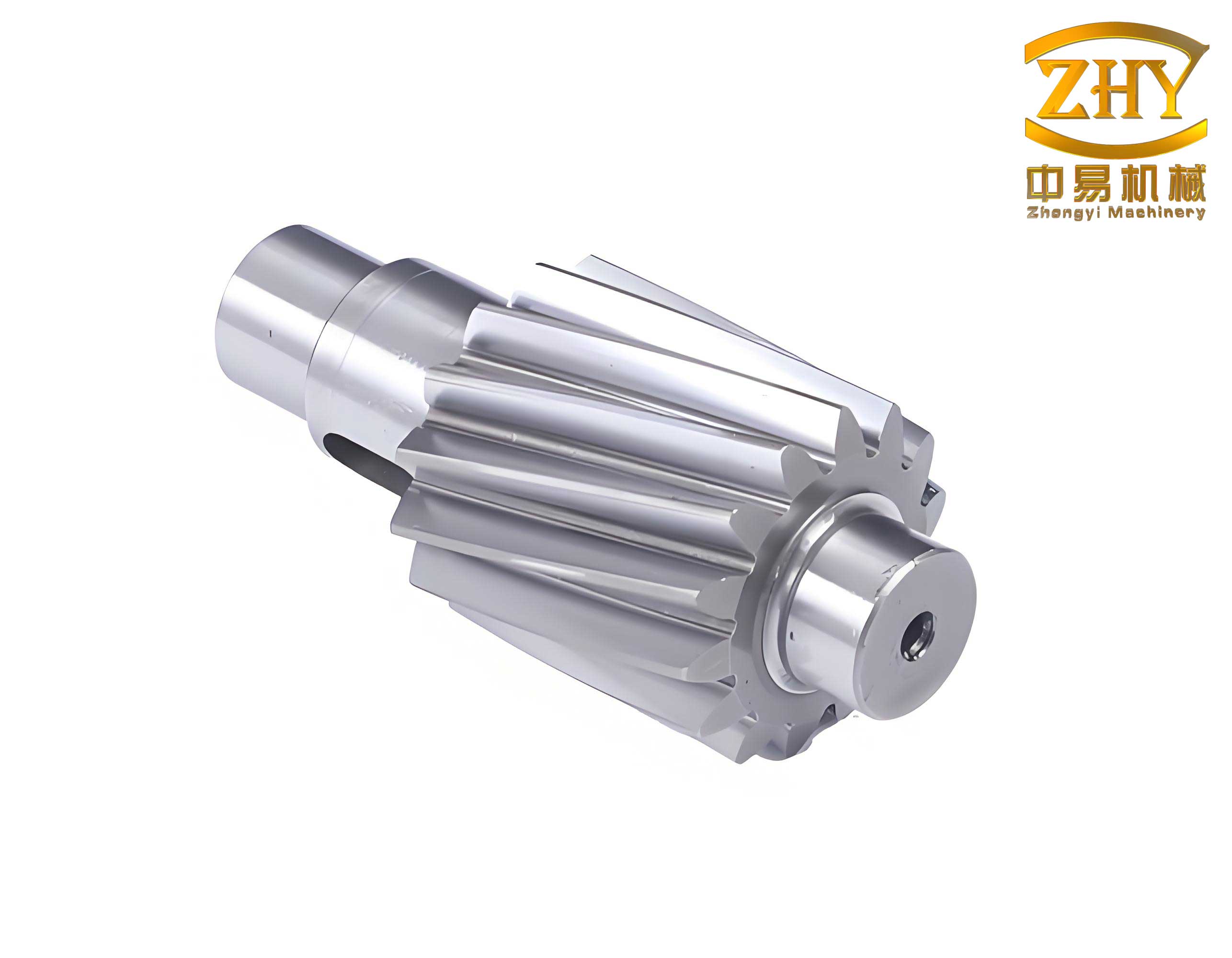
Gear shafts are typically manufactured from materials such as 20CrMnTi, a low-alloy steel known for its high strength and toughness. In this study, the repair focused on a static sealing surface represented by an outer diameter of Ø85f9, with damage characterized by grooves 0.3–0.5 mm in depth, 30–40 mm in length, spaced 5–8 mm apart, and 0.8–1 mm in width. The objective was to restore the gear shaft to meet original drawing requirements without affecting other regions. Through comparative analysis of various repair methods, cold welding was selected due to its precision and minimal thermal impact. The following sections detail the comprehensive methodology adopted for successful gear shaft repair.
Pre-Repair Preparations
Pre-repair preparations are foundational to the success of any gear shaft restoration process. They encompass assessments of internal quality and surface conditions to ensure the component is repairable.
Internal Quality Assessment
Used gear shafts must be evaluated for internal and surface defects that could compromise repair integrity. Non-destructive testing (NDT) methods are employed for this purpose. Ultrasonic testing is used to detect internal flaws such as cracks or voids, while liquid penetrant testing identifies surface discontinuities. The criteria for proceeding with repair are based on established standards; only gear shafts that pass these inspections are deemed suitable for cold welding. The relationship between defect size and repairability can be expressed using a threshold formula:
$$ \delta \leq \delta_{\text{max}} $$
where $\delta$ represents the defect depth and $\delta_{\text{max}}$ is the maximum allowable defect size for repair (e.g., 0.5 mm in this case). Table 1 summarizes the NDT methods and acceptance criteria for gear shafts.
| Testing Method | Principle | Applicable Defects | Acceptance Standard |
|---|---|---|---|
| Ultrasonic Testing | Sound wave reflection | Internal cracks, voids | JB/T 6908-2002 Grade I |
| Liquid Penetrant Testing | Capillary action | Surface cracks, porosity | JB/T 12582-2015 Grade I |
Surface Preparation Requirements
Given the shallow damage profile and narrow grooves on the gear shaft, machining is necessary prior to cold welding to facilitate the repair process and ensure dimensional accuracy. The outer diameter is machined to remove material, with a single-side allowance of 0.5 mm and a surface roughness of Ra ≤ 12.5 µm. This step eliminates irregular geometries and provides a clean substrate for deposition. Additionally, to prevent contamination from oils or residues, the repair area and a 10 mm surrounding zone are thoroughly cleaned using isopropyl alcohol. The surface preparation process can be modeled by the following equation for material removal:
$$ V_{\text{remove}} = \pi \cdot D \cdot L \cdot a $$
where $V_{\text{remove}}$ is the volume of material removed, $D$ is the original diameter of the gear shaft, $L$ is the length of the damaged section, and $a$ is the allowance per side. Proper surface preparation is critical for achieving a robust bond in cold welding of gear shafts.
Requirements During the Repair Process
The repair phase involves precise control over equipment, materials, and parameters to guarantee the quality of the restored gear shafts. Key aspects include device selection, welding wire characteristics, pulse settings, and temperature management.
Repair Equipment Selection
Cold welding devices vary in capabilities, and based on operational experience, the AXT-J300 precision welding machine was chosen for this application. This equipment offers adjustable pulse currents and times, making it suitable for delicate repairs on gear shafts. The machine’s operational principle relies on capacitive discharge, where the energy per pulse is given by:
$$ E = \frac{1}{2} C V^2 $$
where $E$ is the energy, $C$ is the capacitance, and $V$ is the voltage. This energy is dissipated during the micro-second discharge, melting the welding wire without excessive heat buildup in the gear shaft.
Welding Wire Material and Diameter
The choice of welding wire is dictated by the base material of the gear shaft and desired mechanical properties. For 20CrMnTi gear shafts, P20 mold welding wire (imported) was selected due to its low cracking susceptibility and hardness range of 30–34 HRC post-weld. This ensures compatibility and reduces defects like porosity or lack of fusion. The wire diameter is optimized based on repair thickness and component size; for gear shafts with damage depths of 0.3–0.5 mm, a diameter of 1.2 mm balances efficiency and heat input. The relationship between wire diameter $d_w$ and repair thickness $t_r$ can be approximated as:
$$ d_w \approx k \cdot t_r $$
where $k$ is a constant typically between 2 and 3 for cold welding applications. Table 2 outlines the welding wire specifications for gear shaft repair.
| Parameter | Value | Rationale |
|---|---|---|
| Material | P20 Mold Steel | Matches base material hardness and reduces defects |
| Diameter | 1.2 mm | Optimizes deposition rate and minimizes heat input |
| Hardness (Post-Weld) | 30–34 HRC | Ensures wear resistance for gear shafts |
Pulse Current and Pulse Time Settings
Pulse parameters are critical for controlling the fusion process in cold welding of gear shafts. The pulse current $I_p$ is determined by the welding wire diameter; for a 1.2 mm wire, empirical data suggests an optimal current of 49 A. The pulse time $T_p$ is related to the current to ensure proper melting without overheating. Based on operational experience, the pulse time is set 2–3 units higher than the current, resulting in $T_p = 52$ ms. This relationship can be expressed as:
$$ T_p = I_p + \Delta t $$
where $\Delta t$ ranges from 2 to 3 ms. Deviations from these values may lead to incomplete fusion or excessive thermal effects on the gear shaft. The energy input per pulse can be calculated using:
$$ Q_p = I_p^2 \cdot R \cdot T_p $$
where $Q_p$ is the heat input per pulse, and $R$ is the effective resistance of the welding circuit. Maintaining these parameters ensures consistent deposition on gear shafts.
Temperature Control During Repair
To prevent distortion of non-repaired sections, the temperature of the gear shaft must be regulated throughout the cold welding process. Based on long-term experience, the allowable temperature range is 45°C to 60°C. Exceeding 60°C necessitates a cooling period before resuming work. The temperature rise $\Delta T$ during welding can be estimated using the heat transfer equation:
$$ \Delta T = \frac{Q_{\text{total}}}{m \cdot c} $$
where $Q_{\text{total}}$ is the cumulative heat input, $m$ is the mass of the gear shaft, and $c$ is the specific heat capacity of the material. Intermittent welding and passive cooling are employed to stay within the limits, preserving the dimensional stability of the gear shaft.
Post-Repair Inspection and Validation
After cold welding, the repaired gear shaft undergoes machining (turning and grinding) to achieve final dimensions. Post-repair inspections are essential to verify that the restoration meets all specifications. Common defects in cold welding, such as porosity or pinholes, are detected using NDT methods, while dimensional accuracy is confirmed through direct measurement.
Non-Destructive Testing
Ultrasonic, magnetic particle, and liquid penetrant testing are conducted on the repaired area to identify internal and surface flaws. The acceptance criteria align with industry standards, ensuring the gear shaft is free from critical defects. The probability of defect detection $P_d$ can be modeled as:
$$ P_d = 1 – e^{-\lambda A} $$
where $\lambda$ is the defect density and $A$ is the inspection area. Table 3 presents the inspection record for a typical gear shaft repair.
| Inspection Method | Standard | Requirement | Result |
|---|---|---|---|
| Ultrasonic Testing | JB/T 6908-2002 Grade I | No internal defects | Qualified |
| Magnetic Particle Testing | JB/T 6908-2002 Grade I | No surface cracks | Qualified |
| Liquid Penetrant Testing | JB/T 12582-2015 Grade I | No porosity or pinholes | Qualified |
| Dimensional Accuracy | Drawing: Ø85f9 (-0.036, -0.123 mm) | Within tolerance | Qualified |
| Surface Roughness | Drawing: Ra 1.6 µm | ≤ 1.6 µm | Qualified |
Dimensional and Surface Analysis
The final dimensions of the gear shaft, particularly the Ø85f9 outer diameter, are measured using precision instruments like micrometers or coordinate measuring machines. The surface roughness is assessed to ensure it meets the Ra 1.6 µm specification. The restoration process aims to achieve geometric conformity, with deviations controlled within tight limits. The overall success rate $S$ for gear shaft repairs can be expressed as:
$$ S = \frac{N_{\text{success}}}{N_{\text{total}}} \times 100\% $$
where $N_{\text{success}}$ is the number of gear shafts meeting all criteria, and $N_{\text{total}}$ is the total repaired. In practice, cold welding has demonstrated high success rates for gear shafts, often exceeding 95% when parameters are optimized.
Conclusion
The application of cold welding technology for repairing gear shafts offers a reliable and economical solution to localized damage. By adhering to systematic pre-repair assessments, precise process controls, and rigorous post-repair inspections, gear shafts can be restored to original specifications without compromising other regions. The use of specialized equipment, tailored welding wires, and optimized pulse parameters ensures minimal thermal impact and high-quality deposits. Compared to manufacturing new gear shafts, this approach reduces costs and downtime significantly, providing substantial benefits to users. Future work may involve refining parameter models or exploring advanced materials for even broader applications in gear shaft maintenance. Overall, cold welding stands as a versatile technique for extending the service life of critical components like gear shafts in mechanical systems.