
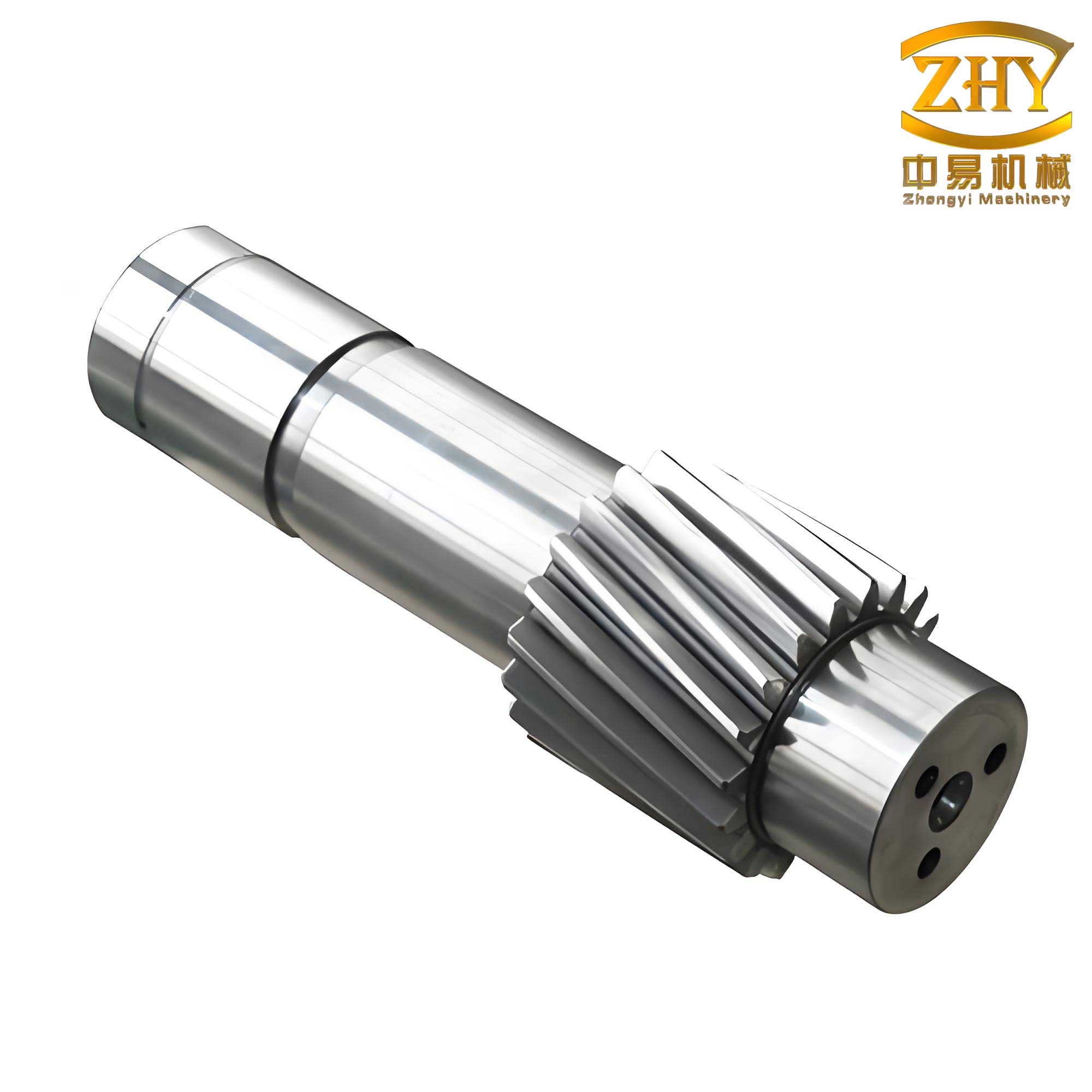
In my extensive experience in industrial maintenance and surface engineering, I have encountered numerous cases where critical components like gear shafts suffer from severe wear and tear, leading to costly downtime and replacements. The gear shaft, a vital element in machinery such as coal mills, often experiences excessive abrasion and corrosion due to harsh operational environments. This not only compromises equipment efficiency but also results in significant economic losses. To address this, I have explored innovative repair techniques, focusing on thermal spray coatings, particularly using ultrafine WC-Co composite powders applied via high-velocity oxygen fuel (HVOF) technology. This approach aims to restore the functionality of gear shafts, extend their service life, and enhance overall performance.
The gear shaft, being a central component in power transmission systems, is subjected to high loads and friction, making it prone to surface degradation. Traditional repair methods, such as welding or electroplating, often fall short due to issues like poor adhesion, thermal distortion, or inadequate wear resistance. In contrast, thermal spraying offers a versatile solution by depositing protective coatings that can withstand extreme conditions. Among various thermal spray techniques, HVOF stands out due to its ability to produce dense, well-bonded coatings with minimal oxidation and decarburization, which is crucial for maintaining the integrity of materials like WC-Co cermets. In my work, I have leveraged this technology to repair large-scale coal mill gear shafts, achieving remarkable results in terms of durability and cost-effectiveness.
To begin, I synthesized the WC-Co composite powder using an in-situ reaction method, which involves the reduction of tungsten and cobalt oxides at high temperatures. This process yields ultrafine particles with an average size of approximately 0.3 μm, as confirmed by scanning electron microscopy (SEM). The powder exhibits high purity, primarily consisting of WC and Co phases, with minimal impurities. However, such fine powders pose challenges in handling and spraying due to poor flowability. Therefore, I employed a granulation step using a centrifugal spray dryer, where the powder was mixed with a binder like PEG and atomized into spherical granules. These granules, ranging from 20 to 30 μm in diameter, significantly improved the powder’s flow characteristics, facilitating efficient feeding during the HVOF process. The granulation can be described by the following equation, which relates particle size distribution to spray drying parameters:
$$ d_p = k \cdot \left( \frac{\rho \cdot Q}{\eta \cdot N} \right)^{1/3} $$
where \( d_p \) is the granule diameter, \( k \) is a constant, \( \rho \) is the slurry density, \( Q \) is the feed rate, \( \eta \) is the viscosity, and \( N \) is the rotational speed of the atomizer. This ensures uniform granule formation, critical for consistent coating deposition.
The HVOF spraying was conducted using a commercial system with propane as the fuel gas and oxygen as the oxidizer, at a ratio of 4:1. The spraying distance was set to 150 mm, and other parameters were optimized to achieve high particle velocities and controlled temperatures. The key advantage of HVOF is its supersonic flame velocity, which accelerates particles to speeds exceeding 1000 m/s, resulting in high kinetic energy upon impact with the gear shaft substrate. This promotes strong mechanical bonding and dense microstructure. The process can be modeled using gas dynamics equations, such as the Bernoulli principle for compressible flows:
$$ \frac{v^2}{2} + \frac{\gamma}{\gamma – 1} \cdot \frac{p}{\rho} = \text{constant} $$
where \( v \) is the gas velocity, \( \gamma \) is the specific heat ratio, \( p \) is the pressure, and \( \rho \) is the density. This ensures efficient particle acceleration and heating, minimizing residence time in the hot zone to reduce phase transformations.
Upon deposition, the coating’s phase composition was analyzed using X-ray diffraction (XRD). Compared to the original powder, the coating showed the presence of minor decarburized phases like W₂C and trace tungsten, indicating some degree of thermal decomposition during spraying. However, due to the rapid cooling in HVOF, these phases were limited, preserving the majority of WC and Co. The XRD patterns revealed distinct peaks corresponding to WC (hexagonal structure) and Co (fcc structure), with peak broadening suggesting nanocrystalline features. The phase stability can be expressed by the Gibbs free energy change for decarburization:
$$ \Delta G = \Delta H – T \Delta S $$
where \( \Delta G \) is the Gibbs free energy, \( \Delta H \) is the enthalpy change, \( T \) is the temperature, and \( \Delta S \) is the entropy change. For WC, \( \Delta G \) remains negative at high temperatures, but the short exposure in HVOF suppresses extensive reaction, as confirmed by the low intensity of W₂C peaks.
The microstructure of the coating was examined using SEM, revealing a dense, homogenous layer with excellent adhesion to the gear shaft substrate. The interface between the coating and the base material (35SiMn steel) was smooth and free of cracks, indicating strong metallurgical bonding. Within the coating, WC particles were uniformly dispersed in the Co matrix, with grain sizes ranging from 1 to 3 μm. This slight growth compared to the original powder is attributed to Ostwald ripening during the brief heating cycle, described by the Lifshitz-Slyozov-Wagner theory:
$$ r^3 – r_0^3 = \frac{8 \gamma D c_\infty V_m^2 t}{9 RT} $$
where \( r \) is the particle radius at time \( t \), \( r_0 \) is the initial radius, \( \gamma \) is the interfacial energy, \( D \) is the diffusion coefficient, \( c_\infty \) is the solubility, \( V_m \) is the molar volume, \( R \) is the gas constant, and \( T \) is the temperature. The dense structure contributes to enhanced mechanical properties, critical for gear shaft applications where wear resistance is paramount.
To evaluate the coating’s performance, I conducted mechanical tests, including hardness measurements and wear resistance assessments. The hardness was measured using a Vickers microhardness tester, with an average value of 1093 HV0.3, significantly higher than that of conventional electroplated zinc coatings (688 HV0.3). This superior hardness is due to the fine-grained WC reinforcement and the dense Co binder. The wear resistance was tested using a pin-on-disk method under varying loads, and the results are summarized in the table below. The wear volume loss for the HVOF coating was substantially lower than that of electroplated coatings, demonstrating its efficacy in protecting gear shafts from abrasion.
| Coating Type | Hardness (HV0.3) | Wear Loss (g) at 50 N Load | Wear Loss (g) at 80 N Load |
|---|---|---|---|
| HVOF WC-Co Coating | 1093 | 0.004 | 0.008 |
| Electroplated Zinc Coating | 688 | 0.008 | 0.020 |
The wear mechanism can be analyzed using Archard’s wear equation, which relates wear volume to load and hardness:
$$ V = k \cdot \frac{F \cdot s}{H} $$
where \( V \) is the wear volume, \( k \) is the wear coefficient, \( F \) is the applied load, \( s \) is the sliding distance, and \( H \) is the hardness. For the HVOF coating, the high hardness reduces wear volume, as evidenced by the lower wear loss values. Additionally, the coating’s toughness, derived from the Co binder, prevents crack propagation under cyclic loading, which is common in gear shaft operations.
In practical applications, I implemented this HVOF coating process to repair a damaged coal mill gear shaft in an industrial setting. The gear shaft had exhibited severe wear grooves and scoring due to prolonged operation, threatening to halt production. After surface preparation, including grit blasting and cleaning, the WC-Co composite powder was sprayed onto the worn areas. The coated gear shaft was then machined to restore its original dimensions and assembled back into the mill. Over a year of operation, the repaired gear shaft showed no signs of significant wear, with reduced vibration and improved bearing performance. This success underscores the technology’s potential for extending the lifespan of critical components like gear shafts, leading to substantial cost savings and minimized downtime.
To further optimize the process, I investigated the influence of spraying parameters on coating properties. Using design of experiments (DOE), I varied factors such as fuel-to-oxygen ratio, spray distance, and powder feed rate. The results indicated that a higher particle velocity, achieved by optimizing gas flows, enhances coating density and adhesion. The relationship can be expressed through a quadratic model for coating quality (Q):
$$ Q = \beta_0 + \beta_1 x_1 + \beta_2 x_2 + \beta_{12} x_1 x_2 + \epsilon $$
where \( x_1 \) and \( x_2 \) represent normalized parameters, \( \beta \) are coefficients, and \( \epsilon \) is the error term. This allows for fine-tuning the process for specific gear shaft geometries and materials.
Moreover, the economic benefits of this repair method are significant. Compared to replacing a gear shaft, which involves high costs for new components and installation, thermal spraying reduces expenses by up to 70%. The table below compares the costs associated with different repair strategies for a typical gear shaft in a coal mill.
| Repair Method | Material Cost (USD) | Labor Cost (USD) | Downtime (Days) | Total Cost (USD) |
|---|---|---|---|---|
| Gear Shaft Replacement | 15,000 | 5,000 | 10 | 20,000 |
| HVOF Coating Repair | 2,000 | 3,000 | 2 | 5,000 |
| Electroplating Repair | 1,000 | 2,000 | 5 | 3,000 |
As shown, HVOF coating offers a balanced approach with moderate costs and minimal downtime, making it ideal for industries reliant on continuous operation of gear shaft-driven machinery.
In conclusion, my research demonstrates that using ultrafine WC-Co composite powders with HVOF thermal spraying is a highly effective method for repairing and enhancing gear shafts. The coatings exhibit superior hardness, wear resistance, and adhesion, addressing common failure modes in industrial gear shafts. By integrating advanced materials and processes, we can achieve sustainable maintenance solutions that prolong equipment life and reduce environmental impact. Future work will focus on developing nanocrystalline powders and automated spraying systems to further improve performance and scalability for gear shaft applications across various sectors.
Throughout this study, the gear shaft has been a focal point, highlighting its critical role in mechanical systems and the importance of innovative repair techniques. The success of this approach not only validates HVOF technology but also opens avenues for applying similar methods to other worn components, such as bearings or seals, in gear shaft assemblies. By continuing to refine these processes, we can contribute to more resilient and efficient industrial operations worldwide.