
In our manufacturing facility, we produce large gear shafts for blast furnace distribution systems, which are critical components in steel production. These gear shafts are typically made from 42CrMo steel and can weigh up to 2200 kg. During operation, these gear shafts are subjected to extreme conditions, leading to issues like cracking or wear. If left unaddressed, such defects can compromise the entire distribution system, resulting in significant economic losses. Therefore, we have developed a welding-based repair process to restore these gear shafts to their functional state. This article details our approach, focusing on material analysis, welding techniques, and process validation, with an emphasis on the unique challenges associated with the gear shaft.
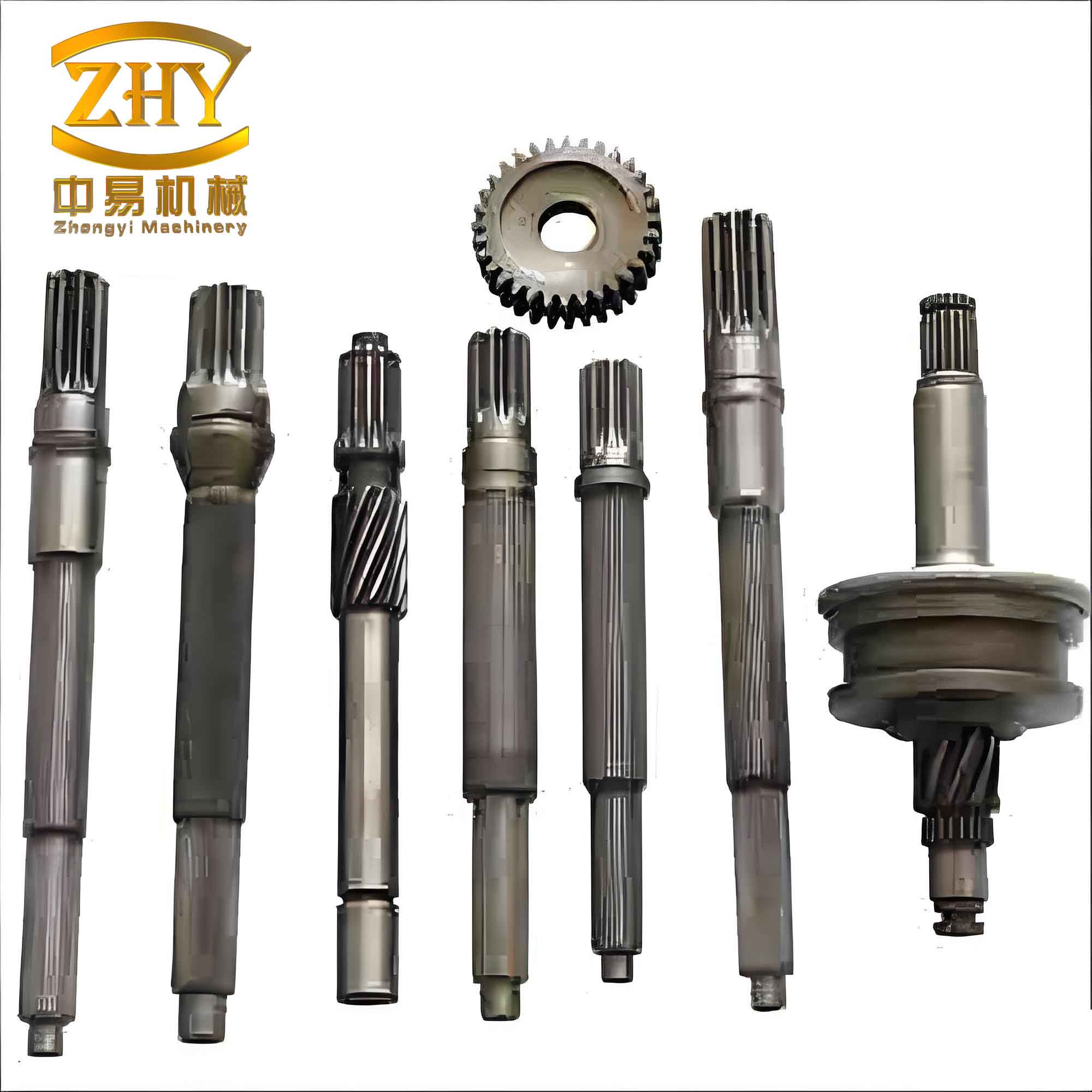
The gear shaft is a pivotal element in ensuring smooth material distribution within blast furnaces. Its failure can lead to downtime and costly replacements. By implementing a robust welding repair strategy, we aim to extend the service life of these gear shafts. This process involves a comprehensive understanding of the material properties, careful selection of welding parameters, and rigorous testing to ensure reliability. Throughout this article, we will explore the chemical composition of the gear shaft material, its weldability, and the step-by-step procedures we have established for successful repair. The term ‘gear shaft’ will be frequently referenced to highlight its centrality in our discussion.
Chemical Composition and Weldability Analysis of the Gear Shaft
The gear shaft is fabricated from 42CrMo steel, a medium-carbon low-alloy steel known for its high strength and toughness. Understanding its chemical composition is crucial for assessing weldability. The table below summarizes the typical chemical composition and mechanical properties of the gear shaft material.
| Element | Content (%) | Mechanical Property | Value |
|---|---|---|---|
| C | 0.38-0.45 | Yield Strength (σs) | ≥930 MPa |
| Mn | 0.50-0.80 | Tensile Strength (σb) | ≥1080 MPa |
| Si | 0.17-0.37 | Impact Energy (Ak) | ≥63 J |
| Cr | 0.90-1.20 | – | – |
| Mo | 0.15-0.25 | – | – |
| V | 0.15-0.45 | – | – |
| P | ≤0.035 | – | – |
| S | ≤0.035 | – | – |
| Ni | ≤0.30 | – | – |
To evaluate the weldability of the gear shaft material, we calculate the carbon equivalent (CE) using the International Institute of Welding (IIW) formula. This helps predict the risk of cold cracking during welding. The CE is given by:
$$ CE = C + \frac{Mn}{6} + \frac{Cr + Mo + V}{5} + \frac{Ni + Cu}{15} $$
For the gear shaft material, with typical values such as C=0.42%, Mn=0.65%, Cr=1.05%, Mo=0.20%, V=0.30%, Ni=0.20%, and Cu=0.10%, the calculation proceeds as follows:
$$ CE = 0.42 + \frac{0.65}{6} + \frac{1.05 + 0.20 + 0.30}{5} + \frac{0.20 + 0.10}{15} = 0.42 + 0.108 + 0.31 + 0.02 = 0.858 \approx 0.86\% $$
This high CE value indicates poor weldability, as it exceeds 0.6%, suggesting a significant risk of hardening and cracking in the heat-affected zone (HAZ) of the gear shaft. The gear shaft’s high carbon content means that during welding, base metal dilution into the weld pool can increase carbon levels, leading to issues like fish-scale cracking perpendicular to the weld. To mitigate this, we opt for low-carbon electrodes to reduce carbon intake in the weld metal.
Further analysis of the gear shaft’s welding performance reveals susceptibility to martensite formation due to the low Ms (martensite start) temperature of 42CrMo steel. This can result in cold cracks, which may appear during cooling or as delayed cracks hours after welding. The primary factors contributing to cold cracking include the material’s hardenability, residual stresses, and hydrogen content in the weld. For the gear shaft, controlling these elements is essential to prevent failures. We emphasize the importance of preheating and post-weld heat treatment to manage hydrogen diffusion and reduce stress concentrations in the gear shaft.
Welding Material Selection for Gear Shaft Repair
Selecting appropriate welding materials is critical for the successful repair of the gear shaft. The goal is to minimize hydrogen-induced cracking while maintaining mechanical properties compatible with the base metal. Hydrogen content in the weld is a key concern, as it can originate from moisture in electrodes, surface contaminants, or environmental humidity. For the gear shaft, we chose J507 (E7015) electrodes with a diameter of 5 mm. Although J507 electrodes have lower strength compared to 42CrMo, they offer advantages in reducing cold cracking tendencies due to their low hydrogen characteristics. The tensile strength of J507 welds is approximately 500 MPa, which is adequate for the gear shaft application when combined with proper工艺.
To ensure low hydrogen levels, we bake the electrodes at 300-450°C for 4 hours and store them in a holding oven at 100-150°C until use. This practice minimizes moisture absorption, which is vital for the gear shaft repair. The table below compares the properties of J507 electrodes with typical requirements for gear shaft welding.
| Parameter | J507 Electrode | Gear Shaft Requirement |
|---|---|---|
| Tensile Strength | ~500 MPa | ≥930 MPa (base metal) |
| Hydrogen Content | <5 mL/100g | Minimized to prevent cracking |
| Preheat Temperature | 300-400°C | Based on calculation |
Using J507 electrodes helps in achieving a weld metal with lower carbon content, thus reducing the risk of cracks in the gear shaft. Additionally, the electrode’s flux coating aids in shielding the arc and controlling hydrogen, which is crucial for the thick sections of the gear shaft.
Determination of Preheat and Interpass Temperatures
Preheating is essential for the gear shaft repair to slow down cooling rates, allow hydrogen escape, and prevent martensite formation. We determine the preheat temperature (To) using multiple empirical formulas to ensure accuracy. For the gear shaft, with a thickness of approximately 200 mm, we apply the following methods:
First, the carbon equivalent method relates To directly to CE. Based on our earlier calculation, CE is 0.86%, and we use the formula:
$$ To = 360 \times CE $$
$$ To = 360 \times 0.86 = 309.6 \approx 310°C $$
This provides a baseline preheat temperature for the gear shaft.
Second, the medium carbon steel formula considers carbon content and thickness. For the gear shaft, with C=0.42% and h=200 mm, we use:
$$ To = 500 \times C + 50 $$
$$ To = 500 \times 0.42 + 50 = 210 + 50 = 260°C $$
This accounts for the section thickness of the gear shaft.
Third, the cold cracking susceptibility formula incorporates Pcm (cold cracking index), hydrogen content [H], and tensile strength σb. For 42CrMo, Pcm can be estimated as:
$$ Pcm = C + \frac{Si}{30} + \frac{Mn}{20} + \frac{Cu}{20} + \frac{Ni}{60} + \frac{Cr}{20} + \frac{Mo}{15} + \frac{V}{10} $$
With typical values, Pcm ≈ 0.32%. Assuming [H]=5 mL/100g and σb=1080 MPa, we calculate To as:
$$ To = 1600 \times Pcm – 400 + 100 \times \log([H]) $$
$$ To = 1600 \times 0.32 – 400 + 100 \times \log(5) = 512 – 400 + 100 \times 0.699 = 112 + 69.9 = 181.9 \approx 182°C $$
However, based on practical experience, we set the preheat temperature for the gear shaft at 350-400°C to account for safety margins. We use an electric furnace to uniformly heat the entire gear shaft to 380°C and maintain it for 6 hours before welding.
Interpass temperature control is equally important for the gear shaft. We keep it at 340°C using heaters to ensure each weld layer does not cool too rapidly, minimizing hydrogen accumulation. The relationship between cooling time and critical crack formation can be expressed as:
$$ t_{8/5} = \frac{1}{k} \ln \left( \frac{T_0 – T_{\infty}}{T – T_{\infty}} \right) $$
where \( t_{8/5} \) is the cooling time between 800°C and 500°C, \( T_0 \) is initial temperature, \( T_{\infty} \) is ambient temperature, and k is a constant. For the gear shaft, maintaining interpass temperature above 300°C ensures \( t_{8/5} \) exceeds the critical value for crack avoidance.
Post-Weld Heat Treatment for Gear Shaft
After welding, the gear shaft undergoes stress relief heat treatment to reduce residual stresses and facilitate hydrogen diffusion. We place the gear shaft in a furnace at 610-670°C for 8 hours, followed by controlled cooling at 70°C per hour to 160°C, then air cooling. This process enhances the toughness of the weld and HAZ, critical for the gear shaft’s performance. The temperature cycle can be modeled as:
$$ T(t) = T_{\text{max}} \exp(-t/\tau) $$
where \( T(t) \) is temperature at time t, \( T_{\text{max}} \) is peak temperature, and τ is time constant. For the gear shaft, this treatment ensures mechanical properties are restored, with hardness measurements post-treatment showing values around HB180, compatible with the base metal.
Welding Process Evaluation and Testing
We conduct welding procedure qualification tests on sample gear shafts to validate our approach. The test involves preheating to 400°C, welding with J507 electrodes, and post-weld heat treatment at 650°C. After 48 hours, magnetic particle inspection reveals no cracks, confirming the effectiveness for the gear shaft. Mechanical tests according to standards like GB2652-89 and GB2654-88 show tensile strength σb=950 MPa, yield strength σs=900 MPa, and hardness HB180, meeting the requirements for 35CrMo equivalent strength.
The welding parameters for the gear shaft are optimized as follows: current 200-250 A, voltage 20-26 V, and speed 200-230 mm/min. We use multi-pass welding with thin layers to control heat input. The heat input per pass can be calculated as:
$$ Q = \frac{60 \times V \times I}{S \times 1000} $$
where Q is heat input (kJ/mm), V is voltage (V), I is current (A), and S is speed (mm/min). For the gear shaft, Q is maintained below 2.0 kJ/mm to avoid excessive HAZ hardening.
| Parameter | Value | Unit |
|---|---|---|
| Welding Current | 200-250 | A |
| Voltage | 20-26 | V |
| Speed | 200-230 | mm/min |
| Heat Input | 1.5-2.0 | kJ/mm |
These parameters ensure minimal defects in the gear shaft weld, with each layer inspected for porosity or cracks. The successful test results demonstrate that our welding repair process is feasible for the gear shaft in industrial applications.
Key Considerations in the Welding Process for Gear Shaft
During the repair of the gear shaft, several precautions must be taken to ensure quality. First, the gear shaft surface must be thoroughly cleaned to remove dirt, oil, and oxides before welding. Second, preheating is maintained consistently to avoid thermal shocks. Third, electrodes are kept dry to control hydrogen levels. Fourth, we monitor interpass temperature closely to prevent rapid cooling. Fifth, after welding, the gear shaft is subjected to stress relief without delay. Sixth, non-destructive testing like ultrasonic or magnetic particle inspection is used to verify the integrity of the gear shaft weld. These steps are crucial for the longevity of the gear shaft in service.
Conclusion
In summary, the repair of large blast furnace gear shafts made from 42CrMo steel requires a meticulous welding approach. We have shown that selecting low-hydrogen electrodes like J507, combined with appropriate preheating and post-weld heat treatment, can effectively mitigate cracking risks. The gear shaft’s high carbon equivalent necessitates careful temperature control, and our qualification tests confirm the viability of this process. By adhering to these guidelines, we can extend the life of critical gear shafts, reducing downtime and costs in steel production. Future work may explore advanced welding techniques for further optimization of gear shaft repairs.