
In my extensive experience as a mechanical engineer specializing in gear systems, I have often dealt with the maintenance and replacement of spiral bevel gears. These gears are crucial components in various industrial applications, from automotive differentials to heavy machinery, due to their ability to transmit power between non-parallel shafts with high efficiency and smooth operation. The unique curved tooth profile of spiral bevel gears allows for gradual engagement, reducing noise and vibration compared to straight bevel gears. However, one of the most critical aspects of their lifecycle management is determining when and how to replace them—whether as a pair or individually. This decision hinges on factors such as wear patterns, manufacturing processes, and operational conditions. In this article, I will delve into the intricacies of spiral bevel gear replacement, drawing on practical insights and technical principles to guide maintenance practices.
Spiral bevel gears, during their service life, inevitably undergo wear due to friction, load fluctuations, and environmental factors. A key advantage of spiral bevel gears is that initial wear can often be compensated through axial displacement adjustments. By shifting the gears along their axes, we can restore proper meshing and extend their usability without immediate replacement. This adjustability stems from the gear geometry, where the tooth contact pattern can be modified to account for minor wear. For instance, the axial displacement $\Delta a$ required to compensate for wear $w$ can be approximated by the relationship derived from gear kinematics: $$\Delta a = k \cdot w \cdot \frac{\cos \beta}{m_n}$$ where $k$ is a correction factor dependent on the spiral angle $\beta$, and $m_n$ is the normal module. This equation highlights how wear compensation is integral to spiral bevel gear maintenance, allowing for continued operation in many cases. However, as wear progresses beyond a certain threshold, typically when the tooth profile deviation exceeds allowable limits, adjustment alone becomes insufficient, and replacement becomes necessary to ensure reliable performance and prevent catastrophic failure.
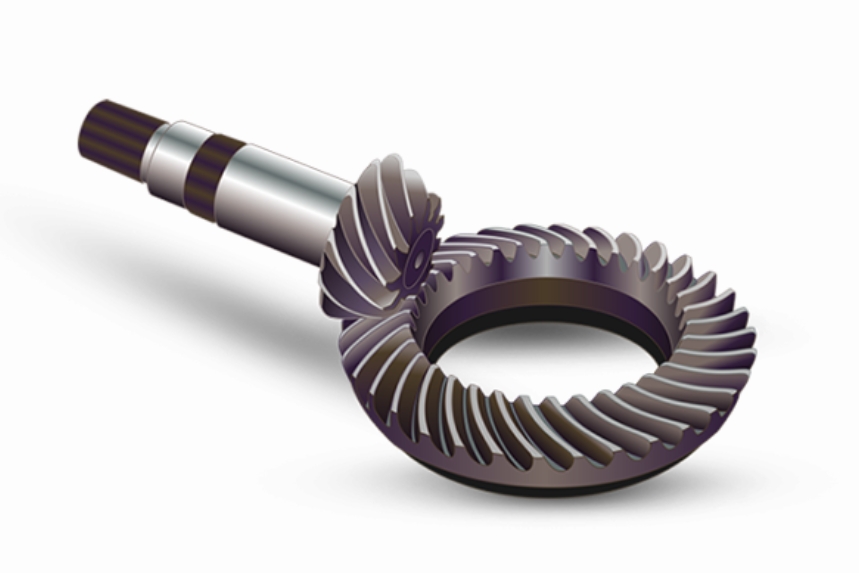
In standard practice, spiral bevel gears are almost always replaced as a matched pair. This requirement is deeply rooted in their manufacturing and quality control processes. At our current production and technological level, the cutting and machining of spiral bevel gears involve complex theoretical calculations and machine adjustments. The geometry of a spiral bevel gear is defined by parameters such as the spiral angle $\beta$, pitch diameter $d$, pressure angle $\alpha$, and tooth curvature. The basic gear equation for spiral bevel gears can be expressed as: $$d = m_t \cdot z$$ where $m_t$ is the transverse module and $z$ is the number of teeth. However, due to inaccuracies in calculation and heat treatment-induced deformations, it is challenging to achieve perfect啮合 (meshing) directly from theoretical specs. Therefore, manufacturers typically adopt a paired manufacturing approach: the larger gear is first cut based on theoretical adjustments, and then the smaller gear is配切 (matched-cut) according to the actual profile of the larger gear. This ensures compatibility but limits interchangeability.
After cutting, spiral bevel gears undergo rigorous testing on rolling check machines, where they are paired and selected based on啮合 performance. Gears that exhibit optimal contact patterns, low noise, and minimal vibration are marked with matching numbers and shipped as pairs. For high-precision applications, additional lapping on专用研齿机 (dedicated lapping machines) is performed to refine tooth surfaces, improve roughness, and enhance啮合 quality. As a result, each spiral bevel gear pair is essentially unique, and substituting one gear from another pair can lead to misalignment, increased wear, and operational issues. The contact stress $\sigma_H$ between gears, given by the Hertzian formula, emphasizes the importance of precise matching: $$\sigma_H = \sqrt{\frac{F_n \cdot E^*}{\pi \cdot \rho_c}}$$ where $F_n$ is the normal load, $E^*$ is the effective modulus of elasticity, and $\rho_c$ is the relative curvature radius. Mismatched gears alter $\rho_c$, leading to elevated stress and premature failure.
Despite the general rule of paired replacement, there are scenarios where individual replacement of spiral bevel gears is feasible and economical. Based on my field observations, these cases can be categorized and analyzed through practical criteria. To summarize, I have compiled the following table that outlines conditions for single replacement of spiral bevel gears, along with technical justifications and recommended actions.
| Condition Category | Description | Technical Rationale | Recommended Action |
|---|---|---|---|
| High Gear Ratio (e.g., >5:1) | In large and medium-sized spiral bevel gear sets with a significant speed difference, the smaller gear wears out faster due to higher cycle counts. | The wear rate $w$ is proportional to the number of cycles $N$, where $N = n \cdot t$, with $n$ as rotational speed and $t$ as time. For a gear ratio $i = z_2/z_1$, the smaller gear’s speed $n_1$ is higher, leading to accelerated wear: $$w_1 \propto n_1 = i \cdot n_2$$ This makes paired replacement uneconomical if the larger gear is still serviceable. | Stockpile small gears with increased tooth thickness for replacement; monitor wear regularly. |
| Uneven Load or Usage | In gear pairs where one gear experiences more frequent operation or higher loads, such as the sun gear in planetary systems, it wears faster. | The load distribution factor $K_H$ affects wear. For a gear under higher load $F$, the wear depth $d_w$ can be modeled as: $$d_w = C \cdot K_H \cdot F^m \cdot s$$ where $C$ is a material constant, $m$ is an exponent, and $s$ is the sliding distance. Uneven loads cause disparate wear rates. | Maintain a larger inventory of the frequently used gear; implement load balancing if possible. |
| Material Disparity | When one gear is made of softer material and wears out prematurely, while the harder gear remains intact. | Wear resistance correlates with material hardness $H$. The Archard wear equation gives: $$V = k \cdot \frac{F \cdot s}{H}$$ where $V$ is wear volume, $k$ is a wear coefficient. Softer materials (lower $H$) wear faster, justifying single replacement. | Replace only the worn soft gear; consider material upgrades for future pairs. |
| Severe Damage to One Gear | One gear is extensively damaged or broken due to overload or impact, while the other is in good condition. | Catastrophic failure often localizes to one gear; the other may have residual life. Analysis of failure root cause (e.g., via fracture mechanics) is essential before replacement. | Replace the damaged gear after root cause analysis and corrective measures; inspect the mate for hidden defects. |
In cases where single replacement is considered, it is crucial to assess the啮合 compatibility. For instance, when replacing a small spiral bevel gear in a high-ratio pair, we must account for tooth thickness variations. The theoretical tooth thickness $s_t$ for a spiral bevel gear is given by: $$s_t = m_n \cdot \left( \frac{\pi}{2} + 2x \tan \alpha_n \right)$$ where $x$ is the profile shift coefficient and $\alpha_n$ is the normal pressure angle. By manufacturing replacement gears with a positive profile shift (increased $x$), we can compensate for wear on the mate and ensure proper backlash. However, this requires precise measurement and customization, underscoring the need for careful planning in single replacements.
Another aspect to consider is the thermal and dynamic behavior of spiral bevel gears. During operation, temperature rise $\Delta T$ can affect clearances and wear rates. The heat generation $Q$ due to friction is approximated by: $$Q = \mu \cdot F_n \cdot v_s$$ where $\mu$ is the coefficient of friction and $v_s$ is the sliding velocity. This heat can accelerate wear, particularly in mismatched pairs. Therefore, when replacing a single spiral bevel gear, we should verify that the thermal expansion coefficients of both gears are compatible to avoid seizure or excessive clearance under operating conditions.
From a practical standpoint, I have often implemented condition monitoring techniques to guide replacement decisions. Vibration analysis, for example, can detect early signs of wear in spiral bevel gears. The vibration signal $v(t)$ can be decomposed into frequency components related to gear meshing frequency $f_m = n \cdot z / 60$ and its harmonics. An increase in amplitude at these frequencies indicates wear. For a worn gear, the vibration level $A$ might exceed a threshold $A_{\text{thresh}}$, prompting replacement: $$A = \int_{f_m}^{f_m+\Delta f} |V(f)|^2 df > A_{\text{thresh}}$$ This data-driven approach helps in deciding whether single or paired replacement is needed, based on the severity of wear on each gear.
Moreover, the economic implications of replacement strategies cannot be overlooked. Paired replacement of spiral bevel gears ensures optimal performance but can be costly, especially for large gears. Single replacement offers cost savings but risks reduced efficiency and lifespan. To quantify this, we can use a cost-benefit model. Let $C_p$ be the cost of a paired replacement, $C_s$ be the cost of a single replacement, and $L_p$ and $L_s$ be the expected lifetimes after replacement. The cost per operating hour $C_{ph}$ for paired replacement is: $$C_{ph} = \frac{C_p}{L_p}$$ and for single replacement: $$C_{sh} = \frac{C_s}{L_s}$$ If $C_{sh} < C_{ph}$ and performance degradation is acceptable, single replacement may be justified. However, this requires accurate estimation of $L_s$, which depends on the compatibility of the new spiral bevel gear with the old mate.
In my work, I have also encountered situations where spiral bevel gears are used in critical applications, such as aerospace or mining equipment. Here, the stakes are higher, and replacement decisions must account for safety factors. The safety factor $S$ for gear tooth bending stress $\sigma_F$ is given by: $$S = \frac{\sigma_{F,\text{lim}}}{\sigma_F}$$ where $\sigma_{F,\text{lim}}$ is the allowable stress. Mismatched gears from single replacement can lower $S$ due to stress concentrations, potentially leading to failure. Therefore, in critical systems, I generally advocate for paired replacement unless thorough analysis supports single replacement. This aligns with industry standards that emphasize reliability over short-term savings.
To further elaborate on the technical nuances, let’s explore the geometry and manufacturing tolerances of spiral bevel gears. The tooth surface of a spiral bevel gear is a complex three-dimensional shape, often described using mathematical models. For example, the position vector $\mathbf{r}$ of a point on the tooth surface can be expressed in terms of parameters $u$ and $\theta$: $$\mathbf{r}(u, \theta) = \begin{bmatrix} x(u, \theta) \\ y(u, \theta) \\ z(u, \theta) \end{bmatrix}$$ where $x$, $y$, and $z$ are functions derived from the gear design. During manufacturing, deviations $\delta x, \delta y, \delta z$ occur due to machine inaccuracies and heat treatment. These deviations are why spiral bevel gears are paired; the cumulative error between two gears from different batches can cause啮合 issues. The root mean square (RMS) deviation $\Delta_{\text{RMS}}$ is a measure of this: $$\Delta_{\text{RMS}} = \sqrt{\frac{1}{N} \sum_{i=1}^N (\delta x_i^2 + \delta y_i^2 + \delta z_i^2)}$$ In paired production, $\Delta_{\text{RMS}}$ is minimized for the specific pair, but for individually replaced gears, it may be higher, leading to performance loss.
Additionally, the lubrication regime plays a vital role in wear and replacement decisions. For spiral bevel gears, elastohydrodynamic lubrication (EHL) is common, where the film thickness $h$ is calculated using the Dowson-Higginson equation: $$h = 2.65 \cdot R^{0.54} \cdot (\alpha E’)^{0.06} \cdot \left( \frac{\eta_0 u}{E’ R} \right)^{0.7} \cdot W^{-0.13}$$ where $R$ is the effective radius, $\alpha$ is the pressure-viscosity coefficient, $E’$ is the reduced modulus, $\eta_0$ is the dynamic viscosity, $u$ is the rolling velocity, and $W$ is the load per unit width. Wear accelerates when $h$ falls below a critical value, indicating the need for replacement. If only one spiral bevel gear is replaced, the film thickness may change due to altered surface roughness, affecting lubrication efficiency.
In conclusion, the replacement of spiral bevel gears—whether as pairs or individually—is a multifaceted decision that balances technical, economic, and operational factors. Based on my experience, I recommend a systematic approach: regularly monitor wear through vibration and temperature sensors, use the criteria outlined in the table above to evaluate single replacement feasibility, and always prioritize啮合 quality to avoid vibration, noise, and accelerated wear. While paired replacement