
In the realm of power transmission systems, the spiral bevel gear stands as an indispensable component. Characterized by its complex geometry, it offers significant advantages such as high overlap ratio, superior load-bearing capacity, and excellent transmission efficiency. Consequently, spiral bevel gears are extensively employed in demanding industries including aerospace, automotive, and precision machinery. In helicopter main gearboxes, spiral bevel gears transmit the full load from the engine, making them a core component whose reliability is paramount to flight safety.
The traditional method for finishing the tooth tips of spiral bevel gears involved manual rounding performed by skilled fitters using pneumatic tools and grinding wheels. This process, while functional, suffered from critical drawbacks: inconsistent quality, irregular shapes, and the frequent occurrence of sharp edges and burrs. When such a bevel gear meshes with its counterpart, these imperfections can cause interference, damaging the root area of the mating gear. Under long-term operational stresses, this damage can evolve into stress concentration points, leading to fatigue cracks and ultimately, tooth breakage—a severe hazard. To address this fundamental manufacturing challenge, an automated rounding methodology based on reverse engineering and digital modeling has been developed. This approach leverages the reverse modeling capability of specialized bevel gear calculation software to reconstruct a precise mathematical model of the gear tooth geometry. This model is then imported into CAD/CAM software for the generation of the tip rounding profile, followed by the programming and execution of a 5-axis CNC machining process. This technology fundamentally resolves the issue of achieving high-efficiency, high-precision, and consistent tooth tip rounding for bevel gears, offering a superior, repeatable, and environmentally cleaner alternative to manual craftsmanship.
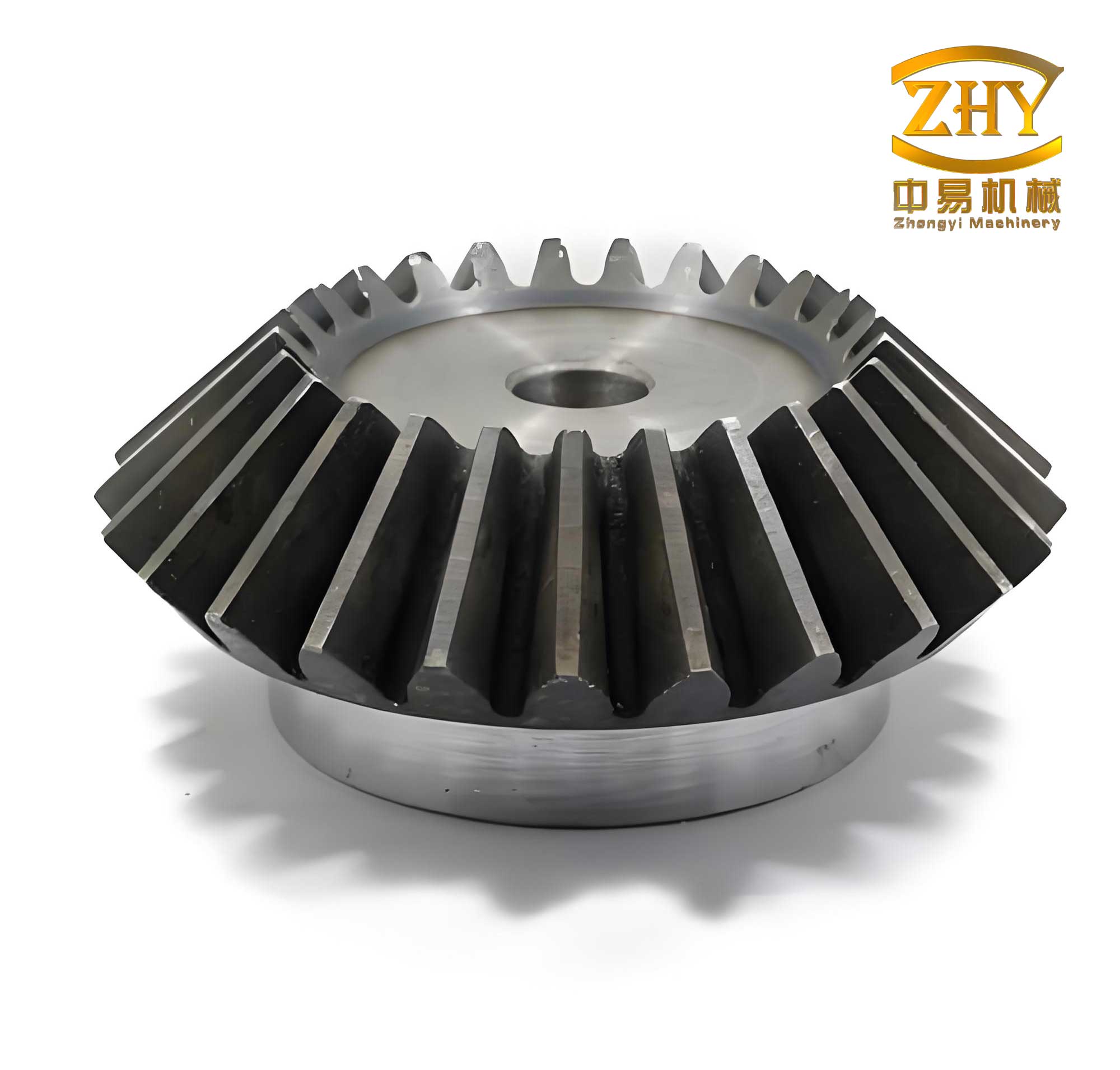
The cornerstone of this advanced manufacturing process is the creation of an accurate digital twin of the bevel gear. For spiral bevel gears operating in high-speed, high-load environments like helicopter transmissions, the tooth surface requirements are exceptionally stringent. The modeling process begins within dedicated bevel gear software (e.g., KIMOS), where the model is defined by a comprehensive set of basic parameters, selected cutting processes, and specific machine tool settings.
Taking a main gearbox spiral bevel gear pair as an example, the digital modeling workflow is as follows. Initial calculations are performed based on design drawing dimensions to generate a basic data card. Given the demanding application, the gear teeth are typically carburized to achieve high surface hardness while maintaining a tough core. To enhance load capacity, the tooth flanks are often modified with profile and longitudinal crowning. The software’s simulation tools are used to iteratively adjust these modification parameters until a qualified static contact pattern is achieved. The contact ellipse’s position, size, and shape on the tooth flank are critical indicators of proper meshing.
Following static simulation, dynamic analysis is conducted. By establishing a relative coordinate system between the pinion and gear tooth surfaces and inputting operational power and load data, the software simulates the gear pair under working conditions. This yields a dynamic contact pattern and contact stress analysis, visualized with color-coded stress maps. The dynamic contact pattern must also meet strict design criteria, guiding further fine-tuning of the static setup. A successful dynamic simulation confirms the theoretical soundness of the bevel gear design before physical manufacturing.
The mathematical foundation for the tooth surface geometry in such software is often based on the generating principle. The surface of a spiral bevel gear generated by a curved blade cutter can be represented parametrically. A point on the tooth surface is defined by the machine tool settings and cutter geometry. The basic coordinate transformation from the cutter coordinate system \( S_c \) to the gear coordinate system \( S_g \) involves a series of rotations and translations defined by machine settings like cradle angle \( q \), machine root angle \( \gamma_m \), and sliding base \( \Delta X_B \).
The locus of the cutter surface, represented in the gear coordinate system, gives the family of surfaces. The meshing equation, derived from the condition that the common normal at the contact point must be perpendicular to the relative velocity vector, is:
$$ f(u_c, \theta_c, q) = \mathbf{n}^{(c)} \cdot \mathbf{v}^{(cg)} = 0 $$
where \( u_c \) and \( \theta_c \) are the cutter surface parameters, \( \mathbf{n}^{(c)} \) is the normal vector on the cutter surface, and \( \mathbf{v}^{(cg)} \) is the relative velocity of the cutter relative to the gear. Solving this equation with the locus equation yields the mathematical model of the generated bevel gear tooth surface.
Contact stress analysis, a key output of the dynamic simulation, can be estimated using formulas like the Hertzian contact stress for elliptical contacts, which, while simplified, highlights the parameters involved:
$$ \sigma_H = \frac{3F_n}{2\pi a b} $$
Where \( F_n \) is the normal load, and \( a \) and \( b \) are the semi-major and semi-minor axes of the contact ellipse, whose dimensions are influenced by the relative curvature of the two bevel gear tooth surfaces and the load.
| Parameter Category | Specific Parameters | Influence on Gear Performance |
|---|---|---|
| Basic Geometry | Number of Teeth (N) | Determines gear ratio and size. |
| Module (m) | Defines tooth size and load capacity. | |
| Face Width (b) | Affects bending strength and contact pattern. | |
| Machine Settings | Cradle Angle (q) | Controls tooth curvature and spiral angle. |
| Machine Root Angle (γₘ) | Sets the root angle during cutting. | |
| Sliding Base (ΔX_B) | Influences tooth depth and profile. | |
| Modification Parameters | Profile Crowning | Prevents edge contact, accommodates misalignment. |
| Longitudinal Crowning | Localizes contact, improves load distribution. | |
| Flank Tilt | Adjusts contact pattern position. |
While the forward modeling process creates a theoretical bevel gear, the automated rounding technique often starts from a physical master gear—a proven component with excellent dynamic performance. This necessitates reverse modeling. The process involves measuring the actual tooth flanks of the master bevel gear on a precision gear measuring machine (e.g., a Gleason P100). A dense grid of points (e.g., a 5×9 grid of 45 points) is measured, capturing the actual surface coordinates (CMM data).
This point cloud data is imported into the bevel gear calculation software as a “master gear” or “sample gear.” The software’s “tooth surface comparison” function is used to adjust the theoretical model’s parameters (effectively, the virtual machine settings and cutter parameters) until the deviation between the theoretical surface and the measured points is minimized, typically within a tight tolerance of 0.003mm. This iterative adjustment reverses the traditional process: instead of using settings to predict a surface, we use the measured surface to deduce the effective settings that produced it. Once the theoretical model converges with the master gear data, the software can generate a 3D solid model of the bevel gear tooth geometry. This reverse-engineered digital model is geometrically faithful to the proven physical bevel gear and serves as the perfect foundation for developing subsequent finishing operations like tip rounding.
| Step | Action | Tool/Equipment | Output |
|---|---|---|---|
| 1 | Measurement of Master Bevel Gear | High-Precision Gear Measuring Machine | Cloud of (x, y, z) coordinate points for tooth flanks. |
| 2 | Data Import & Comparison | Bevel Gear Software (e.g., KIMOS) | Deviation map between theoretical model and measured data. |
| 3 | Parameter Optimization | Software Adjustment Algorithms | Optimized machine/cutter settings that minimize deviation. |
| 4 | 3D Model Generation | Software CAD Kernel | Accurate 3D solid model (.stp, .igs) of the bevel gear teeth. |
The 3D solid model obtained from reverse modeling typically contains the core tooth geometry: the active flank surfaces, root cone, face cone, and back cone. However, the tooth tip edges remain sharp. The next phase is to construct the rounding geometry digitally. The model is imported into a high-end CAD system (e.g., Siemens NX). Using surface modeling tools, a smooth, continuous fillet surface is created along the sharp edge where the tooth flank and the top land meet. The radius of this fillet is defined based on design requirements, which may specify a specific value or simply a smooth transition to eliminate sharp edges. The core challenge is ensuring tangency between the new fillet surface and both adjacent surfaces (the tooth flank and the top land) along the entire, complex 3D edge of the bevel gear tooth. This operation is performed parametrically for one tooth and then patterned around the entire gear, ensuring perfect consistency for every tooth on the bevel gear.
With the complete 3D model now featuring the rounded tooth tips, the process moves to manufacturing planning. This involves CAM programming for a 5-axis CNC machining center. The choice of tooling is critical because the bevel gear is often made from high-strength alloy steel (e.g., 9310 steel) and is carburized and hardened to a high surface hardness (e.g., HRA 81-83). Machining this hardened material requires specialized tooling. A solid carbide ball-nose end mill with a wear-resistant coating (e.g., a nano-blue coated tool) is selected, with a diameter suitable for the fillet radius, such as φ4 mm.
Within the CAM software, a multi-axis contouring operation is defined. The tool path is strategically planned to follow the 3D curve of the fillet. A single, continuous reciprocating tool path is often employed for each fillet to avoid visible witness lines from multiple entries and exits. The 5-axis capability is fully utilized, dynamically orienting the tool axis to maintain optimal cutting conditions and avoid collisions with the complex bevel gear geometry. The tool path generation must account for the kinematics of the specific 5-axis machine tool (e.g., a DMU 80P).
The generated CL (cutter location) data is then post-processed using a machine-specific postprocessor to create the final NC code (G-code). Before any physical cutting, the entire process is validated in a virtual environment using simulation software like VERICUT. This step is crucial for verifying the absence of collisions between the tool, holder, and the bevel gear workpiece, and for ensuring the tool path correctly produces the intended geometry.
The physical setup involves securely fixturing the hardened bevel gear on the 5-axis machine’s rotary table. The workpiece coordinate system is established, typically referencing the mounting distance face. A critical alignment step involves “teaching” the angular (C-axis) position. After machining the tip round on a single tooth, the result is inspected. If the fillet overcuts the left flank, the C-axis is offset slightly in the negative direction; if it overcuts the right flank, the offset is positive. This is adjusted until the fillet blends perfectly with both the tooth flank and the top land. Once this angular alignment is confirmed, the C-axis offset is saved, and the automated program is run to machine all tooth tips on the bevel gear identically.
| Parameter | Typical Setting / Choice | Rationale |
|---|---|---|
| Machine Tool | 5-Axis Machining Center (e.g., DMU 80P) | Provides full contouring capability for complex 3D curves. |
| Workpiece Material | Carburized & Hardened Alloy Steel (9310) | High core strength, hard wear-resistant surface. |
| Tool Type | Solid Carbide Ball-Nose End Mill | Required to cut hardened steel; ball-nose creates smooth fillet. |
| Tool Diameter | φ4 mm | Suited for typical fillet radii; provides good rigidity. |
| Tool Coating | Nano-Blue (AlTiN-based) | Enhances lubricity, heat resistance, and tool life on hard materials. |
| Spindle Speed (S) | High Speed (e.g., 10,000 – 15,000 rpm) | Optimizes cutting conditions for carbide tools on hard steel. |
| Feed Rate (F) | High Feed (e.g., 1,500 – 2,500 mm/min) | Maximizes efficiency while maintaining surface finish. |
| Cutting Strategy | Single-pass, Continuous Reciprocating Path | Avoids stop/start marks, ensures consistent surface finish. |
| Coolant | Minimum Quantity Lubrication (MQL) or Air Blast | Provides necessary cooling/lubrication in a clean, environmentally friendly manner. |
The successful implementation of this technology yields a bevel gear with tooth tip rounds that are geometrically precise, consistent from tooth to tooth, and possess a high-quality surface finish (achieving roughness values like Ra 0.4 μm). The rounding deviation is typically less than 0.1 mm, comfortably meeting design specifications. The elimination of sharp edges and burrs removes the source of interference and root damage during meshing. This directly contributes to the enhanced durability and service life of the entire bevel gear pair, mitigating the risk of fatigue failure and improving overall system reliability.
In conclusion, the automated rounding technology for bevel gear tooth tips represents a sophisticated integration of multiple advanced digital manufacturing disciplines. It synergizes bevel gear digital modeling and simulation, precision metrology, reverse engineering, 3D CAD/CAM programming, virtual machining verification, and finally, high-performance 5-axis machining. This methodology provides a definitive solution to the historical challenge of finishing bevel gear tooth tips. Compared to manual methods, it guarantees exceptional and repeatable quality, dramatically improves production efficiency, and fosters a safer, more sustainable manufacturing environment. The application of this technology is particularly valuable for high-performance bevel gears used in critical applications like aerospace, where reliability, consistency, and longevity are non-negotiable. The economic and operational benefits of producing superior, longer-lasting bevel gears through this automated process are substantial and wide-ranging.