
As a pivotal component in high-precision motion control systems, the Rotary Vector (RV) reducer represents a sophisticated evolution of the cycloidal drive. Its defining characteristics—compactness, high reduction ratios, exceptional torsional stiffness, minimal backlash, and superior motion accuracy—have cemented its role as a core technology, particularly in industrial robotics, machine tools, and semiconductor manufacturing equipment. The development trajectory of the RV reducer is marked by intense research into its design theory, manufacturing processes, and performance validation. This article synthesizes the current state of this research from both theoretical and experimental perspectives, outlining key advancements and charting a course for future investigation.
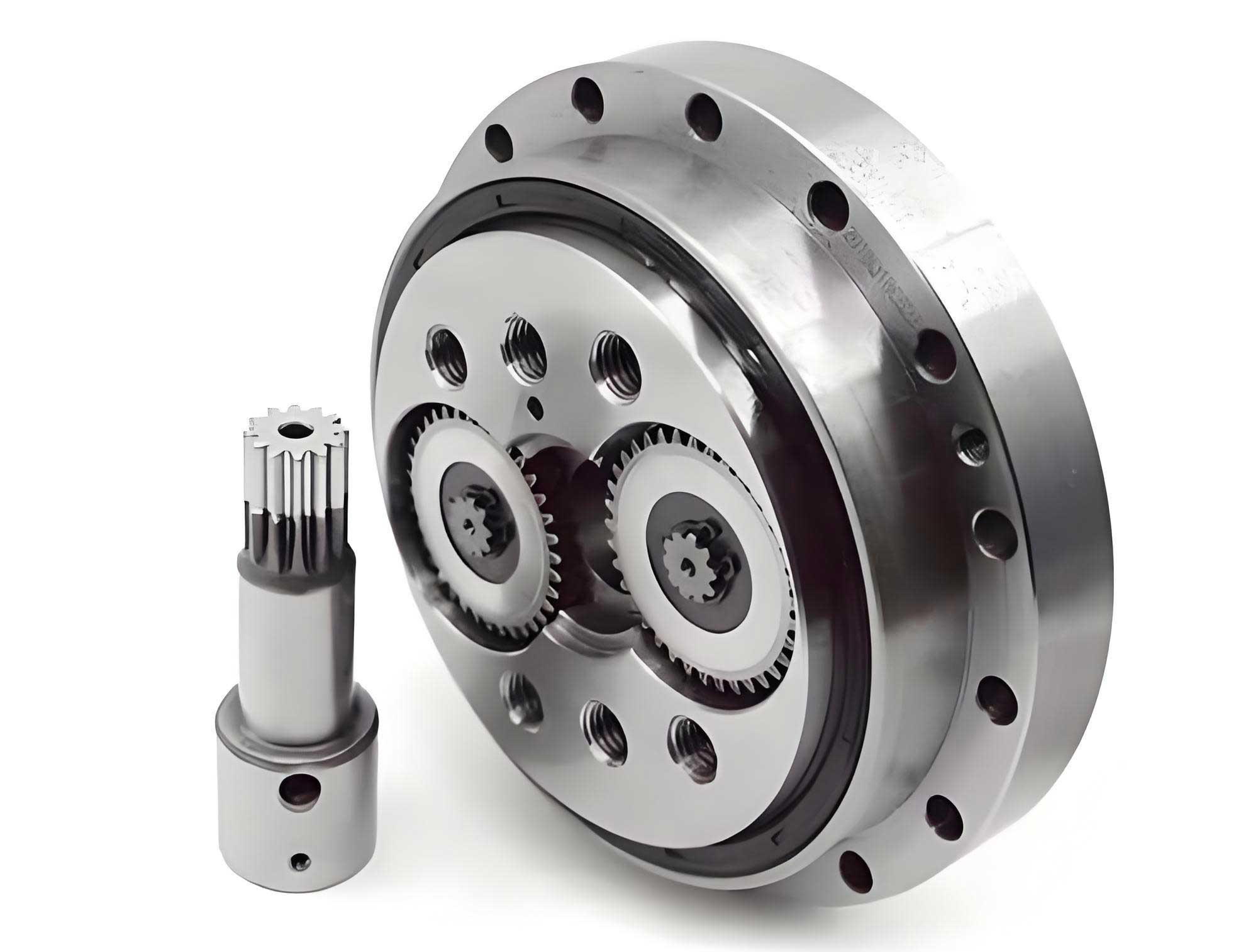
The operational principle of the RV reducer combines a first-stage planetary gear train with a second-stage cycloidal-pinwheel (or involute-cycloidal) differential. This two-stage configuration is the foundation for its high performance. The pursuit of optimizing this complex transmission system has branched into several interconnected research domains.
I. Foundational Theoretical Research Domains
Theoretical research provides the blueprint for the RV reducer’s performance. It focuses on mathematically modeling its behavior to optimize design parameters, predict performance under load, and understand the influence of imperfections.
1.1 Tooth Profile Optimization for the Cycloidal Gear
The heart of the RV reducer’s second stage is the meshing between the cycloidal disc and the ring of stationary pins. Pure conjugate cycloidal profiles theoretically provide multi-tooth contact but are impractical due to the need for lubrication clearance and compensation for manufacturing errors. Therefore, profile modification (or “tooth flank correction”) is essential. Research aims to find the optimal modification strategy that balances load distribution, backlash, and efficiency.
Common modification methods include equidistant modification ($$ \Delta R_{rp} $$), moving distance modification ($$ \Delta R_{rrp} $$), and profile angle modification ($$ \Delta \delta $$). The trend is toward combined modifications. For instance, a positive equidistant combined with a negative moving distance modification can generate a working profile that closely approximates the ideal conjugate shape while ensuring necessary radial clearance. This approach is expressed as modifications to the theoretical profile coordinates ($$ x_c, y_c $$):
$$ x_m = (R_{rp} + \Delta R_{rp}) \sin(\phi) – (a + \Delta a) \sin(z_c \phi) / \rho $$
$$ y_m = (R_{rp} + \Delta R_{rp}) \cos(\phi) – (a + \Delta a) \cos(z_c \phi) / \rho $$
where $$ R_{rp} $$ is the pin circle radius, $$ a $$ is the eccentricity, $$ z_c $$ is the number of pins, $$ \phi $$ is the input angle, and $$ \rho $$ is a reduction-related factor. Optimization algorithms are then used to solve for the modification amounts ($$ \Delta R_{rp}, \Delta a $$) that minimize objectives like transmission error under load or maximum contact stress.
1.2 Transmission Accuracy: From Static Geometry to Dynamic Behavior
Transmission accuracy, defined as the deviation between the actual and theoretical output position for a given input, is paramount for precision applications like robotic positioning. Research has evolved from static, geometric error analysis to complex dynamic models.
Static/Geometric Error Modeling: Early models treated the RV reducer as a kinematic chain. The cumulative effect of component errors (e.g., pin radius error $$ \Delta R_r $$, cycloid disc profile error, crank shaft eccentricity error $$ \Delta e $$, bearing clearance) on the output angle ($$ \theta_{out} $$) is analyzed. A simplified sensitivity model can be represented as:
$$ \Delta \theta_{out} = \sum_{i=1}^{n} S_i \cdot \delta_i $$
where $$ S_i $$ is the sensitivity coefficient for the i-th error source $$ \delta_i $$. Studies systematically rank these error sources. For example, the fit clearance between the pin and its housing often emerges as a dominant factor in geometric backlash.
Dynamic Transmission Error (DTE) Modeling: Modern research incorporates system dynamics, treating components as masses and meshing actions as time-varying springs. A dynamic model for an RV reducer with $$ N $$ crank shafts and two cycloidal discs may consider over 19 degrees of freedom, including torsional, radial, and axial motions. The equations of motion take the matrix form:
$$ \mathbf{M}\ddot{\mathbf{q}} + \mathbf{C}\dot{\mathbf{q}} + \mathbf{K(t)}\mathbf{q} = \mathbf{F(t)} $$
where $$ \mathbf{M} $$, $$ \mathbf{C} $$, and $$ \mathbf{K(t)} $$ are the mass, damping, and time-varying stiffness matrices, respectively; $$ \mathbf{q} $$ is the generalized coordinate vector; and $$ \mathbf{F(t)} $$ is the force vector including errors and loads. The time-varying meshing stiffness $$ k_{mesh}(t) $$ between the cycloid disc and pins is a critical component of $$ \mathbf{K(t)} $$, making the system nonlinear. Solving this system via numerical methods (e.g., Runge-Kutta) yields the DTE, revealing how errors and deformations interact under operating conditions, not merely sum linearly.
| Research Focus | Evolution of Approaches | Key Challenges & Current Frontiers |
|---|---|---|
| Tooth Profile Optimization | Single modification (e.g., equidistant) → Combined modifications (e.g., equidistant + moving) → Segmented/optimized composite profiles. | Finding the global optimum for multi-objective performance (stiffness, stress, efficiency, backlash). Linking profile parameters directly to dynamic performance metrics. |
| Transmission Accuracy | Geometric/static error analysis → Linear dynamic models → Nonlinear dynamic models with time-varying stiffness and clearances. | Accurately modeling the coupling effects of multiple nonlinearities (contact, friction, bearing clearance). Validating complex dynamic models with high-fidelity experimental data. |
| Backlash Analysis | Worst-case tolerance stack-up → Statistical tolerance analysis → Probabilistic models considering error distributions. | Dynamic backlash under varying load and temperature. Optimal allocation of manufacturing tolerances to minimize cost while meeting a probabilistic backlash target. |
| Torsional Stiffness | Component-based analytical formulas → Finite Element Analysis (FEA) of sub-assemblies → System-level nonlinear stiffness models. | Modeling the full system’s nonlinear, load-dependent stiffness characteristic. The coupled effect of housing, bearing, and gear mesh compliance on overall stiffness. |
1.3 Backlash Analysis and Control
Backlash, the lost motion when direction is reversed, critically affects positioning accuracy and system stability. For the RV reducer, backlash arises from multiple clearances: pin-pin hole fit ($$ J_{pin} $$), bearing internal clearance ($$ J_{bearing} $$), and the designed tooth flank clearance from profile modification ($$ J_{tooth} $$). The total geometric backlash ($$ J_{total} $$) is not a simple sum but a complex function of the kinematic chain. An approximate formula for the contribution of pin fit clearance to angular output backlash is:
$$ J_{ang-pin} \approx \frac{2 \cdot C_{pin}}{R_{rp}} \cdot \frac{z_c}{z_c – 1} \cdot i_{total} $$
where $$ C_{pin} $$ is the radial clearance from the pin fit, and $$ i_{total} $$ is the total reduction ratio. Research focuses on modeling all sources and developing compensation strategies, either through precision manufacturing and assembly (minimizing sources) or through advanced control algorithms that anticipate and counteract its effects.
1.4 Torsional Stiffness Modeling
High torsional stiffness ensures the RV reducer resists deformation under load, maintaining accuracy. Stiffness ($$ K_T $$) is defined as the applied output torque ($$ T $$) divided by the resulting elastic torsional deflection ($$ \Delta \theta $$): $$ K_T = T / \Delta \theta $$. The overall stiffness is a series combination of several compliances:
$$ \frac{1}{K_{T\_total}} = \frac{1}{K_{T\_stage1}} + \frac{1}{K_{T\_crank}} + \frac{1}{K_{T\_bearing}} + \frac{1}{K_{T\_stage2}} + \frac{1}{K_{T\_output}} $$
Stage 2 (cycloidal-pin mesh) stiffness ($$ K_{T\_stage2} $$) is often the most complex and significant. It is time-varying due to the changing number of tooth pairs in contact. A common modeling approach treats each contacting tooth pair as a nonlinear spring, and the combined mesh stiffness $$ k_{mesh}(t) $$ is calculated as the sum in action. The equivalent torsional stiffness at the output due to the cycloid stage is then related to $$ k_{mesh}(t) $$, the eccentricity, and the pitch circle radii. Advanced models use finite element analysis or analytical contact mechanics to predict this stiffness more accurately, informing designs that achieve the required rigidity (often targeting an elastic backlash of less than 1 arc-minute under rated torque).
II. Experimental and Applied Research Frontiers
Theoretical models must be validated and refined through experimental research, which also tackles the practical challenges of making and proving an RV reducer.
2.1 Manufacturing Process Technology
The performance promised by theory is only realized through precision manufacturing. Key challenges include:
- Cycloidal Disc Grinding: Achieving the optimized, modified profile with micron-level accuracy and excellent surface finish. The process must also manage residual stresses and heat treatment distortions, especially for thin-rimmed designs.
- Crank Shaft Machining: Manufacturing the eccentric cranks with high dimensional accuracy, parallelism, and surface hardness. The consistency of eccentricity between multiple cranks on a single shaft is critical for load sharing.
- Precision Assembly: Developing assembly techniques and sequences that minimize induced stress and error. This includes methods for selective fitting, preload adjustment for bearings, and verification of gear mesh patterns. Research into automated, precision assembly lines is crucial for achieving consistent quality in mass production.
Process capability studies are essential to link theoretical tolerance analyses with practical, cost-effective manufacturing. For instance, determining the actual distribution of pin hole position errors on a housing allows for a statistical, rather than worst-case, backlash analysis.
2.2 Integrated Performance Testing
Comprehensive testing is required to certify an RV reducer’s performance against specifications like ISO 9409 or proprietary standards. Research focuses on developing accurate, reliable, and efficient test rigs. Key measurements include:
- Static Stiffness & Hysteresis: Applying a slowly increasing then decreasing torque to the output while measuring angular displacement. This yields the stiffness curve and the hysteresis loop, from which loss motion (a combination of backlash and friction-induced loss) can be derived.
- Motion Accuracy & Dynamic Transmission Error: Using high-resolution encoders on both input and output shafts under no-load and loaded conditions, often across multiple revolutions, to measure positioning error. Dynamic tests involve running the RV reducer at operational speeds.
- Efficiency Mapping: Measuring input and output power (torque and speed) across the operating range (varying torque and speed) to generate efficiency contour maps.
- Lifetime and Durability Testing: Accelerated life testing under overload or continuous operation to predict service life and identify failure modes.
Advanced test systems integrate these capabilities into a single platform, using real-time data acquisition and analysis to provide a complete performance signature of the RV reducer unit. The data from these tests is invaluable for validating and refining the theoretical models described earlier.
| Component | Key Error Sources | Primary Impact on Performance | Typical Mitigation Strategy |
|---|---|---|---|
| Cycloidal Disc | Profile form error, pitch error, tooth spacing error, eccentricity error relative to bearing bore. | Transmission error (velocity ripple), increased vibration and noise, uneven load sharing, reduced torsional stiffness. | High-precision form grinding with CBN wheels, post-grinding inspection with coordinate measuring machines (CMM), optimized heat treatment process. |
| Pin Ring / Housing | Pin position (circle) error, pin diameter error, pin hole roundness and fit clearance. | Significant contributor to geometric backlash, transmission error, affects load distribution among pins. | Precision boring of pin holes, use of fitted pins or adjustable pins, selective assembly based on pin diameter measurement. |
| Crank Shaft | Eccentric journal diameter error, eccentric phase error between journals, journal parallelism error. | Uneven loading between cycloidal discs, induces wobble and vibration, affects system stiffness. | Precision CNC grinding, in-process gauging, strict control of journal geometry and relative positioning. |
| Bearings | Internal radial clearance, preload inconsistency, raceway runout. | Affects system stiffness, contributes to backlash and axial/radial play, influences running torque and life. | Use of high-precision bearings (P4/P2 class), controlled preload during assembly, thermal management to maintain preload. |
| Gears (Stage 1) | Involute profile error, pitch error, tooth alignment error, center distance error. | Contributes to overall transmission error and noise, especially at higher input speeds. | Precision gear grinding or honing, accurate housing boring for bearing seats. |
III. Synthesis and Prospective Research Directions
The development of the RV reducer is a multidisciplinary endeavor integrating mechanical design, dynamics, tribology, materials science, and precision engineering. While significant progress has been made, several frontiers demand continued research to achieve the next level of performance, reliability, and accessibility.
Future Research Trajectories:
- Unified High-Fidelity Digital Twin: Developing integrated simulation models that seamlessly combine nonlinear dynamics, thermo-mechanical effects, lubrication, and wear progression. This “digital twin” would allow for virtual prototyping and lifetime prediction, drastically reducing development time and cost for new RV reducer designs.
- Advanced Materials and Surface Engineering: Exploring new material pairs for gears and bearings (e.g., advanced case-hardening steels, ceramic hybrids) and novel surface treatments (e.g., diamond-like carbon coatings, micro-texturing) to further increase power density, efficiency, and service life.
- Intelligent Manufacturing and Assembly: Implementing in-process monitoring and adaptive control in machining (e.g., using force feedback in grinding). Researching AI-driven assembly lines that can automatically select components and adjust processes to compensate for measured part variations, ensuring consistently high performance from mass-produced units.
- Condition Monitoring and Prognostic Health Management (PHM): Embedding sensors (e.g., for vibration, temperature, acoustic emission) within the RV reducer to enable real-time health assessment. Developing algorithms to detect incipient faults (e.g., spalling, crack initiation) and predict remaining useful life, enabling predictive maintenance for robotic systems.
- Standardization of Performance Characterization: Promoting the establishment of more detailed, internationally recognized test standards for RV reducers, covering dynamic accuracy under load, efficiency maps, and lifetime testing protocols. This would facilitate objective comparison and accelerate technological diffusion.
The trajectory of RV reducer research is clear: from understanding and modeling its complex static behavior to mastering its dynamic personality under real-world conditions, and ultimately towards intelligent, self-aware, and ultra-reliable mechanical power transmission units. The ongoing research across theory, manufacturing, and testing is not merely about replicating existing high-performance designs but about advancing the fundamental science of precision gearing to unlock new capabilities for future high-end machinery and robotics.