
In the field of mechanical engineering, spiral bevel gears play a crucial role due to their superior performance in power transmission systems. The spiral bevel gear, characterized by its curved tooth line on the pitch cone, offers significant advantages over straight bevel gears, including higher overlap ratios, increased load-bearing capacity, and smoother operation. These attributes make spiral bevel gears indispensable in applications such as aerospace engines, automotive drivetrains, tractors, and mining machinery. However, the complex tooth surface geometry of spiral bevel gears, described by transcendental nonlinear equations, poses substantial challenges in manufacturing, often requiring specialized and expensive equipment.
Traditional machining methods for spiral bevel gears, such as the fixed-setting method, are tailored for mass production. These approaches involve multiple mechanical movements, lengthy process chains, cumbersome adjustments, and limited precision and efficiency. In recent years, advanced five-axis or six-axis CNC spiral bevel gear milling machines have been developed by several companies worldwide. These machines transfer complexity from hardware to software, embodying informatization and intelligence with simpler structures, enhanced rigidity, high accuracy, and program-controlled flexibility. Nonetheless, their high technological content and cost render them unsuitable for small-batch or single-piece production. To address this gap, this study explores a simplified NC machining method based on form-cutting principles, enabling the production of spiral bevel gears using retrofitted ordinary vertical milling machines. This approach leverages open-architecture CNC systems to reduce costs while maintaining acceptable precision, making it viable for prototyping and low-volume manufacturing.
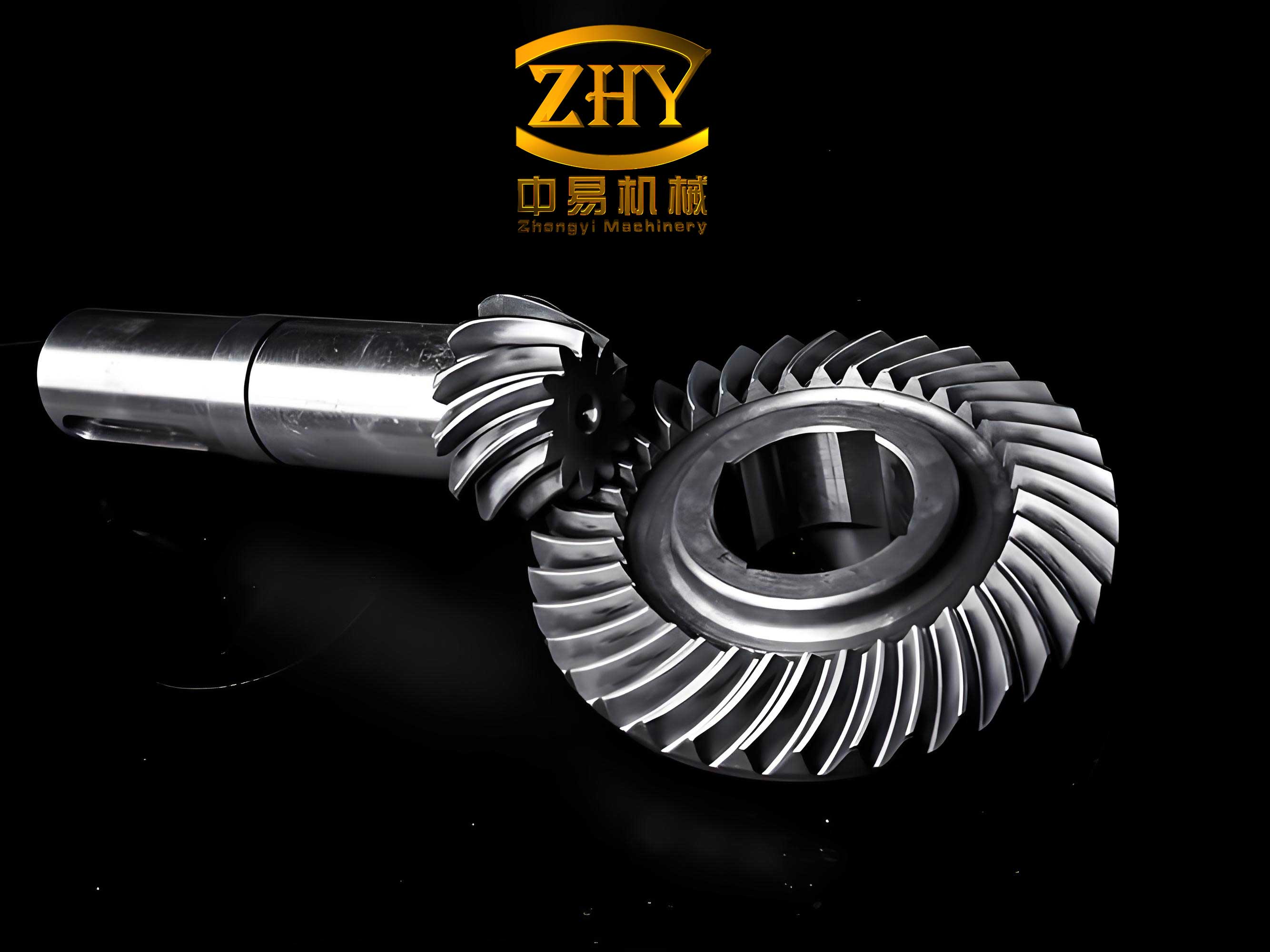
The core of this research lies in deriving a straightforward mathematical model for the tooth profile generation of spiral bevel gears. By analyzing the geometric relationships during cutting, we establish formulas that facilitate easy implementation on a CNC system. The methodology involves retrofitting a standard vertical milling machine with a PC-based open CNC system, incorporating a multi-axis motion control card to coordinate linear and rotational movements. This setup allows for the form-cutting of spiral bevel gears with minimal hardware modifications. Below, we detail the principles, error compensation strategies, hardware and software configurations, and practical outcomes of this simplified NC process. Throughout this discussion, the term “spiral bevel gear” will be frequently emphasized to underscore its centrality to the study.
Principles of Simplified NC Machining for Spiral Bevel Gears
The simplified NC machining method is grounded in form-cutting, where a tool with a predefined profile generates the gear tooth shape. For spiral bevel gears, the goal is to produce a curved tooth line that approximates an arc on the pitch cone. The process involves fixing the gear blank on an inclined surface, ensuring that the root cone is tangent to the horizontal plane. A finger-type milling cutter then moves horizontally along the root cone at a constant velocity. If the blank remains stationary, straight teeth are cut; however, by simultaneously rotating the blank at a controlled speed, the tooth profile becomes curved, forming a spiral bevel gear. In practice, the blank is mounted on a dividing head attached to an inclined slide that moves horizontally on the machine table, while the cutter remains fixed. This synchronized linear and rotational motion generates the desired spiral tooth geometry.
To mathematically describe this process, consider the development of the outer cone of a right-hand spiral bevel gear. Let O1 be the cone apex, O2 the center of the cutter circle, and B the midpoint of the tooth width on the pitch cone. When cutting starts from the small end point A, the rotation of the dividing head results in an arc AC. From triangle O1O2B, with known values of the spiral angle β, radius R1 (segment O1B), and radius R (segment O2B), the distance L between O1 and O2 can be derived using the law of cosines:
$$ L^2 = R^2 + R_1^2 – 2RR_1 \sin \beta $$
Solving for L:
$$ L = \sqrt{R^2 + R_1^2 – 2RR_1 \sin \beta } $$
Next, angles α1 and α2 are defined relative to the geometry. Specifically, α1 is the angle between O1O2 and O1B, while α2 is the angle between O1O2 and O1A, where r denotes the distance from the cone apex to the current point A (i.e., segment O1A). These angles are given by:
$$ \alpha_1 = \arccos \left( \frac{R_1 – R \sin \beta}{L} \right) $$
$$ \alpha_2 = \arccos \left( \frac{R_1^2 + r^2 – 2RR_1 \sin \beta}{2L R_1} \right) $$
The variation in angle, Δα, as a function of r is:
$$ \Delta \alpha = \alpha_2 – \alpha_1 $$
This leads to the key relationship for the rotational angle Δθ of the dividing head during the cutting of one tooth:
$$ \Delta \theta = \frac{\Delta \alpha}{\sin \gamma} $$
where γ is the pitch cone half-angle. This formula encapsulates the fundamental kinematic requirement for generating the spiral tooth profile. By programming the CNC system to adjust Δθ based on real-time linear displacement, the spiral bevel gear tooth can be accurately machined. The following table summarizes the geometric parameters involved in these calculations:
| Symbol | Description | Unit |
|---|---|---|
| β | Midpoint spiral angle | degrees or radians |
| R1 | Distance from cone apex to tooth width midpoint | mm |
| R | Radius of cutter circle (tool offset) | mm |
| L | Distance between cone apex and cutter center | mm |
| r | Current distance from cone apex along tooth | mm |
| γ | Pitch cone half-angle | degrees or radians |
| Δθ | Rotational angle of dividing head per tooth | degrees or radians |
These equations provide a simplified yet effective model for NC machining of spiral bevel gears. However, due to the varying spiral angle along the tooth line, a single form tool designed for the midpoint engagement introduces errors toward the ends. To mitigate this, an error compensation strategy is essential.
Error Compensation Strategy
In form-cutting of spiral bevel gears, the tool profile is optimized for the midpoint of the tooth, leading to deviations at the toe and heel regions. The error increases with distance from the midpoint, potentially affecting gear meshing quality. To address this, we propose an iterative compensation method based on empirical data. Initially, a standard spiral bevel gear manufactured via conventional gear generation methods (e.g., cutter tilt and roll) is measured to obtain the actual tooth flank trajectory. Through multiple trial cuts and comparisons with the standard, a trajectory correction parameter table is constructed. This table contains incremental correction values for the rotational angle Δθ at discrete points along the tooth length.
During machining, as the cutter moves from the midpoint toward the large end, a negative correction parameter is added to Δθ at each step; conversely, when moving from the small end toward the midpoint, a positive correction is applied. The correction values are averaged from adjacent entries in the parameter table to ensure smooth transitions. Repeated iterations refine these parameters, gradually reducing tooth profile errors to within acceptable tolerances. This adaptive approach compensates for tool misalignment and geometric inaccuracies, enhancing the precision of the simplified NC process for spiral bevel gears. The compensation process can be summarized as follows:
Let Δθ_nom be the nominal rotational angle calculated from the geometric model, and δ_i be the correction parameter at point i along the tooth. The compensated angle Δθ_comp is:
$$ \Delta \theta_{\text{comp}} = \Delta \theta_{\text{nom}} + \delta_i $$
where δ_i is derived from the trajectory correction table. Over successive machining trials, δ_i is updated to minimize the root mean square error between the machined profile and the standard spiral bevel gear profile. This method, while empirical, proves effective for small-batch production where high-cost measurement systems are not justified.
NC System Retrofit for Ordinary Milling Machines
To implement the simplified machining method, an ordinary vertical milling machine is retrofitted with an open-architecture CNC system. This retrofit adopts a “PC + multi-axis controller” approach, which replaces traditional complex mechanical components like rockers, eccentric mechanisms, and cutter tilt adjustments with software control. The system leverages the versatility and computational power of personal computers, combined with dedicated motion control cards, to achieve coordinated multi-axis movements. This configuration not only reduces hardware costs but also improves flexibility and maintainability, making it ideal for machining spiral bevel gears in resource-constrained settings.
Hardware Configuration
The hardware core is a motion control card, specifically the HDMC-CP-630, developed for economical multi-axis control. This card is inserted into an ISA slot of a standard PC (e.g., with a 586 or higher processor and at least 64 MB RAM). The HDMC-CP-630 utilizes three National LM628 motion control chips, providing 32-bit resolution for position, velocity, and acceleration control. It supports PID compensation filtering with 16-bit resolution for proportional, integral, and derivative coefficients, enabling precise servo tuning and accurate positioning.
The card interfaces with external components via flat cables connected to an I/O board. Key connections include:
- Differential or single-ended incremental encoder inputs for feedback from servo motors.
- Limit switch inputs for safety boundaries.
- Enable signals for drive amplifiers.
- Home signal and error detection interfaces.
- General-purpose digital I/O for auxiliary controls.
In this setup, three axes are independently controlled: one for the horizontal linear motion of the worktable (X-axis), one for the rotational motion of the dividing head (C-axis), and one optionally for vertical adjustments (Z-axis). The worktable is driven by a DC servo motor with an integrated rotary encoder, providing real-time position feedback to the motion control card. Similarly, the dividing head is equipped with a servo motor that receives angle commands from the card. The control accuracy reaches 6×10^(-6) degrees per pulse, sufficient for spiral bevel gear machining. The hardware connections are illustrated in the following diagram (described textually due to HTML constraints):
- PC with HDMC-CP-630 card → I/O interface board → Servo motors (X, C axes) and encoders.
- Power amplifiers and limit switches are integrated into the loop.
The table below outlines the key specifications of the HDMC-CP-630 motion control card:
| Feature | Description |
|---|---|
| Control Axes | 3 independent axes (position or velocity mode) |
| Resolution | 32-bit for position, speed, acceleration |
| PID Filter | 16-bit coefficients for precise servo adjustment |
| Encoder Interface | Industrial differential/single-ended incremental |
| Digital I/O | 24-bit input (16 opto-isolated, 8 TTL), 16-bit output (8 opto-isolated, 8 open-collector) |
| Communication | ISA bus interface with PC |
This hardware framework enables closed-loop control, where the encoder feedback from the worktable continuously updates the system, allowing the motion control card to compute and send corresponding rotation angles to the dividing head. This synchronization is crucial for accurate generation of spiral bevel gear teeth.
Software System Development
The software system is developed in C++ Builder under Windows 98 or higher, utilizing the command set provided by the HDMC-CP-630 card. The code is modular, consisting of three primary modules that handle parameter management, NC machining operations, and peripheral data acquisition. This structure enhances usability, maintainability, and scalability for machining spiral bevel gears.
1. Part Parameter Management Module: This module allows users to input and store machining parameters for the spiral bevel gear, such as geometric dimensions (pitch cone angle, spiral angle, tooth width), accuracy tolerances, and correction coefficients. Parameters are saved in files for future retrieval and modification. Functions include opening, closing, saving, and resetting parameter sets, ensuring that different gear specifications can be managed efficiently.
2. NC Machining Control Module: This core module processes the input parameters using the HDMC-CP-630 command set. It performs real-time calculations based on the geometric formulas (e.g., equations (1) to (4)) to generate drive signals for the servo motors. The interface displays real-time data, such as worktable displacement and dividing head rotation angle, providing operators with visual feedback. Additionally, the module configures the motion control card settings, including initialization, control mode selection (e.g., point-to-point or continuous path), PID parameter tuning, and interface customization (colors, fonts). The control algorithm ensures smooth interpolation between linear and rotational axes, critical for spiral bevel gear accuracy.
3. Peripheral Data Acquisition Module: To facilitate operation and maintenance, the milling machine’s control panel includes buttons, switches, and limit switches. This module monitors these external devices, capturing signal changes and triggering appropriate actions in the software. For example, emergency stops, feed hold, or cycle start commands are handled in real time, enhancing system safety and responsiveness.
The software integrates the error compensation strategy by accessing the trajectory correction table during machining. As the cutter progresses along the tooth, the system retrieves compensation values and adjusts Δθ dynamically. This integration is achieved through subroutine calls within the NC machining module, ensuring seamless error correction without operator intervention.
Implementation and Practical Results
The simplified NC machining system has been deployed in a domestic manufacturing facility for producing spiral bevel gears in small batches. The retrofit involved installing the motion control hardware on a conventional vertical milling machine and configuring the software with gear-specific parameters. During trials, spiral bevel gears with moderate sizes (e.g., pitch diameters up to 200 mm) were machined using form cutters tailored to the gear specifications. The process steps included:
- Mounting the gear blank on the inclined dividing head.
- Setting tool offsets and workpiece zero points.
- Inputting gear parameters into the software.
- Running the NC program to perform synchronized linear and rotational cuts.
- Applying error compensation based on pre-calibrated correction tables.
Results indicated that the system operates reliably, with machining times comparable to traditional methods for single-piece production. The accuracy of the generated spiral bevel gears was evaluated using coordinate measuring machines (CMMs) and gear analyzers. Key performance metrics included tooth profile error, pitch deviation, and surface roughness. After several iterations of error compensation, the tooth profile error was reduced to within 0.05 mm, acceptable for many industrial applications. The table below summarizes the comparative advantages of this simplified NC method over conventional approaches:
| Aspect | Traditional Fixed-Setting Method | Advanced Multi-Axis CNC Machines | Simplified NC Retrofit Method |
|---|---|---|---|
| Cost | Moderate (but high for setup) | Very high | Low |
| Flexibility | Low (batch-oriented) | High (programmable) | Moderate (suitable for small batches) |
| Precision | Moderate | High | Acceptable (with compensation) |
| Setup Complexity | High (mechanical adjustments) | Low (software-based) | Low (minimal hardware changes) |
| Ideal Production Volume | Mass production | Medium to high volume | Single-piece and small batches |
The economic benefits are significant: the retrofit costs a fraction of a dedicated CNC spiral bevel gear machine, while still enabling the production of functional gears for prototypes, repairs, or low-volume orders. Moreover, the open-architecture system allows for easy upgrades and integration with modern CAD/CAM software, further enhancing its capability for spiral bevel gear manufacturing.
Mathematical Extensions and Optimization
To deepen the understanding of the spiral bevel gear machining process, we can extend the geometric model to include dynamic factors such as cutter wear, thermal effects, and machine tool deflections. However, for the simplified NC method, the core equations suffice. We reiterate the key formulas in a consolidated form, emphasizing their role in spiral bevel gear generation.
The distance L between cone apex and cutter center is fundamental:
$$ L = \sqrt{R^2 + R_1^2 – 2RR_1 \sin \beta } $$
The angular relationship for any point along the tooth, at distance r from the apex, is given by:
$$ \alpha_1 = \arccos \left( \frac{R_1 – R \sin \beta}{L} \right), \quad \alpha_2 = \arccos \left( \frac{R_1^2 + r^2 – 2RR_1 \sin \beta}{2L R_1} \right) $$
Thus, the required rotation angle Δθ per tooth increment is:
$$ \Delta \theta = \frac{\arccos \left( \frac{R_1^2 + r^2 – 2RR_1 \sin \beta}{2L R_1} \right) – \arccos \left( \frac{R_1 – R \sin \beta}{L} \right)}{\sin \gamma} $$
This equation can be discretized for CNC interpolation. Let the linear displacement along the worktable be Δx, corresponding to a change Δr in the radial distance. Assuming a constant feed rate, the relationship between Δx and Δr is linear for small increments. Then, the CNC system updates r and computes Δθ at each step, sending pulses to the dividing head servo motor. This real-time computation is handled efficiently by the PC, ensuring smooth motion profiles.
For optimization, we can consider the sensitivity of Δθ to parameter variations. Partial derivatives with respect to β, R, or R1 indicate how machining errors propagate. For instance, the sensitivity to spiral angle β is:
$$ \frac{\partial \Delta \theta}{\partial \beta} = \frac{1}{\sin \gamma} \left( \frac{\partial \alpha_2}{\partial \beta} – \frac{\partial \alpha_1}{\partial \beta} \right) $$
where the derivatives of α1 and α2 can be computed analytically. Such analysis helps in setting tighter tolerances for critical parameters during gear blank preparation, improving overall spiral bevel gear quality.
Conclusion
This research presents a simplified NC machining method for spiral bevel gears, leveraging form-cutting principles and open-architecture CNC systems. By deriving straightforward geometric formulas and implementing them on a retrofitted ordinary milling machine, we achieve a cost-effective solution for single-piece and small-batch production. The method eliminates complex mechanical components, relying instead on software control to synchronize linear and rotational axes. Error compensation through empirical trajectory correction enhances accuracy, making the spiral bevel gears suitable for various industrial applications.
The hardware setup centered on the HDMC-CP-630 motion control card provides precise multi-axis coordination, while the modular software ensures user-friendly operation and adaptability. Practical deployment in a manufacturing environment has demonstrated the system’s reliability, efficiency, and economic advantages. Future work could focus on integrating advanced sensing for real-time adaptive control, extending the method to other gear types, and incorporating machine learning for automatic error compensation. Nonetheless, this simplified approach represents a significant step toward democratizing spiral bevel gear manufacturing, particularly for small enterprises and research institutions. The repeated emphasis on spiral bevel gears throughout this study underscores their engineering importance and the value of accessible machining technologies.
In summary, the synergy of geometric modeling, error compensation, and PC-based CNC retrofitting offers a viable pathway for producing spiral bevel gears without prohibitive costs. As industries continue to demand customized and low-volume gear solutions, such simplified methods will play an increasingly vital role in advancing mechanical transmission systems.