
In the field of mechanical transmission, gear systems are pivotal due to their high efficiency, compact structure, and reliability. Among various gear types, helical gears are widely used because of their smooth operation and high load-carrying capacity. However, bending fatigue failure remains a primary mode of failure for gears, making bending fatigue strength a critical indicator for evaluating gear performance. In this study, I focus on the bending fatigue testing of involute helical gears, addressing the challenges in accurately assessing their strength through simulations and experimental methods. The necessity for direct testing arises from limitations in current standard calculation methods, which rely on simplified corrections that may not capture the complex stress distributions in helical gears. Through this research, I aim to develop a robust testing methodology that can enhance the accuracy of helical gear design and evaluation.
The bending fatigue strength of gears is traditionally evaluated using standards such as GB/T 3480—1997, which calculates root stress based on equivalent spur gears with multiple correction factors. However, for helical gears, the presence of a helix angle introduces complexities in stress distribution due to inclined contact lines and varying contact lengths during meshing. This complexity is not fully accounted for in standard formulas, leading to potential discrepancies between calculated and actual stresses. Therefore, I embarked on a comprehensive analysis using simulation software to understand the behavior of helical gears under load and to design an effective bending fatigue test method. The goal is to bridge the gap between theoretical predictions and real-world performance, ensuring the reliability of helical gears in practical applications.
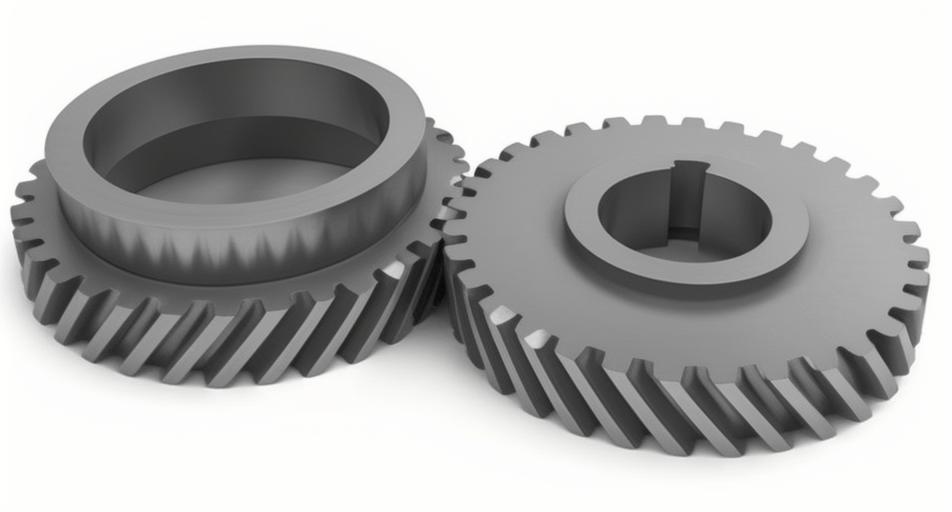
To investigate the influence of the helix angle on root stress in helical gears, I utilized RomaxDesigner simulation software. This tool allows for detailed finite element analysis of gear meshing processes, enabling the observation of stress variations and contact line dynamics. I modeled helical gears with different helix angles while keeping other parameters constant, as summarized in Table 1. The parameters include number of teeth, module, pressure angle, helix angle, and face width. The load applied was a constant torque to simulate realistic operating conditions. Through these simulations, I captured the maximum root stress during meshing and analyzed how it changes with the helix angle and contact line length.
| Parameter | Value |
|---|---|
| Number of Teeth, z | 20 |
| Normal Module, m_n (mm) | 6 |
| Normal Pressure Angle, α_n (°) | 20 |
| Helix Angle, β (°) | 0 to 30 |
| Face Width, b (mm) | 38 |
| Addendum Coefficient, h*_an | 1 |
| Dedendum Coefficient, c*_n | 0.264 |
| Profile Shift Coefficient, x | 0 |
| Applied Torque, T (N·m) | 2640 |
The simulation results revealed that for helical gears, the maximum root stress occurs at the instant when the contact line enters the full face width, corresponding to the shortest total contact length. This is in contrast to spur gears, where stress distribution is more uniform. The stress patterns for different longitudinal contact ratios (ε_β) are illustrated through contour plots, showing concentrated stress areas along the inclined contact lines. As the helix angle increases, the contact line becomes more倾斜, affecting the load distribution and stress magnitude. I quantified this by comparing the maximum root stress values from simulations with those calculated using the standard method from GB/T 3480—1997.
The standard formula for root stress calculation is given by:
$$
\sigma_F = \sigma_{F0} K_A K_V K_{F\beta} K_{F\alpha}
$$
where σ_{F0} is the nominal root stress, calculated as:
$$
\sigma_{F0} = \frac{F_t}{b m_n} Y_S Y_F Y_\beta
$$
Here, F_t is the nominal tangential force in the transverse plane, b is the face width, m_n is the normal module, Y_S is the form factor, Y_F is the stress correction factor, and Y_β is the helix angle factor. For simplicity, I denote Y = Y_S Y_F Y_β, which incorporates corrections for the helix angle. However, this factor may not accurately reflect the actual stress variations in helical gears due to the complex interplay of contact geometry and load sharing.
To assess the accuracy of the standard method, I computed the root stress for helical gears with varying helix angles and compared it with simulation results. The data is presented in Table 2, which includes the helix angle, longitudinal contact ratio, correction factor Y, nominal tangential force, and ratios of standard calculated values and simulation values relative to a spur gear (β = 0°). The trends show that as the helix angle increases, the root stress decreases, but the standard calculations consistently underestimate the stress compared to simulations. This discrepancy becomes more pronounced at higher helix angles, indicating a need for more precise evaluation methods for helical gears.
| Helix Angle, β (°) | Longitudinal Contact Ratio, ε_β | Correction Factor, Y | Nominal Tangential Force, F_t (kN) | Standard Calculation Ratio | Simulation Ratio |
|---|---|---|---|---|---|
| 0 | 0 | 3.087 | 44.000 | 1.000 | 1.000 |
| 2.85 | 0.1 | 3.003 | 43.945 | 0.972 | 0.978 |
| 5.70 | 0.2 | 2.968 | 43.783 | 0.957 | 0.966 |
| 8.56 | 0.3 | 2.908 | 43.510 | 0.932 | 0.952 |
| 11.45 | 0.4 | 2.877 | 43.124 | 0.913 | 0.950 |
| 14.37 | 0.5 | 2.845 | 42.623 | 0.893 | 0.949 |
| 17.32 | 0.6 | 2.624 | 42.005 | 0.811 | 0.887 |
| 20.32 | 0.7 | 2.485 | 41.262 | 0.755 | 0.853 |
| 23.39 | 0.8 | 2.399 | 40.384 | 0.713 | 0.840 |
| 26.52 | 0.9 | 2.354 | 39.370 | 0.682 | 0.837 |
| 29.74 | 1.0 | 1.297 | 38.205 | 0.646 | 0.833 |
The comparison highlights a significant difference between standard calculations and simulation results, especially for helical gears with helix angles above 20°. The simulation ratios tend to stabilize, whereas the standard ratios continue to decrease. This underestimation in the standard method can lead to non-conservative designs, where helical gears might be perceived as stronger than they actually are, potentially resulting in premature failures. To quantify the impact on fatigue life, I refer to the S-N curve from GB/T 3480—1997, which relates stress to the number of cycles to failure. For case-hardened gears, the fatigue life N_L is given by:
$$
N_L = \left( \frac{Y_{NT}}{3 \times 10^6} \right)^{8.7}
$$
where Y_{NT} is the life factor. A small error in stress calculation can amplify into a large discrepancy in predicted life, as evidenced by the example where the difference in stress ratios translates to a nine-fold variation in fatigue life. This underscores the necessity of conducting direct bending fatigue tests on helical gears to obtain accurate strength data.
Bending fatigue testing for gears can be performed using two main methods: gear running tests (Method A) and single-tooth pulsating loading tests (Method B). Method A simulates actual operating conditions but is time-consuming and costly. In contrast, Method B offers efficiency, simplicity, and cost-effectiveness, making it suitable for comparative studies. For helical gears, however, Method B requires careful determination of loading position and load magnitude due to the inclined contact lines and varying load distribution. My research focuses on adapting Method B for helical gears by leveraging simulation insights to define these parameters accurately.
To determine the loading position for single-tooth bending fatigue tests on helical gears, I analyzed the meshing process to identify the contact line position corresponding to maximum root stress. As shown in Figure 6 from the original study, for spur gears (β = 0°), the maximum stress occurs at the highest point of single-tooth contact, with the contact line parallel to the base cylinder generatrix. For helical gears, the contact line is inclined at an angle β_b (the base helix angle) and passes through the highest point of single-tooth contact. This position is critical for applying the load in tests, as it replicates the worst-case stress scenario. Through simulations, I confirmed that for helical gears with ε_β ≠ 0, the maximum stress aligns with this inclined contact line at the instant of shortest total contact length.
Next, I addressed the load determination for the test. In helical gears, the load is not uniformly distributed along the contact line due to stiffness variations from the root to the tip. Using RomaxDesigner, I simulated the unit load distribution along the contact line at the moment of maximum stress. The results, summarized in Table 3, show that for spur gears, the unit load is constant, but for helical gears, it varies with the helix angle. The deviation from the average unit load increases with the helix angle, though it remains within a reasonable range. Based on this, I assumed a uniform load distribution for test simplification and calculated the required loading forces for different helix angles, as presented in Table 4.
| Helix Angle, β (°) | Average Unit Load, F_avg (N/mm) | Deviation Range from Average |
|---|---|---|
| 0 | 1872.919 | 0% |
| 10 | 1847.670 | -0.82% to 0.37% |
| 20 | 1772.968 | -1.4% to 0.56% |
| 30 | 1651.992 | -2.4% to 1.33% |
However, in single-tooth loading tests for helical gears, the stiffness variation along the inclined contact line can cause non-uniform loading, diverging from the actual meshing conditions in paired gears. To mitigate this, I propose using specialized fixtures with adaptive loading heads that offer flexibility along the contact line direction. These fixtures ensure even load distribution, mimicking the natural load sharing in helical gear pairs. An example is a patented fixture with high axial stiffness and low stiffness along the contact line, allowing self-adjustment to achieve uniform loading.
| Helix Angle, β (°) | Normal Load, F_n (kN) | Tangential Load, F_t (kN) |
|---|---|---|
| 0 | 46.8 | 44.0 |
| 10 | 46.2 | 42.8 |
| 20 | 44.3 | 39.1 |
| 30 | 41.3 | 33.6 |
The test setup involves using a high-frequency resonance fatigue testing machine, which provides efficient and reliable loading. The fixture, as described, includes an adaptive loading head to maintain uniform pressure along the contact line. By following the procedures outlined in GB/T 14230—1993 for Method B, with the determined loading position and load, one can conduct bending fatigue tests on helical gears to obtain actual fatigue strength data. This data can then be used to refine the standard calculation methods, improving the accuracy of helical gear design.
In conclusion, my research demonstrates the importance of direct bending fatigue testing for helical gears due to limitations in current standard calculations. Through simulation analysis, I identified the maximum root stress positions and load distributions for helical gears with varying helix angles, enabling the design of an effective single-tooth bending fatigue test method. The key findings include the discrepancy between standard and simulation stress values, the stabilization of stress at higher helix angles, and the need for adaptive fixtures to ensure uniform loading in tests. By implementing this methodology, the results from helical gear bending fatigue tests can be integrated into national standards, enhancing the evaluation accuracy for helical gears in practical applications.
Looking forward, there are several areas for further exploration. For instance, the effect of manufacturing tolerances and surface treatments on the bending fatigue strength of helical gears could be investigated. Additionally, extending the simulation models to include dynamic effects and multi-axial loading conditions would provide a more comprehensive understanding. The methodology developed here can also be applied to other gear types, such as double-helical or bevel gears, to improve their fatigue assessment. Overall, this work contributes to the advancement of gear technology by providing a robust framework for testing and evaluating helical gears, ensuring their reliability and performance in diverse mechanical systems.
To summarize the mathematical relationships, the root stress in helical gears can be expressed through a modified version of the standard formula that accounts for simulation insights. Let σ_{F,sim} represent the simulated root stress, which depends on the helix angle β, face width b, and load distribution. A proposed correction factor K_{helical} can be defined as:
$$
K_{helical} = \frac{\sigma_{F,sim}}{\sigma_{F,std}}
$$
where σ_{F,std} is the standard calculated stress. This factor can be tabulated for different helix angles and incorporated into design calculations. For example, based on Table 2, for β = 20°, K_{helical} ≈ 0.853/0.755 = 1.13, indicating that the standard underestimates stress by about 13%. Integrating such factors into the standard would yield more accurate predictions for helical gears.
Furthermore, the fatigue life relationship can be adjusted using the simulated stress. The modified S-N curve for helical gears might take the form:
$$
N_L = \left( \frac{\sigma_{F,end}}{\sigma_{F,sim}} \right)^m \times N_0
$$
where σ_{F,end} is the endurance limit, m is the slope exponent (e.g., 8.7 for case-hardened gears), and N_0 is a reference cycle count (e.g., 3×10^6). By deriving σ_{F,sim} from tests, designers can better estimate the service life of helical gears under various loading conditions.
In practice, the testing of helical gears requires attention to detail in fixture design and load application. The adaptive loading head mentioned earlier can be modeled as a spring system with variable stiffness along the contact line. The force distribution F(x) along the contact line length L can be described by:
$$
F(x) = F_{avg} + \Delta F(x)
$$
where x is the position along the contact line, F_{avg} is the average unit load, and ΔF(x) is the deviation function obtained from simulations. For uniform loading in tests, the fixture should minimize ΔF(x) through compliance. This can be achieved by designing the head with a low stiffness k in the contact line direction, such that:
$$
k = \frac{dF}{dx} \approx 0
$$
ensuring even pressure distribution.
Finally, the broader implications of this research extend to industries relying on helical gears, such as automotive, aerospace, and wind turbine sectors. Accurate fatigue data can lead to lighter, more efficient gear designs, reducing material costs and energy consumption. By advancing the testing methodologies for helical gears, we contribute to the sustainability and innovation in mechanical engineering. I encourage further collaboration between academia and industry to validate and apply these findings, fostering the development of next-generation gear systems that meet the demands of modern technology.