
In the field of mechanical engineering, gear transmission systems are fundamental components, and the involute tooth profile is widely adopted due to its advantages, such as ensuring constant velocity ratio, center distance separability, and a constant pressure angle equal to the pitch circle pressure angle. Among various manufacturing methods, gear hobbing is one of the most common techniques for producing involute tooth profiles. This process involves generating the tooth shape through the continuous enveloping motion of the cutting edges of a hob, which simulates the meshing of a gear pair or a gear and rack. Gear hobbing offers high precision, efficiency, and versatility in production. As a mechanical engineer, I have extensively studied the gear hobbing process, focusing on the calculation of the involute starting point, which is critical for ensuring gear performance in terms of motion accuracy, smooth operation, and low noise. Moreover, the root fillet and transition curve, often overlooked, directly impact the bending fatigue strength of gears. Only a properly controlled root fillet size can guarantee effective bending strength. This article delves into the forms of root transition curves generated during gear hobbing, explains the relationship between designed root fillets and those produced in manufacturing, and provides detailed methods for calculating the involute starting point through coordinate expressions and curve fitting. Throughout this discussion, I will emphasize the role of the gear hobbing machine in achieving these outcomes, and I will incorporate formulas and tables to summarize key concepts.
The gear hobbing process is a continuous generating method that relies on the synchronized rotation of the hob and the workpiece. In a typical gear hobbing machine, the hob rotates as the primary cutting motion, while the workpiece rotates correspondingly—each revolution of the hob advances the workpiece by one tooth. This relative motion, combined with axial feed along the tooth width, creates the enveloping action that forms the involute tooth surface. The gear hobbing machine must maintain precise coordination between these movements to ensure accurate tooth geometry. During this process, the involute starting circle is determined by the hob parameters and tool structure. Specifically, the point where the hob’s cutting edges cease to generate the involute profile defines the start of the effective involute, which is crucial for subsequent finishing operations like grinding. Understanding this mechanism is essential for optimizing the gear hobbing process and avoiding issues such as undercutting or incomplete tooth formation.
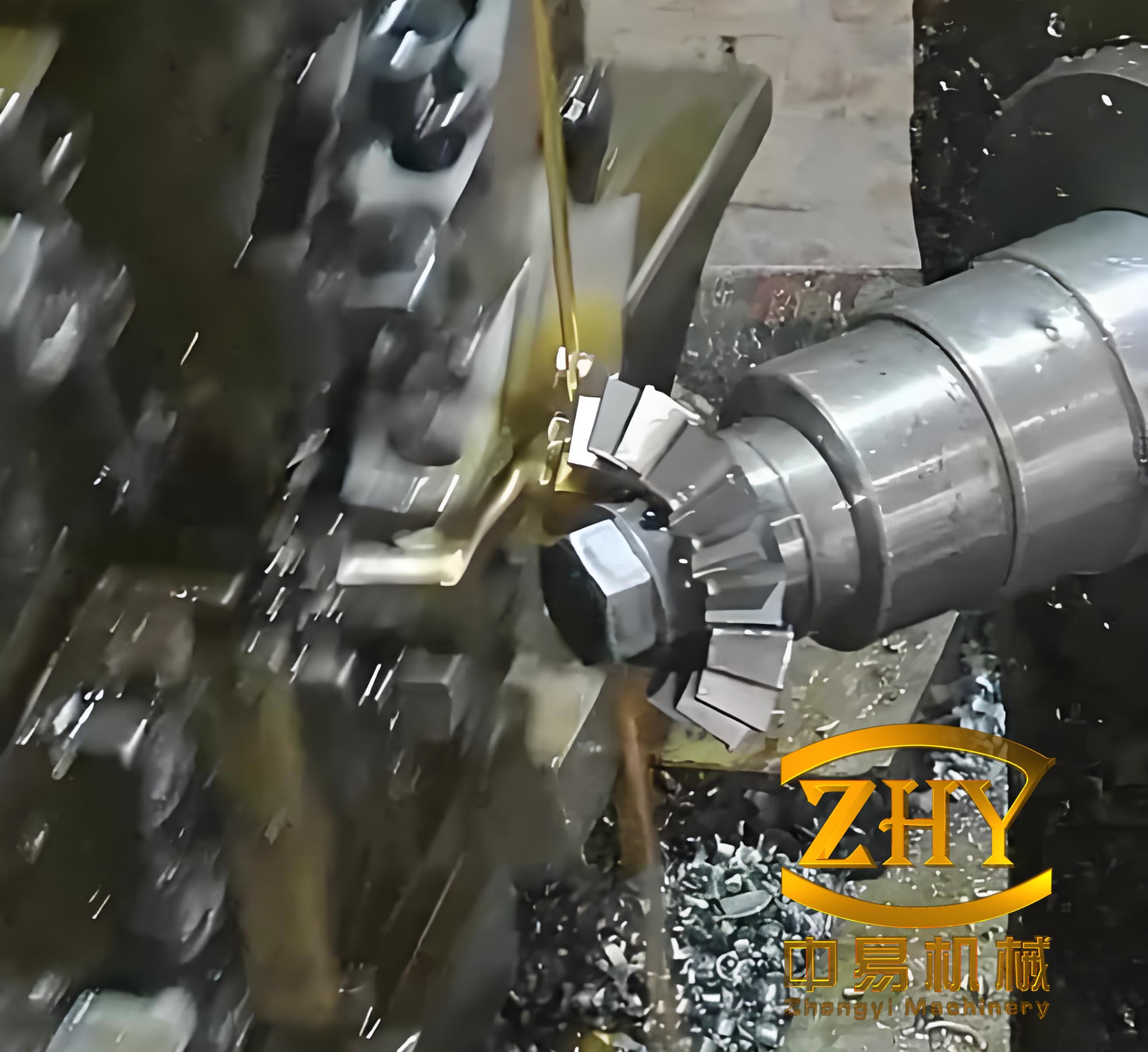
In gear hobbing, the root fillet and transition curve play a significant role in stress distribution and fatigue life. The root fillet refers to the curved portion between the tooth flank and the root circle, while the transition curve is the path connecting the effective involute starting point to the root circle. This curve can take various forms, such as a single arc or a double arc, depending on the hob design. For instance, a standard hob with relief on both the tooth flank and root produces a transition curve that may lead to challenges in grinding, such as burning or cracking, due to poor grinding conditions. In contrast, a specialized hob with root relief—often called a protuberance hob—creates a transition curve that minimizes grinding issues but requires custom tool design and is sensitive to the generating length of the workpiece. The design specifications typically include a root fillet coefficient \( P_f \) or root fillet radius \( r_f \), calculated as \( P_f = r_f / m \), where \( m \) is the module. Common values, such as 0.25m, 0.38m, or 0.45m, are derived from standards like GB/T 1356-2001. However, the actual transition curve in manufacturing differs from the design fillet; it is an extended involute or its equidistant curve, influenced by the hob’s tooth tip geometry. To illustrate, let’s consider the bending fatigue strength calculation based on standards like ISO 6336:1996, where the stress is given by:
$$ \sigma_F = \frac{F_t}{b m_n} K_A K_V K_{F\beta} K_{F\alpha} Y_F Y_S Y_\beta $$
Here, \( Y_F \) is the form factor, and \( Y_S \) is the stress correction factor, both dependent on the root fillet geometry. A larger hob tip radius generally increases \( Y_F \) and \( Y_S \), enhancing bending resistance. Thus, controlling the transition curve through gear hobbing parameters is vital for performance.
To calculate the effective involute starting point, we must first understand the mathematical representation of the involute curve and the root transition curve. The involute is defined as the trajectory of a point on a straight line rolling without slipping on a base circle. For a gear with center O and the tooth space symmetry line as the Y-axis, the parametric equations of the involute are:
$$ X_y = r_y \sin \eta_y $$
$$ Y_y = r_y \cos \eta_y $$
where \( \eta_y = \eta + \theta – \theta_y \), \( r_y \) is the radius at any point on the involute (ranging from the base circle to the tip circle), \( \eta \) is the tooth space half-angle, \( \theta \) is the involute generating angle, and \( \theta_y \) is the generating angle at any circle. By varying \( r_y \), we can plot the entire involute profile. For example, consider a gear with module \( m = 15.8 \, \text{mm} \), pressure angle \( \alpha = 22.5^\circ \), helix angle \( \beta = 10^\circ \) (left-hand), number of teeth \( z = 36 \), and profile shift coefficient \( x = 0.2 \). Using software or Excel, we can generate coordinates to visualize the involute tooth shape.
When using a standard hob in a gear hobbing machine, the root transition curve coordinates are derived from the tool geometry. With the gear center O as the origin and the tooth space symmetry line as the Y-axis, the equations are:
$$ X = (r – h_c’) \sin \phi – \left( r \phi + \frac{S_a}{2} \right) \cos \phi $$
$$ Y = (r – h_c’) \cos \phi + \left( r \phi + \frac{S_a}{2} \right) \sin \phi $$
where \( S_a \) is the hob tooth tip width, \( h_c’ \) is the hob tooth height at the pitch line, \( h_c’ = m (h_a’ – x) \), \( h_a’ \) is the hob addendum, \( r \) is the pitch radius, and \( \phi \) is a parameter. The effective involute starting radius is given by:
$$ r_F = \sqrt{ r_b^2 + \left( r \sin \alpha – \frac{h_c’}{\sin \alpha} \right)^2 } $$
This formula applies to a rack-type tool without tip rounding. However, practical hobs have a tip radius to prevent interference and provide clearance. In such cases, \( h_c’ \) refers to the height at the point where the hob tip radius tangentially meets the cutting edge, not the full addendum. For instance, with a gear of module \( m = 5 \, \text{mm} \), pressure angle \( \alpha = 20^\circ \), helix angle \( \beta = 7^\circ \) (left-hand), teeth \( z = 46 \), profile shift \( x = 0.45 \), hob tip radius \( r_c = 1.2 \, \text{mm} \), and single-flank allowance of 0.5 mm, substituting into the formula yields \( r_F = 228.569 \, \text{mm} \). Simulation of the gear hobbing process confirms this value.
For a protuberance hob with a rounded tip, the transition curve coordinates are more complex. Using the same coordinate system, the equations become:
$$ X = r \sin \phi – \left( \frac{h_c’}{\sin \alpha_1} + r_c \right) \cos (\alpha_1 – \phi) $$
$$ Y = r \cos \phi – \left( \frac{h_c’}{\sin \alpha_1} + r_c \right) \sin (\alpha_1 – \phi) $$
where \( h_c’ = h_c – x_1 m \), \( r_c \) is the hob tip radius, \( \alpha_1 \) is a parameter related to \( \phi \) by \( \phi = \frac{h_c’ \cot \alpha_1}{r} \), and \( \alpha_1 \) varies from the pressure angle to 90°. Consider a gear with \( m = 15.8 \, \text{mm} \), \( \alpha = 22.5^\circ \), \( \beta = 10^\circ \) (left-hand), \( z = 36 \), \( x = 0.2 \), single-flank allowance 0.4 mm, hob protuberance 0.2 mm, side edge angle 12°, and hob tip radius \( r_c = 5.6 \, \text{mm} \). After calculating parameters like \( \eta = 0.039 \) and \( \eta_b = 0.018 \), we can plot both the involute and transition curves. The intersection point, found by comparing coordinates, defines the involute starting point. For accuracy, we set a tolerance (e.g., \( |Y – Y’| < 0.01 \, \text{mm} \) and \( |X – X’| < 0.01 \, \text{mm} \)) to identify the coincidence point, and then compute \( r_F = \sqrt{X^2 + Y^2} \).
To facilitate understanding, the following table summarizes sample coordinate data for the involute tooth profile and root transition curve, based on the protuberance hob example. This data can be used in programming or spreadsheet tools for curve fitting.
| \( r_y \) (mm) | \( \eta_y \) (rad) | X (mm) | Y (mm) | \( \alpha_1 \) (deg) | \( \phi \) (deg) | X’ (mm) | Y’ (mm) |
|---|---|---|---|---|---|---|---|
| 532.399 | 0.017 | 4.410 | 266.162 | 14 | 9.999 | -7.598 | 280.397 |
| 532.499 | 0.017 | 4.411 | 266.212 | 16 | 8.694 | -7.457 | 278.979 |
| 532.999 | 0.017 | 4.425 | 266.462 | 18 | 7.672 | -7.292 | 277.940 |
| 533.499 | 0.0168 | 4.443 | 266.712 | 20 | 6.849 | -7.120 | 277.129 |
| … | … | … | … | … | … | … | … |
| 614.499 | 0.070 | 21.512 | 306.495 | 92 | -0.087 | 0.235 | 270.779 |
| 614.999 | 0.071 | 21.674 | 306.734 | 94 | -0.017 | 0.471 | 270.791 |
| 615.499 | 0.071 | 21.836 | 306.973 | 96 | -0.262 | 0.706 | 270.811 |
| 615.999 | 0.072 | 21.999 | 307.212 | 98 | -0.350 | 0.940 | 270.839 |
In practice, the gear hobbing machine’s settings must be optimized to achieve the desired transition curve. For example, the hob’s axial feed rate and rotational speed influence the generating length, which can shift the involute starting point. Additionally, factors like the number of teeth and profile shift coefficient may cause secondary enveloping or interference, raising the starting point above the hob tip intersection. Therefore, adjustments based on real-time simulations or measurements are necessary. Modern gear hobbing machines often integrate CNC systems to automate these calculations, ensuring consistency across production batches.
Another critical aspect is the relationship between the hob geometry and the resulting tooth root stress. As mentioned, the form factor \( Y_F \) and stress correction factor \( Y_S \) in the bending stress equation depend on the transition curve’s radius of curvature. A larger hob tip radius, achievable through specialized gear hobbing tools, reduces stress concentration and improves fatigue life. However, this must be balanced with manufacturing constraints, such as tool wear and cost. The following formula illustrates the curvature calculation for a standard hob transition curve:
$$ \kappa = \frac{1}{r_c} + \frac{d^2 y}{dx^2} \left[ 1 + \left( \frac{dy}{dx} \right)^2 \right]^{-3/2} $$
where \( \kappa \) is the curvature, and the derivatives are derived from the transition curve equations. This curvature affects \( Y_S \), emphasizing the importance of precise gear hobbing control.
In conclusion, this research provides a comprehensive method for calculating the involute starting point in gear hobbing, highlighting the interplay between hob parameters, transition curves, and gear performance. By deriving coordinate expressions for both the involute and root transition curves, and fitting them to find intersections, we can accurately determine the effective involute start. This approach aids in understanding tooth root formation, optimizing the gear hobbing process, and enhancing bending strength. Future work could explore advanced simulations of the gear hobbing machine dynamics or the effects of thermal processing on transition curves. Ultimately, mastering these calculations enables engineers to design and manufacture gears with reliable performance and longevity, leveraging the capabilities of modern gear hobbing machines.