
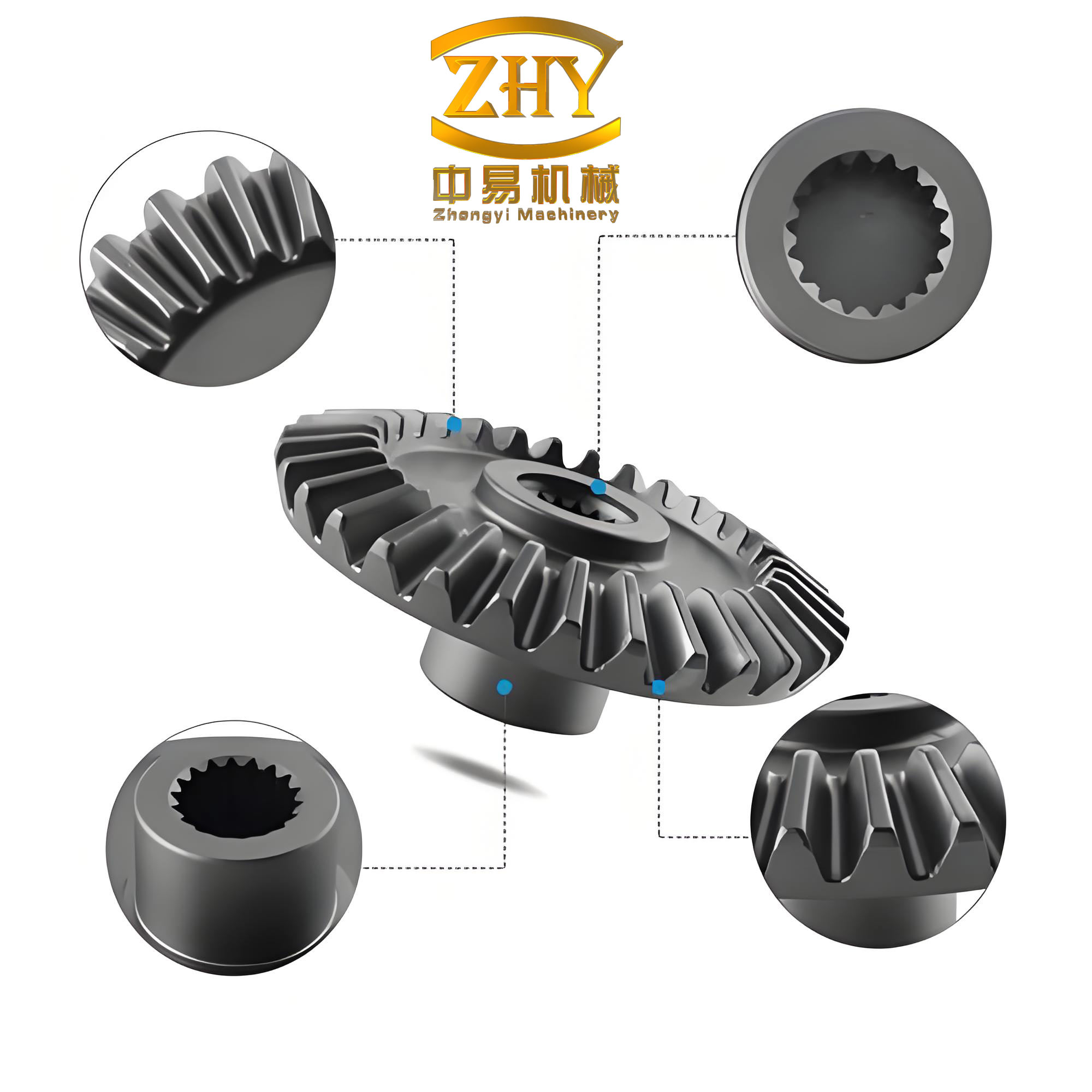
In gear transmission systems, the straight bevel gear plays a crucial role due to its ability to transmit power between intersecting shafts. The time-varying meshing stiffness is a primary excitation source during gear engagement, significantly influencing system stability and inducing parametric self-excited vibrations. Thus, accurately determining the meshing stiffness of straight bevel gears is essential for dynamic analysis. While extensive research has been conducted on cylindrical gears, the complex geometry of straight bevel gears poses challenges for rapid analytical solutions. Most existing studies rely on finite element methods, which are computationally intensive. This study aims to develop a fast calculation method for the meshing stiffness of straight bevel gears by transforming them into equivalent spur gears at the midpoint of the tooth width and applying energy principles. The proposed method enriches gear stiffness calculation theory and provides a theoretical tool for dynamics research.
The straight bevel gear exhibits varying tooth profiles along the tooth width, making stiffness calculation complex. To simplify, we convert the straight bevel gear into an equivalent spur gear at the tooth width midpoint. Key parameters include the pitch cone angle δ, pitch diameter d, outer cone distance R, tooth width b, and addendum and dedendum angles. The equivalent spur gear parameters are derived as follows. The pitch cone angles for the driving and driven gears are given by:
$$ \delta_1 = \arctan(z_1 / z_2), \quad \delta_2 = 90^\circ – \delta_1 $$
where z1 and z2 are the tooth numbers. The pitch diameters are:
$$ d_1 = m z_1, \quad d_2 = m z_2 $$
with m as the module. The outer cone distance R is calculated as:
$$ R = \frac{1}{2} \sqrt{d_1^2 + d_2^2} $$
The tooth width coefficient φd is:
$$ \phi_d = \frac{b}{R} $$
The equivalent tooth numbers at the midpoint are:
$$ z_{v1} = \frac{z_1}{\cos \delta_1}, \quad z_{v2} = \frac{z_2}{\cos \delta_2} $$
and the equivalent module mv is:
$$ m_v = m (1 – 0.5 \phi_d) $$
These parameters define the equivalent spur gear model, which simplifies the analysis. The tooth is modeled as a variable-section cantilever beam rooted at the dedendum circle. Under a meshing force F along the line of action, the tooth deformations include bending, shear, and axial compression. The stiffness components are derived using energy methods. The bending stiffness Kb is expressed as:
$$ \frac{1}{K_b} = \int_0^d \frac{(x \cos \alpha_1 – h \sin \alpha_1)^2}{E I_x} dx $$
where α1 is the angle between the meshing force and the tooth thickness direction, h is half the tooth thickness at the meshing point, x is the distance from the meshing point, E is the elastic modulus, and Ix is the area moment of inertia. Similarly, the shear stiffness Ks and axial compression stiffness Ka are:
$$ \frac{1}{K_s} = \int_0^d \frac{1.2 \cos^2 \alpha_1}{G A_x} dx $$
$$ \frac{1}{K_a} = \int_0^d \frac{\sin^2 \alpha_1}{E A_x} dx $$
where G is the shear modulus, given by G = E / [2(1 + υ)] with υ as Poisson’s ratio, and Ax is the cross-sectional area. The Hertzian contact stiffness Kh, which remains constant during engagement, is:
$$ \frac{1}{K_h} = \frac{4(1 – \upsilon^2)}{\pi E b} $$
The fillet foundation stiffness Kf, accounting for gear body deformation, is:
$$ \frac{1}{K_f} = \frac{\delta_f}{F} $$
where δf is the deformation amount. The single-tooth meshing stiffness Ke is then the reciprocal of the sum of compliances:
$$ K_e = \frac{1}{\left( \frac{1}{K_{b1}} + \frac{1}{K_{s1}} + \frac{1}{K_{a1}} + \frac{1}{K_{f1}} + \frac{1}{K_{b2}} + \frac{1}{K_{s2}} + \frac{1}{K_{a2}} + \frac{1}{K_{f2}} + \frac{1}{K_h} \right)} $$
For time-varying meshing stiffness, we consider multiple tooth pairs in engagement based on the contact ratio. The transverse contact ratio at the midpoint εa is calculated as:
$$ \varepsilon_{a1} = \frac{z_{v1} \cos^2 \beta_b}{2\pi \cos \alpha_n} \left[ \sqrt{\left(1 + \frac{2 h_{anm1}^*}{z_{v1}}\right)^2 – \cos^2 \alpha_n} – \cos \alpha_n \right] $$
$$ \varepsilon_{a2} = \frac{z_{v2} \cos^2 \beta_b}{2\pi \cos \alpha_n} \left[ \sqrt{\left(1 + \frac{2 h_{anm2}^*}{z_{v2}}\right)^2 – \cos^2 \alpha_n} – \sin \alpha_n \right] $$
$$ \varepsilon_a = \varepsilon_{a1} + \varepsilon_{a2} $$
where βb is the base circle helix angle (zero for straight bevel gears), αn is the normal pressure angle, and h*anm1 and h*anm2 are the modified addendum coefficients:
$$ h_{anm1}^* = 0.52 + 0.44 \mu_v $$
$$ h_{anm2}^* = 1.41 – 0.44 \mu_v $$
with μv = zv2 / zv1. Using the displacement compatibility principle, the total meshing stiffness K for N engaging teeth is:
$$ K = \sum_{i=1}^{N} K_i \frac{L_i \cos \alpha_i}{L_1 \cos \alpha_1} $$
where Ki is the single-tooth stiffness, Li is the distance from the meshing point to the gear center, and αi is the force angle. This model captures the nonlinear behavior of straight bevel gear meshing stiffness.
To validate the method, we analyze three case studies with different gear parameters. The finite element method (FEM) is used as a benchmark, employing a quasi-static approach with hexahedral elements for accuracy. The single-tooth meshing stiffness Kn is computed as:
$$ K_n = \frac{F_n}{u_n} $$
where Fn is the normal contact force and un is the elastic deformation. The time-varying meshing stiffness is obtained by superimposing stiffness curves from multiple teeth shifted by an angle Δα:
$$ \Delta \alpha = \frac{\phi}{\varepsilon} $$
where φ is the rotation angle and ε is the contact ratio. The comprehensive stiffness K is:
$$ K = \sum_{i=1}^{N} K_{ni} $$
The gear parameters for the cases are summarized in the table below.
| Gear Parameter | Case 1 | Case 2 | Case 3 |
|---|---|---|---|
| Module (mm) | 2 | 4 | 4 |
| Number of Teeth | 17 | 19 | 20 |
| Mating Gear Teeth | 19 | 34 | 25 |
| Normal Pressure Angle (°) | 20 | 23 | 20 |
| Tooth Width (mm) | 8 | 10 | 12 |
| Addendum Coefficient | 1 | 1 | 1 |
| Clearance Coefficient | 0.2 | 0.2 | 0.2 |
| Modification Coefficient | 0 | 0 | 0 |
| Elastic Modulus (MPa) | 2.06e5 | 2.06e5 | 2.06e5 |
| Poisson’s Ratio | 0.3 | 0.3 | 0.3 |
The results show that the proposed analytical method and FEM yield similar trends for single-tooth and comprehensive meshing stiffness. However, discrepancies arise due to the simplification of the straight bevel gear to a midpoint equivalent spur gear. The table below compares the maximum single-tooth stiffness and average time-varying stiffness, along with relative errors.
| Gear Parameter | Case 1 | Case 2 | Case 3 |
|---|---|---|---|
| Method | FEM / Analytical | FEM / Analytical | FEM / Analytical |
| Max Single-Tooth Stiffness (kN/mm) | 313 / 355 | 835 / 1028 | 758 / 921 |
| Relative Error (%) | 0 / 13.4 | 0 / 23.1 | 0 / 21.5 |
| Avg Time-Varying Stiffness (kN/mm) | 505 / 546 | 1409 / 1646 | 1275 / 1439 |
| Relative Error (%) | 0 / 8.0 | 0 / 16.8 | 0 / 12.8 |
In conclusion, the energy-based method using an equivalent spur gear model provides a fast calculation for straight bevel gear meshing stiffness. The single-tooth stiffness model effectively captures deformation components, and the time-varying stiffness model incorporates displacement compatibility. However, accuracy can be improved by segmenting the tooth width into multiple sections to better represent the straight bevel gear’s geometry. Additionally, the contact ratio calculation at the midpoint may need refinement. This research advances the calculation theory for straight bevel gears and supports dynamic studies, though further enhancements are necessary for precision.
The straight bevel gear’s unique characteristics, such as tapered teeth and varying load distribution, necessitate careful consideration in stiffness modeling. Future work could explore multi-segment approaches or hybrid methods combining analytical and numerical techniques. The proposed method offers a practical tool for engineers, facilitating efficient design and analysis of straight bevel gear systems in various applications, including automotive and aerospace industries. By continuously refining these models, we can achieve higher accuracy in predicting the behavior of straight bevel gears under dynamic conditions.
Overall, the study demonstrates the feasibility of using equivalent spur gear models for straight bevel gear stiffness calculation. The integration of energy methods and displacement compatibility principles provides a comprehensive framework. As research progresses, these methods will contribute to optimizing straight bevel gear performance and reliability, ultimately enhancing the efficiency of mechanical transmission systems.