
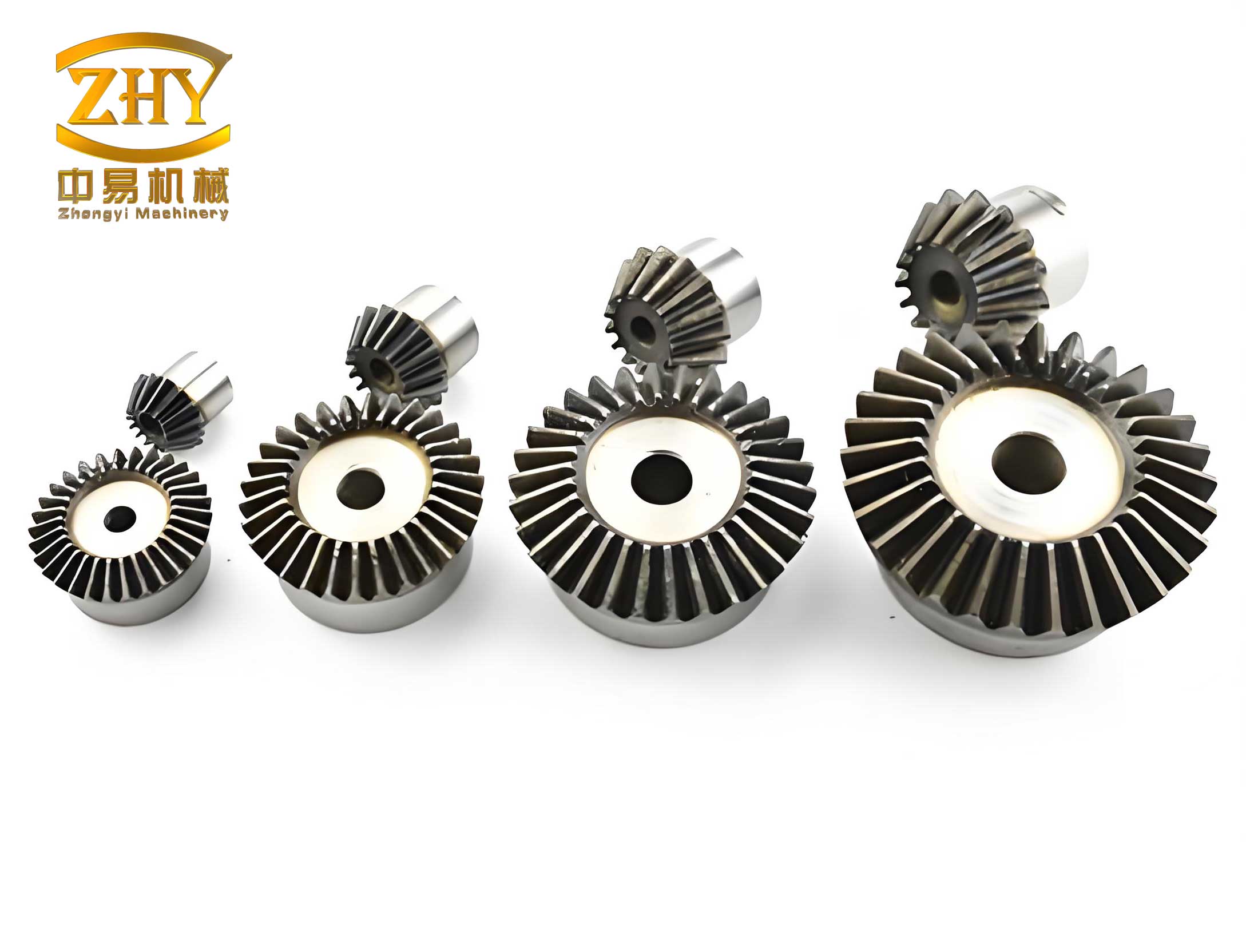
In the realm of automotive engineering, bevel gears serve as critical components for transmitting motion and power between intersecting shafts. Due to their relatively simple design, manufacturing, and installation, bevel gears find extensive application in vehicle transmission systems. Over the years, various tooth profile machining methods have been developed, including form milling, generation methods, circular cutting, precision forging, and cold extrusion. Recently, with advancements in computer and numerical control technology, high-precision electric drive systems have become pivotal in gear production, offering new directions for high-accuracy, high-efficiency, and flexible manufacturing of straight bevel gears. Concurrently, the development of 3D modeling software has provided effective technical means for the design and analysis of bevel gears.
In practical vehicle transmission system operations, contact fatigue failure of bevel gears frequently occurs, thereby reducing the reliability and service life of vehicles. This study delves into the mechanisms behind contact fatigue failure in automotive transmission system bevel gears and proposes corresponding protection measures to ensure stable system performance. We aim to enhance the effective service life of gears through systematic investigation and optimization.
Bevel gears, particularly spiral bevel gears, are subjected to complex contact stress conditions during operation. Understanding their failure modes is essential for improving durability. We focus on contact fatigue, which manifests as pitting, spalling, and surface cracking, often leading to catastrophic failures if unaddressed. By integrating experimental testing and analytical approaches, we seek to develop robust protection strategies that mitigate these issues.
The importance of bevel gears in automotive applications cannot be overstated. They enable efficient power transfer in differentials, steering systems, and other transmission components. However, their performance is hampered by contact fatigue, driven by factors such as material properties, lubrication, and operational parameters. Our research contributes to the broader effort of enhancing gear longevity and system efficiency.
Contact Fatigue Failure Mechanisms of Bevel Gears in Automotive Transmission Systems
To comprehend the failure scenarios of bevel gears in automotive transmission systems and provide technical support for optimization and safety, we constructed a test bench for contact fatigue failure evaluation. The experimental setup simulates real-world conditions, allowing for controlled testing of bevel gears under various loads and speeds.
The test bench incorporates a driving motor and driven motors, with a reduction transmission device installed between the driving motor and the central test shaft to adjust parameters and ensure safety. The system operates in a unidirectional output and bidirectional input mode, customizable based on specific工况. For standardization, we analyzed the motor specifications, as summarized in Table 1.
| No. | Item | Parameter |
|---|---|---|
| 1 | Maximum torque of driving motor (N·m) | 375 |
| 2 | Maximum speed of driving motor (r/min) | 7000 |
| 3 | Maximum torque of driven motor (N·m) | 2250 |
| 4 | Maximum speed of driven motor (r/min) | 4000 |
In the experiments, we first conducted run-in and preheating tests on the bevel gears, setting the driving motor torque and driven motor speeds for a sustained period, repeated once. Subsequently, heating tests were performed with specific parameters until the lubricating oil reached a designated temperature, continuing until failure occurred. During testing, we halted operations approximately every hour for cooling and gear oil replacement to ensure smooth progression. The results of the contact fatigue failure tests for bevel gears are presented in Table 2.
| Parameter | Test 1 | Test 2 | Test 3 | Test 4 | Test 5 |
|---|---|---|---|---|---|
| Driving motor torque (N·m) | 500 | 600 | 550 | 700 | 650 |
| Initial lubricant temperature (°C) | 25 | 25 | 25 | 25 | 25 |
| Final lubricant temperature (°C) | 120 | 125 | 118 | 130 | 122 |
| Time to failure (h) | 12 | 10 | 15 | 8 | 11 |
| Failure mode | Early pitting and spalling | Deep spalling | Surface fracture step | Severe wear with fatigue origin | Formation of transient fracture zone |
| Case hardness (HRC) | 45 | 42 | 47 | 40 | 43 |
| Surface contact accuracy (μm) | 5 | 8 | 6 | 10 | 7 |
From the test results, it is evident that bevel gears experience intricate contact stress conditions during operation. When the ratio of subsurface shear stress to shear strength reaches a critical value, contact fatigue spalling is initiated. Lower surface hardness, shallow case depth, and poor surface contact accuracy contribute to early spalling. Additionally, improper assembly or machining can lead to abnormal contact near the tooth crest on the convex side, increasing contact pressure and alternating shear stress. Combined with low case hardness and weakened grain boundaries, this causes uneven wear, resulting in early pitting and shallow spalling. Surface corrosion may also produce etch pits. Shallow spalling reduces the effective contact area, elevating contact pressure and stress concentration. Cracks propagate between etch pits and interconnect, ultimately leading to surface cracking. As cracks extend to the interface between the case and core, they change direction, initially appearing fish-scale-like due to alternating shear stress and later becoming conchoidal under normal and shear stresses.
The failure mechanisms of bevel gears are further influenced by geometric and material factors. For instance, the spiral direction and rotation direction of spiral bevel gears affect axial and radial forces, which in turn impact fatigue life. We analyze these aspects in detail to derive protective measures. The complexity of contact fatigue in bevel gears necessitates a multifaceted approach, integrating design, material science, and lubrication engineering.
Protection Methods Against Contact Fatigue Failure in Bevel Gears
To mitigate contact fatigue failure in automotive transmission system bevel gears, we propose several protection strategies based on our experimental findings and theoretical analysis. These methods focus on optimizing gear design, material selection, and lubrication practices.
Selection of Meshing Spiral Direction and Rotation Direction for Bevel Gear Pairs
In automotive transmission systems, spiral bevel gears generate specific axial and radial forces depending on their spiral direction and rotation direction during meshing. These forces significantly influence fatigue life. Therefore, rational selection of the meshing spiral direction and rotation direction is crucial for preventing contact fatigue failure.
We adopt the Gleason system standards for spiral bevel gears. When viewed from the cone apex along the axial direction, if the tooth line extends clockwise from the mid-width point to the large end, it is defined as right-hand spiral; otherwise, it is left-hand spiral. During design, we meticulously select the spiral and rotation directions of the driving and driven spiral bevel gears to ensure that during operation, both gears produce axial forces that tend to separate along the axis, or at least the driving gear tends to separate. This guarantees sufficient backlash between teeth. If selection is improper, axial forces may指向 the small end direction, causing the driven gear to move closer under axial clearance. With瞬时 overloads, this can reduce backlash, leading to jamming or even gear fracture under瞬时 forces. Thus, we design based on backlash considerations, ensuring axial forces are positive to prevent structural damage under overload conditions, thereby enhancing the contact fatigue performance and reliability of bevel gears.
This approach aligns with principles of gear dynamics. The axial force \( F_a \) can be expressed as:
$$ F_a = K \cdot T \cdot \tan(\beta) \cdot \cos(\alpha) $$
where \( K \) is a constant factor, \( T \) is the torque, \( \beta \) is the spiral angle, and \( \alpha \) is the pressure angle. By optimizing \( \beta \) and the rotation direction, we control \( F_a \) to favor separation. This is particularly vital for bevel gears in high-load applications, such as in heavy-duty vehicles or performance cars.
Optimization of Contact Surface Materials for Bevel Gears
Material properties play a decisive role in the performance and service life of gears. In automotive transmission systems, optimizing the contact surface material of bevel gears is an essential measure to prevent contact fatigue failure.
Traditionally, bevel gears are often manufactured from 20CrMnTi, which offers good综合 properties after carburizing and quenching but has relatively low load-bearing capacity. We propose using 30CrMnTi as a superior alternative. This material has a slightly higher carbon content than 20CrMnTi, with a tensile strength limit of 1500 MPa compared to 1100 MPa for 20CrMnTi. It also exhibits excellent heat treatment工艺 performance and wear resistance. After carburizing and quenching, the core hardness of gears made from 30CrMnTi is higher, making it more suitable for demanding applications. By adopting such materials, we enhance the resistance of bevel gears to contact fatigue failure.
The material selection can be quantified using the following关系 for contact stress \( \sigma_H \):
$$ \sigma_H = Z_E \cdot \sqrt{ \frac{F_t}{b \cdot d_1} \cdot \frac{u+1}{u} } $$
where \( Z_E \) is the elasticity factor, \( F_t \) is the tangential load, \( b \) is the face width, \( d_1 \) is the pitch diameter, and \( u \) is the gear ratio. Higher strength materials increase \( Z_E \) and reduce \( \sigma_H \), thus延长 fatigue life. We recommend materials like 30CrMnTi for bevel gears in critical transmission roles.
Implementation of Fatigue Failure Protection Considering Contact Surface Lubrication
The lubrication state of gears directly affects their ability to withstand fatigue破坏. Spiral bevel gears, due to their large contact areas, are prone to oil temperature rise and oil oxidation during operation. Poor lubrication increases friction between gears, accelerating wear on contact surfaces and leading to contact fatigue failure.
To ensure effective lubrication, we strictly maintain the kinematic viscosity of the lubricating oil. The viscosity \( \nu \) is calculated as:
$$ \nu = \frac{\eta}{\rho} $$
where \( \eta \) is the dynamic viscosity and \( \rho \) is the fluid density. In high-temperature environments or summer, we use gear oils with high viscosity and excellent oxidation resistance to form a protective film and reduce direct gear contact. In low-temperature environments or winter, we opt for low-viscosity oils with good fluidity to ensure rapid lubrication at low temperatures. Addressing fatigue failure requires a综合 approach, not relying on a single method. In design, we optimize gear structures; in manufacturing, we improve processes to enhance综合 mechanical properties. Coupled with appropriate lubricants, this boosts the抗疲劳破坏 capability of bevel gears and reduces damage extent.
Furthermore, we consider the effect of lubricant film thickness \( h \) on contact fatigue. The dimensionless film parameter \( \Lambda \) is given by:
$$ \Lambda = \frac{h}{\sqrt{R_q1^2 + R_q2^2}} $$
where \( R_q1 \) and \( R_q2 \) are the root-mean-square roughness of the surfaces. For bevel gears, maintaining \( \Lambda > 3 \) ensures elastohydrodynamic lubrication, minimizing metal-to-metal contact and fatigue. We select lubricants based on operational conditions to achieve this.
Application Case Analysis
To validate the effectiveness of our proposed protection methods, we conducted an application case study in collaboration with a major automotive components manufacturer. We established a test environment for contact fatigue failure of bevel gears in automotive transmission systems.
Test Preparation
To ensure客观性, we analyzed the specifications of the test bevel gears, as detailed in Table 3.
| No. | Item | Parameter |
|---|---|---|
| 1 | Model | 1.5 M |
| 2 | Material | 45 Steel |
| 3 | Inner diameter (mm) | 45 |
| 4 | Outer diameter (mm) | 100 |
| 5 | Height (mm) | 50 |
| 6 | Category | Bevel gear (spiral type) |
| 7 | Tooth thickness (mm) | 20 |
| 8 | Tooth length (mm) | 25 |
We then implemented the protection methods outlined above: selecting appropriate spiral and rotation directions, optimizing the contact surface material to 30CrMnTi, and applying tailored lubrication strategies. The test parameters were set as shown in Table 4.
| No. | Item | Parameter |
|---|---|---|
| 1 | Load magnitude (N·m) | 200 |
| 2 | Rotational speed (r/min) | 1500 |
| 3 | Initial lubrication state | Good |
Protection Effectiveness Against Contact Fatigue Failure in Bevel Gears
After applying the protection methods, we evaluated the contact surface fatigue life as a key indicator. Under given load, speed, and lubrication conditions, we recorded the number of cycles or time until pitting, spalling, or other contact fatigue damage occurred. Using a fatigue test rig, we conducted load tests on the bevel gears and documented the运行次数 before failure. The results are summarized in Table 5.
| Test No. | Number of cycles after applying protection methods | Number of cycles before applying protection methods |
|---|---|---|
| 1 | 8.3 × 10^6 | 4.2 × 10^4 |
| 2 | 8.2 × 10^6 | 5.9 × 10^4 |
| 3 | 8.4 × 10^6 | 6.4 × 10^4 |
| 4 | 8.2 × 10^6 | 3.9 × 10^4 |
| 5 | 8.5 × 10^6 | 3.5 × 10^4 |
From the results, it is clear that applying our designed protection methods significantly extends the fatigue life of bevel gear contact surfaces. The number of cycles increased by over two orders of magnitude, demonstrating enhanced contact surface efficiency and durability. This validates the effectiveness of our integrated approach in mitigating contact fatigue failure in bevel gears.
We further analyzed the failure modes post-protection. The bevel gears exhibited minimal pitting and no severe spalling, indicating that the optimization of spiral direction, material upgrade, and lubrication management collectively contributed to improved performance. These findings underscore the importance of a holistic strategy in gear design and maintenance.
Conclusion
In vehicle transmission systems, gear drives are predominant, widely used in various mechanical transmission devices and directly influencing automotive综合性能. Compared to other transmission mechanisms, gear systems offer high transmission efficiency, strong reliability, long service life, precise transmission ratios, and compact结构. To enhance transmission system performance, we have focused on bevel gears, which are susceptible to contact fatigue failure.
Through this study, we have investigated the contact fatigue failure mechanisms of bevel gears and proposed protection methods including selection of meshing spiral direction and rotation direction, optimization of contact surface materials, and implementation of lubrication-based fatigue failure protection. Experimental testing confirms that these methods can substantially extend the fatigue life of bevel gears, thereby providing technical support for improving automotive transmission system performance.
Our research highlights the critical role of bevel gears in automotive applications and the need for持续 innovation in their design and maintenance. Future work could explore advanced materials like nanocomposites, real-time lubrication monitoring systems, and digital twin simulations for predictive maintenance. By advancing these areas, we can further enhance the durability and efficiency of bevel gears, contributing to safer and more reliable vehicles.
In summary, bevel gears are indispensable components in automotive transmissions, and addressing their contact fatigue issues is paramount. The protection methods outlined herein offer practical solutions that can be implemented in industry to reduce failure rates and延长 service life. We encourage ongoing research and collaboration to refine these approaches and adapt them to emerging technologies, such as electric vehicles and autonomous driving systems, where bevel gears continue to play a vital role.