
In the field of precision mechanical transmission systems, the planetary roller screw assembly stands out as a critical component for converting rotational motion into linear motion with high efficiency, load capacity, and accuracy. My research delves into the static contact characteristics of this assembly, particularly focusing on a type where the rollers lack a helical lead. This design choice simplifies certain aspects but introduces complexities in contact analysis that warrant detailed investigation. The primary goal of this study is to develop a robust analytical framework for understanding the contact behavior between the screw and rollers, leveraging shape function analysis and Hertzian contact theory. By establishing a contact model and validating it through finite element analysis, I aim to provide insights that can guide the optimization of planetary roller screw assembly designs for applications such as aerospace, robotics, and industrial machinery, where reliability and performance are paramount.
The planetary roller screw assembly consists of a central screw with a helical thread, multiple rollers distributed circumferentially around the screw axis, and a nut that typically houses the rollers. In the variant I examine, the rollers are straight (without helical lead), making them bodies of revolution. This configuration leads to point or line contacts between the screw and roller threads, which are subject to significant stresses under load. Understanding the contact geometry and stress distribution is essential for predicting wear, fatigue life, and overall assembly performance. Previous studies have often simplified the contact model, drawing parallels with ball screw assemblies, but the unique geometry of planetary roller screw assemblies demands a more tailored approach. My work addresses this gap by deriving an accurate shape function for the contact surfaces and applying Hertzian contact theory to model static contact forces.
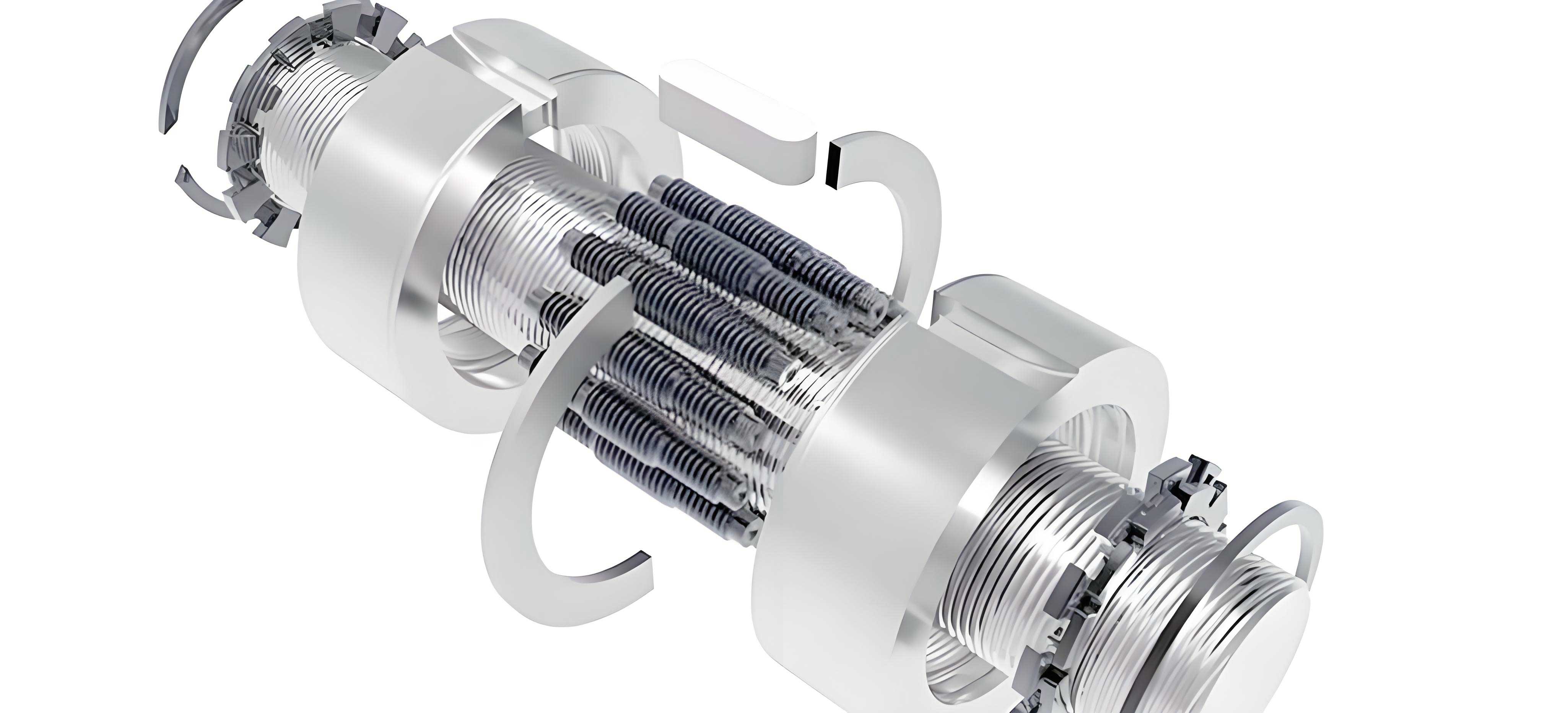
To begin, I analyze the contact shape function of the planetary roller screw assembly under static conditions. The geometry is defined in coordinate systems attached to the roller and screw. For a roller without helical lead, any point A on its tooth surface can be described in the roller’s cylindrical coordinates as having coordinates dependent on radial distance, angular position, and a height parameter. Transforming this point to the screw’s coordinate system involves accounting for the screw’s helical lead angle, which introduces trigonometric terms. Through mathematical derivations, I find that the distance between corresponding points on the screw and roller surfaces, when projected onto a plane perpendicular to the roller’s radial direction, can be expressed as a quadratic function. This is a key insight: the contact shape function in such cross-sections exhibits a parabolic characteristic, which simplifies the application of contact mechanics theories.
The derived shape function can be summarized as follows. Let $\Delta z$ represent the separation between surfaces along the axial direction in the screw’s coordinates, and let $y_2$ be a coordinate in the roller’s system. After coordinate transformations and approximations using Taylor series expansions, $\Delta z$ takes the form:
$$ \Delta z \approx k \cdot \cos \psi \cdot (a y_2^2 + b y_2 + c) $$
Here, $\psi$ is the screw’s helical lead angle, $k$ is related to the tooth profile angle, and $a$, $b$, $c$ are coefficients that depend on geometric parameters such as radial distances, lead angle, and initial positions. For a fixed radial distance $r$ from the roller axis, these coefficients become constants, confirming the quadratic nature. To validate this, I performed numerical analysis with $r = 16 \text{ mm}$ and other typical parameters. A comparison between exact numerical solutions and the quadratic fit showed a correlation coefficient of 0.99974, strongly supporting the accuracy of the shape function model. This finding is fundamental because it allows the contact problem to be treated as two-dimensional in specific cross-sections, paving the way for Hertzian contact analysis.
Building on this shape function, I proceed to develop a contact force model for the planetary roller screw assembly. By aligning the coordinate axes appropriately and considering the state of initial contact (where surfaces just touch without deformation), the shape function simplifies to $\Delta z = k \cdot \cos \psi \cdot a x^2$, where $x$ is a coordinate in the contact plane. This represents a parabolic gap between the surfaces, which is a classic scenario in Hertzian contact theory for two-dimensional bodies. According to Hertz theory, the contact pressure distribution $p(x)$ over a half-width $B$ can be expressed as:
$$ p(x) = \frac{2P}{\pi B^2} \sqrt{B^2 – x^2} $$
where $P$ is the line load per unit length along the contact, and $B$ is the half-contact width given by:
$$ B = \left[ \frac{2 P}{\pi a k \cos \psi E^*} \right]^{1/2} $$
Here, $E^*$ is the effective elastic modulus, combining the material properties of the screw and roller. The contact deformation $\delta$ at the center relates to the line load as $\delta = a B^2 = \frac{\pi P}{2 E^*}$. Using the shape function coefficients, the line load $P(r)$ for a given radial distance $r$ can be derived as:
$$ P(r) = \frac{2E^*}{\pi} \cdot k \cos \psi \cdot \left( \frac{b^2}{4a} – c \right) $$
This equation indicates that the contact force per unit length varies with radial position. To find the total contact force $F$ over the entire engaged tooth surface, I integrate $P(r)$ across the radial extent of contact, from the inner to outer diameters of the roller tooth profile:
$$ F = \int_{r_{\text{min}}}^{r_{\text{max}}} P(r) \, dr $$
This integration accounts for the varying geometry along the roller’s radial direction, providing a comprehensive static contact force model for the planetary roller screw assembly. The model assumes elastic deformation and small contact areas, which are reasonable for typical operating conditions.
To apply this model, I consider a specific planetary roller screw assembly design where a single contact interface carries approximately 55 N. Using MATLAB, I implemented the shape function and contact model to compute key parameters. The results are summarized in the table below, which highlights the maximum contact depth, half-width, and stress predicted by the analytical model.
| Parameter | Value | Unit |
|---|---|---|
| Maximum Contact Depth | 0.00011 | mm |
| Maximum Half-Contact Width | 0.059 | mm |
| Maximum Contact Stress | 229.9 | MPa |
These analytical predictions were then verified through finite element analysis (FEA) using ANSYS software. I constructed a detailed 3D model of the planetary roller screw assembly, meshing the contact regions finely to capture stress concentrations. The FEA simulation, under the same load condition, yielded a maximum contact stress of 235.7 MPa, which differs from the analytical result by only -2.5%. This close agreement validates the accuracy of my contact model. Additionally, I extracted contact pressure distributions from FEA on cross-sections at constant radial distances and fitted them to quadratic functions. The fits showed high correlation coefficients, reaffirming that the contact shape function indeed follows a parabolic trend, as assumed in the Hertzian approach.
The implications of these findings are significant for the design and optimization of planetary roller screw assemblies. The quadratic shape function simplifies contact analysis, enabling rapid evaluation of stress and deformation without resorting to complex FEA for every design iteration. Moreover, the successful application of Hertzian theory confirms that static contact behavior in these assemblies can be treated with classical elasticity methods, provided the geometry is properly accounted for. This is particularly useful for initial sizing and material selection in planetary roller screw assembly development. For instance, designers can use the model to assess the impact of changing parameters like tooth angles, lead angles, or radial clearances on contact stresses, thereby avoiding over-design or potential failure points.
In practice, the planetary roller screw assembly often operates under dynamic conditions with varying loads and speeds. My static model serves as a foundation for extending to dynamic analysis, where factors like inertia, friction, and thermal effects come into play. Future work could involve incorporating these elements into the shape function and contact model, perhaps using numerical methods for time-dependent simulations. Additionally, experimental validation through physical testing would further strengthen the model’s credibility. For now, the static analysis provides a reliable baseline for understanding the fundamental contact mechanics in planetary roller screw assemblies.
Another aspect to consider is the manufacturing tolerances and surface finishes in planetary roller screw assemblies. Deviations from ideal geometry might alter the shape function coefficients, affecting contact stresses. My model can be adapted to include tolerance ranges by adjusting parameters like radial distances or lead angles probabilistically. This would help in assessing robustness and reliability in real-world applications. Furthermore, the model’s flexibility allows it to be applied to variants of planetary roller screw assemblies, such as those with different roller profiles or preload mechanisms, by modifying the shape function derivation accordingly.
To illustrate the geometric relationships more clearly, I present below a table of key parameters used in the shape function derivation for a typical planetary roller screw assembly. These parameters influence the coefficients $a$, $b$, and $c$, and thus the contact behavior.
| Parameter | Symbol | Typical Value | Unit |
|---|---|---|---|
| Screw Minor Diameter | $s_1$ | 15 | mm |
| Screw Major Diameter | $s_3$ | 20 | mm |
| Roller Minor Diameter | $g_1$ | 10 | mm |
| Roller Major Diameter | $g_3$ | 14 | mm |
| Distance Between Centers | $d$ | 12.5 | mm |
| Helical Lead Angle | $\psi$ | 5° | degree |
| Tooth Profile Angle (Roller) | $k$ | 30° | degree |
| Tooth Profile Angle (Screw) | $j$ | 30° | degree |
| Screw Pitch | $n$ | 5 | mm |
Using these values, the shape function coefficients can be computed, and the contact model can predict stresses for various loads. For example, if the load per contact increases, the model shows a proportional rise in contact stress, but with a square-root dependency due to the Hertzian relations. This non-linearity is crucial for understanding load limits in planetary roller screw assemblies.
In conclusion, my research on the planetary roller screw assembly has established that the contact shape function in cross-sections perpendicular to the roller radial direction exhibits a quadratic characteristic. This allows the application of Hertzian contact theory to develop a static contact force model, which predicts contact parameters like stress, width, and deformation with good accuracy. Validation via finite element analysis confirms the model’s reliability, with discrepancies under 3%. These insights contribute to the foundational knowledge of planetary roller screw assembly mechanics, aiding in design optimization and performance prediction. Future studies can build on this work to explore dynamic effects, manufacturing variances, and extended life analysis, ensuring that planetary roller screw assemblies continue to meet the demands of advanced mechanical systems.
The planetary roller screw assembly, with its unique geometry and high-performance capabilities, remains a focal point in precision engineering. By deepening our understanding of its contact behavior, we can unlock further innovations in transmission technology. My analytical approach, combining shape function analysis and Hertzian theory, offers a practical tool for engineers working with planetary roller screw assemblies, from conceptual design to failure analysis. As applications evolve towards higher loads and speeds, such models will be indispensable for ensuring reliability and efficiency.