
In this study, we investigate a novel dynamic force mutual lapping process for spiral bevel gears, which is based on the concept of using lapping instead of grinding for hard-tooth-surface finishing. The fundamental principle involves two workpiece spiral bevel gears (the gears being lapped) operating at high speeds under a large moment of inertia with a predetermined speed ratio (the tooth number ratio) under no-load conditions. During lapping, the speed ratio remains constant, while the center distance between the two spiral bevel gears is periodically altered. Utilizing the dynamic forces generated by gear errors during meshing, along with the action of lapping compound, the gear errors are corrected, thereby enhancing the accuracy of both spiral bevel gears. This approach represents a significant departure from traditional lapping methods, as it leverages dynamic grinding and error averaging effects to improve gear precision efficiently.
The motivation for this research stems from the need to develop advanced finishing techniques for spiral bevel gears that are suitable for domestic industrial applications. Traditional lapping processes primarily improve surface roughness and marginally correct tooth profile and alignment errors, with limited impact on other errors. This is because, in free meshing during lapping, the rolling and sliding quantities are uneven across the tooth surface—minimal near the pitch circle and greater at the root and tip—leading to potential degradation of tooth profile quality over time. Therefore, exploring new hard-tooth-surface finishing processes based on gear meshing characteristics, meshing dynamics, and lapping principles is imperative. Our study focuses on a dynamic force lapping method that integrates error homogenization theory, aiming to achieve higher gear accuracy and productivity.
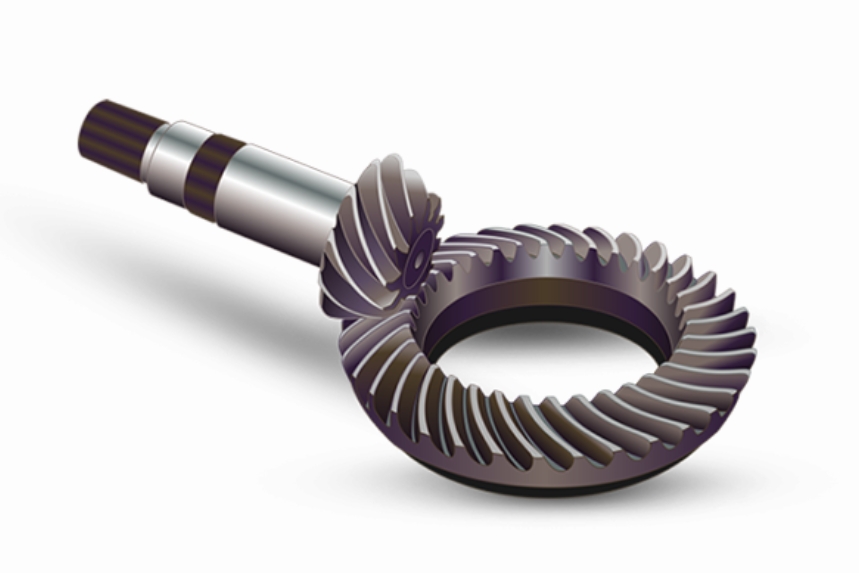
The development of this process is part of a collaborative R&D project involving academic and industrial partners, targeting the trial production and deployment of CNC spiral bevel gear lapping machines. Internationally, companies like Gleason in the USA and Klingelnberg (formerly Oerlikon) in Germany dominate this field, with products such as the Gleason 650GH CNC spiral bevel gear lapping machine offering high-speed capabilities up to 3000 rpm and adjustable braking torque. Our work aims to break this technological monopoly by developing an indigenous solution tailored to local manufacturing needs. The new lapping machine features a unique single-column structure that minimizes footprint while enhancing rigidity, similar to advanced designs but optimized for cost-effectiveness and performance.
Structure and Working Principle of the New Lapping Machine
The new lapping machine, as illustrated in Figure 1 (refer to the image above for a visual representation), comprises two identical spindle systems. Each spindle is equipped with a workpiece (the spiral bevel gear) and a flywheel, enabling high-speed steady-state rotation as the primary motion during lapping. A transverse worktable moves along guides to adjust the center distance between the two spiral bevel gears, remaining fixed during lapping. Mounted on the transverse worktable, a longitudinal worktable is driven by a stepper motor under CNC control to perform reciprocating movements, periodically varying the center distance. At the rear of the bed, a column supports a sliding saddle fixed with an upper motor. During lapping, the sliding saddle executes micro-stroke reciprocating motions (0.5–5 mm) along the column guides via an eccentric mechanism, ensuring full lapping across the tooth width of the spiral bevel gears. Springs connect the sliding saddle to the column for stable motion.
The working principle involves positioning the spiral bevel gears on mandrels via their inner holes, using a transition fit. Since the gears operate under no-load, radial and axial forces are negligible. After installation, the center distance is manually adjusted via the transverse worktable, considering minimum center distance deviation limits and meshing clearance. With lapping compound applied to the tooth surfaces, the motors are activated, and voltage regulation synchronizes the spindle speeds. The stepper motor drives the longitudinal worktable to change the center distance cyclically, while the sliding saddle’s micro-strokes ensure comprehensive lapping. Flywheels near the DC motors stabilize high-speed operation, with one attached to each spindle end.
Mechanism of Dynamic Force Lapping for Spiral Bevel Gears
The improvement in accuracy of both spiral bevel gears during lapping is primarily driven by two mechanisms: dynamic grinding and error averaging. After machining, spiral bevel gears exhibit manufacturing errors. When a pair of spiral bevel gears meshes, error excitation and other factors generate dynamic forces on the tooth surfaces. The new dynamic force lapping process exploits these forces for lapping purposes. The dynamic force can be expressed as:
$$ F_d(t) = k(t) \left[ r_{b1} \theta_1(t) + r_{b2} \theta_2(t) + e(t) – \delta \right] $$
Where \( F_d(t) \) is the dynamic force due to gear errors, \( k(t) \) is the meshing stiffness of the spiral bevel gear tooth profile, \( r_{b1} \) and \( r_{b2} \) are the base circle radii of the two spiral bevel gears, \( \theta_1(t) \) and \( \theta_2(t) \) are the torsional vibration angular displacements, \( e(t) \) is the comprehensive error of the spiral bevel gears (measured using gear integrated error measuring instruments), and \( \delta \) represents deformation effects. The product of the dynamic meshing force and the coefficient of friction acts as the cutting force during lapping, causing yield and wear on surface asperities, thus enhancing accuracy.
Vibrations induced by gear errors during lapping lead to plastic deformation and adhesion of surface asperities, as per tribology theory. Small-amplitude vibrations shear adhesion points, exposing fresh metal surfaces that oxidize to form abrasive oxides like Fe₂O₃, further contributing to wear and precision improvement. The addition of lapping compound introduces abrasive particles that roll and slide on the tooth surfaces, inducing minor plastic deformation and cutting actions that reduce surface roughness. Chemical and electrochemical reactions with oxygen or esters in the compound generate surface films that are repeatedly removed, accelerating the lapping process.
Since lapping occurs under no-load, the dynamic meshing force stems solely from gear errors; larger errors produce higher forces and greater lapping amounts, while smaller errors result in less lapping. As spiral bevel gear accuracy improves, dynamic forces diminish, reducing lapping effects and preventing distortion—a key advantage over traditional methods. Periodically changing the center distance ensures full lapping along the tooth profile, while altering meshing tooth pitches equalizes lapping probability across teeth, facilitating error averaging. This process is analogous to mutual lapping of three flat plates, where errors are homogenized to improve flatness, though more complex for spiral bevel gears due to their geometry.
Selection of Lapping Process Parameters for Spiral Bevel Gears
Optimal lapping parameters are crucial for efficiency and accuracy. The following table summarizes key parameters and their considerations:
| Parameter | Description | Typical Range or Choice | Impact on Spiral Bevel Gear Lapping |
|---|---|---|---|
| Spindle Speed | Determines lapping frequency and surface interactions | 1000–1500 rpm (adjust based on gear diameter) | Higher speeds increase sliding velocity and friction, boosting efficiency; stability is vital for precision, achieved via digital control systems. |
| Center Distance Variation | Ensures even lapping across tooth profiles | Reciprocating motion via stepper motor | Maintains involute tooth shape; methods include perpendicular or along the line of action movement to control velocity differences. |
| Lapping Compound | Abrasive medium for material removal | Commercial compounds with base oil, abrasives, additives | Reduces roughness and protects surfaces; applied continuously during operation for consistent effects. |
| Lapping Allowance | Amount of material to be removed | Minimal on gear tooth thickness or public line length | Affects efficiency and accuracy; pre-lapping gear accuracy must be controlled, especially for radial runout. |
| Gear Tooth Numbers | Influences error averaging | Ideally no common factors (e.g., prime numbers) | Enhances uniform lapping; for gears with common factors, timed tooth separation is required. |
The spindle speed directly affects lapping efficiency through the number of lapping cycles per unit time. Higher speeds increase circumferential velocity and relative sliding between spiral bevel gear teeth, raising the friction coefficient based on experimental data (e.g., Kragelsky’s studies). However, speed must be balanced with gear diameter; typically, 1000–1500 rpm is suitable for medium-sized spiral bevel gears. To ensure平稳性, a direct digital control system comprising a computer, encoder, and programmable timer/counter regulates DC motor speed effectively.
Center distance variation is essential for preserving involute profiles. Theoretical analysis confirms that conjugate tooth profiles remain conjugate after center distance changes, implying involute geometry is maintained. Two variation methods are considered: (1) Moving one spiral bevel gear perpendicular to the original centerline at constant speed, which introduces velocity differences along the line of action as a function of time, and (2) Moving along the line of action for constant velocity but requiring precise endpoint positioning to avoid jamming. Our trials employ the first method, with stepper motor-controlled displacements to minimize velocity discrepancies. Reversal of rotation direction periodically ensures equal lapping on both flanks of the spiral bevel gears.
Lapping compound selection is based on properties like structural stability, rheology, and non-corrosiveness. Compounds from collaborative R&D efforts, containing base oil, suspending agents, and abrasives, are applied during operation to maintain a thin layer on spiral bevel gear tooth surfaces, preventing dry friction and enhancing material removal.
Lapping allowance should be minimal to avoid excessive time and potential accuracy loss. Pre-lapping spiral bevel gear accuracy, particularly radial runout, must be stringent, along with ensuring coaxiality and perpendicularity of gear bores and faces for precise mounting.
For tooth numbers, selecting spiral bevel gear pairs without common factors promotes uniform lapping across teeth. If factors exist, timed tooth separation—disengaging and rotating one gear by a tooth—is implemented to equalize lapping probability.
Experimental Study on Dynamic Force Lapping of Spiral Bevel Gears
Our experimental aims are to explore accuracy evolution during lapping, error correction capabilities, influencing factors, and production feasibility. We focus on measuring tooth profile error, radial runout, public line length variation, pitch deviation, pitch cumulative error, and surface roughness for spiral bevel gears. The following table outlines the test specimens used:
| Test No. | Gear ID | Tooth Number (z) | Module (m, mm) | Face Width (b, mm) | Material | Heat Treatment | Lapping Speed (rpm) |
|---|---|---|---|---|---|---|---|
| 1 | 1 | 20 | 2 | 20 | Steel | Quenching | 1000 |
| 1 | 2 | 31 | 2 | 20 | Steel | Quenching | 1100 |
| 2 | 3 | 20 | 2.5 | 20 | Steel | Quenching | 1000 |
| 2 | 4 | 31 | 2.5 | 20 | Steel | Quenching | 1100 |
| 3 | 5 | 40 | 2.5 | 30 | Steel | Tempering | 1200 |
| 3 | 6 | 52 | 2.5 | 30 | Steel | Tempering | 1100 |
| 4 | 7 | 41 | 2 | 20 | Cast Iron | None | 1100 |
| 4 | 8 | 40 | 2 | 20 | Steel | Tempering | 1150 |
| 5 | 9 | 31 | 2 | 20 | Steel | Quenching | 800 |
| 5 | 10 | 30 | 2 | 20 | Steel | Quenching | 1100 |
| 6 | 11 | 20 | 2.5 | 20 | Steel | Quenching | 1000 |
| 6 | 12 | 31 | 2.5 | 20 | Steel | Quenching | 1100 |
Experiments were conducted on the new lapping machine (designed by our team and manufactured by a partner). During lapping, center distance was varied cyclically, and for gears with common tooth factors, timed tooth separation was applied. Accuracy metrics were measured before and after lapping, with data processed to identify trends. For instance, tooth profile error was assessed using a universal involute tester, showing reduced error and smoother profiles post-lapping, indicating error homogenization without distortion over time. Radial runout, measured with a gear runout tester, demonstrated correction capabilities, with higher lapping amounts at peak runout points due to increased dynamic forces. The table below presents sample radial runout data for a spiral bevel gear (Gear ID 1, module 2 mm, tooth number 20):
| Tooth No. | 1 | 2 | 3 | 4 | 5 | 6 | 7 | 8 | 9 | 10 | 11 | 12 | 13 | 14 | 15 | 16 | 17 | 18 | 19 | 20 |
|---|---|---|---|---|---|---|---|---|---|---|---|---|---|---|---|---|---|---|---|---|
| Before Lapping | 15 | 20 | 12 | – | 12 | 11 | 9 | 15 | 43 | 27 | 11 | 11 | 15 | 5 | 42 | 26 | 15 | 7 | 9 | 15 |
| After Lapping | 12 | 2 | 11 | – | 1 | , | – | 2 | 1 | , | 1 | 1 | , | 4 | 4 | 5 | 7 | 7 | 15 | 11 |
Pitch deviation and cumulative error were measured relatively using a pitch tester, with one adjacent pitch as reference. Data indicated error averaging, making pitch deviations more uniform—beneficial for spiral bevel gear transmission. Sample data for a spiral bevel gear (Gear ID 1, module 2 mm, tooth number 20) is summarized below, showing improved consistency post-lapping:
| Tooth No. | Relative Deviation Before | Absolute Deviation Before | Cumulative Error Before | Relative Deviation After | Absolute Deviation After | Cumulative Error After |
|---|---|---|---|---|---|---|
| 1 | , | 10 | 10 | , | 18.2 | 18.2 |
| 2 | -16 | -6 | 4 | 2 | 20.2 | 38.4 |
| 3 | 20 | 10 | 14 | 1 | 19.2 | 57.6 |
| 4 | 4 | -6 | 8 | -2 | 17.2 | 74.8 |
| 5 | – | -10 | -2 | 2 | 19.2 | 94.0 |
| 6 | -8 | -18 | -20 | -4 | 15.2 | 109.2 |
| 7 | -4 | -22 | -42 | -1 | 14.2 | 123.4 |
| 8 | -16 | -38 | -80 | -2 | 12.2 | 135.6 |
| 9 | -15 | -53 | -133 | -1 | 11.2 | 146.8 |
| 10 | -17 | -70 | -203 | -2 | 9.2 | 156.0 |
Public line length variation and surface roughness also showed improvements. Tooth profile error curves revealed tool marks pre-lapping, replaced by smooth curves post-lapping, indicating effective surface refinement for spiral bevel gears. These results validate the dynamic force lapping process’s ability to enhance multiple accuracy parameters simultaneously.
Mathematical Modeling and Analysis
To further elucidate the dynamics, we derive a comprehensive model for spiral bevel gear lapping. The dynamic force equation can be extended to include damping and inertial effects. Considering a two-degree-of-freedom system for spiral bevel gears in mesh, the equations of motion are:
$$ I_1 \ddot{\theta}_1 + c_1 \dot{\theta}_1 + k(t) [r_{b1} \theta_1 + r_{b2} \theta_2 + e(t)] = T_1 $$
$$ I_2 \ddot{\theta}_2 + c_2 \dot{\theta}_2 + k(t) [r_{b1} \theta_1 + r_{b2} \theta_2 + e(t)] = T_2 $$
Where \( I_1 \) and \( I_2 \) are moments of inertia, \( c_1 \) and \( c_2 \) are damping coefficients, and \( T_1 \) and \( T_2 \) are torques (zero under no-load lapping). For lapping analysis, we assume steady-state vibrations, so the dynamic force simplifies to the earlier expression. The lapping removal rate \( R \) can be modeled as proportional to the dynamic force and sliding velocity \( v_s \):
$$ R = \alpha \cdot F_d \cdot v_s $$
Where \( \alpha \) is a coefficient encompassing abrasive and material properties. The sliding velocity between spiral bevel gear teeth varies along the profile, given by:
$$ v_s = \omega_1 r_1 – \omega_2 r_2 $$
With \( \omega_1 \) and \( \omega_2 \) as angular velocities, and \( r_1 \) and \( r_2 \) as contact point radii. During center distance variation, these parameters change, affecting \( R \). Integrating over time, the total lapping amount \( L \) on a spiral bevel gear tooth is:
$$ L = \int_{0}^{T} R \, dt = \alpha \int_{0}^{T} k(t) \left[ r_{b1} \theta_1(t) + r_{b2} \theta_2(t) + e(t) \right] v_s(t) \, dt $$
This integral highlights how error \( e(t) \) influences lapping non-uniformly, driving error correction. Error averaging can be represented statistically: if errors are distributed across teeth, lapping tends to reduce variance. Let \( E_i \) be the initial error on tooth \( i \) of a spiral bevel gear, and \( L_i \) the lapping amount; then, post-lapping error \( E_i’ \) is:
$$ E_i’ = E_i – L_i $$
With \( L_i \) correlated to \( E_i \) via the dynamic force, leading to homogenization as \( \text{Var}(E_i’) < \text{Var}(E_i) \).
Discussion on Industrial Applications
The dynamic force mutual lapping process for spiral bevel gears offers substantial benefits for manufacturing. By replacing expensive grinding machines with simpler, cost-effective lapping equipment, production costs can be reduced while maintaining high accuracy. Our experiments suggest that spiral bevel gears with initial moderate errors can be refined to higher precision levels, suitable for applications in automotive, aerospace, and machinery sectors. Key advantages include:
- Simultaneous improvement of multiple spiral bevel gear accuracy parameters.
- No distortion due to self-limiting dynamic forces.
- High productivity through optimized parameters.
- Compatibility with CNC automation for consistent results.
Challenges remain in scaling up for mass production, such as ensuring consistent lapping compound distribution and managing thermal effects during high-speed operation. Future work should focus on real-time monitoring and adaptive control systems to further enhance the process for spiral bevel gears.
Conclusion
Our research on the dynamic force mutual lapping process for spiral bevel gears demonstrates a novel approach that effectively combines dynamic grinding and error averaging. Through theoretical analysis and experimental validation, we show that this method can significantly improve tooth profile error, radial runout, pitch accuracy, and surface roughness for spiral bevel gears without causing distortion. The new lapping machine design, with its adjustable center distance and stable high-speed rotation, provides a practical platform for implementing this process. By selecting appropriate parameters like spindle speed, center distance variation, and lapping compound, manufacturers can achieve efficient and precise finishing of spiral bevel gears. This technology holds promise for domestic industry, reducing reliance on imported equipment and advancing gear manufacturing capabilities. Continued research into intelligent control and process optimization will further solidify its application for spiral bevel gears in various high-precision fields.