
Bevel gears are critical components in mechanical systems such as automotive differentials, machine tools, and other power transmission devices. They offer constant speed ratios, smooth transmission, and easy installation. However, during the meshing process of straight bevel gears, sudden engagement along the tooth direction can lead to system impact, reducing operational stability and causing vibration and noise. Therefore, studying the dynamic performance of bevel gears in differentials is essential for reducing vehicle vibration and improving the efficiency of gear systems.
Currently, methods to reduce vibration and noise in bevel gear transmissions include improving manufacturing precision, which increases costs; altering gear structures, such as applying coatings to tooth surfaces; and enhancing lubrication or assembly quality. However, these approaches have limited effectiveness. Research has shown that合理的 tooth profile modification can improve transmission performance without additional costs. Although some成果 have been achieved, a systematic theory on how modification affects the dynamic performance of bevel gears is still lacking.
This paper focuses on straight bevel gears used in automotive differentials. Based on the principles of spherical involute formation and gear dynamics theory, precise three-dimensional models of modified straight bevel gears are developed using SolidWorks software. A multi-degree-of-freedom dynamic model is established, and dynamic simulation models for both modified and unmodified gears are created. Under specific load conditions, the dynamic performance, impact, and vibration during meshing are analyzed using dynamic simulation techniques. By comparing the vibration performance before and after modification, the influence of different modification parameters (modification length, modification amount, modification curve) on gear meshing performance is summarized.
The research work in this paper has significant guiding value and practical significance for improving the dynamic performance of straight bevel gear transmissions, reducing vibration and noise, and achieving effective modification.
Tooth Profile Modification Technology
Tooth profile modification is a key technology for enhancing the comprehensive performance of gears. It aims to compensate for factors such as time-varying meshing stiffness, gear eccentric loading due to shaft bending deformation, and other errors in gear transmission. The goal is to achieve good contact spots, small transmission errors, and ultimately reduce noise and vibration. For straight bevel gears, modification techniques are not as mature as those for cylindrical gears, and research on how modification affects dynamic meshing performance is limited.
Common modification methods include profile modification and lead modification. Profile modification involves removing part of the involute profile near the tooth tip or root to compensate for base pitch deviations. Lead modification, such as tip relief or crowning, improves load distribution along the tooth width to avoid stress concentration at the ends.
Internationally, researchers have proposed various modification curves and optimization algorithms. For example, Walker initially proposed a modification curve of $$e_j = e_{kj} (x/l)^{1.5}$$, and subsequent studies have expanded on this. Finite element analysis and specialized software like Romaxdesigner are used to determine modification parameters. However, these methods are not fully adapted to specific working conditions.
In China, studies on cylindrical gear modification have yielded rich theoretical results, but research on bevel gear modification is still incomplete. Most modifications only consider elastic deformation, ignoring factors like machining errors, thermal deformation, and variable loads. Additionally, most studies focus solely on profile or lead modification, with limited research on comprehensive modification.
The following table summarizes common modification parameters for bevel gears based on ISO standards:
| Parameter | Range | Considerations |
|---|---|---|
| Profile Modification Length | Short modification for straight gears | Based on gear size and finite element analysis |
| Lead Modification Amount | 10–40 μm for low precision, 10–25 μm for high precision | Includes manufacturing errors of 5–10 μm |
| Modification Curve | Arc curve for smooth transition | Better than linear modification for reducing dynamic loads |
Dynamics Analysis Methods for Bevel Gears
Gear dynamics involves studying the dynamic characteristics of gear systems, such as vibration, squeal, and noise, to improve transmission performance. The dynamic behavior of bevel gears directly affects the stability and efficiency of mechanical equipment. With the development of nonlinear dynamics theory, research on gear dynamics has deepened, forming a systematic theoretical system.
Dynamic analysis software like Romaxdesigner is widely used for simulating gear transmission systems. Romaxdesigner allows for static analysis, dynamic analysis, and NVH (Noise, Vibration, and Harshness) analysis. It can model entire transmission systems, including shafts, bearings, and gears, and analyze their performance under various load conditions.
The analysis process in Romaxdesigner typically includes:
- Modeling: Creating 3D models of gears and other components.
- Static Analysis: Checking strength, life, and safety factors.
- Dynamic Analysis: Calculating natural frequencies, transmission errors, and dynamic responses.
For bevel gears, dynamic simulation helps identify critical frequencies and vibration modes, enabling optimization to reduce noise and vibration. The following equation represents the general dynamic model of a gear pair:
$$[M]\{\ddot{x}\} + [C]\{\dot{x}\} + [K]\{x\} = \{F\}$$
where [M] is the mass matrix, [C] is the damping matrix, [K] is the stiffness matrix, and {F} is the force vector.
Three-Dimensional Solid Modeling of Bevel Gears
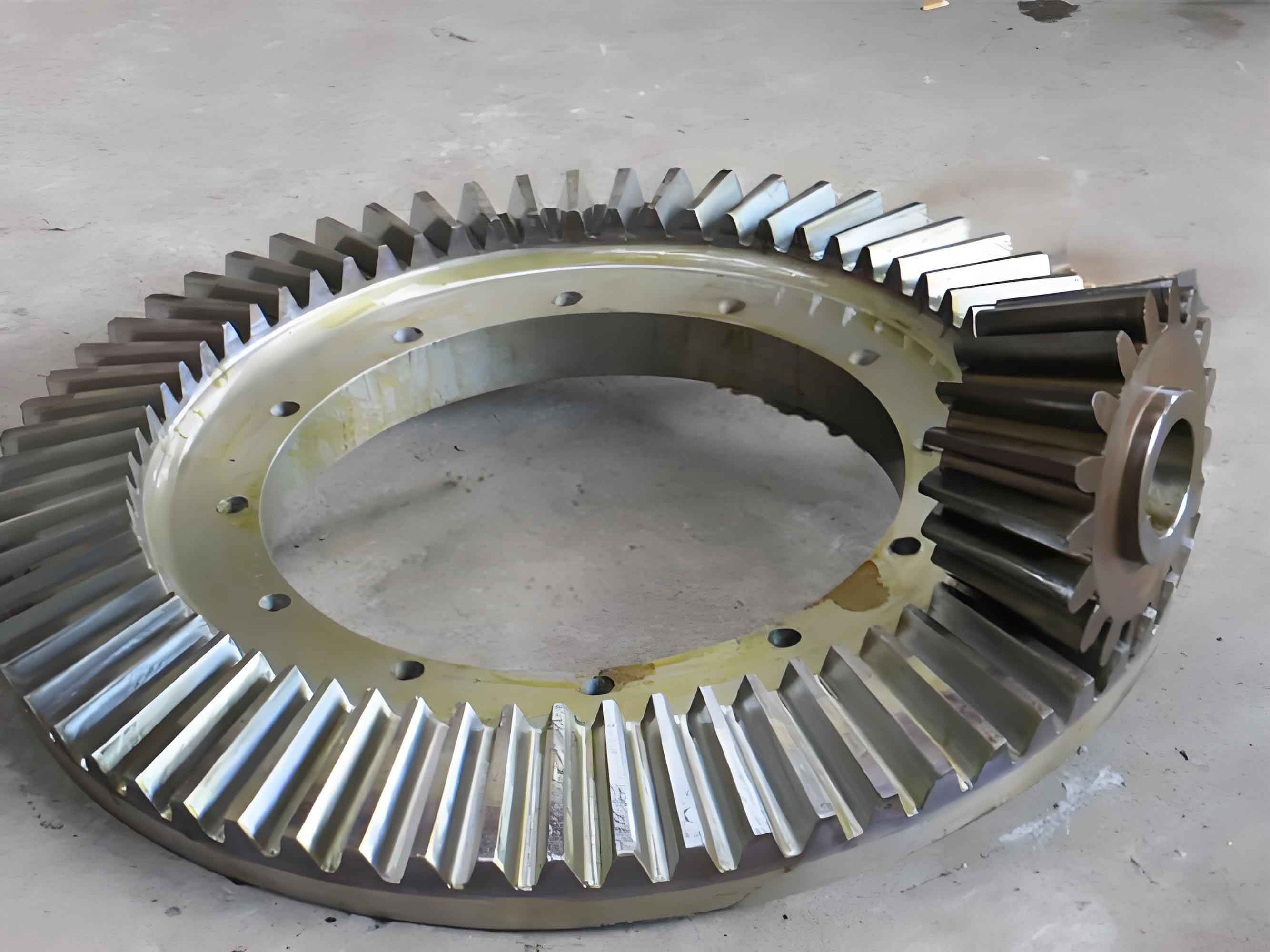
The accuracy of the 3D model of straight bevel gears affects subsequent dynamic analysis and manufacturing precision. The tooth profile of bevel gears is a spherical involute, which has a complex topological structure. Traditional modeling methods using back-cone principles or approximate curves are not accurate enough.
This paper uses Matlab and SolidWorks to achieve precise 3D modeling of spherical involute straight bevel gears. The spherical involute is generated based on its parametric equations:
$$x = l \sin(\phi) \cos(\theta) + l \cos(\phi) \sin(\theta) \sin(\varphi)$$
$$y = l \sin(\phi) \sin(\theta) – l \cos(\phi) \cos(\theta) \sin(\varphi)$$
$$z = l \cos(\phi) \cos(\theta)$$
where $$l$$ is the spherical radius, $$\theta$$ is the base cone angle, $$\phi$$ is the parameter related to the rolling angle, and $$\varphi = \phi \sin(\theta)$$.
Using Matlab, coordinates of the spherical involute are calculated and imported into SolidWorks to generate curves. Through operations such as surface filling, trimming, and rotating, the 3D model of the gear tooth is created. The gear body is formed by arraying the tooth model and combining it with the gear blank.
For modification, parameters are determined based on finite element analysis and empirical formulas. Profile modification uses an arc curve, and lead modification uses isometric crowning. The modification parameters for the example bevel gears are as follows:
| Gear | Profile Modification Length (mm) | Lead Modification Amount (μm) |
|---|---|---|
| Planet Gear | 1.79 (small end), 3.0 (large end) | 30 |
| Side Gear | 2.4 (small end), 3.0 (large end) | 30 |
The modified gear models are assembled in SolidWorks, and interference checks are performed to ensure proper meshing. The accurate 3D models provide a foundation for dynamic simulation.
Dynamic Simulation Analysis Using Romaxdesigner
Romaxdesigner is used for dynamic simulation of the bevel gear system. The 3D models from SolidWorks are imported in STL format. After defining inputs, outputs, and load conditions, static and dynamic analyses are performed.
For static analysis, a load case with input speed of 1500 rpm and torque of 100 Nm is defined. The results show that the gear system meets strength and life requirements, ensuring safe operation. For example, the contact life of the side gear is 7.5 hours, and the safety factor for bending is 1.208.
Dynamic analysis includes calculating transmission error and dynamic response. Transmission error is a key internal excitation in gear systems, caused by errors and deformations. In Romaxdesigner, the dynamic transmission error and dynamic contact load are obtained as shown in the following table for unmodified gears:
| Frequency Range (Hz) | Max Transmission Error (μm) | Max Dynamic Contact Load (N) |
|---|---|---|
| 400–1120 | 3.39 | 521 |
The natural frequencies of the gear system are also analyzed to avoid resonance. The first 10 natural frequencies range from 109.96 Hz to 4529.6 Hz, and the meshing frequency is 249.87 Hz, which does not coincide with the natural frequencies, indicating no resonance.
The dynamic response, represented by linear modal flexibility, shows peaks at specific frequencies. For unmodified gears, the peak value is $$4.96 \times 10^{-4}$$ μm/N at 730 Hz, indicating significant vibration.
Mathematical Model of Bevel Gear Dynamics
A multi-degree-of-freedom dynamic model is established for straight bevel gears, considering torsional and axial vibrations. The model ignores the elasticity of housings and supports, focusing on the gear pair. The relative displacement along the meshing line is given by:
$$\lambda_n = (X_p – X_g)c_1 + (Y_p – Y_g)c_2 + (Z_p – Z_g)c_3 + r_p \theta_p – r_g \theta_g – e_n(t)$$
where $$c_1 = \cos(\delta_p) \sin(\alpha_n)$$, $$c_2 = \cos(\delta_p) \cos(\alpha_n)$$, $$c_3 = \cos(\alpha_n)$$, $$\delta_p$$ is the pitch cone angle, $$\alpha_n$$ is the normal pressure angle, $$r_p$$ and $$r_g$$ are pitch radii, and $$e_n(t)$$ is the static transmission error.
The dynamic meshing force is:
$$F_n = k_b(t) f(\lambda_n) + c_b \dot{\lambda_n}$$
where $$k_b(t)$$ is the time-varying meshing stiffness, $$c_b$$ is the meshing damping, and $$f(\lambda_n)$$ is the backlash function.
The equations of motion are derived using Newton’s second law:
$$m_p \ddot{X_p} + c_{px} \dot{X_p} + k_{px} X_p = -F_{nx}$$
$$m_p \ddot{Y_p} + c_{py} \dot{Y_p} + k_{py} Y_p = -F_{ny}$$
$$m_p \ddot{Z_p} + c_{pz} \dot{Z_p} + k_{pz} Z_p = -F_{nz}$$
$$I_p \ddot{\theta_p} = T_p – r_p F_n$$
Similar equations apply for the driven gear.
The nonlinear factors include time-varying meshing stiffness and backlash. The meshing stiffness is calculated based on the number of tooth pairs in contact. The backlash function is approximated by a polynomial:
$$f(\lambda_n) = a_1 \lambda_n + a_3 \lambda_n^3$$
where $$a_1 = 0.344$$ and $$a_3 = 1.201 \times 10^7$$, obtained through curve fitting in Matlab.
The dynamic equations are solved using numerical methods such as the Adomian decomposition method, which decomposes the nonlinear terms into polynomials and solves iteratively.
Analysis of Dynamic Performance After Modification
After modification, the dynamic performance of bevel gears is analyzed using Romaxdesigner. The transmission error, dynamic contact load, and dynamic response are compared for unmodified and modified gears.
For lead isometric modification, the maximum transmission error is reduced to 1.13 μm, and the maximum dynamic contact load is 170.2 N. For profile arc modification, the values are 1.19 μm and 173.6 N, respectively. The dynamic response peaks are also reduced, as shown below:
| Modification Type | Max Transmission Error (μm) | Max Dynamic Contact Load (N) | Max Linear Modal Flexibility (μm/N) |
|---|---|---|---|
| Unmodified | 3.39 | 521 | 4.96 × 10⁻⁴ |
| Profile Arc Modification | 1.19 | 173.6 | 1.35 × 10⁻⁴ |
| Lead Isometric Modification | 1.13 | 170.2 | 1.10 × 10⁻⁴ |
The results show that modification significantly improves dynamic performance. Lead isometric modification performs slightly better than profile arc modification in reducing transmission error and vibration. The reduction in transmission error is about 67% for lead modification and 65% for profile modification. The vibration improvement is about 78% and 73%, respectively.
These findings indicate that合理的 tooth profile modification can effectively enhance the dynamic behavior of straight bevel gears, reducing vibration and noise during meshing.
Conclusion and Outlook
This research studies the dynamic performance of modified straight bevel gears through precise 3D modeling, dynamic simulation, and mathematical modeling. The main conclusions are:
- Accurate 3D models of bevel gears are developed using spherical involute equations, ensuring high precision for simulation and manufacturing.
- Dynamic simulation in Romaxdesigner shows that tooth profile modification reduces transmission error, dynamic contact load, and vibration. Lead isometric modification outperforms profile arc modification.
- A multi-degree-of-freedom dynamic model is established, considering nonlinear factors like time-varying stiffness and backlash. The model provides a foundation for analyzing gear dynamics.
Future work should focus on solving the nonlinear dynamic equations accurately, conducting experimental validations, and considering thermal deformation effects. This research contributes to the development of modification techniques for bevel gears, promoting their application in high-performance mechanical systems.