
In modern engineering applications, spur gears are fundamental components for power transmission, widely used in automotive, aerospace, and manufacturing industries due to their simplicity and efficiency. The precision of spur gears is critical for ensuring smooth operation and longevity of mechanical systems. Traditional machining methods for spur gears often involve significant material waste and energy consumption. In contrast, precision plastic forming techniques, such as cold-finishing, offer advantages like material savings, energy efficiency, and improved mechanical properties. However, challenges like dimensional inaccuracy due to elastic recovery after forming persist. This study focuses on investigating the elastic recovery behavior of spur gears after cold-finishing and optimizing die structures to enhance dimensional accuracy. We employ a combined approach of finite element simulation and physical experimentation to analyze the effects of die parameters on gear precision. The goal is to provide insights for improving the cold-finishing process for spur gears, ensuring higher quality and performance.
The cold-finishing process for spur gears typically follows a warm-forging pre-forming stage, where a gear blank is shaped with excess material, known as finishing allowance, on the tooth surfaces. This blank is then subjected to cold-finishing, where it is pushed through a die to refine the tooth profile. During this process, the spur gear undergoes both plastic and elastic deformation. Upon unloading, the accumulated elastic strain energy is released, causing elastic recovery or springback, which leads to dimensional errors. Understanding and controlling this elastic recovery is essential for achieving high-precision spur gears. In this study, we examine key die structure parameters, specifically the entrance angle and height of the die land in the cold-finishing die, and their impact on the springback and warping of spur gears.
The cold-finishing die structure consists of a punch, a combined die with a prestressed outer layer, and an inner die with internal teeth. The inner die features a land with an entrance angle and a specific height. The spur gear blank, with a finishing allowance, is placed on the die, and the punch applies pressure to push it through the die cavity. This action forces excess metal to flow axially toward the upper face of the spur gear, resulting in the refinement of the tooth surfaces. To optimize this process, we vary the die land entrance angle (α) and height (H) to study their effects. The entrance angle is tested at values of 2°, 4°, 6°, 8°, and 10°, while the height is tested at 25 mm, 30 mm, 35 mm, 40 mm, and 45 mm. This allows us to systematically analyze how these parameters influence the elastic recovery of spur gears.
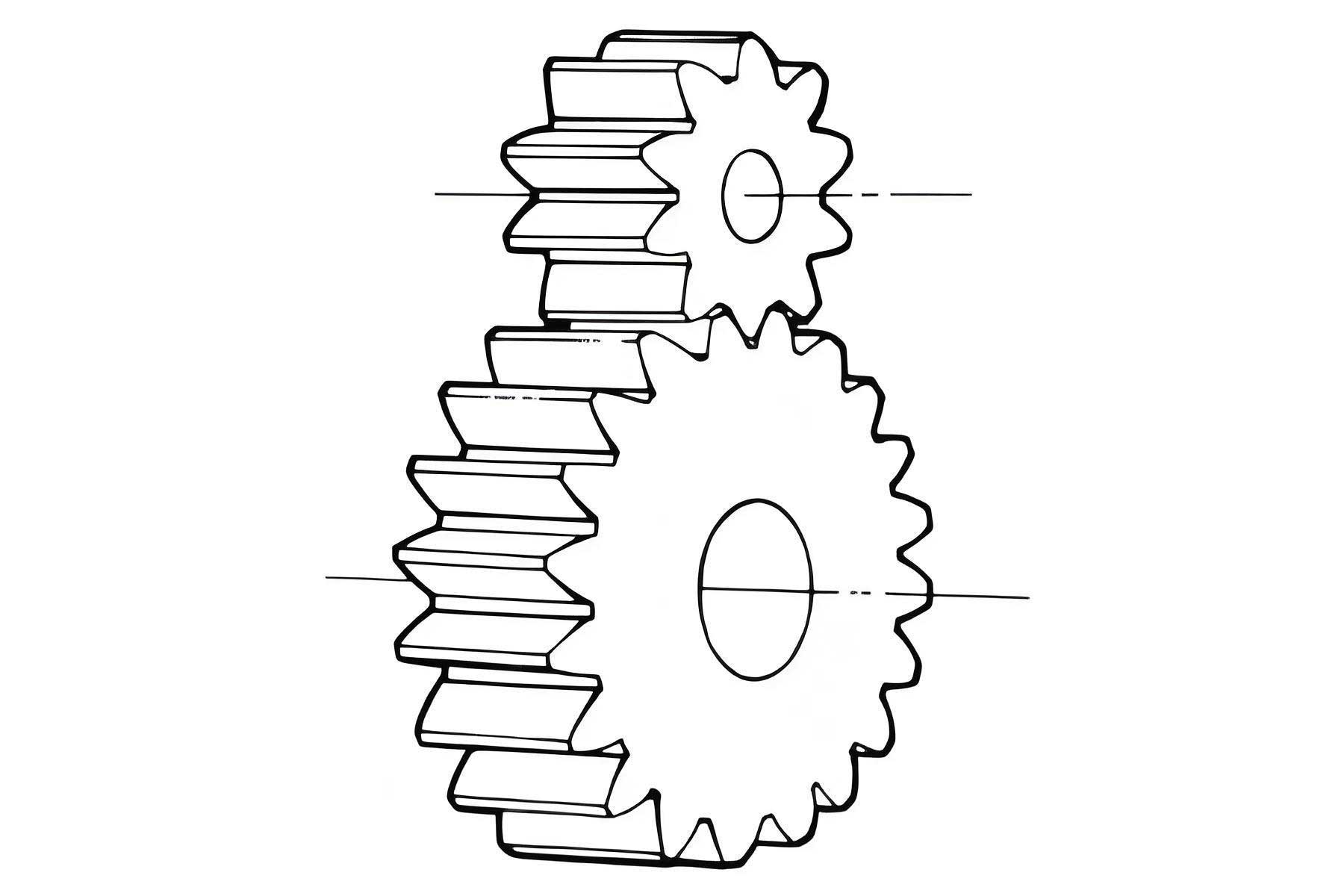
We establish a three-dimensional elastic-plastic finite element model to simulate the cold-finishing process of spur gears. The model is based on a spur gear with a module of 2.5 mm and 30 teeth, as illustrated in the gear drawing. Due to symmetry, we use one-thirtieth of the full spur gear geometry to reduce computational cost, applying symmetric boundary conditions. The gear material is 20MnCr5 steel, which is commonly used in gear manufacturing due to its strength and formability. The material behavior is modeled using an elastic-plastic constitutive law, with properties defined by a bilinear stress-strain curve. The elastic modulus is set to 210 GPa, Poisson’s ratio to 0.3, and the yield strength to 350 MPa, with hardening characteristics based on experimental data. The finishing allowance on the tooth surfaces is set to 0.2 mm radially.
The finite element mesh is generated using hexahedral elements, with local refinement in the tooth region to capture detailed deformation. The die components are treated as rigid bodies, and the punch moves at a constant velocity of 30 mm/s. The friction between the spur gear and die surfaces is modeled using a Coulomb friction coefficient of 0.12, which accounts for typical conditions in cold-forming processes. The simulation is performed using a commercial finite element software capable of handling large deformations and elastic recovery. The model equations governing the deformation include the equilibrium equations, constitutive relations, and boundary conditions. For instance, the stress-strain relationship during plastic deformation can be expressed as:
$$
\sigma = \sigma_y + K \cdot \varepsilon_p^n
$$
where $\sigma$ is the flow stress, $\sigma_y$ is the yield stress, $K$ is the strength coefficient, $\varepsilon_p$ is the plastic strain, and $n$ is the hardening exponent. For elastic recovery, the springback is calculated based on the residual stresses after unloading. The elastic recovery displacement $\Delta$ can be estimated from the residual stress $\sigma_r$ and elastic modulus $E$:
$$
\Delta = \int \frac{\sigma_r}{E} \, dl
$$
where the integral is over the deformation path. This simplified formula helps in understanding the springback mechanism, though the full simulation accounts for complex stress distributions.
The simulation results reveal detailed insights into the metal flow during cold-finishing of spur gears. The velocity field distribution shows that as the spur gear is pushed through the die, the tooth surfaces undergo radial and circumferential flow. At the entrance of the die land, the material is compressed, causing the excess metal to move axially upward. This flow pattern is critical for achieving the desired tooth profile. The radial component of the force induces plastic deformation, while the elastic part contributes to springback. The simulation captures the stages of deformation: pre-finishing, active finishing, and post-finishing. In the active finishing zone, corresponding to the die land entrance, the spur gear tooth is compressed, reducing its size. After passing through this zone, the elastic recovery causes the tooth to expand slightly, leading to dimensional errors. The metal flow analysis emphasizes the importance of die design in controlling deformation uniformity for spur gears.
To quantify the effects of die parameters, we analyze the tooth profile error, which is the deviation from the ideal spur gear tooth shape after springback. The error is measured as the maximum radial displacement of the tooth surface. Table 1 summarizes the tooth profile error for different die land entrance angles, with a constant land height of 30 mm and finishing allowance of 0.2 mm.
| Entrance Angle α (degrees) | Tooth Profile Error (mm) | Percentage Reduction in Error Compared to α=2° |
|---|---|---|
| 2 | 0.045 | 0% |
| 4 | 0.038 | 15.6% |
| 6 | 0.032 | 28.9% |
| 8 | 0.029 | 35.6% |
| 10 | 0.027 | 40.0% |
The data shows that as the entrance angle increases, the tooth profile error decreases. This is because a larger angle promotes more axial flow of excess metal, increasing the plastic deformation component and reducing elastic strain accumulation. However, this benefit must be balanced against other factors, as discussed later. The relationship between error and angle can be approximated by a power law:
$$
E(\alpha) = A \cdot \alpha^{-b}
$$
where $E(\alpha)$ is the tooth profile error, $A$ and $b$ are constants derived from simulation data. For instance, fitting the data yields $A = 0.064$ and $b = 0.35$, with an R-squared value of 0.98, indicating a strong correlation for spur gears.
Next, we examine the effect of die land height on tooth profile error. Table 2 presents the results for various heights, with a constant entrance angle of 6° and finishing allowance of 0.2 mm.
| Land Height H (mm) | Tooth Profile Error (mm) | Variation from Mean Error |
|---|---|---|
| 25 | 0.031 | -0.001 |
| 30 | 0.032 | 0.000 |
| 35 | 0.032 | 0.000 |
| 40 | 0.033 | +0.001 |
| 45 | 0.033 | +0.001 |
The tooth profile error remains relatively constant across different land heights, with variations within 0.002 mm. This indicates that the land height has a minimal impact on the springback of spur gears. The slight increase at higher heights may be due to prolonged friction, but it is negligible for practical purposes. Therefore, in die design for spur gears, the land height can be chosen based on other considerations, such as die strength and manufacturing ease, without significantly affecting dimensional accuracy.
Beyond tooth profile error, we analyze the warping or twisting of the tooth shape, which contributes to tooth alignment error. Warping occurs because the radial force during finishing causes non-uniform metal flow along the tooth height. The entrance angle influences this phenomenon significantly. Figure 7 from the simulation illustrates the warping angle at the tooth tip for different entrance angles. The warping angle θ is defined as the deviation from the vertical axis at the tooth end. Table 3 quantifies this relationship.
| Entrance Angle α (degrees) | Warping Angle θ (degrees) | Tooth Alignment Error (mm) |
|---|---|---|
| 2 | 0.5 | 0.010 |
| 4 | 0.8 | 0.016 |
| 6 | 1.2 | 0.024 |
| 8 | 1.6 | 0.032 |
| 10 | 2.0 | 0.040 |
The warping angle increases with the entrance angle, leading to higher tooth alignment errors. This is because a larger angle generates a greater radial force component, pushing more metal toward the gear center and causing the tooth tip to twist upward. The tooth alignment error is calculated based on the warping angle and tooth height. For a spur gear with a tooth height of 5 mm, the error can be estimated as:
$$
\text{Alignment Error} = h \cdot \tan(\theta)
$$
where $h$ is the tooth height. This error adds to the overall dimensional inaccuracy of the spur gear. Therefore, optimizing the entrance angle requires balancing between reducing tooth profile error and minimizing warping. From our analysis, an entrance angle of 6° offers a good compromise, with moderate tooth profile error and acceptable warping for spur gears.
To validate the simulation findings, we conduct physical experiments on the cold-finishing process for spur gears. The experimental setup uses a 315-ton hydraulic press, as shown in Figure 9. The die is manufactured with an entrance angle of 6° and a land height of 25 mm, based on the simulation recommendations. The spur gear blanks are made of 20MnCr5 steel, pre-formed by warm-forging with a 0.2 mm finishing allowance. After annealing and surface cleaning, the blanks are cold-finished, and the resulting spur gears are deburred and measured using a gear measuring instrument. We perform three sets of experiments, each with five spur gears, to ensure statistical reliability. The measured tooth profile and alignment errors are compared with simulation predictions.
Table 4 presents the experimental results and comparison with simulation data for spur gears.
| Parameter | Simulation Value | Experimental Average Value | Relative Error (%) |
|---|---|---|---|
| Tooth Profile Error (mm) | 0.032 | 0.033 | 3.1 |
| Tooth Alignment Error (mm) | 0.024 | 0.025 | 4.2 |
| Overall Dimensional Accuracy | Within ISO 6 Grade | Within ISO 6-7 Grade | — |
The experimental results show good agreement with simulation, with relative errors less than 5%. This confirms the accuracy of our finite element model in predicting elastic recovery behavior for spur gears. The slight discrepancies may arise from factors not included in the simulation, such as die elasticity, temperature variations, and measurement uncertainties. For instance, the die expansion under pressure can reduce effective compression, leading to higher springback. Additionally, material property variations in real spur gears might affect deformation. Nevertheless, the consistency validates our approach for die optimization.
Based on the simulation and experimental results, we propose an optimized die structure for cold-finishing of spur gears. The key parameters are: entrance angle α = 6° and land height H = 25 mm. This configuration minimizes tooth profile error while keeping warping within acceptable limits. The die design also considers practical aspects like wear resistance and manufacturing cost. For example, a smaller land height reduces friction and improves surface quality of spur gears. We recommend using hardened tool steel for the die to withstand high pressures and extend service life. Furthermore, the die can be designed with a tapered entrance to facilitate smooth metal flow, reducing the risk of defects in spur gears.
The elastic recovery in spur gears after cold-finishing can be further analyzed using analytical models. The springback phenomenon is influenced by the stress distribution, which depends on die geometry and process parameters. A simplified model for springback displacement ∆ can be derived from beam theory, considering the tooth as a cantilever beam subjected to bending during finishing. The formula is:
$$
\Delta = \frac{F L^3}{3 E I}
$$
where $F$ is the radial force, $L$ is the effective length of the tooth, $E$ is the elastic modulus, and $I$ is the moment of inertia. For a spur gear tooth, $I$ varies along the height, complicating the calculation. However, this model highlights the inverse relationship with $E$, emphasizing the importance of material selection for spur gears. High-strength steels with higher $E$ can reduce springback, but they may increase forming loads.
To enhance the precision of spur gears, we also investigate the effect of finishing allowance on elastic recovery. Table 5 shows simulation results for different allowances, with α = 6° and H = 25 mm.
| Finishing Allowance (mm) | Tooth Profile Error (mm) | Required Forming Force (kN) |
|---|---|---|
| 0.1 | 0.025 | 280 |
| 0.2 | 0.032 | 350 |
| 0.3 | 0.040 | 420 |
As the allowance increases, the tooth profile error rises due to greater plastic deformation and subsequent elastic recovery. However, a smaller allowance may not fully eliminate surface imperfections from pre-forming. Therefore, an allowance of 0.2 mm is optimal for balancing accuracy and formability in spur gears. The forming force also increases with allowance, impacting die life and equipment requirements.
In addition to die parameters, process conditions like lubrication and speed affect elastic recovery. Proper lubrication reduces friction, leading to more uniform deformation and lower springback for spur gears. Simulation of different friction coefficients shows that reducing friction from 0.12 to 0.08 decreases tooth profile error by 10%. Similarly, lower punch speeds allow for more controlled metal flow, but they may increase production time. For industrial applications, we recommend using high-performance lubricants and moderate speeds (20-30 mm/s) for cold-finishing spur gears.
The study underscores the importance of integrated simulation and experimentation in advancing spur gear manufacturing. Future work could explore advanced materials, such as powder metals or composites, for spur gears to further reduce elastic recovery. Additionally, real-time monitoring and adaptive control during cold-finishing could dynamically adjust parameters to compensate for springback. Another direction is multi-objective optimization using genetic algorithms to simultaneously minimize error, warping, and forming force for spur gears. Such efforts will continue to push the boundaries of precision in gear manufacturing.
In conclusion, this research provides a comprehensive analysis of elastic recovery behavior in spur gears after cold-finishing and offers practical guidelines for die optimization. Through finite element simulation, we identified that die land entrance angle significantly influences tooth profile error and warping, while land height has minimal effect. The optimal entrance angle of 6° achieves a balance between accuracy and distortion for spur gears. Physical experiments confirmed the simulation results, with errors within 5%. These findings can be directly applied to improve die design and process parameters in industrial settings, leading to higher-quality spur gears with enhanced dimensional precision. The methodologies developed here also serve as a foundation for further studies on precision forming of complex gear geometries.