
In the field of high-precision mechanical transmission, the planetary roller screw assembly stands out for its superior load capacity, stiffness, and efficiency compared to traditional ball screws. Among its variants, the differential planetary roller screw assembly offers a unique advantage: the ability to achieve very small linear displacements per revolution of the input member. This characteristic makes it exceptionally valuable in applications requiring ultra-fine positioning or miniaturization. However, my extensive analysis and practical experience have identified a fundamental flaw inherent in the conventional differential design: slippage. This paper presents my systematic investigation into the root cause of this slippage and proposes a definitive structural solution. Furthermore, I will derive the governing equations for lead calculation, introduce the novel concept of self-locking in this context, and establish the mathematical conditions for its occurrence, thereby presenting a comprehensive framework for designing highly precise and reliable differential planetary roller screw assemblies.
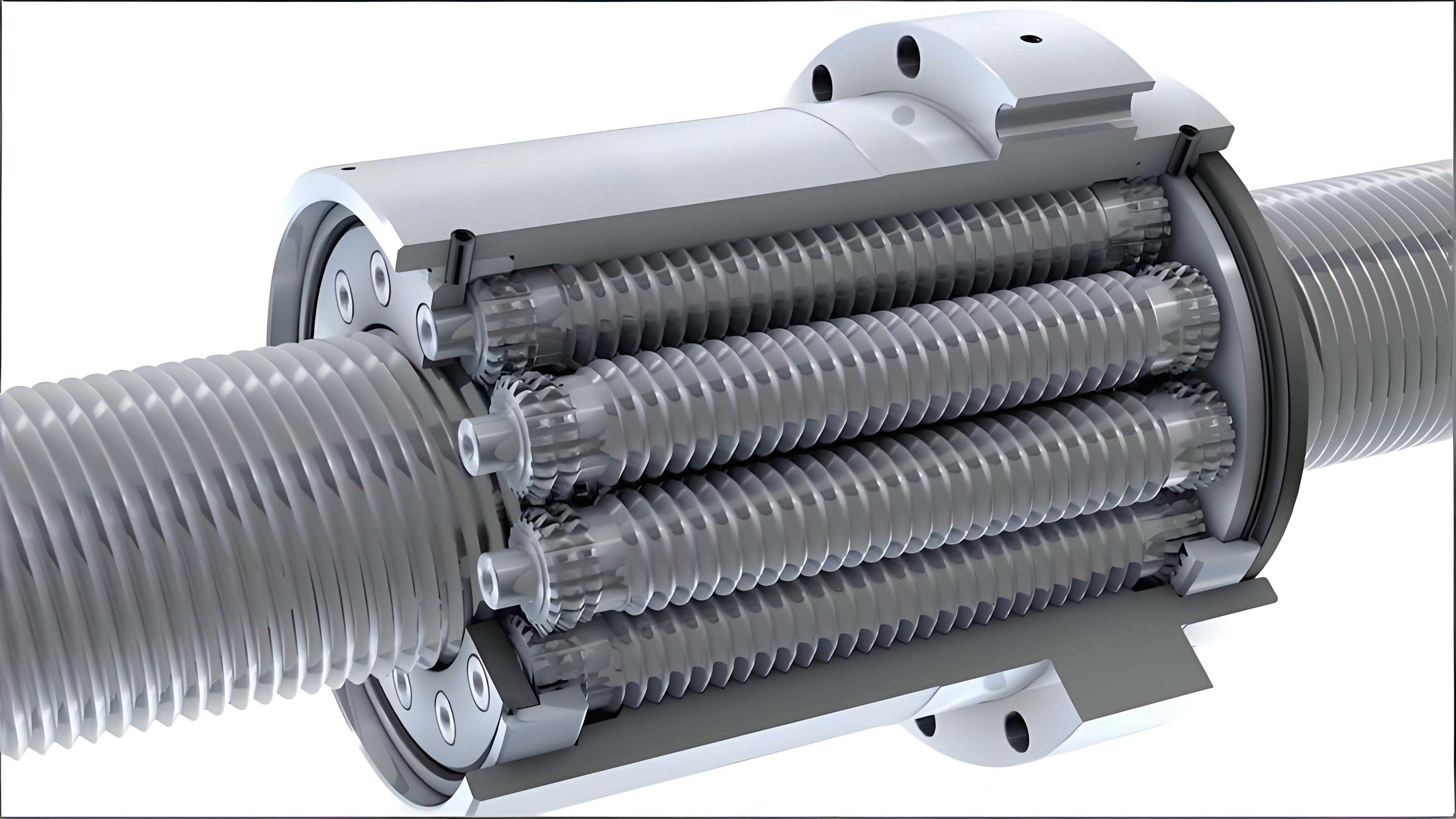
The core principle of a differential planetary roller screw assembly lies in its compound planetary gearing action combined with screw threads. In a standard planetary roller screw assembly, the nut, screw, and rollers all have threaded profiles with matched leads. In the differential type, the kinematic relationship is altered to achieve a reduced net lead. The traditional configuration can be understood through its kinematic equivalent. The screw acts as the sun gear, the rollers as the planets, and the nut as the ring gear. The critical distinction is that in a common differential design, the threads on the rollers and either the nut or the screw are not true helices but rather concentric rings (i.e., a helix with zero lead angle). This is the primary source of the problem.
The motion is transmitted from the driving member (usually the screw) to the driven member via the rollers. For pure rolling contact to occur at the meshing interfaces between the roller rings and the screw/nut rings, the motion must be enforced solely by friction. While manufacturing precision and applied preload can minimize the relative slip, it cannot be entirely eliminated. This slippage manifests as a deviation from the theoretical kinematic output, often quantified as a slip rate. Even with slip rates reportedly controlled below 1%, this non-deterministic behavior is unacceptable for the most demanding precision applications such as semiconductor lithography, advanced optical systems, or scientific instrumentation. My research was driven by the need to remove this stochastic element entirely from the operation of the differential planetary roller screw assembly.
Proposed Solution: Integrated Gear Meshing
The solution I propose is conceptually elegant and structurally sound: replace the friction-dependent ring contact with positive gear engagement at the non-helical interfaces. This involves integrating spur gears onto the ends of the rollers and corresponding internal ring gears into the nut (or onto the screw for the reverse differential type). This modification transforms the kinematic pair from a friction drive to a guaranteed geometric drive, eliminating the possibility of slippage at its root. It is important to clarify that the primary role of these added gears in this differential planetary roller screw assembly context is to enforce kinematic certainty, not necessarily to balance loads across rollers as is common in standard designs. The gear teeth do not require a threaded form, as they do not contact the opposing screw thread. Their phasing must be controlled, similar to the thread phasing in a standard planetary roller screw assembly, to ensure even load distribution and smooth operation.
Kinematic Analysis of the Improved Assemblies
To fully characterize the improved differential planetary roller screw assembly, a precise kinematic analysis is essential. We will examine both the standard and reverse configurations. The following notations are used:
- $\omega_s$, $\omega_n$, $\omega_r$: Angular velocities of the screw, nut, and roller (spin), respectively.
- $\omega_c$: Angular velocity of the roller carrier (revolution).
- $r_{rs}$, $r_{rn}$: Pitch radii of the roller at its screw-interface and nut-interface, respectively.
- $r_s$, $r_n$: Pitch radii of the screw thread and nut thread, respectively.
- $L_s$, $L_n$: Lead of the screw thread and nut thread, respectively. For a differential assembly, one of these is typically zero.
- $v_{out}$: Linear output velocity.
1. Standard Differential Configuration (Screw-driven, Nut output):
In this type, the nut has ring threads (lead $L_n = 0$), while the screw has a helical thread with lead $L_s$. The screw is the input. The gear teeth are added between the roller ends and the nut. The kinematic chain is as follows: Screw rotation drives the roller spin via thread contact at radius $r_{rs}$. The roller spin is then transmitted to force the roller carrier to revolve via the gear mesh between the roller (radius $r_{rn}$) and the stationary nut gear (radius $r_n$). The pure rolling condition at the screw-roller interface is now guaranteed by the gear constraint.
The velocity relationship at the gear mesh (point A in the analysis) is:
$$\omega_r \cdot r_{rn} = \omega_c \cdot (r_n – r_{rn})$$
This can be rearranged to:
$$\omega_c = \omega_r \cdot \frac{r_{rn}}{r_n – r_{rn}}$$
The velocity at the screw-roller contact point must satisfy:
$$\omega_s \cdot r_s = \omega_r \cdot r_{rs} + \omega_c \cdot r_s$$
Substituting the expression for $\omega_c$:
$$\omega_s \cdot r_s = \omega_r \cdot r_{rs} + \omega_r \cdot \frac{r_{rn}}{r_n – r_{rn}} \cdot r_s$$
Solving for the roller spin $\omega_r$:
$$\omega_r = \omega_s \cdot \frac{r_s}{r_{rs} + \frac{r_{rn} \cdot r_s}{r_n – r_{rn}}}$$
The linear output velocity of the nut is given by the revolution of the roller carrier multiplied by the screw’s lead, since the roller rings do not cause axial movement:
$$v_{out} = \omega_c \cdot L_s = \omega_s \cdot \frac{r_{rn}}{r_n – r_{rn}} \cdot \frac{r_s}{r_{rs} + \frac{r_{rn} \cdot r_s}{r_n – r_{rn}}} \cdot L_s$$
The effective lead $L_{eff}$ of the assembly (nut displacement per screw revolution) is therefore:
$$L_{eff} = \frac{v_{out}}{\omega_s / (2\pi)} = 2\pi \cdot \frac{r_{rn}}{r_n – r_{rn}} \cdot \frac{r_s}{r_{rs} + \frac{r_{rn} \cdot r_s}{r_n – r_{rn}}} \cdot L_s$$
This simplifies to a more compact form:
$$L_{eff} = L_s \cdot \left(1 – \frac{r_n \cdot r_{rs}}{r_s \cdot r_{rn} + r_n \cdot r_{rs}}\right)$$
Since $r_n > r_{rn}$, the term in parentheses is less than 1, confirming the differential, speed-reducing effect. The slippage is absent because the relationship between $\omega_r$ and $\omega_c$ is fixed by gear geometry.
2. Reverse Differential Configuration (Nut-driven, Screw output):
In this equally important variant, the screw has ring threads ($L_s=0$), and the nut has a helical thread with lead $L_n$. The nut is the input, and the screw is the output. Gears are added between the roller ends and the screw. A similar analysis yields the effective lead. The gear mesh (now between roller radius $r_{rs}$ and screw gear radius $r_s$) gives:
$$\omega_r \cdot r_{rs} = \omega_c \cdot (r_s + r_{rs}) \quad \Rightarrow \quad \omega_c = \omega_r \cdot \frac{r_{rs}}{r_s + r_{rs}}$$
The velocity at the nut-roller contact point is:
$$\omega_n \cdot r_n = \omega_r \cdot r_{rn} – \omega_c \cdot r_n$$
Note the sign difference due to the opposite direction of carrier movement relative to the roller spin at this contact. Substituting and solving for $\omega_r$:
$$\omega_r = \omega_n \cdot \frac{r_n}{r_{rn} – \frac{r_{rs} \cdot r_n}{r_s + r_{rs}}}$$
The linear output velocity of the screw is:
$$v_{out} = \omega_c \cdot L_n = \omega_n \cdot \frac{r_{rs}}{r_s + r_{rs}} \cdot \frac{r_n}{r_{rn} – \frac{r_{rs} \cdot r_n}{r_s + r_{rs}}} \cdot L_n$$
The effective lead $L_{eff}^{reverse}$ is:
$$L_{eff}^{reverse} = 2\pi \cdot \frac{v_{out}}{\omega_n} = L_n \cdot \frac{r_{rs}}{r_s + r_{rs}} \cdot \frac{r_n}{r_{rn} – \frac{r_{rs} \cdot r_n}{r_s + r_{rs}}}$$
This can be simplified to the formula I derived:
$$L_{eff}^{reverse} = L_n \cdot \left(1 – \frac{r_s \cdot r_{rn}}{r_n \cdot r_{rs} + r_s \cdot r_{rn}}\right)$$
This lead is typically even smaller than that of the standard differential type for comparable dimensions, offering an extended range of miniaturization for the mechanical stroke of a planetary roller screw assembly.
| Parameter | Standard Differential PRSA | Reverse Differential PRSA | Improved Design (Both Types) |
|---|---|---|---|
| Driving Member | Screw | Nut | Unchanged |
| Output Member | Nut | Screw | Unchanged |
| Helical Thread On | Screw ($L_s$) | Nut ($L_n$) | Unchanged |
| Ring Threads On | Nut & Rollers ($L=0$) | Screw & Rollers ($L=0$) | Unchanged |
| Key Motion Constraint | Friction at Ring Interfaces | Friction at Ring Interfaces | Positive Gear Mesh |
| Inherent Slippage | Yes (Controllable by preload) | Yes (Controllable by preload) | Eliminated |
| Effective Lead Formula | $L_{eff} = L_s \cdot \left(1 – \frac{r_n r_{rs}}{r_s r_{rn} + r_n r_{rs}}\right)$ | $L_{eff}^{rev} = L_n \cdot \left(1 – \frac{r_s r_{rn}}{r_n r_{rs} + r_s r_{rn}}\right)$ | Formulas remain valid and now exact. |
Static Force Analysis and Self-Locking Potential
The integration of gears not only solves the slippage issue but also allows us to re-examine the static force equilibrium with certainty. This leads to the significant finding that a differential planetary roller screw assembly can be designed to be self-locking, a property not typically associated with efficient roller or ball screws. Self-locking implies that a static axial force applied to the output member cannot cause the assembly to back-drive the input member. This is a highly desirable feature for holding positions without external brakes.
Consider the reverse differential configuration under a static axial load $P$ applied to the output screw. The load is transmitted through the roller to the nut’s helical thread. At the contact point on the nut’s thread, the normal force is resolved. The component tangential to the thread (which tries to drive rotation) is $Q = P \cdot \sin(\phi_n)$, where $\phi_n$ is the lead angle of the nut’s helix. The frictional force opposing this motion is $F_f = \mu \cdot N \approx \mu \cdot P \cdot \cos(\phi_n)$, where $\mu$ is the static coefficient of friction.
The first condition for self-locking is that this tangential component is insufficient to overcome static friction:
$$Q \leq F_f$$
$$P \cdot \sin(\phi_n) \leq \mu \cdot P \cdot \cos(\phi_n)$$
$$\tan(\phi_n) \leq \mu$$
This is the classic self-locking condition for an incline plane. For a typical planetary roller screw assembly with a ground thread and roller interface, $\mu$ is relatively low (in the range of 0.05-0.10 for rolling/sliding contact), so this condition often requires a very small lead angle.
However, in a differential planetary roller screw assembly, there is a second, more restrictive condition. The back-driving torque must also overcome the internal resistance to roller spin. The axial force $P$ creates a moment on the roller about its gear meshing point with the screw. For the roller to spin and allow back-drive, this moment must overcome the resistive moment generated by the gear mesh and the friction in the roller bearings/carrier.
Analyzing the forces on a single roller: The axial load $P$ (divided by the number of rollers) creates a normal force at the nut-roller interface. This generates a tangential force $F_t$ at the pitch radius $r_{rn}$ of the roller, attempting to spin it. This spin is resisted by the gear reaction at the screw-roller gear mesh at radius $r_{rs}$. The equilibrium condition for the roller to prevent spin is:
$$F_t \cdot r_{rn} \leq T_{resist}$$
Where $T_{resist}$ is the net resistive torque from the gear contact and bearing friction. A conservative estimate considers only the gear reaction necessary to prevent motion. The driving torque from the load is $M_{drive} = P \cdot \sin(\phi_n) \cdot r_{rn}$. The gear reaction force at the screw interface creates a counter-torque. Detailed static analysis shows that for back-driving to be prevented, a more comprehensive condition emerges, considering the geometry:
$$\frac{r_{rn} – \mu \cdot r_{rs} \cdot \cos(\phi_n)}{r_{rs} \cdot \cos(\phi_n) + \mu \cdot r_{rn}} \leq \mu$$
This inequality defines the second self-locking criterion for a differential planetary roller screw assembly. It is often easier to satisfy than the simple $\tan(\phi) \leq \mu$ condition because the left-hand side can be made very small or even negative by carefully selecting the radius ratio $r_{rn}/r_{rs}$. If the numerator $(r_{rn} – \mu r_{rs} \cos\phi_n)$ is negative, the inequality holds for any positive $\mu$, indicating inherent self-locking from the geometry.
Therefore, by strategically designing the lead angle $\phi_n$ (or $\phi_s$ in the standard type) and the roller pitch radii $r_{rn}$ and $r_{rs}$, a differential planetary roller screw assembly can be made definitively self-locking. This is a direct consequence of the guaranteed kinematic linkage provided by the gears, which allows such static analysis to be meaningful and reliable.
| Design Parameter | Effect on Effective Lead | Effect on Back-Driving Force / Self-Locking | Practical Design Consideration |
|---|---|---|---|
| Nut/Screw Lead ($L_n$, $L_s$) | Directly proportional. Halving the lead halves $L_{eff}$. | Smaller lead reduces lead angle, making $\tan(\phi) \leq \mu$ easier to satisfy (promotes self-locking). | Governs the final resolution. Very small leads require extremely high manufacturing precision. |
| Roller Nut-side Radius ($r_{rn}$) | Increasing $r_{rn}$ decreases $L_{eff}$ in the standard type, effect is complex in reverse type per formula. | Increasing $r_{rn}$ generally increases the driving torque for back-drive, affecting the geometric self-locking condition. | Limited by the internal diameter of the nut and the need to fit multiple rollers. |
| Roller Screw-side Radius ($r_{rs}$) | Increasing $r_{rs}$ decreases $L_{eff}$ in the reverse type, complex effect in standard type. | Key parameter in the geometric self-locking inequality. Can be tuned to make the numerator negative. | Limited by the screw’s root diameter and the desired contact stress. |
| Pitch Radius Ratio ($r_{rn}/r_{rs}$) | Fundamentally determines the differential reduction ratio along with $r_n$ and $r_s$. | The single most important ratio for achieving geometric self-locking independent of friction. | Optimal value is a compromise between lead reduction, self-locking, and structural constraints. |
| Static Friction Coefficient ($\mu$) | No direct effect on kinematic lead (in gear-equipped design). | Critical for the simple incline condition $\tan(\phi) \leq \mu$. Higher $\mu$ promotes self-locking. | Material pairing and lubrication must be chosen carefully if relying on this condition. Surface treatments may be used. |
Advantages and Implications of the Improved Design
The transition to a gear-enforced differential planetary roller screw assembly delivers transformative benefits. Firstly, it renders the assembly kinematically exact. The output position is a deterministic function of the input rotation, governed solely by geometry (leads, pitch radii, gear teeth counts) and free from the statistical uncertainty of friction. This is paramount for absolute positioning systems.
Secondly, it unlocks the potential for reliable self-locking. Designers can now use the derived inequalities as tools to create mechanisms that hold position passively, enhancing safety and reducing system complexity by eliminating external braking devices in some applications.
Thirdly, it combines the best of both worlds: the extremely fine resolution of a differential planetary roller screw assembly (with effective leads potentially an order of magnitude smaller than a standard planetary roller screw assembly of similar size) and the reliability of a positively engaged transmission. This synergy means that in many systems, a single, compact differential planetary roller screw assembly can achieve the performance that previously required a standard planetary roller screw assembly coupled with a bulky external reduction gearbox. The space and weight savings are significant.
In conclusion, my research demonstrates that the inherent slippage in traditional differential planetary roller screw assemblies is not an unavoidable compromise but a solvable design flaw. By integrating positive gear meshing at the non-helical interfaces, we create a new class of transmission component: a slippage-free, potentially self-locking differential planetary roller screw assembly. The derived kinematic formulas provide accurate design tools, and the established self-locking conditions open new avenues for application in precision holding and fail-safe mechanisms. This advancement elevates the differential planetary roller screw assembly from a component requiring careful tolerance and control to mitigate slip, to a fundamentally precise and predictable foundational element for the next generation of high-performance mechatronic systems.