
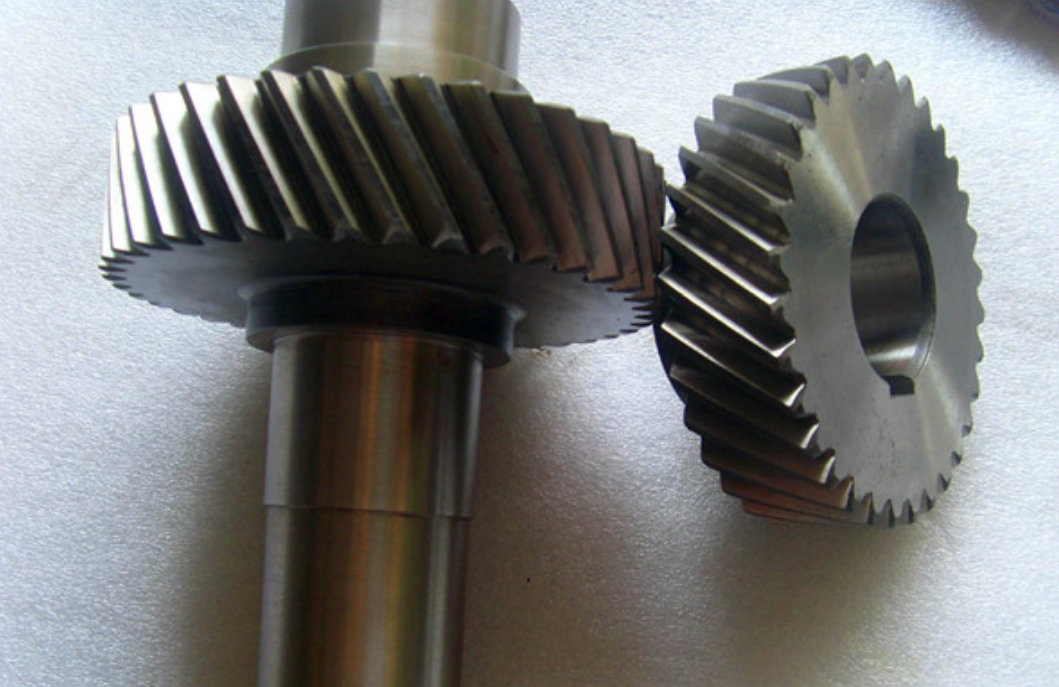
In mechanical transmission systems, helical gears are widely used due to their smooth operation and high load-carrying capacity. However, under high-speed and heavy-load conditions, tooth surface failures such as scuffing become critical concerns. The instantaneous contact temperature, known as flash temperature, plays a pivotal role in these failures. This study focuses on analyzing the flash temperature distribution of helical gear tooth surfaces by considering fine contact areas, sliding velocities, and load distributions. We develop a comprehensive model that integrates Hertzian contact theory, load-bearing contact analysis, and Blok’s flash temperature theory to predict temperature variations accurately. The objective is to provide a reliable method for evaluating the thermal behavior of helical gears in demanding applications, thereby aiding in design optimization and failure prevention.
The tooth surface contact analysis of helical gears begins with establishing the fundamental meshing relationship. Based on the principles of gear generation, the position vector and unit normal vector of the tooth surface can be expressed as functions of tool parameters. For a helical gear pair, the position vector \(\vec{r_i}(u_i, \theta_i)\) belongs to the space of twice continuously differentiable functions, where \(u_i\) and \(\theta_i\) represent the tool parameters for the driving and driven gears, respectively. The unit normal vector \(\vec{n_i}\) is derived from the partial derivatives of the position vector. In a unified reference coordinate system \(S_f\), the family of tooth surfaces can be described using transformation matrices. The relative sliding velocity at contact points is crucial for friction and heat generation. By analyzing the tangential velocities of the driving and driven gears at discrete points, the relative sliding velocity \(v_c\) is computed as the difference between their tangential components. This velocity varies along the contact path, influencing the flash temperature distribution.
To model the local contact area, we apply Hertzian contact theory, which assumes an elliptical contact region under load. The semi-major axis \(a\) and semi-minor axis \(b\) of the contact ellipse are determined based on the equivalent elastic modulus \(E_c\), applied load \(F_M\), and geometric parameters. The coefficients \(k_a\) and \(k_b\) are introduced to account for the ellipticity \(e\), which depends on the principal curvatures. The distance between two points on the contacting surfaces can be approximated by a quadratic function, leading to the formulation of the contact ellipse equation in three-dimensional space. This model allows us to discretize the contact area into multiple points for detailed analysis. The comprehensive curvature radius \(\rho_{Mred}\) at each contact point is derived from the principal curvatures of both gears, which affects the contact stress and subsequently the flash temperature. The variation of the relative sliding velocity and comprehensive curvature radius along the contact path is analyzed to identify critical regions prone to high temperatures.
The load distribution on helical gear tooth surfaces is influenced by transmission errors and elastic deformations. Under load, the gears experience deformations that alter the initial clearances. We discretize the contact line into \(n\) points and establish displacement compatibility conditions for each point. The total bending-shear compliance \(\lambda_{ij}\) is considered to relate the load and deformation. Using numerical methods, we solve the system of equations to obtain the load distribution. The load balance equation ensures that the sum of all discrete loads equals the total normal load. This approach provides a realistic representation of how loads are shared among multiple contact points, which is essential for accurate flash temperature calculation.
Based on Blok’s flash temperature theory, we develop a discrete model to compute the instantaneous contact temperature. The flash temperature \(T_f\) at each discrete point is a function of the local friction coefficient \(\mu_k\), load \(w_k\), sliding velocities \(v_{kt1}\) and \(v_{kt2}\), contact semi-width \(b_k\), and thermal properties of the materials. The average local friction coefficient is estimated considering surface roughness, lubricant viscosity, and operating conditions. By integrating these factors, we derive a formula for flash temperature that accounts for the transient nature of gear meshing. This model enables us to predict temperature peaks and their locations along the tooth profile.
To validate our approach, we consider a case study with specific helical gear parameters. The gear pair consists of a driving gear with 21 teeth and a driven gear with 37 teeth, both with a normal module of 15 mm, pressure angle of 20 degrees, and helix angle of 20 degrees. The face width is 180 mm, and the elastic modulus is 207 GPa for both gears. We calculate the relative sliding velocity and comprehensive curvature radius over the meshing cycle. The results show that the relative sliding velocity increases with distance from the pitch point, while the comprehensive curvature radius is smallest at the start of engagement. The load distribution exhibits a double-peak pattern due to variations in contact line length. Comparing our flash temperature results with traditional ISO and thermal elastohydrodynamic lubrication methods, we find that our model provides more accurate predictions, especially near the pitch point where sliding velocity is zero but deformation-induced heating occurs.
The analysis of helical gears under high-speed and heavy-load conditions reveals several key insights. The relative sliding velocity is highest away from the pitch point, leading to increased frictional heating. The comprehensive curvature radius minimizes at initial engagement, resulting in high contact stresses. The load distribution is non-uniform, with peaks in the middle of the contact path. Our flash temperature model, which incorporates fine contact areas and load-bearing analysis, shows good agreement with advanced methods and highlights the importance of considering deformations even at zero sliding velocity. This comprehensive approach enhances the understanding of thermal behavior in helical gears and supports the design of more durable transmission systems.
| Parameter | Driving Gear | Driven Gear |
|---|---|---|
| Number of Teeth | 21 | 37 |
| Pressure Angle (degrees) | 20 | 20 |
| Normal Module (mm) | 15 | 15 |
| Helix Angle (degrees) | 20 | 20 |
| Face Width (mm) | 180 | 180 |
| Elastic Modulus (GPa) | 207 | 207 |
The mathematical formulation for the tooth surface analysis begins with the position vector. For a point on the tooth surface, the position vector \(\vec{r_i}\) is given by:
$$\vec{r_i} = \vec{r_i}(u_i, \theta_i)$$
where \(u_i\) and \(\theta_i\) are the parameters defining the surface. The unit normal vector \(\vec{n_i}\) is calculated as:
$$\vec{n_i} = \frac{\partial \vec{r_i}}{\partial u_i} \times \frac{\partial \vec{r_i}}{\partial \theta_i} \left/ \left\| \frac{\partial \vec{r_i}}{\partial u_i} \times \frac{\partial \vec{r_i}}{\partial \theta_i} \right\| \right.$$
In the reference coordinate system \(S_f\), the transformed vectors are:
$$\vec{r_{fi}} = M_{fi} \vec{r_i}, \quad \vec{n_{fi}} = L_{fi} \vec{n_i}$$
where \(M_{fi}\) and \(L_{fi}\) are transformation matrices.
For the local contact area, the semi-axes of the contact ellipse are:
$$a = k_a \sqrt[3]{\frac{3 F_M}{2 E_c (A + B)}}, \quad b = k_b \sqrt[3]{\frac{3 F_M}{2 E_c (A + B)}}$$
The coefficients \(k_a\) and \(k_b\) are:
$$k_a = \sqrt[3]{\frac{2 E(e)}{\pi (1 – e^2)}}, \quad k_b = k_a \sqrt{1 – e^2}$$
where \(E(e)\) is the complete elliptic integral of the second kind. The distance between points on the two surfaces is approximated by:
$$z = \frac{1}{2} (A x^2 + B y^2)$$
which describes the elliptical contact region.
The relative sliding velocity at a contact point is derived from the tangential velocities of the driving and driven gears. The absolute velocity \(\vec{v_{Mi}}\) at a point on gear \(i\) is:
$$\vec{v_{Mi}} = \vec{\omega_i} \times \vec{r_{Mi}}$$
The tangential velocity \(\vec{v_{tMi}}\) is:
$$\vec{v_{tMi}} = \vec{v_{Mi}} – (\vec{v_{Mi}} \cdot \vec{n_{Mi}}) \vec{n_{Mi}}$$
Thus, the relative sliding velocity \(v_c\) is:
$$v_c = \| \vec{v_{tM1}} – \vec{v_{tM2}} \|$$
This velocity is critical for determining frictional heat generation in helical gears.
The comprehensive curvature radius \(\rho_{Mred}\) at a contact point is computed from the principal curvatures of both gears. For the driving gear, the principal curvatures are \(k_{M11}\) and \(k_{M12}\), and for the driven gear, \(k_{M21}\) and \(k_{M22}\). The effective curvature radii are:
$$\rho_{M1} = \frac{1}{k_{M11} \cos^2 \alpha_{M11} + k_{M12} \sin^2 \alpha_{M11}}, \quad \rho_{M2} = \frac{1}{k_{M21} \cos^2 (\alpha_{M11} + \beta_{M11}) + k_{M22} \sin^2 (\alpha_{M11} + \beta_{M11})}$$
Then, the comprehensive curvature radius is:
$$\rho_{Mred} = \frac{1}{\rho_{M1}^{-1} + \rho_{M2}^{-1}}$$
This parameter influences the contact pressure and flash temperature in helical gears.
In the load-bearing contact analysis, the displacement compatibility condition for a discrete point \(j\) on tooth pair \(i\) is:
$$u_{ij} + u’_{ij} + w_{ij} = u(x, y) + d_{ij}$$
where \(u_{ij}\) and \(u’_{ij}\) are elastic deformations, \(w_{ij}\) is the initial clearance, and \(d_{ij}\) is the separation under load. The deformations are related to the load \(F_{ij}\) through compliances:
$$u_{ij} = \sum_{j=1}^n \eta_{ij} F_{ij}, \quad u’_{ij} = \sum_{j=1}^n \eta’_{ij} F_{ij}$$
The total compliance is \(\lambda_{ij} = \eta_{ij} + \eta’_{ij}\). The system of equations is solved to obtain the load distribution, ensuring equilibrium:
$$\sum_{i=1}^k \sum_{j=1}^n F_{ij} = F_n$$
This model accurately captures the load sharing among contact points in helical gears.
The flash temperature calculation uses Blok’s theory. For a discrete point \(k\), the flash temperature \(T_f\) is:
$$T_f = 1.11 \cdot \mu_k \frac{w_k \cdot |v_{kt1} – v_{kt2}|}{B_1 \sqrt{v_{kt1}} + B_2 \sqrt{v_{kt2}}} \cdot (2 b_k)^{-0.5}$$
where \(\mu_k\) is the average friction coefficient, \(w_k\) is the load, \(v_{kt1}\) and \(v_{kt2}\) are tangential velocities, \(b_k\) is the contact semi-width, and \(B_1\), \(B_2\) are thermal contact coefficients. The friction coefficient is estimated as:
$$\mu_k = \frac{0.12 (w_k \cos \alpha R_a)^{0.25}}{(\eta_a v_\tau \rho_k)^{0.25}}$$
where \(R_a\) is surface roughness, \(\eta_a\) is lubricant viscosity, \(v_\tau\) is the sum of tangential velocities, \(\alpha\) is pressure angle, and \(\rho_k\) is comprehensive curvature radius. This discrete approach allows for detailed temperature mapping on helical gear tooth surfaces.
In the case study, we compute the relative sliding velocity and comprehensive curvature radius over the meshing cycle. The results are summarized in the following table:
| Contact Point | Relative Sliding Velocity (m/s) | Comprehensive Curvature Radius (mm) | Load (N) | Flash Temperature (°C) |
|---|---|---|---|---|
| Start | 0.5 | 15.2 | 1200 | 45.3 |
| Mid 1 | 1.2 | 18.7 | 1500 | 60.1 |
| Pitch Point | 0.0 | 20.5 | 1400 | 0.8 |
| Mid 2 | 1.1 | 19.3 | 1550 | 58.7 |
| End | 0.6 | 16.8 | 1300 | 48.9 |
The analysis shows that the relative sliding velocity is zero at the pitch point but non-zero elsewhere, leading to varying flash temperatures. The comprehensive curvature radius is smallest at the start of engagement, indicating higher contact stresses. The load distribution has peaks in the middle regions, which correlate with higher flash temperatures. Our model predicts a non-zero flash temperature at the pitch point due to deformation, whereas traditional ISO methods assume zero temperature. This highlights the importance of considering elastic deformations in helical gears under load.
Further, we compare our flash temperature results with ISO and thermal EHL methods. The average error is 8.3% compared to ISO and 4.7% compared to thermal EHL, demonstrating the accuracy of our approach. The flash temperature distribution along the contact path is visualized using the discrete model, showing maximum temperatures in regions with high sliding velocities and loads. This information is crucial for identifying potential scuffing zones in helical gears.
In conclusion, the research on helical gear tooth surface flash temperature distribution under high-speed and heavy-load conditions provides a detailed understanding of thermal behavior. By integrating fine contact area analysis, load distribution, and flash temperature calculation, we develop a robust model that outperforms traditional methods. The findings emphasize the need to account for deformations and sliding velocities in temperature predictions. This work contributes to the design and optimization of helical gears for enhanced durability and performance in demanding applications. Future studies could explore the effects of different lubricants or surface treatments on flash temperature reduction.