
Gear transmission is one of the most widely used mechanical drives in machinery and instruments. It relies on the direct contact of tooth profiles to transmit motion and power between two spatial shafts, offering advantages such as a wide range of transmittable power, high transmission efficiency, accurate transmission ratio, long service life, and reliable operation. The involute tooth profile has found the most extensive application due to its excellent transmission performance and its ease of manufacturing, installation, measurement, and interchangeability. The surface of an involute spiral cylindrical gear is a cylindrical helicoid. Precisely machining this involute helicoid using a grinding method, and subsequently dressing the tool profile as it wears, is a significant and frequently encountered challenge in mechanical manufacturing and the field of gear form grinding technology. This article delves into the theoretical foundations and numerical methods for determining the precise profile of a grinding wheel used to form-grind involute spiral gears. By establishing the mathematical model of the gear surface and the grinding kinematics, the required wheel profile can be calculated. Furthermore, parameter modification enables the generation of a new profile curve for a worn wheel, addressing the critical issue of dressing form grinding wheels.
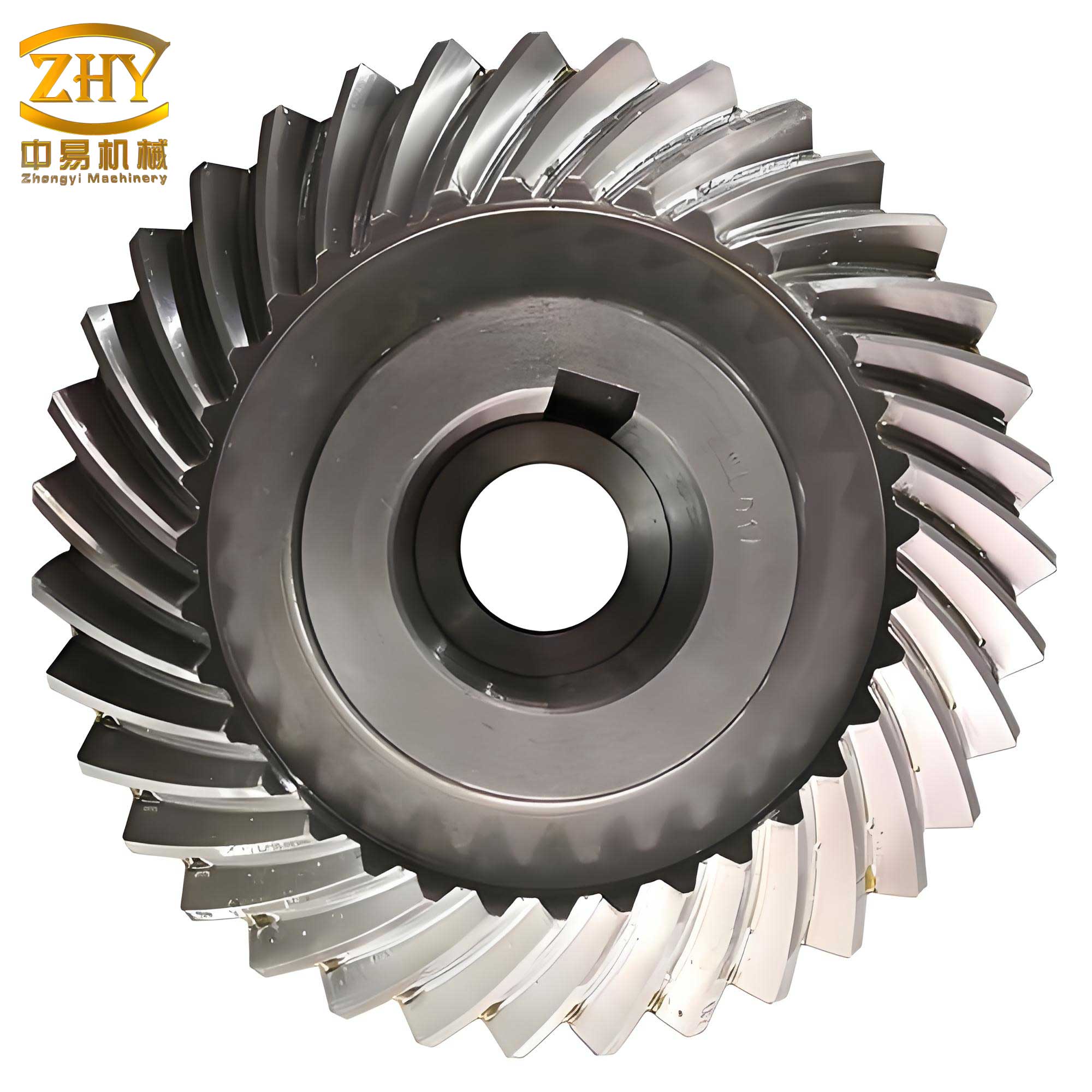
The geometry of a spiral gear is fundamentally defined by its tooth surface. An involute helicoid can be generated by a straight line performing a screw motion. Consider a fixed coordinate system (O – x, y, z) with unit vectors $\mathbf{i}$, $\mathbf{j}$, $\mathbf{k}$. According to the theory of gearing, a right-handed helicoid can be expressed by the vector rotation formula. Let a generating curve be defined in a starting position by the parametric equations $x_0(u)$, $y_0(u)$, $z_0(u)$. After this curve undergoes a screw motion—rotation by an angle $\theta$ about the z-axis combined with a translation $p\theta$ along it—the equation of the generated helicoid is:
$$
\begin{aligned}
x &= x_0(u) \cos\theta – y_0(u) \sin\theta \\
y &= x_0(u) \sin\theta + y_0(u) \cos\theta \\
z &= z_0(u) + p\theta
\end{aligned}
$$
where $\theta$ is the parameter representing the angle of rotation, and $p$ is the spiral parameter. For an involute spiral gear, $p$ is related to the gear’s basic parameters: $p = \frac{z_n m_n}{2 \sin\beta}$, where $z_n$, $m_n$, and $\beta$ are the number of teeth, normal module, and helix angle at the reference circle, respectively.
Specifically, the involute helicoid of a spiral gear is generated by a straight line (the generator) tangent to a base cylinder of radius $r_b$. The generator makes a constant angle $\alpha$ with the transverse plane, which is equal to the lead angle $\gamma$ of the helix on the base cylinder: $\alpha = \gamma = \arctan(p / r_b)$. For the right-side flank, let the starting point of the involute on the base circle be at an angle $\sigma$ from the x-axis. Using the distance $u$ along the generator from the tangent point as a parameter, the equations of the generator in its starting position are:
$$
\begin{aligned}
x_0 &= r_b \cos\sigma – u \cos\alpha \sin\sigma \\
y_0 &= r_b \sin\sigma + u \cos\alpha \cos\sigma \\
z_0 &= u \sin\alpha
\end{aligned}
$$
Substituting these into the general helicoid equation yields the parametric equation for the right-handed involute spiral gear surface:
$$
\begin{aligned}
x &= r_b \cos(\sigma + \theta) – u \cos\alpha \sin(\sigma + \theta) \\
y &= r_b \sin(\sigma + \theta) + u \cos\alpha \cos(\sigma + \theta) \\
z &= u \sin\alpha + p\theta
\end{aligned}
$$
The components of the unit normal vector $\mathbf{n}$ to this surface are:
$$
\begin{aligned}
n_x &= \sin\alpha \sin(\sigma + \theta) \\
n_y &= -\sin\alpha \cos(\sigma + \theta) \\
n_z &= \cos\alpha
\end{aligned}
$$
The core challenge of form grinding a spiral gear lies in determining the exact profile of the rotating grinding wheel (modeled as a surface of revolution) that will generate the desired involute helicoid on the workpiece. The fundamental principle is based on the theory of conjugate surfaces. During the grinding process, the wheel and the gear workpiece are in mesh at every instant along a line of contact. This contact line, when swept around the wheel axis, defines the wheel’s surface. Conversely, when the same line undergoes a screw motion around the gear axis, it defines the gear tooth surface.
The spatial relationship between the grinding wheel and the spiral gear workpiece is crucial. Typically, a disk-shaped grinding wheel is used with its axis crossed relative to the gear axis. The setup is defined by the center distance $a$ (shortest distance between axes) and the crossing angle $\Sigma$. For grinding a spiral gear with helix angle $\beta$, the common setup uses $\Sigma = 90^\circ – \beta$. A coordinate transformation relates the gear coordinate system (O-xyz) to the wheel coordinate system (O’-XYZ). The transformation matrix is:
$$
\begin{bmatrix}
X \\ Y \\ Z
\end{bmatrix}
=
\begin{bmatrix}
a – x \\
-y \cos\Sigma – z \sin\Sigma \\
-y \sin\Sigma + z \cos\Sigma
\end{bmatrix}
$$
The condition for contact between the two surfaces, known as the equation of meshing, stems from the requirement that their relative velocity is orthogonal to the common surface normal at the point of contact. If $\mathbf{v}^{(12)}$ is the relative velocity of the wheel surface (1) with respect to the gear surface (2), and $\mathbf{n}$ is the common normal, the contact condition is $\mathbf{v}^{(12)} \cdot \mathbf{n} = 0$. For the case where the gear surface is a helicoid defined by its own screw motion, this condition can be simplified. Applying this to our specific coordinate setup, the contact condition for points on the involute spiral gear surface that will be in contact with the wheel surface reduces to:
$$ z n_x \sin\Sigma + a n_y \cos\Sigma + \left[ (a – x) \sin\Sigma + p \cos\Sigma \right] n_z = 0 $$
Substituting the expressions for $x$, $y$, $z$, $n_x$, $n_y$, and $n_z$ from the involute helicoid equations into the contact condition yields a single equation relating the two surface parameters $u$ and $\theta$:
$$ (u + p\theta \sin\alpha)\sin(\sigma+\theta) + \frac{r_b – a\cos(\sigma+\theta)}{\sin\alpha} \cot\Sigma + (a – r_b \cos(\sigma+\theta))\cos\alpha = 0 $$
This equation is central to solving for the wheel profile. For a given point on the gear surface (defined by a pair of $u$, $\theta$), it determines whether that point lies on the line of contact for the given wheel position. To find the wheel profile, we proceed with a numerical approach. The equation above is implicit. By choosing a value for the parameter $\theta$, we can solve for the corresponding value of $u$ that satisfies the contact condition. This process generates a series of discrete $(u, \theta)$ pairs, each representing a point on the contact line in the gear coordinate system.
These contact points are then transformed into the grinding wheel’s coordinate system using the transformation equations. Finally, the axial profile of the disk-shaped grinding wheel—its cross-section in the plane containing the wheel axis—is found. For a point $(X, Y, Z)$ on the contact line in wheel coordinates, the radial distance $R$ from the wheel axis and the axial coordinate $Z$ define a point on the wheel’s axial profile:
$$
R = \sqrt{X^2 + Y^2}, \quad \text{Axial Coord} = Z
$$
By calculating $(R, Z)$ for all discrete $(u, \theta)$ pairs, we obtain a set of discrete points defining the required form on the grinding wheel. A smooth curve fitted through these points represents the necessary wheel profile. The density of the $\theta$ parameter sampling controls the accuracy of the profile; a smaller increment yields more points and a more accurate curve fit.
A critical practical aspect is wheel wear. As the grinding wheel wears, its effective diameter decreases, altering the spatial relationship (implicitly affecting the engagement geometry and potentially the center distance ‘a’ if not compensated). The original calculated profile will no longer produce the correct spiral gear tooth form. The power of this numerical method is that it allows for efficient redressing. Once the amount of wheel wear is known (reducing the effective wheel radius), the input parameters in the calculation (like the effective center distance or wheel reference diameter) can be updated, and a new, corrected wheel profile curve can be generated rapidly. This solves the historically difficult problem of dressing form wheels for spiral gears.
The table below summarizes the key parameters involved in the calculation and their influence on the final spiral gear and wheel profile.
| Parameter | Symbol | Role in Spiral Gear & Wheel Generation |
|---|---|---|
| Normal Module | $m_n$ | Defines the basic size of the spiral gear teeth in the normal plane. Affects the spiral parameter $p$. |
| Number of Teeth | $z_n$ | Determines the gear size and the spiral parameter $p$. Influences the curvature of the involute. |
| Helix Angle (at ref. circle) | $\beta$ | Defines the lead of the spiral gear. Directly sets the crossing angle $\Sigma = 90^\circ – \beta$ and affects $p$. |
| Base Circle Radius | $r_b$ | Fundamental geometry of the involute. Defines the start and shape of the tooth profile. $r_b = (m_n z_n \cos\alpha_t) / 2$, where $\alpha_t$ is the transverse pressure angle. |
| Pressure Angle (Normal/Transverse) | $\alpha_n / \alpha_t$ | Defines the inclination of the involute profile. Related to the generator angle $\alpha$ in the model. |
| Spiral Parameter | $p$ | $p = r_b / \tan\alpha = (m_n z_n) / (2 \sin\beta)$. Core parameter defining the screw motion of the helicoid. |
| Center Distance (Machine Setting) | $a$ | The shortest distance between the grinding wheel axis and the spiral gear workpiece axis. A crucial setup parameter. |
| Crossing Angle (Machine Setting) | $\Sigma$ | The angle between the grinding wheel axis and the gear axis. Typically $\Sigma = 90^\circ – \beta$. |
| Wheel Reference Diameter | $d_{ws}$ | The effective diameter of the grinding wheel. Wear reduces this value, necessitating profile recalculation. |
The following table outlines the main steps in the computational procedure to obtain the grinding wheel profile for a spiral gear.
| Step | Action | Key Equations/Output |
|---|---|---|
| 1 | Define Spiral Gear Parameters | Input $m_n$, $z_n$, $\beta$, $\alpha_n$, face width, etc. Calculate derived parameters: $r_b$, $p$, $\alpha$, $\sigma$. |
| 2 | Define Grinding Setup | Input center distance $a$ and crossing angle $\Sigma$. Determine wheel nominal diameter. |
| 3 | Parameterize Gear Surface | Establish the involute helicoid equations and surface normal. $x = r_b \cos(\sigma+\theta) – u \cos\alpha \sin(\sigma+\theta)$, $y = r_b \sin(\sigma+\theta) + u \cos\alpha \cos(\sigma+\theta)$, $z = u \sin\alpha + p\theta$. $n_x, n_y, n_z$ as defined above. |
| 4 | Apply Contact Condition | For a discrete set of $\theta_i$ values, solve the contact equation for $u_i$. $(u + p\theta \sin\alpha)\sin(\sigma+\theta) + \frac{r_b – a\cos(\sigma+\theta)}{\sin\alpha} \cot\Sigma + (a – r_b \cos(\sigma+\theta))\cos\alpha = 0$. |
| 5 | Transform to Wheel Coordinates | For each $(\theta_i, u_i)$ pair, calculate $(X_i, Y_i, Z_i)$. $X = a – x$, $Y = -y\cos\Sigma – z\sin\Sigma$, $Z = -y\sin\Sigma + z\cos\Sigma$. |
| 6 | Compute Wheel Axial Profile | Calculate radial and axial coordinates for the wheel profile. $R_i = \sqrt{X_i^2 + Y_i^2}$, $Z_i$ is the axial coordinate. |
| 7 | Fit & Output Profile | Fit a smooth curve through points $(R_i, Z_i)$. This curve is the required axial profile of the grinding wheel for the spiral gear. |
| 8 (For Dress) | Update for Wheel Wear | Adjust input parameters (e.g., effective $a$ or wheel diameter) based on measured wear. Repeat Steps 4-7 to generate the new dressing profile. |
The curvature of the generated wheel profile is not constant and is significantly influenced by the relative geometry. An important observation is the relationship between wheel diameter and profile shape. For the same spiral gear parameters, a larger grinding wheel diameter generally results in a flatter, less curved axial profile. As the wheel wears and its effective diameter decreases, the recalculated profile becomes more curved. This is illustrated conceptually by the trend that for a fixed gear, reducing the wheel diameter $d_{ws}$ leads to a more pronounced curvature in the $(R, Z)$ profile plot. The ability to compute this changing profile is the key to maintaining accuracy throughout the wheel’s life.
The mathematical framework also allows for the analysis of profile errors. Deviations between the fitted wheel profile and the ideal calculated points, or errors in the machine setup parameters ($a$, $\Sigma$), will translate into deviations on the ground spiral gear tooth. Sensitivity analysis can be performed using differential methods on the core equations. For instance, the impact of a small error $\Delta a$ in center distance on the gear tooth profile error can be estimated by examining how the contact condition and subsequent transformation are perturbed.
In conclusion, the precise form grinding of involute spiral gears relies on a solid theoretical foundation in spatial gearing and screw surface generation. The process can be broken down into a sequence of well-defined steps: 1) Mathematical modeling of the target involute spiral gear surface. 2) Establishing the kinematic relationship and contact condition between the grinding wheel and the spiral gear workpiece. 3) Using coordinate transformation to bridge the two reference frames. 4) Solving the contact condition numerically to obtain discrete points on the line of contact. 5) Mapping these points to the grinding wheel’s coordinate system to derive its required axial profile via curve fitting.
This methodology provides a robust new approach for manufacturing high-precision spiral gears. Its most significant practical advantage is the efficient solution it offers for wheel dressing. As the grinding wheel wears, simple parameter modification in the numerical model allows for the rapid generation of a new, corrected profile curve. This eliminates the reliance on complex and expensive physical masters or trial-and-error methods, thereby greatly enhancing machining efficiency and consistency in producing accurate spiral gears. Future work may involve integrating this calculation method directly into CNC grinding machine controls for real-time dressing data generation and exploring its extension to the form grinding of modified tooth profiles (e.g., tip or root relief) on spiral gears.