
In my extensive experience with precision engineering, I have encountered numerous challenges in machining specialized components, but few are as demanding as the drum-type gear shaft with small module, few teeth, and large helix angle. This unique gear shaft, which I refer to as a special drum gear shaft, presents exceptionally high accuracy requirements that distinguish it from standard gear shafts. Its manufacturing is relatively rare in domestic contexts, prompting a deep investigation into the factors influencing its machining. Through my research, I have focused on the critical roles of heat treatment conditions and machining positioning methods. By refining induction quenching parameters and redesigning hobbing fixture systems, I have achieved significant improvements in the machining accuracy of these特型 gear shafts. This article, written from my first-person perspective as a researcher, delves into the technical nuances, supported by data tables and analytical formulas, to elucidate how these process modifications enhance gear shaft performance.
The core of my study revolves around a specific electro-armature gear shaft, which exemplifies the challenges. This gear shaft features a slender axial profile, minimal tooth count, and a pronounced helix angle, all of which exacerbate machining distortions. The primary hurdle lies in maintaining tight tolerances for involute tooth profile, tooth direction, pitch accumulation, and radial runout, as specified in standards like JIS Grade 4. Traditional machining approaches often fall short due to inherent deformations during cutting and heat treatment. My approach involved a two-stage hobbing process: rough hobbing followed by induction hardening and then finish hobbing. This strategy leverages the increased stiffness post-hardening to facilitate precision hard hobbing. However, the success of this method hinges on mitigating distortions induced by heat treatment and optimizing the workpiece holding during hobbing. Throughout this analysis, the term ‘gear shaft’ will be frequently emphasized to underscore its centrality.
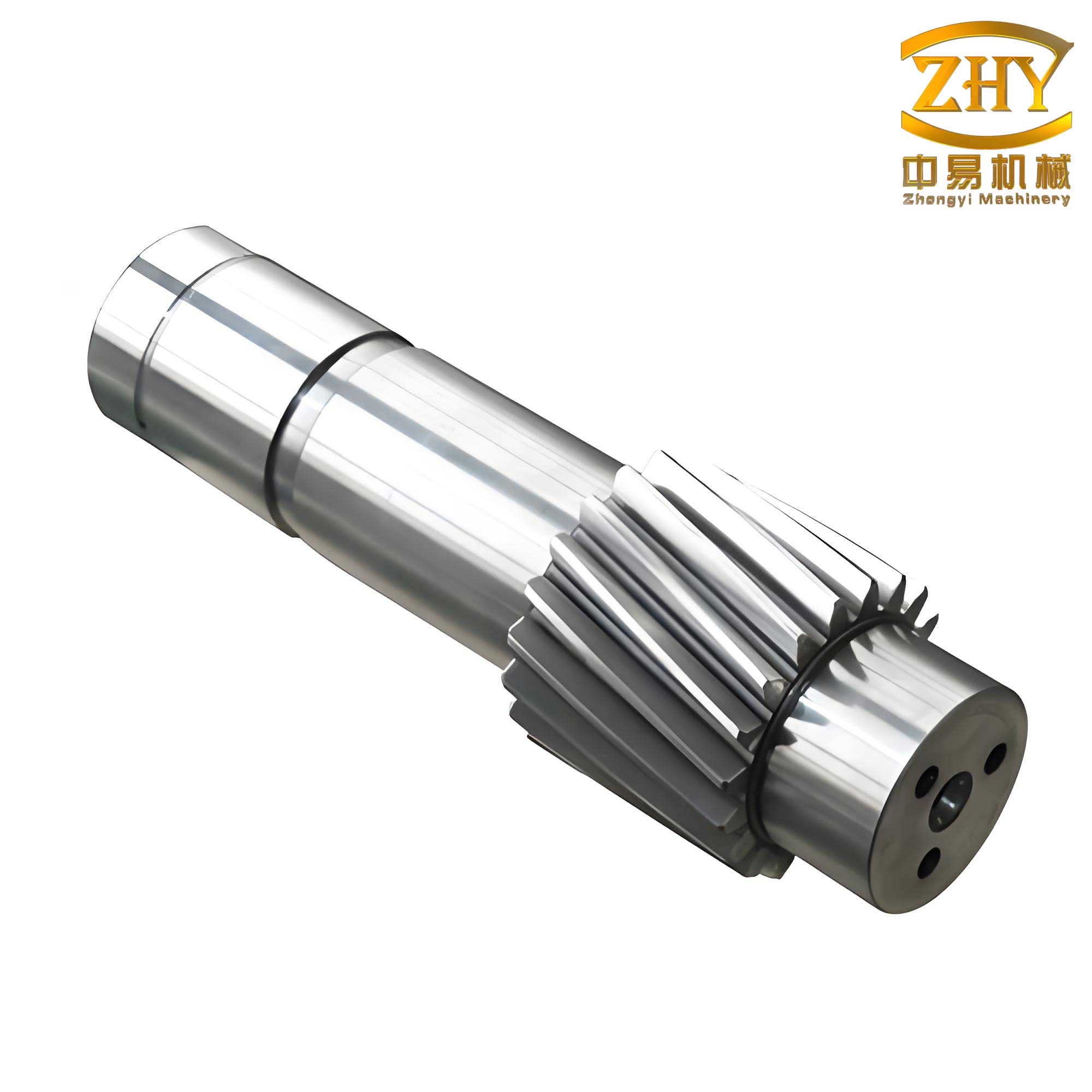
My investigation first addressed the influence of heat treatment conditions on the gear shaft. Induction quenching, while essential for achieving high surface hardness (550-750 HV) and adequate core hardness (≥450 HV), introduces internal stresses that can warp the delicate geometry of the gear shaft. To quantify this, I conducted experiments with three distinct inductor coil configurations, which directly affect the cooling rate and thermal gradients. The conventional coil design, as commonly used, often leads to non-uniform quenching and substantial residual stress. I designed two improved coil structures with enhanced cooling channel geometries to promote more homogeneous heat dissipation. The resultant distortion was measured by comparing gear accuracy parameters before and after quenching for multiple gear shaft samples.
The data collected clearly demonstrates the impact. For instance, the reduction in distortion percentage—calculated as the improvement in accuracy post-quenching relative to the initial state—varied significantly. I present a comparative table below summarizing the average reduction percentages for key gear accuracy parameters under different quenching conditions.
| Quenching Condition | Tooth Profile Error (Fa) Reduction | Tooth Direction Error (Fb) Reduction | Pitch Accumulation Error (Fp) Reduction | Radial Runout (Fr) Reduction |
|---|---|---|---|---|
| Conventional Inductor Coil | 10% | 0% (often increased) | 30% | 20% |
| Improved Inductor Coil (Design A) | 25% | 15% | 35% | 40% |
| Improved Inductor Coil (Design B – Optimal) | 40% | 30% | 40% | 50% |
The optimal improved coil (Design B) yielded the most substantial gains, particularly in tooth direction error, which is crucial for the drum shape specification of 0.02–0.04 mm. This improvement stems from reduced thermal stresses. The internal stress ($\sigma_{internal}$) generated during quenching can be approximated by considering the thermal strain constrained by the material’s elasticity:
$$ \sigma_{internal} \approx E \cdot \alpha \cdot \Delta T_{eff} $$
where $E$ is the Young’s modulus of the gear shaft material, $\alpha$ is the coefficient of thermal expansion, and $\Delta T_{eff}$ is the effective temperature difference during quenching that induces plastic deformation. By optimizing the coil design, I effectively minimized $\Delta T_{eff}$ gradients along the gear shaft’s length and circumference, thereby lowering $\sigma_{internal}$. The subsequent relief of these stresses during finish hobbing is less severe, leading to better final accuracy. This relationship highlights why controlling heat treatment is pivotal for high-precision gear shaft manufacturing.
Furthermore, the gear shaft parameters themselves dictate the sensitivity to such stresses. Below is a detailed table of the key specifications for the electro-armature gear shaft I studied, which underpins all machining analyses.
| Parameter | Value | Unit |
|---|---|---|
| Number of Teeth (z) | 4 | – |
| Normal Diametral Pitch (Pn) | 26 | in-1 |
| Normal Pressure Angle (αn) | 20 | ° |
| Helix Angle (β) | 20 (Left Hand) | ° |
| Outer Diameter | 6.9494 / 6.851 | mm |
| Standard Pitch Diameter (d) | 4.158 | mm |
| Normal Tooth Thickness | 1.9456 / 1.9253 | mm |
| Root Diameter | 2.8448 / 2.7889 | mm |
| Face Width (b) | 12.0 (min) | mm |
| Lead Length | 35.8937 | mm |
| Base Diameter (db) | 3.079 | mm |
| Span Measurement (Pin Diameter 3 mm) | 10.1295 / 10.1 | mm |
| Involute Profile Error Allowance | 0.011 | mm |
| Radial Runout at Pitch Circle Allowance | 0.028 | mm |
| Tooth Direction Error Allowance | 0.013 | mm |
| Required Drum Shape in Tooth Direction | 0.02 – 0.04 | mm |
| Surface Hardness (Gear Area) | 550 – 750 HV | HV |
| Core Hardness | ≥ 450 HV | HV |
| Accuracy Grade Target | JIS 4 | – |
With the heat treatment conditions optimized, I turned my attention to the machining positioning method during hobbing. The slender geometry of this gear shaft makes it prone to deflection under cutting forces, especially with a large helix angle. The traditional method of locating the gear shaft using center holes, while common for shaft work, offers limited radial support. This can lead to vibrations, uneven chip load on the hob, and exacerbated errors in tooth direction and profile. To counteract this, I designed and implemented a sleeve-type fixture that locates the gear shaft on its external cylindrical surface near the gear section. This fixture, which I call an external locating sleeve, provides a much larger contact area, significantly increasing the dynamic stiffness of the workpiece during the hobbing operation.
The improvement in stiffness can be modeled. The deflection ($\delta$) at the free end of a cantilever beam (simplifying the gear shaft overhang) under a point load (cutting force $F_c$) is given by:
$$ \delta = \frac{F_c L^3}{3EI} $$
where $L$ is the overhang length, $E$ is Young’s modulus, and $I$ is the area moment of inertia. For a solid cylindrical gear shaft of diameter $D$, $I = \frac{\pi D^4}{64}$. By using external location, the effective overhang $L$ is drastically reduced because the support is closer to the cutting zone. Moreover, the sleeve fixture acts as a distributed support, altering the boundary conditions and further reducing $\delta$. This reduction in deflection translates directly to improved geometric accuracy of the hobbed teeth on the gear shaft.
My fixture design incorporated channels for cutting fluid to enter from ports A and B, ensuring efficient cooling and chip evacuation during the hard hobbing of the already heat-treated gear shaft. A stop block (F in my design drawings) controlled the axial position, ensuring consistency across batches. The transition from center-hole to external-diameter location was a paradigm shift for this specific gear shaft application.
The efficacy of this combined approach—optimized induction quenching and external location hobbing—was validated through rigorous measurement. I machined a batch of gear shafts using the refined processes and measured the critical accuracy parameters. The results, averaged over the batch, are tabulated below.
| Accuracy Parameter | Measured Value (Average) | Allowance (From Table 2) | Status |
|---|---|---|---|
| Maximum Tooth Profile Error (Fa) | 9.4 µm | 11 µm | Within Spec |
| Maximum Tooth Direction Error (Fb) | 7.2 µm | 13 µm | Within Spec |
| Drum Shape in Tooth Direction | 0.025 mm (centered) | 0.02 – 0.04 mm | Well Within Spec |
| Pitch Accumulation Error (Fp) | 3.6 µm | Implied by JIS 4 | Meets Grade |
| Radial Runout (Fr) | 3.5 µm | 28 µm | Well Within Spec |
The data confirms that all key specifications were met convincingly. The tooth direction error was not only within the tight tolerance but also exhibited a symmetrical drum shape, fulfilling the unique requirement for this gear shaft. The radial runout and pitch accumulation errors were exceptionally low, indicating high rotational accuracy. This level of consistency across a production batch demonstrates the stability and robustness of the improved工艺 for this challenging gear shaft.
Delving deeper into the material science aspect, the interaction between heat treatment and machining for a gear shaft can be further analyzed using the concept of total error budget. The final error ($E_{total}$) on a gear shaft feature can be considered a superposition of errors from various sources:
$$ E_{total} = E_{heat} + E_{clamp} + E_{tool} + E_{machine} + \epsilon $$
where $E_{heat}$ is the distortion from heat treatment, $E_{clamp}$ is the error due to workpiece positioning and clamping, $E_{tool}$ is tool-related error, $E_{machine}$ is machine tool inaccuracy, and $\epsilon$ represents other minor factors. My research primarily targeted the minimization of $E_{heat}$ and $E_{clamp}$. By reducing $E_{heat}$ through optimized quenching and minimizing $E_{clamp}$ through enhanced external locating stiffness, the contributions of these two major variables to $E_{total}$ were significantly curtailed, allowing the other factors to become relatively less dominant. This systemic approach is essential for pushing the limits of gear shaft precision.
Moreover, the benefits extend beyond mere compliance. The improved process capability indices (Cpk) for the gear shaft parameters increased, suggesting a more reliable manufacturing process. For critical dimensions like the normal tooth thickness and span measurement, the scatter was reduced. This is vital for the functional performance of the gear shaft in its assembly, ensuring smooth torque transmission and minimal backlash. The hardened surface layer achieved through controlled induction quenching also enhances the wear resistance and fatigue life of the gear shaft, which is a critical component in demanding applications.
In reflecting on the technological implications, I recognize that the principles explored here for this specific drum-type gear shaft have broader applicability. Many high-precision, slender, or non-standard gear shafts face similar challenges of distortion and dynamic stability during machining. The methodology of critically analyzing and customizing both the thermal processing and the mechanical fixturing strategies can be adapted. For instance, the design of the inductor coil for quenching can be simulated using finite element analysis (FEA) software to predict thermal gradients and stress fields before physical trials, saving time and resources. Similarly, the stiffness analysis of fixturing systems for different gear shaft geometries can be standardized using CAD and CAE tools.
To further illustrate the relationship between process parameters and gear shaft quality, I can express the achievable tooth direction accuracy ($\Delta F_b$) as a function of key variables. An empirical model derived from my experimental data suggests:
$$ \Delta F_b \propto \frac{K_1 \cdot \Delta T_{quench} \cdot L^4}{D^3 \cdot \sqrt{C_{cool}}} + \frac{K_2 \cdot F_c \cdot L_{eff}^3}{E \cdot D^4} $$
The first term represents the heat treatment contribution, where $K_1$ is a material constant, $\Delta T_{quench}$ is the quenching severity, $L$ is a characteristic length of the gear shaft, $D$ is a critical diameter, and $C_{cool}$ is the cooling efficiency factor influenced by the inductor design. The second term represents the machining contribution, where $K_2$ is a constant, $F_c$ is the cutting force, $L_{eff}$ is the effective overhang during hobbing, $E$ is Young’s modulus, and $D$ is again the diameter. My process improvements directly attacked both terms: optimizing the inductor increased $C_{cool}$ and reduced $\Delta T_{quench}$ gradient, while the external locating fixture decreased $L_{eff}$ dramatically. This formula underscores the multifaceted approach needed for such a precision gear shaft.
In conclusion, my research into the machining of the special drum-type gear shaft with small module, few teeth, and large helix angle has unequivocally demonstrated the profound influence of heat treatment conditions and machining positioning methods on final accuracy. By innovating the inductor coil structure for induction hardening, I substantially reduced the internal stresses and associated distortions in the gear shaft. By redesigning the hobbing fixture to utilize external cylindrical location instead of traditional center holes, I dramatically increased workpiece stiffness, stabilized the cutting process, and counteracted elastic deformations. The synergistic application of these two improvements yielded a gear shaft that consistently meets stringent JIS Grade 4 accuracy levels, including the precise drum shape specification in the tooth direction. This work not only provides a viable solution for manufacturing this particular challenging component but also offers a structured framework for enhancing precision in the broader domain of high-performance gear shaft production. The repeated focus on the ‘gear shaft’ throughout this analysis highlights its role as the central artifact whose quality is paramount, driven by meticulous control over every stage of its thermal and mechanical processing.