
The pursuit of higher operating speeds, greater load capacity, and reduced noise in modern machinery has significantly increased the application of helical and herringbone gears. This trend places stringent demands on their manufacturing precision. Among the tools used for machining herringbone gears, especially those with small or no undercuts, the Sachs-type helical slotting cutter stands out. This cutter theoretically generates no manufacturing error, thereby effectively enhancing the profile accuracy of the machined gear. Furthermore, it allows for obtaining ideal cutting rake and relief angles, making it a tool of considerable interest.
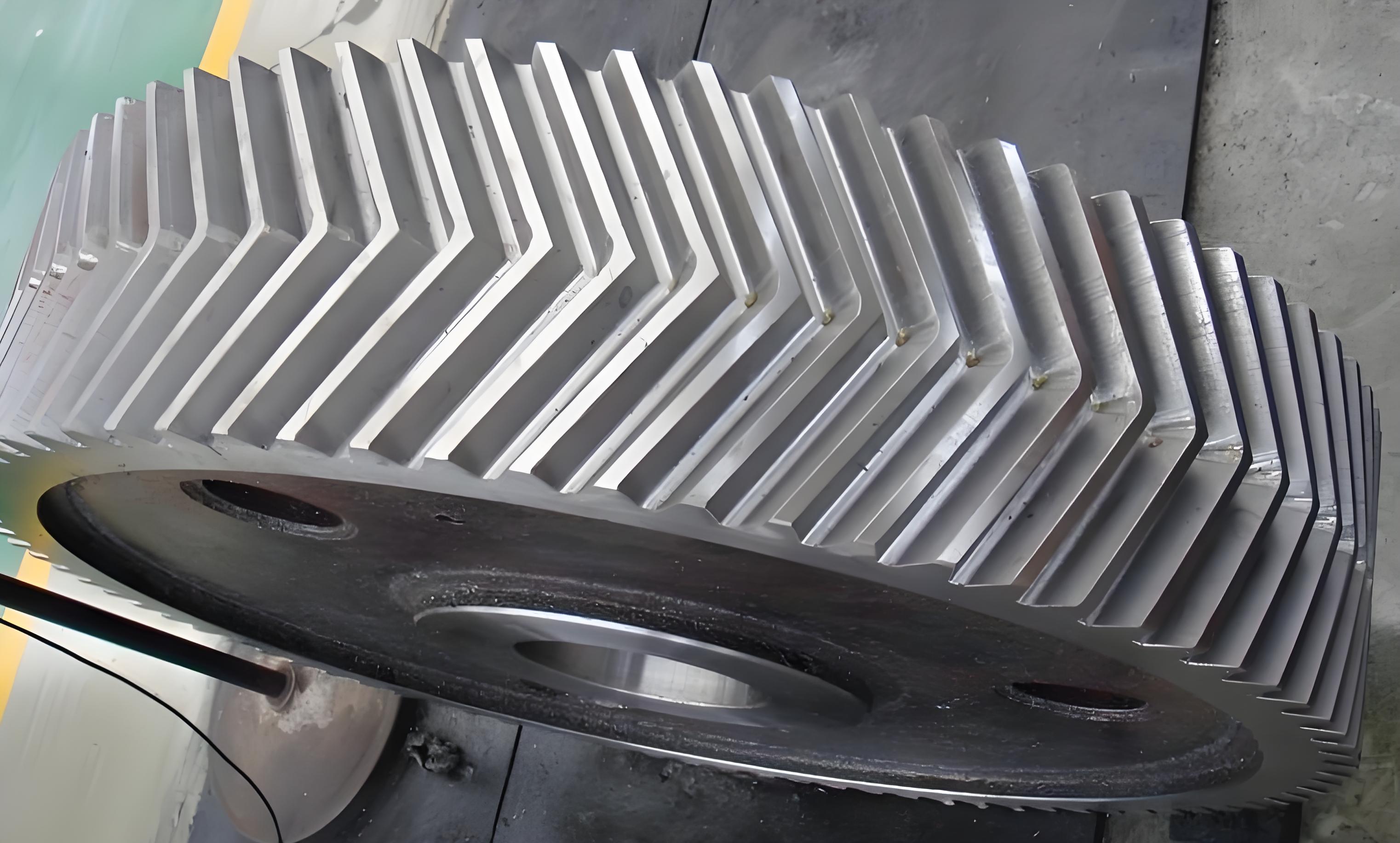
The practical application of the Sachs cutter, or more generally, the herringbone gear slotting cutter, has been limited in many regions due to a lack of in-depth research into its regrinding techniques. To address this gap and facilitate the wider adoption of this advanced tooling, a comprehensive study was undertaken to elucidate its grinding principle, develop a practical methodology, and design a corresponding grinding apparatus. This document presents the findings from this research, conducted from a first-person engineering perspective.
The primary challenge in regrinding a herringbone gear slotting cutter lies in generating the correct front face geometry. Unlike standard spur gear cutters, the front face of a Sachs cutter is not a simple conical surface. For a right-hand herringbone gear cutter, the front face on the “obtuse” flank side features a chip gullet, while the “acute” flank side has a small land or facet. This discussion will focus on the principle of grinding the chip gullet on the obtuse side; the grinding of the acute-side land follows a similar conceptual framework.
The core idea is to use a standard grinding wheel with a conical working surface to generate a curve on the cutter’s front face that closely approximates the desired involute cutting edge when viewed in a plane perpendicular to the cutter axis. To achieve high efficiency and process standardization for cutters of the same nominal pitch diameter, a single master base circle disc is employed on the grinding machine for an entire series of cutters.
To formulate this principle mathematically, we establish several coordinate systems. Let $Oxy$ represent the coordinate system fixed to the slotting cutter, with its origin $O$ at the cutter center. The cutter’s tip circle radius is $r_a$, and its base circle radius is $r_b$. The segment of the involute cutting edge to be matched is denoted as $AB$.
In a separate coordinate system $O_1x_1y_1$, attached to the master base circle disc, the disc has a radius $r_{b0}$ and its center is at $O_1$. The involute curve generated by this disc, originating from point $C$ on the $y_1$-axis, is $CO_2D$.
The grinding wheel’s conical surface is defined in coordinate system $O_2x_2y_2$. The cone has a base diameter $d$, and the desired depth of the chip gullet is $t$. The $x_2$-axis is tangent to the master base circle. The wheel’s axis is perpendicular to the $O_2x_2y_2$ plane, passing through a point on the $z_2$-axis at a distance of $d/2 – t$ from the origin $O_2$.
During the grinding process, the intersection line of the grinding wheel cone with the cutter’s front face (a plane) is a curve $GH$. This curve $GH$ possesses the property that its radius of curvature increases from its starting point, similar to the behavior of the target involute $AB$. The fundamental grinding motion involves traversing the wheel along a path defined by the master base circle disc, which generates an involute relative to the disc. The goal is to find the relative position between the wheel/cutter and the disc such that curve $GH$ best fits the target involute $AB$. This optimal position involves a translation $(a, b)$ and a rotation $\beta$ of the disc coordinate system $O_1x_1y_1$ relative to the cutter system $Oxy$.
An optimization model is constructed to find the parameters $a$, $b$, and $\beta$ that minimize the deviation between $GH$ and $AB$. First, the target involute $AB$ is digitized into a set of $k$ points $(x_i, y_i)$ in the $Oxy$ system:
$$x_i = r_b [ \sin(\varphi_i + \omega_0) – \varphi_i \cos(\varphi_i + \omega_0) ]$$
$$y_i = r_b [ \cos(\varphi_i + \omega_0) + \varphi_i \sin(\varphi_i + \omega_0) ]$$
where $\varphi_i$ is the involute roll angle for point $i$, and $\omega_0$ is the semi-angle of the base circle tooth space for the cutter.
Similarly, the wheel-cutter intersection curve $GH$ (for $x_2 < 0$) is digitized into $m$ points $(x_{2j}, y_{2j})$ in the $O_2x_2y_2$ system, satisfying the cone equation:
$$y_{2j}^2 + \left( \frac{d}{2} – t \right)^2 – \left( \frac{d}{2} + x_{2j} \tan \gamma \right)^2 = 0$$
where $\gamma$ is the wheel’s semi-cone angle.
The coordinate transformation from the wheel system $O_2x_2y_2$ to the cutter system $Oxy$ involves two steps: $O_2x_2y_2 \rightarrow O_1x_1y_1 \rightarrow Oxy$. The composite transformation matrix is:
$$M_{02} = M_{01} M_{12} =
\begin{bmatrix}
\cos(\phi – \beta) & \sin(\phi – \beta) & r_{b0}[\sin(\phi – \beta) – \phi \cos(\phi – \beta)] + a \\
-\sin(\phi – \beta) & \cos(\phi – \beta) & r_{b0}[\cos(\phi – \beta) + \phi \sin(\phi – \beta)] + b \\
0 & 0 & 1
\end{bmatrix}$$
where $\phi$ is the roll angle for the master disc involute.
Using this transformation, the coordinates of the wheel curve points in the cutter system are:
$$x_{ij}’ = (x_{2j} – r_{b0}\phi_i) \cos(\phi_i – \beta) + (y_{2j} + r_{b0}) \sin(\phi_i – \beta) + a$$
$$y_{ij}’ = -(x_{2j} – r_{b0}\phi_i) \sin(\phi_i – \beta) + (y_{2j} + r_{b0}) \cos(\phi_i – \beta) + b$$
For a given set of grinding parameters $(a, b, \beta)$ and a sequence of $\phi_i$, this generates $m \times n$ candidate points $(x_{ij}’, y_{ij}’)$.
For each target point $(x_i, y_i)$, the minimum distance to any of these candidate points is calculated:
$$\epsilon_{i, \min} = \min_{j} \sqrt{ (x_i – x_{ij}’)^2 + (y_i – y_{ij}’)^2 }$$
The overall optimization problem is then to minimize the sum of these minimum distances, subject to constraints ensuring the generated curve is valid and the error at each point is within a specified tolerance (e.g., 0.025 mm):
$$\epsilon = \sum_{i=1}^{k} \epsilon_{i, \min} \rightarrow \text{min}$$
subject to:
$$ (y_{2j}’)^2 – (y_{2j})^2 \ge 0, \quad x_{2j}’ – x_{2j} < 0, \quad 0 < \epsilon_{i, \min} < 0.025 $$
Solving this yields the optimal setup parameters $(a, b, \beta)$ that make the ground chip gullet profile $GH$ the best possible approximation of the ideal involute $AB$ for the herringbone gear cutter.
The successful application of this grinding principle depends critically on the correct selection of several key parameters. These choices ensure not only profile accuracy but also grinding efficiency and cutter performance.
Grinding Wheel Diameter and Cutter Rake Angle: A primary constraint is avoiding interference between the ground chip gullet curve $GH$ and the cutter’s side cutting edge. This requires that the radius of curvature of the wheel-workpiece intersection curve, $\rho_{int}$, at the region near $y_2=0$, must be less than the radius of curvature at the start of the active profile on the gear being cut, $\rho_{start}$:
$$\rho_{int} < \rho_{start}$$
The intersection curvature is given by:
$$\rho_{int} = \frac{ \left[ y_2^2 + \left( \frac{d}{2} + x_2 \tan \gamma \right)^2 \tan^2 \gamma \right]^{3/2} }{ y_2^2 \tan^2 \gamma – \left( \frac{d}{2} + x_2 \tan \gamma \right)^2 \tan^2 \gamma }$$
The starting curvature is a function of the gear mesh geometry:
$$\rho_{start} = a \sin \alpha_{mesh} – \sqrt{ r_{a,gear}^2 – r_{b,gear}^2 }$$
where $a$ is the cutting center distance, $\alpha_{mesh}$ is the working pressure angle, and $r_{a,gear}$, $r_{b,gear}$ are the gear’s tip and base circle radii. From the formula for $\rho_{int}$, it is evident that a smaller wheel diameter $d$ and a smaller wheel semi-cone angle $\gamma$ lead to a smaller $\rho_{int}$, which reduces the theoretical fitting error $\epsilon$. However, an excessively small wheel diameter reduces peripheral speed, worsening surface finish on the cutter’s front face and increasing cutting forces and heat during gear machining. Therefore, a wheel diameter in the range of 60-70 mm is typically recommended.
The relationship between the wheel semi-cone angle $\gamma$ and the desired cutter side rake angles $\gamma_c$ is direct. For the acute flank land (denoted with a single prime) and the obtuse flank chip gullet (denoted with a double prime), the relations are:
$$\gamma’ = \beta_{b0} – \gamma_{c1}$$
$$\gamma” = \beta_{b0} + \gamma_{c2}$$
Here, $\beta_{b0}$ is the nominal base cylinder helix angle of the herringbone gear slotting cutter. For machining normalized or quenched-and-tempered structural steel gears, side rake angles $\gamma_{c1}$ and $\gamma_{c2}$ between 5° and 7° are recommended.
Acute Flank Land Geometry: To ensure the herringbone gear cutter correctly forms the crest (or “spine”) of the herringbone gear, the cutting edge on the obtuse flank must be axially offset from the edge on the acute flank by a small amount $\Delta k$. This offset is calculated as:
$$\Delta k = B_1 \cdot \sin(\beta_{b0} – \gamma_{c1}’)$$
where $B_1$ is the width of the land on the acute flank, typically chosen as:
$$B_1 = (0.25 \text{ to } 0.4) \cdot S_{aot}$$
and $S_{aot}$ is the width of the cutter’s tip tooth in the transverse section.
The following table presents a set of calculated grinding parameters for a series of herringbone gear slotting cutters with a constant helix angle, demonstrating the application of the optimization model. The parameter $\Delta l = r_{b0} \cdot \beta$ represents the necessary offset or “extension” of the grinding path related to the rotation $\beta$.
| Module $m$ (mm) | Teeth $z$ | Helix Angle $\beta$ | Master Base Radius $r_{b0}$ (mm) | Wheel Diameter $d$ (mm) | Side Rake $\gamma_c$ (°) | Horizontal Shift $a$ (mm) | Vertical Shift $b$ (mm) | Extension $\Delta l$ (mm) | Calc. Error $\epsilon$ (mm) |
|---|---|---|---|---|---|---|---|---|---|
| 4 | 31 | 23°23’05” | 63 | 65 | 6 | 5.113 | 3.281 | 1.275 | 0.121 |
| 4.5 | 28 | 23°23’05” | 63 | 65 | 6 | 7.041 | 4.216 | 2.147 | 0.413 |
| 5 | 25 | 23°23’05” | 63 | 65 | 6 | 6.910 | 3.604 | 1.156 | 0.152 |
| 5.5 | 23 | 23°23’05” | 63 | 65 | 6 | 8.114 | 4.336 | 1.401 | 0.138 |
| 6 | 21 | 23°23’05” | 63 | 65 | 6 | 9.474 | 4.051 | 1.843 | 0.157 |
Based on the mathematical principle described, a dedicated grinding apparatus was designed and constructed. The machine’s core function is to physically realize the coordinated motions defined by the parameters $a$, $b$, $\beta$, and the involute generation via the master base circle disc.
The main structure features an L-shaped column supporting a vertically adjustable table. A transverse slide is mounted on this table. The master base circle disc, which has a distinctive shape (wider at the top and bottom with a narrower middle for stiffness), is supported on a circular rolling guide. A short cylindrical spigot on the disc fits with clearance into a bore on the transverse slide, allowing it to rotate freely. Above the disc, a two-stage compound slide (one longitudinal, one transverse) provides the adjustment for parameters $a$ and $b$. A dividing head, which holds the herringbone gear slotting cutter, is mounted atop these slides. The rotation $\beta$ is achieved by adjusting the angular orientation of this entire upper assembly relative to the machine base.
The grinding wheel is driven at high speed by an electric motor via a belt-drive system for speed increase. The essential involute generating motion is produced by a steel band mechanism. One end of a steel band is fastened to the master base circle disc, and the other end is fixed to a stationary bracket equipped with a tensioning device. The axis of the grinding wheel is carefully aligned to lie in the same vertical plane as the straight portion of the taut steel band. When the transverse slide is moved laterally via a handwheel, the constraint of the steel band unwinding from or winding onto the master disc causes a precise relative motion between the grinding wheel axis and the disc. This motion is the rectilinear translation of the wheel axis along the tangent to the base circle, which is the kinematic basis for generating an involute curve. The depth of the chip gullet, $t$, is set by a separate vertical in-feed mechanism for the grinding wheel head.
To validate the grinding methodology and the performance of the reground herringbone gear slotting cutters, machining tests were conducted on a Sachs-type gear slotting machine. The cutters, made from W18Cr4V high-speed steel, were used to machine quenched and tempered 45 steel gears. The test conditions and key results are summarized below:
| Cutting Speed $V$ (m/min) | Feed $s$ (mm/rev) | Workpiece Material | Hardness State | Cutter Material |
|---|---|---|---|---|
| 39 | 0.2 | 45 Steel | Quenched & Tempered | W18Cr4V |
| Gear & Performance Results | ||||
| Gear Teeth $z$ | Gear Module $m$ (mm) | Flank Wear $VB$ (mm) | Tool Life $T$ (min) | Profile Error $\Delta f_f$ (μm) |
| 50 | 6 | 0.3 | 492 | 9 |
The research and experimental verification lead to two principal conclusions. First, the proposed grinding principle, along with its associated mathematical models, computational formulas, and optimization procedures for the herringbone gear slotting cutter, has been proven correct and effective. The ground cutter profiles accurately approximate the theoretical involute form within acceptable tolerances.
Second, and most importantly, herringbone gear slotting cutters reground using this methodology exhibit significantly enhanced performance. The tests demonstrated a substantial increase in tool life, with the cutter remaining functional for 492 minutes before reaching the defined wear criterion. Furthermore, the profile accuracy of the gears machined with these correctly reground cutters was notably high, with a profile error of only 9 micrometers. This confirms that the proper application of this specialized grinding technique is crucial for unlocking the full potential of Sachs-type cutters in the high-precision manufacturing of herringbone gears, contributing directly to the production of more reliable and efficient power transmission components.