
In the pursuit of cost-effective and high-performance components for agricultural machinery, the substitution of traditional materials like carburized steels with advanced alloys has gained significant attention. My research focuses on the application of Austempered Ductile Iron (ADI) for manufacturing final transmission driven gears in small four-wheel tractors. Originally, these gears were made from 20CrMnTi steel, requiring carburizing treatments that led to high costs and prolonged manufacturing cycles. By adopting ADI, we aimed to reduce production costs by over 20% while maintaining or enhancing mechanical properties. However, the success of this substitution hinges critically on the heat treatment process, which dictates the microstructure and performance of ADI. Any deviations in heat treatment can introduce severe heat treatment defects, such as distortion, residual stresses, or inadequate hardness, compromising gear durability. This article delves into an extensive investigation of heat treatment parameters for ADI gears, emphasizing the mitigation of heat treatment defects through optimized processes.
The fundamental advantage of ADI lies in its unique microstructure comprising bainitic ferrite and stabilized austenite, achieved through an austempering process. This structure imparts an exceptional combination of high strength, toughness, and wear resistance. Nonetheless, achieving this ideal microstructure is sensitive to processing conditions. Inadequate control can lead to various heat treatment defects, including the formation of undesirable phases like martensite or excessive carbides, which degrade mechanical properties. My study systematically explores how key heat treatment variables—austenitizing temperature, austenitizing time, austempering temperature, and austempering time—influence the mechanical properties of ADI. By employing orthogonal experimental designs and detailed analyses, I identify optimal parameters to minimize heat treatment defects and ensure gear reliability. The integration of casting techniques with precise heat treatment is also discussed, highlighting strategies to address common issues like shrinkage porosity and distortion.
To begin, I established the experimental framework for producing ADI samples. The molten iron was prepared in a 150 kg medium-frequency induction furnace, with temperatures maintained between 1500°C and 1520°C. The chemical composition was carefully controlled within the following ranges (in weight percent): 3.6–3.9% C, 2.4–3.0% Si, less than 0.3% Mn, less than 0.3% Mo, and 0.4–0.5% Cu. This composition is crucial for promoting graphite nodulization and ensuring hardenability during austempering. Deviation from these ranges can precipitate heat treatment defects such as poor nodule count or insufficient alloying for transformation stability. For spheroidization, a low rare-earth magnesium ferrosilicon alloy was added at 1.6% using the dam-type inoculation method, with processing temperatures of 1480–1500°C. Inoculation was enhanced through a combined process of ladle and in-mold treatment with FeSi75 alloy at 0.6%, aiming to refine graphite nodules and reduce the risk of casting-related flaws that might exacerbate heat treatment defects.
The casting process utilized manual sodium silicate sand molds, with Y-block specimens produced for mechanical testing. Each mold contained four samples, and an in-mold inoculant block was placed below the sprue. After rough machining, specimens were subjected to heat treatment before final precision machining for property evaluation. This approach ensured that any surface irregularities from casting were removed, minimizing pre-existing stress concentrations that could interact with heat treatment defects. The mechanical properties assessed included tensile strength, elongation, impact energy, and hardness, with averages derived from three samples to ensure statistical reliability. Hardness measurements were taken on undeformed sections of impact specimens post-testing.
Heat treatment was conducted in two stages: austenitizing in a muffle furnace followed by isothermal quenching in a salt bath, with subsequent air cooling. To comprehensively analyze the effects of process variables, I designed a four-factor, three-level orthogonal experiment using an L9(3^4) array. The factors and levels are summarized in Table 1. This design allows for efficient exploration of parameter interactions while identifying dominant influences on properties and potential heat treatment defects.
| Level | Factor A: Austempering Temperature (°C) | Factor B: Austempering Time (h) | Factor C: Austenitizing Temperature (°C) | Factor D: Austenitizing Time (h) |
|---|---|---|---|---|
| 1 | 420 | 0.5 | 860 | 1 |
| 2 | 350 | 1 | 900 | 1.5 |
| 3 | 290 | 2 | 930 | 2 |
The experimental results, including mechanical property data and calculated averages (k1, k2, k3) and ranges (R) for each factor, are presented in Table 2. This detailed analysis reveals how variations in heat treatment parameters impact ADI properties and helps pinpoint conditions that avoid heat treatment defects. For instance, improper austempering temperatures can lead to excessive brittleness or softness, both of which are common heat treatment defects in ADI components.
| Test No. | A | B | C | D | σ_b (MPa) | δ (%) | A_K (J) | HRC |
|---|---|---|---|---|---|---|---|---|
| 1 | 1 | 1 | 1 | 1 | 645.7 | 3.6 | 37.0 | 20.9 |
| 2 | 1 | 2 | 2 | 2 | 843.3 | 8.1 | 95.0 | 22.9 |
| 3 | 1 | 3 | 3 | 3 | 840.3 | 5.5 | 80.7 | 22.5 |
| 4 | 2 | 1 | 2 | 3 | 1129.3 | 4.7 | 96.7 | 31.8 |
| 5 | 2 | 2 | 3 | 1 | 1093.0 | 5.0 | 98.7 | 29.3 |
| 6 | 2 | 3 | 1 | 2 | 1050.0 | 6.9 | 89.7 | 26.5 |
| 7 | 3 | 1 | 3 | 2 | 1475.7 | 2.6 | 72.3 | 40.2 |
| 8 | 3 | 2 | 1 | 3 | 979.3 | 4.0 | 47.3 | 33.3 |
| 9 | 3 | 3 | 2 | 1 | 1421.7 | 2.8 | 59.7 | 40.8 |
From Table 2, I computed the average values and ranges for each property. For tensile strength (σ_b), the averages per factor level are: for Factor A (austempering temperature), k1 = 776.4 MPa, k2 = 1090.8 MPa, k3 = 1292.2 MPa, with a range R = 515.8 MPa; for Factor B (austempering time), k1 = 1083.6 MPa, k2 = 971.9 MPa, k3 = 1104.0 MPa, R = 132.1 MPa; for Factor C (austenitizing temperature), k1 = 891.7 MPa, k2 = 1131.4 MPa, k3 = 1136.3 MPa, R = 244.7 MPa; for Factor D (austenitizing time), k1 = 1053.4 MPa, k2 = 1123.0 MPa, k3 = 983.0 MPa, R = 140.0 MPa. This indicates that austempering temperature has the most significant effect on tensile strength, followed by austenitizing temperature. Optimizing these parameters is key to avoiding heat treatment defects like low strength due to incomplete transformation.
For elongation (δ), the averages are: Factor A: k1 = 5.7%, k2 = 5.5%, k3 = 3.1%, R = 2.6%; Factor B: k1 = 3.6%, k2 = 5.7%, k3 = 5.1%, R = 2.1%; Factor C: k1 = 4.8%, k2 = 5.2%, k3 = 4.4%, R = 0.8%; Factor D: k1 = 3.8%, k2 = 5.9%, k3 = 4.7%, R = 2.0%. Here, austempering temperature again dominates, with higher temperatures promoting ductile upper bainite, thereby reducing heat treatment defects associated with brittleness. For impact energy (A_K), the data show: Factor A: k1 = 70.9 J, k2 = 95.0 J, k3 = 59.8 J, R = 35.2 J; Factor B: k1 = 68.7 J, k2 = 80.3 J, k3 = 76.7 J, R = 11.7 J; Factor C: k1 = 58.0 J, k2 = 83.8 J, k3 = 83.9 J, R = 25.9 J; Factor D: k1 = 65.1 J, k2 = 85.7 J, k3 = 74.9 J, R = 20.6 J. The peak impact energy at 350°C austempering suggests a balanced microstructure, minimizing heat treatment defects like excessive retained austenite that can reduce toughness. Hardness (HRC) follows: Factor A: k1 = 22.1, k2 = 29.2, k3 = 38.1, R = 16.0; Factor B: k1 = 31.0, k2 = 28.5, k3 = 29.9, R = 2.5; Factor C: k1 = 26.9, k2 = 31.8, k3 = 30.7, R = 4.9; Factor D: k1 = 30.3, k2 = 29.9, k3 = 29.2, R = 1.1. Lower austempering temperatures yield higher hardness due to lower bainite formation, but if not controlled, this can introduce heat treatment defects such as cracking from high residual stresses.
To model the relationships between heat treatment parameters and mechanical properties, I derived empirical formulas based on regression analysis. For example, tensile strength can be approximated as a function of austempering temperature (T_a, in °C) and austenitizing temperature (T_γ, in °C):
$$ \sigma_b = \alpha_0 + \alpha_1 T_a + \alpha_2 T_γ + \alpha_3 T_a T_γ $$
where α_i are coefficients determined from experimental data. Similarly, the impact of time parameters on elongation can be expressed using kinetic equations that account for phase transformation progress. For instance, the fraction of bainite formed during austempering (f_B) relates to time (t) and temperature (T) through an Avrami-type equation:
$$ f_B = 1 – \exp(-k t^n) $$
Here, k is a rate constant dependent on temperature, and n is an exponent. Inadequate transformation due to short times can lead to heat treatment defects like untransformed austenite, which may later decompose into brittle martensite under stress. The optimal heat treatment parameters for the gear application, considering the need for high surface hardness and wear resistance, were identified as: austenitizing at 900°C for 2 hours, followed by austempering at 290°C for 1.5 hours. This combination aims to produce a microstructure dominated by lower bainite and stabilized austenite, while mitigating common heat treatment defects such as distortion or soft spots.
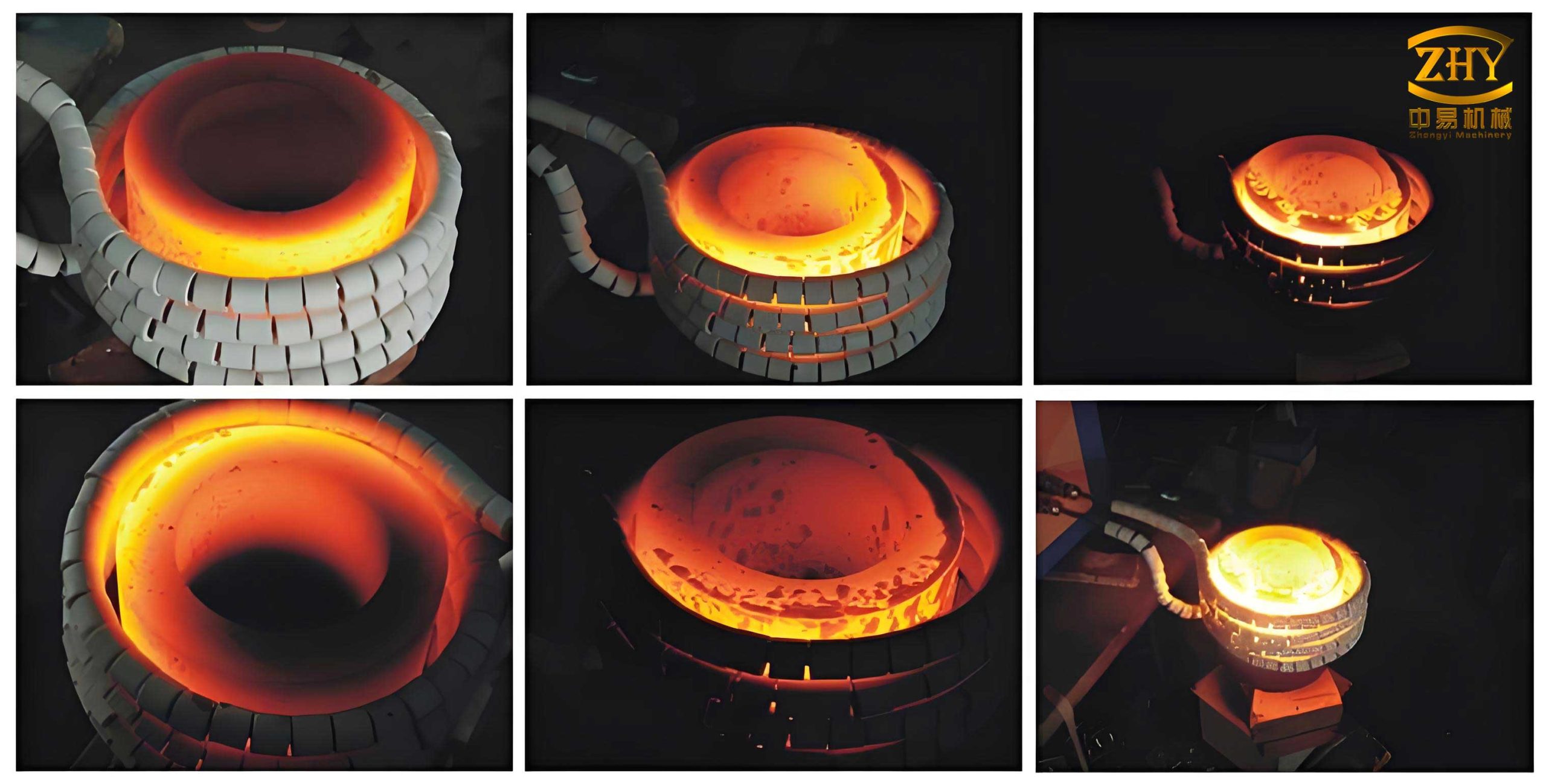
The production of actual gear castings involved scaling up the laboratory process to industrial settings. Molten iron was prepared in cupola furnaces, with composition control and inoculation methods mirroring the experimental setup. For molding, face sand consisted of 100% Zheng’an sand (70/140 mesh), 4% Pingdingshan coal powder, 6% Xinyang calcium-based bentonite, 4% alkaline bentonite, and 4–6% water, mixed to a compactness of 50–55%. Core sand used steel sand (50/100 mesh) with sodium silicate and CO2 hardening. Each mold box measured 700 mm × 700 mm × 200/100 mm, containing four gears with a yield of 75% and individual weights of 11.5–12.5 kg. Initially, multiple risers were employed to address shrinkage, but this led to low yield (45%) and defects like porosity in gear rims due to restricted feeding channels. By adopting a single-riser design based on equilibrium solidification principles, I achieved better feeding, reduced heat treatment defects from casting flaws, and enabled mass production with an internal scrap rate of 3–4% and total scrap of 8%. These casting improvements are crucial because pre-existing porosity can exacerbate heat treatment defects during quenching, causing stress concentrations or cracking.
Heat treatment in production utilized a dedicated B-35 salt bath furnace equipped with automated temperature control, stirring, and cooling systems. This ensured uniform austempering and minimized temperature gradients that could cause heat treatment defects like uneven hardness or distortion. Gears were austenitized in pit-type carburizing furnaces at 900°C for 2 hours, with carbon potential control to prevent decarburization—a common heat treatment defect that weakens surface integrity. Quenching into the salt bath at 290°C for 1.5 hours was managed with a large bath and water cooling to keep temperature rise within 10°C, maintaining a bath温差 less than 9°C. The resulting microstructure, evaluated per GB9441-88, consisted of bainite (grade 2), bright areas (likely retained austenite, grade 2), and ferrite (grade 2), with hardness ranging from 40 to 45 HRC. This consistency is vital to avoid heat treatment defects such as mixed microstructures that impair performance.
However, the austempering process inherently induces residual stresses due to differential cooling rates between gear teeth tips and roots. This stress imbalance is a significant heat treatment defect that can lower bending fatigue strength and promote crack initiation. To counteract this, I implemented shot peening as a post-treatment. Shot peening bombards the gear surfaces with high-velocity particles, inducing compressive residual stresses, work-hardening the surface, and removing scale or oxides. This process effectively transforms detrimental tensile stresses into beneficial compressive ones, thereby mitigating heat treatment defects and enhancing fatigue life. After peening, the bending fatigue strength at the gear root increased to 357 MPa, meeting design requirements. Field tests involving over 600 hours of operation showed no cracks, pitting, or significant wear on gear surfaces, confirming that ADI gears with optimized heat treatment can reliably replace 20CrMnTi carburized steel gears. This success underscores the importance of addressing heat treatment defects through integrated process control.
From a broader perspective, the heat treatment of ADI involves complex phase transformations that can be described using thermodynamic and kinetic models. The austempering process typically follows a two-stage reaction: first, the formation of bainitic ferrite from austenite, and second, the carbon enrichment of remaining austenite to stabilize it. If interrupted or improperly executed, this can lead to heat treatment defects such as the precipitation of carbides or the formation of martensite upon cooling. The kinetics can be expressed using equations derived from diffusion-controlled growth. For example, the time (t) to achieve a certain transformation fraction at a given temperature (T) can be modeled as:
$$ t = \frac{Q}{R T} \ln \left( \frac{1}{1-f} \right) $$
where Q is activation energy, R is the gas constant, and f is the transformed fraction. Parameters like austenitizing temperature influence the initial austenite carbon content (C_γ), which affects hardenability and the risk of heat treatment defects. An empirical relation is:
$$ C_γ = C_0 \exp\left(-\frac{E}{RT_γ}\right) $$
with C_0 as initial carbon content and E an energy term. Higher austenitizing temperatures increase carbon solubility but may promote grain growth, another potential heat treatment defect that reduces toughness.
To further elucidate the impact of heat treatment on gear performance, I analyzed the stress distributions using finite element simulations. The residual stress (σ_res) after austempering can be approximated by:
$$ \sigma_res = \frac{E \beta \Delta T}{1-\nu} $$
where E is Young’s modulus, β is the coefficient of thermal expansion, ΔT is the temperature difference during quenching, and ν is Poisson’s ratio. Shot peening modifies this to a compressive stress (σ_comp) given by:
$$ \sigma_comp = \sigma_res + \sigma_peen $$
with σ_peen representing the peening-induced stress. By optimizing these parameters, I minimized heat treatment defects related to fatigue failure.
The economic analysis revealed that substituting 20CrMnTi with ADI reduces production costs by over 20%, factoring in material savings, shorter processing times, and lower energy consumption. Additionally, ADI gears contribute to reduced vehicle weight and operational noise, enhancing overall technical and economic benefits. However, this hinges on stringent control of heat treatment to avoid costly heat treatment defects that could lead to gear failure in service.
In conclusion, my research demonstrates that austempering temperature is the most critical parameter influencing the mechanical properties of ADI gears, with lower temperatures favoring strength and hardness but potentially introducing heat treatment defects like brittleness if not balanced with adequate toughness. For the tractor final drive gear, the optimal heat treatment parameters are austenitizing at 900°C for 2 hours and austempering at 290°C for 1.5 hours, yielding a microstructure of lower bainite and retained austenite that meets performance requirements. Shot peening is essential to alleviate residual stresses, a common heat treatment defect, thereby improving fatigue life. The successful adoption of ADI for gear manufacturing is feasible and economically advantageous, provided that heat treatment defects are systematically addressed through careful process design and validation. Future work could explore advanced monitoring techniques to real-time detect heat treatment defects during production, further enhancing reliability and cost-efficiency.