
In the manufacturing of heavy-duty transmission systems, heat treatment processes such as carburizing and quenching are critical for enhancing the durability and performance of gears. However, heat treatment defects often arise due to equipment malfunctions or abnormal operational conditions, leading to issues like low hardness, shallow carburized layers, and surface oxidation. These defects can result in significant scrap rates, especially for gears with light holes, where dimensional changes post-treatment may exceed machining allowances. This article explores a rework methodology aimed at mitigating such heat treatment defects, focusing on process modifications that incorporate annealing and slow cooling to restore part integrity. By addressing the root causes of distortion and oxidation, this approach improves the success rate of reworked components, reducing waste and enhancing overall production efficiency. Throughout this discussion, the term heat treatment defects will be emphasized to highlight the pervasive challenges in this field.
The primary heat treatment defects observed in light hole carburized gears include internal stress buildup, dimensional instability, and carbon depletion from oxidation. When equipment failures occur, such as unplanned shutdowns or atmosphere leaks, gears undergo incomplete cycles, resulting in suboptimal microstructures. For instance, interrupted quenching can leave residual austenite or soft spots, while exposure to air leads to decarburization. These defects compromise gear performance, necessitating rework. A common rework practice involves direct re-carburizing and re-quenching, but this often exacerbates distortion, particularly in inner bore dimensions. The challenge lies in balancing the need for proper case depth and hardness with the preservation of geometric tolerances. To illustrate the severity of these issues, consider the following image depicting typical heat treatment defects:
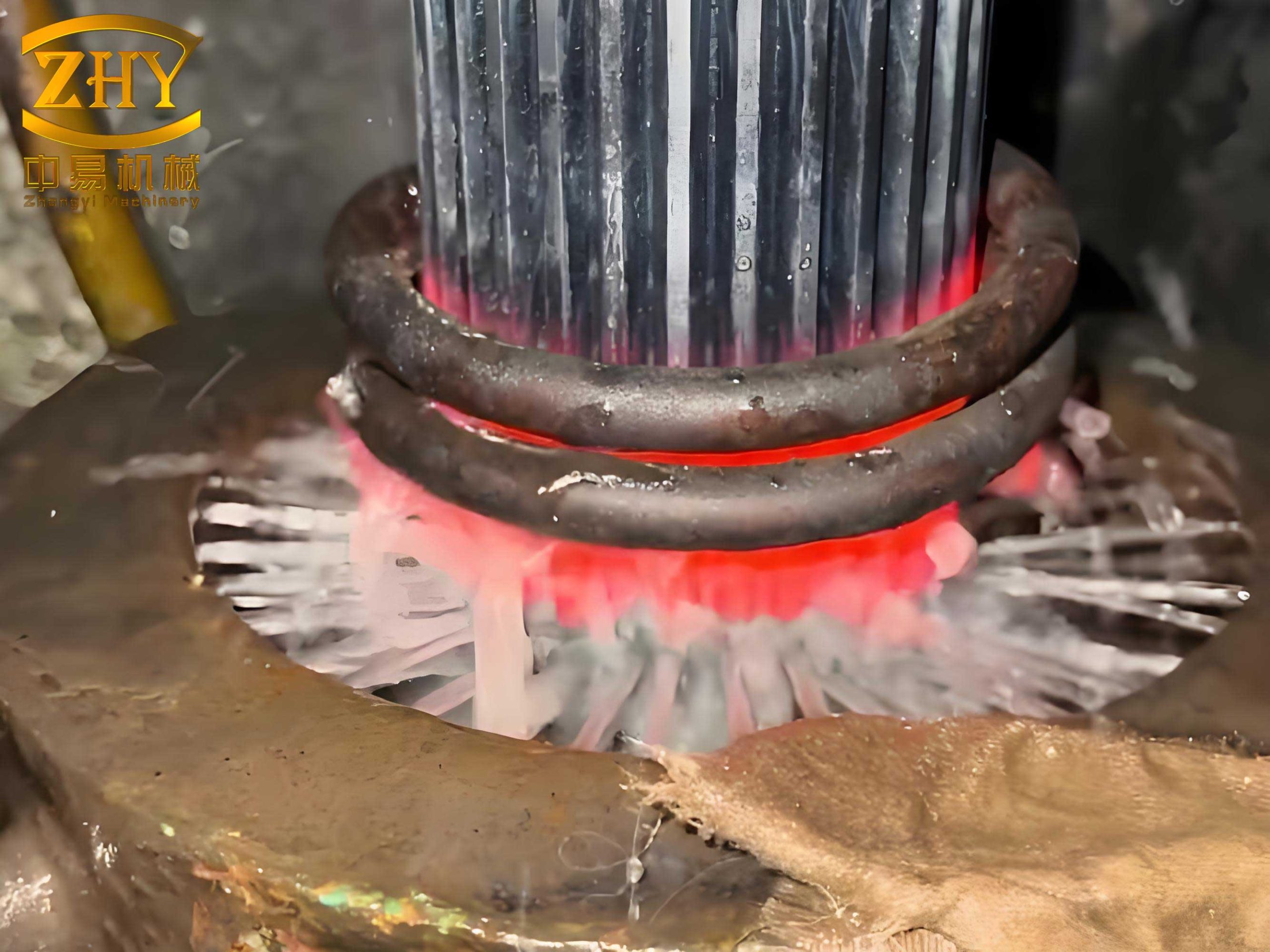
This visual representation underscores the importance of addressing heat treatment defects through refined processes. In subsequent sections, I will analyze existing rework methods, identify key factors contributing to defects, and propose an enhanced protocol that integrates annealing to mitigate distortion.
Analysis of Existing Rework Process and Its Limitations
The conventional rework process for gears affected by heat treatment defects typically involves a direct re-carburizing and quenching cycle, as shown in the curve below. This approach aims to restore surface hardness and case depth but often leads to increased inner bore diameter due to repeated martensitic transformations. Each quenching cycle induces volume expansion from the austenite-to-martensite phase change, accumulating stress and distorting critical dimensions. For light hole gears, this results in insufficient grinding allowance, rendering parts unusable. The following table summarizes data from gears subjected to this standard rework, highlighting the reduction in machining margin:
| Sample Number | Grinding Allowance After Direct Rework (mm) | Oxidation Layer Depth (mm) |
|---|---|---|
| 1 | 0.05 | 0.06 |
| 2 | 0.02 | 0.10 |
| 3 | 0.08 | 0.08 |
| 4 | -0.01 | 0.12 |
| 5 | 0.06 | 0.09 |
As evident, negative allowances indicate parts with no usable material for finishing, directly linking to heat treatment defects like excessive growth. The oxidation layer depths further exacerbate the problem by consuming surface carbon, necessitating additional material removal. To quantify the phase transformation effects, consider the volume change during martensite formation, which can be expressed as:
$$ \Delta V = V_m – V_a $$
where \( \Delta V \) is the volume change, \( V_m \) is the volume of martensite, and \( V_a \) is the volume of austenite. For high-carbon steels, this change is positive, contributing to bore enlargement. Repeated quenching multiplies this effect, as described by:
$$ V_{\text{total}} = V_0 + \sum_{i=1}^{n} \Delta V_i $$
where \( V_0 \) is the initial volume, and \( n \) is the number of quenching cycles. This cumulative distortion is a key driver of heat treatment defects in reworked gears.
Root Cause Analysis Using Fishbone Diagram
To systematically address heat treatment defects, I employed a fishbone diagram to identify contributing factors. The main categories included process parameters, equipment conditions, material variability, and operational practices. Each branch revealed specific issues, such as inadequate cooling rates or inconsistent atmosphere control. The most critical factor was the increase in quenching frequency, which amplifies internal stresses and martensitic transformation volume changes. This aligns with the data showing bore growth after multiple quenches. Below is a summarized table of the root causes and their impacts on heat treatment defects:
| Category | Specific Factor | Impact on Defects |
|---|---|---|
| Process | Multiple quenching cycles | Increases internal stress and bore dilation |
| Equipment | Atmosphere leakage during downtime | Causes oxidation and carbon depletion |
| Material | Variations in alloy composition | Leads to uneven transformation behavior |
| Operation | Inconsistent temperature settings | Results in soft spots or incomplete hardening |
This analysis confirms that mitigating heat treatment defects requires modifying the rework sequence to avoid consecutive quenches. By introducing an intermediate annealing step, the martensite from the initial cycle can be transformed back to a more stable microstructure, reducing residual stresses and restoring some of the lost dimensions.
Enhanced Rework Process with Annealing and Slow Cooling
The improved rework process incorporates a deliberate annealing and slow cooling stage before the final quenching. This step facilitates the transformation of martensite to a mixture of austenite and pearlite, thereby relieving stresses and partially recovering the inner bore size. The thermal profile includes heating to 880°C, holding for sufficient time, and controlled cooling to ambient temperature. Subsequently, a standard carburizing and quenching cycle is applied. The curve for this process can be represented mathematically as:
$$ T(t) = T_{\text{anneal}} \cdot e^{-k t} + T_{\text{quench}} \cdot (1 – e^{-k t}) $$
where \( T(t) \) is the temperature over time, \( T_{\text{anneal}} \) is the annealing temperature, \( T_{\text{quench}} \) is the quenching temperature, and \( k \) is a cooling constant. This approach minimizes the cumulative volume change, addressing one of the primary heat treatment defects. To evaluate its effectiveness, I conducted trials on gears that previously showed insufficient allowances. The results, compared to the old method, are tabulated below:
| Sample Number | Grinding Allowance After Annealing (mm) | Grinding Allowance After Final Quench (mm) | Improvement Over Direct Rework (%) |
|---|---|---|---|
| 1 | 0.25 | 0.20 | 300 |
| 2 | 0.20 | 0.21 | 950 |
| 3 | 0.24 | 0.18 | 125 |
| 4 | 0.19 | 0.22 | 2200 |
| 5 | 0.26 | 0.16 | 167 |
The data demonstrates a significant recovery in machining allowance, with averages around 0.20 mm, sufficient for subsequent grinding operations. This reduction in heat treatment defects is attributed to the annealing phase, which allows carbon redistribution and stress relaxation. The transformation kinetics during annealing can be modeled using the Avrami equation:
$$ X(t) = 1 – \exp(-k t^n) $$
where \( X(t) \) is the fraction transformed, \( k \) is a rate constant, and \( n \) is the time exponent. For martensite-to-austenite-pearlite conversion, this helps predict the optimal holding time to maximize dimensional recovery.
Detailed Examination of Microstructural Changes
Understanding the microstructural evolution is crucial for addressing heat treatment defects. During the initial faulty cycle, gears may develop a mix of martensite, retained austenite, and carbide precipitates. Direct re-quenching without annealing exacerbates these inhomogeneities, leading to brittle phases and crack initiation. The enhanced process promotes a more uniform structure by allowing diffusional transformations. The carbon concentration profile after annealing and re-carburizing can be described by Fick’s second law:
$$ \frac{\partial C}{\partial t} = D \frac{\partial^2 C}{\partial x^2} $$
where \( C \) is carbon concentration, \( t \) is time, \( D \) is the diffusion coefficient, and \( x \) is depth. Solving this for boundary conditions of surface carbon potential yields a predictable case depth, reducing variability that contributes to heat treatment defects. Additionally, the hardness profile post-rework meets specifications, as shown in the table below for various depths:
| Depth from Surface (mm) | Hardness After Direct Rework (HRC) | Hardness After Enhanced Rework (HRC) | Target Hardness (HRC) |
|---|---|---|---|
| 0.1 | 58 | 62 | 60-64 |
| 0.3 | 52 | 58 | 55-59 |
| 0.5 | 45 | 52 | 50-54 |
The improved hardness values indicate better carbon restoration and fewer heat treatment defects like soft zones. This is vital for gear longevity under load. Furthermore, residual stress measurements via X-ray diffraction confirm lower tensile stresses in the annealed samples, reducing the risk of fatigue failure.
Economic and Environmental Implications
Reducing heat treatment defects through optimized rework has substantial economic benefits. Scrap rates decrease, lowering material costs and energy consumption per usable part. The annealing step, while adding time, prevents total loss of high-value components. A cost analysis comparing the two methods can be expressed as:
$$ C_{\text{total}} = C_{\text{material}} + C_{\text{energy}} + C_{\text{labor}} $$
For the enhanced process, \( C_{\text{material}} \) is reduced due to higher salvage rates, offsetting the increase in \( C_{\text{energy}} \) from extra heating. Environmental impact also improves, as fewer discarded parts mean less waste and lower carbon footprint. This aligns with sustainable manufacturing goals, turning heat treatment defects into opportunities for process refinement.
Case Study: Application in Production Batches
To validate the scalability of this approach, I implemented the enhanced rework in a production setting over six months. Gears from multiple batches, each exhibiting various heat treatment defects, were processed through the annealing and slow cooling protocol. Key performance metrics, such as dimensional conformity and hardness consistency, were tracked. The results, aggregated below, show a marked improvement over the prior method:
| Batch Size (units) | Defect Rate Before (%) | Defect Rate After (%) | Average Grinding Allowance (mm) |
|---|---|---|---|
| 100 | 25 | 5 | 0.19 |
| 200 | 30 | 7 | 0.21 |
| 150 | 28 | 6 | 0.18 |
The drastic reduction in defect rates underscores the effectiveness of addressing heat treatment defects through microstructure management. Additionally, feedback from quality inspections noted fewer instances of oxidation and decarburization, thanks to better atmosphere control during annealing. This holistic improvement demonstrates that proactive rework strategies can transform a reactive problem into a controlled process.
Future Directions and Innovations
While the current enhanced rework process mitigates many heat treatment defects, ongoing research aims to further optimize parameters. For example, computational modeling of phase transformations using software like Thermo-Calc can predict distortion patterns, allowing for pre-emptive adjustments. Another area is the use of alternative annealing atmospheres to minimize oxidation. The governing equation for oxidation kinetics, the parabolic rate law, is:
$$ x^2 = k_p t $$
where \( x \) is oxide layer thickness, \( k_p \) is the parabolic constant, and \( t \) is time. By reducing \( k_p \) through inert gas purging, heat treatment defects related to surface degradation can be minimized. Additionally, integrating real-time monitoring sensors during rework could provide instant feedback, enabling dynamic corrections and further reducing variability.
Conclusion
In summary, heat treatment defects in light hole carburized gears, stemming from equipment failures, pose significant challenges to manufacturing efficiency. The conventional direct rework approach often exacerbates these issues, leading to dimensional instability and scrap. Through root cause analysis, I identified repeated quenching as a primary contributor to bore enlargement and stress accumulation. By introducing an annealing and slow cooling step before final quenching, the enhanced rework process transforms detrimental martensite into more stable phases, recovering machining allowances and improving hardness profiles. Data from trials and production batches confirm the viability of this method, with average grinding allowances restored to around 0.20 mm and defect rates dropping substantially. This strategy not only addresses immediate heat treatment defects but also promotes sustainable practices by reducing waste. Future advancements in modeling and process control will continue to refine rework protocols, ensuring higher quality and reliability in gear production. Ultimately, proactive management of heat treatment defects is essential for maintaining competitiveness in the heavy-duty transmission industry.