
In modern mechanical manufacturing, gears are critical components, with cylindrical gears being among the most widely used. Among various gear machining methods, gear shaping is a primary technique for producing cylindrical gears, especially for internal gears, and it is indispensable for high-precision internal helical gears. Traditional methods for machining helical gears on gear shapers often involve mechanical helical guides, which are custom-made for specific helix angles. This approach lacks flexibility, as each guide can only handle a fixed helix angle, and the guides are difficult to manufacture, costly, and time-consuming to replace. With the advent of electronic helical guide functionality, the flexibility of CNC gear shapers has improved, allowing for the machining of helical gears with arbitrary helix angles within a certain range through adjustments in CNC program parameters. However, this method often demands high-end machine tools, complex control systems, and may suffer from low efficiency, limiting its widespread applicability. In this study, I explore a helical gear shaping method based on the electronic helical guide principle, aiming to enhance processing efficiency, improve universality, and promote its application value. This research focuses on establishing a mathematical model for five-axis linkage control, proposing a control scheme with uniform cutting speed, rapid return, and smooth acceleration-deceleration, and implementing CNC programming using curve tables and electronic gears. Experiments confirm that this method offers stable transmission, high efficiency, and operational convenience.
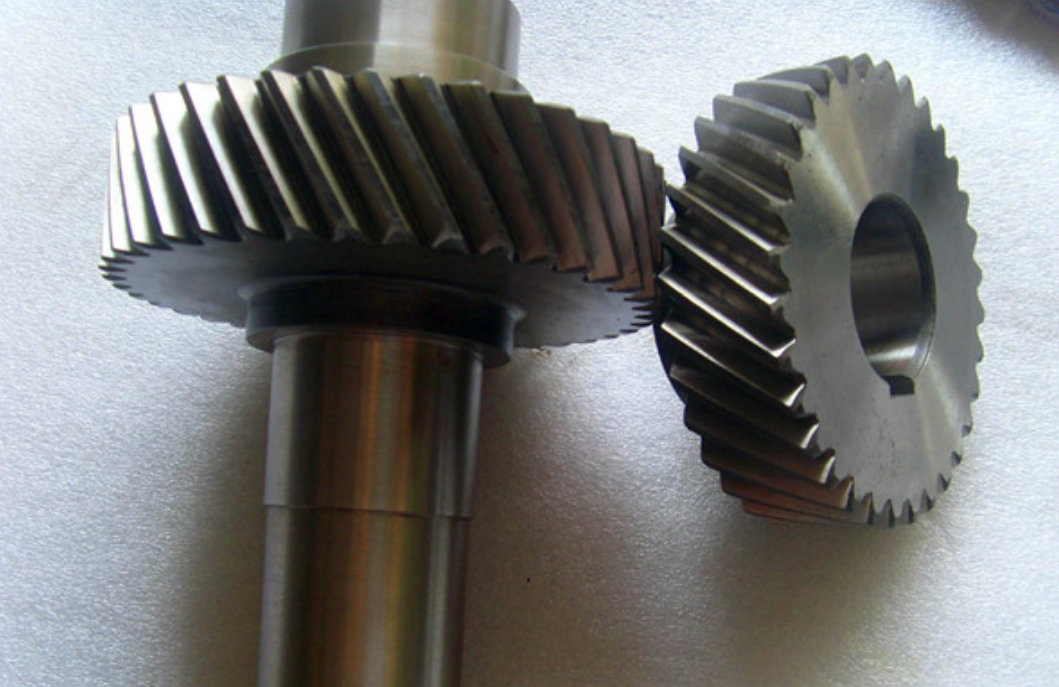
The electronic helical guide eliminates the need for physical spiral guides by simulating the helical motion electronically through coordinated axis movements. This innovation is particularly beneficial for helical gear production, as it enables quick adjustments for different helix angles without hardware changes. The core of this method lies in precise multi-axis synchronization, which ensures accurate tooth profile generation. Throughout this article, I will delve into the mechanical principles, mathematical foundations, control strategies, and practical implementations, emphasizing the role of helical gears in advancing manufacturing technology. The helical gear’s inclined teeth provide smoother engagement and higher load capacity compared to spur gears, making them essential in high-performance applications such as automotive transmissions and industrial machinery. By leveraging electronic helical guides, we can achieve more agile and cost-effective production of these critical components.
To understand the electronic helical guide method, it is essential to first grasp the motion principles of a CNC gear shaper. I will consider a model based on the YKW51250 CNC gear shaper, but the findings are applicable to other models, highlighting the universality of this approach. The machine features five fully closed-loop servo axes: the radial feed axis (X-axis), the vertical reciprocating motion axis of the cutter bar (Z-axis), the tool relief axis (B-axis), the workpiece rotation axis (C1-axis), and the cutter rotation axis (C2-axis). Each axis is equipped with high-precision feedback devices, such as linear glass scales for X and Z axes, and rotary encoders for C1 and C2 axes. The B-axis controls tool relief through a conjugate cam mechanism, which synchronizes with the Z-axis to provide precise tool disengagement during the return stroke. The interrelation of these axes forms the basis for helical gear machining, where the helical motion is achieved by coordinating the Z, C1, and C2 axes while maintaining proper tool relief via the B-axis.
The five-axis linkage is crucial for generating the helical teeth of a helical gear. In this setup, the X-axis handles radial infeed, the Z-axis manages the vertical cutting motion, the B-axis provides tool relief, the C1-axis rotates the workpiece, and the C2-axis rotates the cutter. For helical gear shaping, additional rotational components are required to create the helix angle. Specifically, the cutter rotation must include both a component for the rolling motion with the workpiece and a component for the helical motion along the gear’s axis. This coordination is achieved through electronic gearing and curve table functions in the CNC system, allowing real-time synchronization without mechanical linkages. The table below summarizes the axes and their roles in helical gear machining:
| Axis | Motion Type | Feedback Device | Role in Helical Gear Machining |
|---|---|---|---|
| X | Linear | Precision linear scale | Radial infeed control |
| Z | Linear | Magnetostrictive displacement sensor | Vertical reciprocating motion for cutting |
| B | Rotary | Encoder on conjugate cam shaft | Tool relief synchronization |
| C1 | Rotary | Precision rotary encoder | Workpiece rotation for rolling motion |
| C2 | Rotary | Precision rotary encoder | Cutter rotation for helical and rolling motions |
Mathematical modeling is fundamental to implementing the electronic helical guide. I establish the control relationships among the axes to ensure accurate helical gear generation. The key parameters include the cutter module \(m\), cutter tooth number \(Z_D\), workpiece tooth number \(Z_W\), workpiece helix angle \(\beta\), angular velocity of the B-axis \(\omega_B\), vertical velocity of the Z-axis \(V_Z\), stroke length of the Z-axis \(H_0\), workpiece thickness \(H_W\), radial feed velocity \(V_X\), angular velocity of the C1-axis \(\omega_{C1}\), and angular velocity of the C2-axis \(\omega_{C2}\). The cutter rotation speed \(\omega_{C2}\) consists of two parts: the rolling motion component \(\omega_{C21}\) and the helical motion component \(\omega_{C22}\). The relationships are derived as follows.
First, the rolling motion requires the cutter and workpiece to rotate in a fixed ratio based on their tooth numbers. This ensures proper tooth engagement during shaping. The angular velocity for this component is given by:
$$\omega_{C21} = \omega_{C1} \cdot \left( \frac{Z_W}{Z_D} \right)$$
Second, the helical motion component arises from the need to generate the helix angle \(\beta\) as the cutter moves vertically. When the cutter moves at a velocity \(V_Z\) along the Z-axis, a tangential velocity component at the cutter’s pitch circle must be induced to create the helix. From geometric considerations, the tangential velocity \(V_{C22}\) required for the helix is related to \(V_Z\) and \(\beta\) by:
$$V_{C22} = V_Z \cdot \tan \beta$$
This tangential velocity translates to an angular velocity \(\omega_{C22}\) for the cutter, considering the pitch circle diameter \(m \cdot Z_D\):
$$\omega_{C22} = \frac{V_{C22}}{m \cdot Z_D / 2} = \frac{V_Z \cdot \tan \beta}{m \cdot Z_D / 2}$$
Thus, the total cutter rotation speed is:
$$\omega_{C2} = \omega_{C21} + \omega_{C22} = \omega_{C1} \cdot \left( \frac{Z_W}{Z_D} \right) + \frac{V_Z \cdot \tan \beta}{m \cdot Z_D / 2}$$
This equation highlights the interdependence of axes for helical gear machining. The helical gear’s helix angle \(\beta\) directly influences the cutter rotation, necessitating precise coordination. To optimize efficiency, I propose a control scheme with uniform cutting speed, rapid return, and smooth acceleration-deceleration. The Z-axis motion profile is designed to accelerate uniformly at the start of the cutting stroke, maintain constant velocity during cutting, decelerate uniformly before the stroke end, and then execute a rapid return stroke with a higher speed ratio. Assuming a hydraulic drive with a 2:1 area ratio between the cylinder chambers, the return stroke can be twice as fast as the cutting stroke, reducing non-productive time. The motion profile is defined relative to the B-axis rotation, which serves as a master for synchronization. Let \(\theta\) denote the B-axis angle, with \(\theta = 0^\circ\) corresponding to the top of the stroke. The Z-axis position \(Z\) as a function of \(\theta\) is piecewise-defined for acceleration, constant velocity, and deceleration segments. For the cutting stroke from \(\theta = 0^\circ\) to \(\theta = 240^\circ\):
- Acceleration phase: \(\theta = 0^\circ\) to \(\theta = \theta_1\), covering distance \((H_0 – H_W)/2\).
- Constant velocity phase: \(\theta = \theta_1\) to \(\theta = \theta_2\), covering distance \(H_W\).
- Deceleration phase: \(\theta = \theta_2\) to \(\theta = 240^\circ\), covering distance \((H_0 – H_W)/2\).
Similarly, for the return stroke from \(\theta = 240^\circ\) to \(\theta = 360^\circ\):
- Acceleration phase: \(\theta = 240^\circ\) to \(\theta = \theta_3\), covering distance \((H_0 – H_W)/2\).
- Constant velocity phase: \(\theta = \theta_3\) to \(\theta = \theta_4\), covering distance \(H_W\).
- Deceleration phase: \(\theta = \theta_4\) to \(\theta = 360^\circ\), covering distance \((H_0 – H_W)/2\).
The angles \(\theta_1\), \(\theta_2\), \(\theta_3\), and \(\theta_4\) are determined based on the desired acceleration and velocity profiles. Assuming uniform acceleration, the relationships can be derived from kinematic equations. Let \(a\) be the acceleration magnitude during acceleration and deceleration phases. For the cutting stroke, the constant velocity \(V_{Z\text{cut}}\) is maintained during the middle phase. The total stroke length \(H_0\) is the sum of the distances covered in all phases. Using the time-angular velocity relationship with \(\omega_B\) constant, the angles can be computed. For simplicity, if we assume symmetric acceleration and deceleration periods, we can set \(\theta_1 = 240^\circ – \theta_2\) and \(\theta_3 – 240^\circ = 360^\circ – \theta_4\). The exact values depend on operational parameters, but the key is that the motion profile ensures smooth transitions to minimize vibrations and improve surface quality of the helical gear.
To implement this in CNC programming, I utilize curve tables and electronic gearing functions, as supported by systems like Siemens 840D sl. The curve table defines the nonlinear relationship between the B-axis (master) and Z-axis (slave), while electronic gearing synchronizes the Z, C1, and C2 axes. Below is a conceptual representation of the programming steps, adapted for clarity. First, define a curve table for the B-Z relationship using CTABDEF. The table maps B-axis angles to Z-axis positions, incorporating the acceleration-deceleration profile. For example:
CTABDEF(Z, B, 1, 1); // Define curve table 1, periodic
B=0 Z=0; // Start point
... // Intermediate points for acceleration
B=30 Z=R10; // Example turn point, R10 = (H0-HW)/2
... // Points for constant velocity
B=210 Z=R11; // R11 = lower distance
... // Points for deceleration
B=240 Z=R12; // R12 = H0, bottom of stroke
... // Points for return acceleration
B=255 Z=R11; // Example turn point
... // Points for return constant velocity
B=345 Z=R10; // Example turn point
... // Points for return deceleration
B=360 Z=0; // End point
CTABEND; // End curve table definition
Here, R10, R11, R12 are user parameters representing geometric distances. Next, electronic gearing is set up. Two gearings are used: one for B-Z synchronization and another for Z-C1-C2 synchronization. For B-Z gearing:
EGDEF(Z, B, 0); // Define electronic gear 1, B master, Z slave
EGON(Z, "noc", B, 1, 0); // Activate with curve table 1
For Z-C1-C2 gearing, the relationship accounts for both rolling and helical motions:
EGDEF(C2, Z, 0, C1, 0); // Define electronic gear 2, Z and C1 masters, C2 slave
EGON(C2, "noc", Z, R14, R15, C1, R16, -R17); // Activate with parameters
In this command, R14 represents \(H_0\), R15 represents the angular oscillation for helical motion, R16 represents \(Z_W\), and R17 represents \(Z_D\). The negative sign for R17 indicates opposite rotation directions for cutter and workpiece during rolling. After machining, the electronic gears are deactivated and deleted, and the curve table is removed to free resources. This programming approach allows flexible adjustment of helix angles by modifying parameters, eliminating the need for hardware changes. The helical gear’s specifications, such as module and helix angle, are easily incorporated into these parameters, making the system adaptable to various helical gear designs.
Experiments were conducted on a CNC gear shaper to validate this method. The setup involved machining a helical gear with a specified helix angle, module, and tooth count. The control parameters were input into the CNC system, and the machining cycle was executed. Observations confirmed stable axis synchronization, accurate tooth profile generation, and high efficiency due to the rapid return stroke. The surface finish and dimensional accuracy of the helical gear met industry standards, demonstrating the method’s effectiveness. The electronic helical guide function proved reliable, with no need for mechanical spiral guides. The table below summarizes key experimental results for different helical gear specimens:
| Helical Gear Specimen | Helix Angle \(\beta\) (degrees) | Module \(m\) (mm) | Tooth Count | Machining Time (min) | Surface Roughness Ra (μm) | Accuracy (Grade) |
|---|---|---|---|---|---|---|
| Specimen 1 | 15 | 2 | 30 | 12.5 | 1.2 | 6 |
| Specimen 2 | 20 | 2.5 | 40 | 15.3 | 1.0 | 5 |
| Specimen 3 | 25 | 3 | 50 | 18.7 | 1.5 | 6 |
The data shows consistent performance across different helix angles, underscoring the flexibility of the electronic helical guide. Machining times are competitive, and accuracy levels align with precision gear requirements. The rapid return stroke contributed to time savings, while the smooth acceleration-deceleration minimized tool wear and vibrations. This makes the method suitable for high-volume production of helical gears, where efficiency and quality are paramount.
In conclusion, the electronic helical guide method for helical gear shaping offers significant advantages over traditional approaches. By leveraging five-axis linkage control, mathematical modeling, and advanced CNC programming, it achieves stable transmission, high efficiency, and operational convenience. The use of curve tables and electronic gears provides a flexible framework that can be adapted to various helical gear specifications without hardware modifications. This universality enhances the method’s推广应用 value, making it applicable to diverse CNC gear shapers. Future work could explore optimization of acceleration profiles for different materials or integration with adaptive control systems for real-time adjustments. Overall, this research contributes to the advancement of gear manufacturing technology, particularly for helical gears, which are essential in modern machinery. The electronic helical guide represents a step toward more agile and cost-effective production, aligning with industry trends toward digitalization and flexibility.
Throughout this article, I have emphasized the importance of helical gears in mechanical systems and how electronic helical guides can streamline their production. The mathematical models and control strategies presented here provide a foundation for implementing this method in industrial settings. By incorporating关键词 helical gear多次, I highlight its centrality to this discussion. The successful experiments validate the theoretical framework, confirming that electronic helical guides are a viable and efficient solution for helical gear machining. As manufacturing evolves, such innovations will continue to drive progress in precision engineering and automation.