
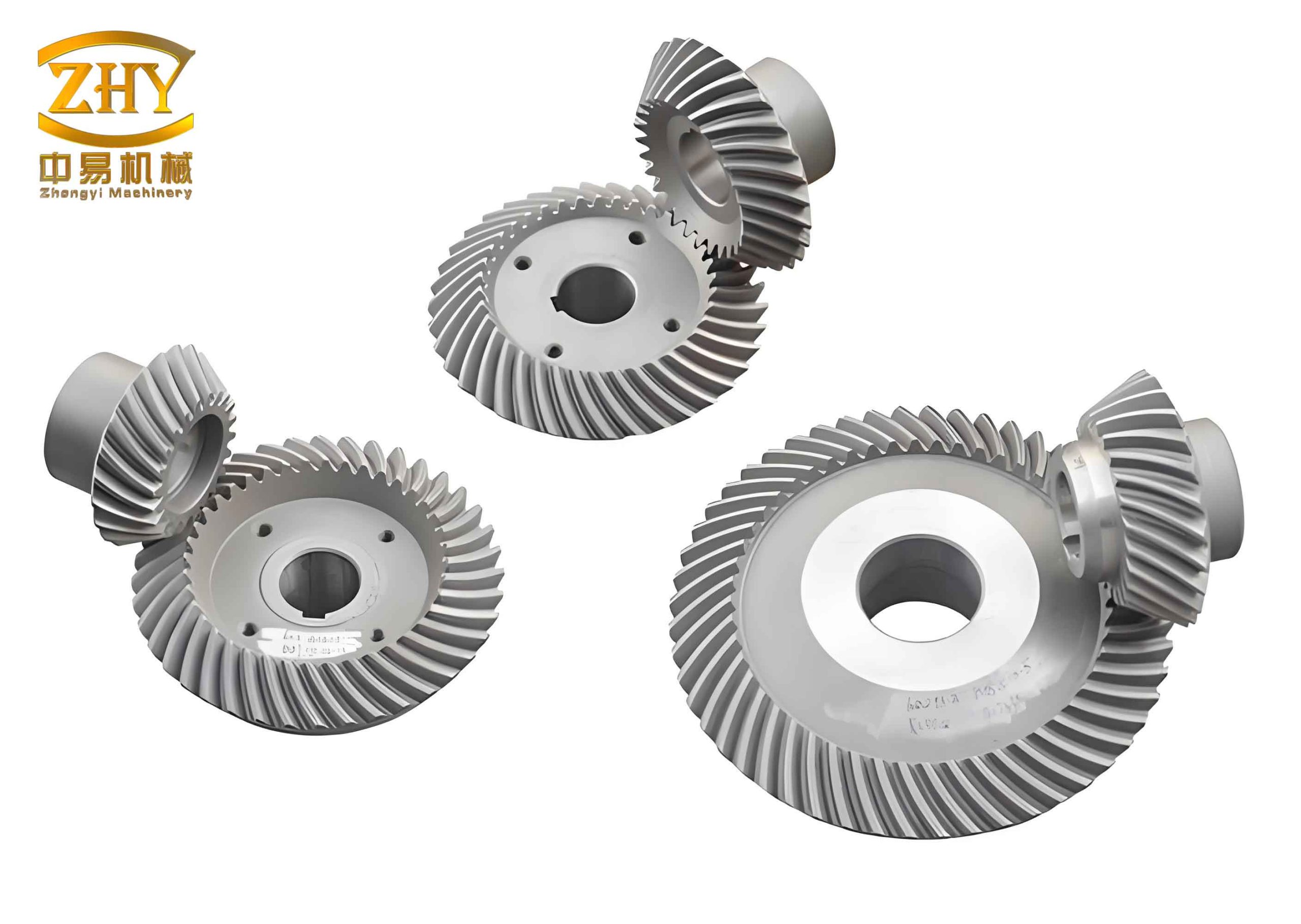
In the field of mechanical transmission, hyperboloid gears are widely used in automotive drive axles, machine tools, helicopters, and mining machinery due to their smooth operation and high strength. Particularly in single-stage axle heavy-duty vehicles, hyperboloid gears offer significant advantages over conventional spiral bevel gears in terms of spatial arrangement during installation and torque-bearing capacity. The common manufacturing process for these gears involves the “five-cut method” of milling followed by lapping (or grinding), with final inspection focusing on contact pattern shape and position, backlash variation, and noise. Lapping is often preferred over grinding for hyperboloid gears in automotive applications, primarily because it preserves the high-quality hardened surface layer after heat treatment, which is crucial for gear longevity, and it is more efficient, taking only 4–6 minutes per gear pair compared to over 30 minutes for grinding. Moreover, the relative sliding along both the tooth length and height directions in hyperboloid gears facilitates run-in, allowing for minor tooth form corrections after heat treatment to improve contact patterns, enhance surface quality, and reduce noise. Since the 1970s, lapped hyperboloid gears have remained mainstream in automotive drive axles, making lapping a critical post-heat treatment finishing process that is economical, effective, and prevalent. The quality of lapping directly determines the final gear quality, affecting not only surface roughness and meshing noise but also service life.
However, during the lapping process, hyperboloid gears can experience tooth surface burn, similar to grinding burn. This defect has often been overlooked due to its subtle macroscopic features, leading to failure modes such as pitting, spalling, and tooth breakage during use. In this study, we investigate the lapping burn phenomenon in hyperboloid gears, focusing on identification methods through macroscopic characteristics, analysis of metallographic structures and hardness changes to assess impact on gear life, and verification via rig and road tests. By establishing a mathematical model for the relative sliding at meshing points, we calculate the relative sliding velocities to identify areas prone to burn. Through multiple reproducibility tests, we demonstrate that zero-backlash lapping is a primary factor contributing to burn. Based on production experience, we propose inhibition methods, including standardized lapping procedures and automatic backlash monitoring. This research aims to provide insights into controlling lapping burn, thereby improving the durability and reliability of hyperboloid gears in automotive applications.
The lapping of hyperboloid gears typically involves semi-automatic lapping machines where the pinion’s pitch cone is oscillated to achieve localized grinding. Under normal process conditions—such as a pinion speed ranging from 0 to 1,450 rpm, a pinion pitch cone oscillation angle within ±2°, a load torque less than 20 N·m, and lapping fluid application—approximately 10% of gears exhibit tooth surface burn. The burn locations are consistently found on the gear wheel tooth surface, near the pitch circle close to the root, about 8–10 mm from the root, with a width of 2–3 mm. On the convex side, the burn extends from the tooth center to the toe along the length, while on the concave side, it is symmetrically located in the central part of the tooth length. These characteristic patterns allow for macroscopic identification of lapping burn, which is essential for quality control in production lines. Early detection can prevent defective gears from proceeding to assembly, reducing potential failures in service.
To understand the impact of lapping burn on gear performance, we conducted metallographic and hardness analyses. Hyperboloid gears for automotive axles are commonly made from 22CrMoH2 material, carburized and hardened to achieve a surface hardness of 58–63 HRC, a core hardness of 33–45 HRC, and an effective case depth of 1.7–2.1 mm. Samples were taken from burned areas on both convex and concave surfaces of the gear wheel, etched with a 5% nitric alcohol solution, and examined. The burned surface layer showed a troostite structure due to tempering, with depths ranging from 0.6 to 1.1 mm. In contrast, unburned tooth surfaces exhibited a martensitic structure with residual austenite (grade 3), and the core showed low-carbon martensite with minimal ferrite (grade 1), meeting technical requirements. During lapping, frictional heat raises the tooth surface temperature; when it exceeds the tempering temperature but remains below Ac1, the surface tempered martensite transforms into tempered sorbitte, reducing surface hardness. Analysis of samples with varying burn severity revealed that mild burn areas contain troostite, moderate burn areas show secondary quenched martensite and secondary tempered martensite, and severe burn areas exhibit sorbitte.
Microhardness analysis further elucidated the changes. Hardness impressions were measured at different depths from the burned and unburned surfaces, and the results are summarized in Table 1. The hardness at burned areas drops sharply near the surface, then gradually recovers beyond a depth of 0.6 mm, reaching a maximum surface hardness of approximately 635 HV. Beyond this, hardness stabilizes, and the effective case depth remains around 2.0 mm. The unburned areas maintain a consistent martensitic structure, with hardness decreasing uniformly due to carbon concentration gradients. This hardness reduction in burned zones compromises surface strength and wear resistance, leading to premature failure in service.
| Depth from Surface (mm) | Hardness at Burned Area (HV) | Hardness at Unburned Area (HV) | Notes |
|---|---|---|---|
| 0.0 | 635 | 750 | Surface hardness |
| 0.2 | 580 | 720 | Near-surface layer |
| 0.4 | 520 | 690 | Mid-case region |
| 0.6 | 500 | 660 | Transition zone |
| 0.8 | 550 | 630 | Recovery zone |
| 1.0 | 600 | 600 | Stabilization |
| 1.5 | 620 | 580 | Core influence |
| 2.0 | 630 | 560 | Effective case depth |
The degradation in material properties due to lapping burn significantly affects gear life. The formation of troostite and sorbitte reduces surface hardness, diminishing wear resistance and fatigue strength. Under load, the lack of a hard protective layer leads to metal flow, scoring, and in severe cases, pitting, adhesion, and tooth fracture. To validate this, we performed rig tests according to the JB3803-84 standard for automotive drive axles. Gears with lapping burn were subjected to 10,000 and 100,000 cycles, after which inspection revealed noticeable wear and grooves on the tooth surfaces. Additionally, road tests were conducted by installing burned gears in vehicles and tracking them over 2,000 km. Post-run disassembly showed similar wear patterns, confirming that lapping burn accelerates failure in hyperboloid gears. These findings underscore the importance of controlling lapping processes to prevent burn and ensure long-term reliability.
The mechanism of lapping burn in hyperboloid gears is closely tied to the relative sliding velocities at meshing points. During lapping, the interaction between the pinion and gear wheel generates frictional heat, with sliding speed being a key factor in heat generation. To analyze this, we established a mathematical model for the relative sliding at any meshing point M. Consider a hyperboloid gear pair where P denotes the pinion and G denotes the gear wheel. The surface velocities at point M can be defined as:
$$ \mathbf{V}_P = \omega_P (\mathbf{a}_P \times \mathbf{r}_P) $$
$$ \mathbf{V}_G = \omega_G (\mathbf{a}_G \times \mathbf{r}_G) $$
where $\omega_P$ and $\omega_G$ are angular velocities, $\mathbf{a}_P$ and $\mathbf{a}_G$ are unit vectors along axes, and $\mathbf{r}_P$ and $\mathbf{r}_G$ are position vectors. The relative sliding velocity $\mathbf{V}_S$ is given by:
$$ \mathbf{V}_S = \mathbf{V}_P – \mathbf{V}_G $$
In the tangential plane at the contact point, the sliding velocity can be decomposed into components along the instantaneous contact line direction $\mathbf{t}$ and perpendicular direction $\mathbf{t}’$. The magnitude of the total sliding velocity is:
$$ |\mathbf{V}_S| = \sqrt{(\mathbf{V}_S \cdot \mathbf{t})^2 + (\mathbf{V}_S \cdot \mathbf{t}’)^2} $$
For hyperboloid gears, the contact ellipse dimensions vary along the tooth due to constant curvature along the length and variable curvature along the profile. Using this model, we calculated sliding velocities at five points on the tooth surface for a typical hyperboloid gear pair with parameters listed in Table 2. Point 1 is near the tooth root, and point 5 is near the tooth tip. The results, including sliding velocity components and contact ellipse parameters, are shown in Table 3.
| Parameter | Pinion (Driving Gear) | Gear Wheel (Driven Gear) |
|---|---|---|
| Offset Distance | 40 mm | – |
| Gear Ratio | 7/48 | – |
| Input Torque | 0.8 N·m | – |
| Input Speed | 530 rpm | – |
| Pressure Angle | 22°30′ | 22°30′ |
| Spiral Angle | 25°21′ | 25°21′ |
| Pitch Diameter | – | 355.6 mm |
| Face Width | – | 47 mm |
| Point Location | V_SX (mm/rad) | V_SY (mm/rad) | |V_S| (m/s) | Contact Ellipse Semi-axis a (mm) | Contact Ellipse Semi-axis b (mm) | Angle γ (°) |
|---|---|---|---|---|---|---|
| 1 (Near Root) | -10.871 | 12.802 | 0.933 | 15.088 | 0.940 | 17.83 |
| 2 | -10.389 | 11.303 | 0.853 | 15.189 | 0.889 | 17.25 |
| 3 | -9.423 | 8.077 | 0.689 | 15.342 | 0.813 | 16.08 |
| 4 | -8.458 | 4.496 | 0.532 | 15.646 | 0.711 | 14.87 |
| 5 (Near Tip) | -7.112 | -1.473 | 0.402 | 16.180 | 0.533 | 13.05 |
The calculations reveal that the relative sliding velocity is highest near the tooth root (point 1) and decreases towards the tip. This aligns with the observed burn locations, indicating that areas with maximum sliding velocity are most susceptible to burn due to greater frictional heat generation. Additionally, the contact time at a point influences heat accumulation; for the gear wheel, contact time is $d_1 / V_{GR}$, where $d_1$ is the distance along the motion direction over the contact ellipse. The combination of high sliding velocity and longer contact time near the root exacerbates temperature rise, leading to burn. In semi-automatic lapping machines, the oscillation of the pinion’s pitch cone causes localized grinding at the root area of the gear wheel, where heat dissipation is poorer compared to the pinion tip, further contributing to burn occurrence on the gear wheel.
To verify the lapping burn mechanism and identify contributing factors, we conducted a series of experiments using 100 sets of 485-10/37 hyperboloid gears. The experiments were designed to test conditions such as lapping fluid application and backlash control. Initial trials (Tests 1–4) involved varying lapping fluid status and backlash settings, as summarized in Table 4. The results indicated that both lapping fluid and backlash influence burn, with zero-backlash lapping leading to burn even with adequate fluid. To determine the dominant factor, additional tests (Tests 5–6) were performed, focusing on fluid maintenance and backlash variation. Table 5 details these tests, showing that zero-backlash lapping consistently produced burn, regardless of fluid conditions, while controlled backlash minimized burn.
| Test Condition | Test 1 | Test 2 | Test 3 | Test 4 |
|---|---|---|---|---|
| Lapping Fluid Ratio (Oil:Abrasive) | 4:1 | 4:1 | 4:1 | 4:1 |
| Lapping Fluid Flow | Off | On | On | On |
| Lapping Backlash (mm) | 0 | 0.10 | 0.05 | 0 |
| Load Torque (N·m) | 10 | 10 | 10 | 10 |
| Spindle Speed (rpm) | 1000 | 1000 | 1000 | 1000 |
| Lapping Time (min per side) | 3-3 | 3-3 | 3-3 | 3-3 |
| Fresh Abrasive Added | N/A | Every 25 sets | Not added | Not added |
| Number of Gear Sets | 25 | 25 | 25 | 25 |
| Burn Observation | No burn | No burn | Mild burn, no white layer | Mild burn, white layer present |
| Test Condition | Test 5 | Test 6 |
|---|---|---|
| Lapping Fluid Ratio (Oil:Abrasive) | 4:1 | 4:1 |
| Lapping Backlash (mm) | 0.10 | 0, 0.05, 0.10, 0.15, 0.20 (10 sets each) |
| Load Torque (N·m) | 10 | 10 |
| Spindle Speed (rpm) | 1000 | 1000 |
| Lapping Time (min per side) | 3-3 | 3-3 |
| Fresh Abrasive Added | Not added for 50 sets | Added every 25 sets |
| Number of Gear Sets | 50 | 50 |
| Burn Observation | Last 5 sets showed mild burn, microstructure normal | Zero-backlash sets all burned with white layer; others burn-free |
The experiments conclusively demonstrate that zero-backlash lapping is a primary cause of burn in hyperboloid gears. Under zero backlash, the meshing becomes too tight, increasing friction and heat generation beyond the material’s tolerance. This is exacerbated by inadequate lapping fluid, which fails to cool and lubricate the interface. The reproducibility of burn under zero-backlash conditions highlights the need for precise backlash control during lapping. Furthermore, comparing different lapping methods—such as gear wheel oscillation, pinion oscillation, and V/H coordinate movement—reveals that V/H coordinate movement lapping, enabled by multi-axis CNC technology, significantly reduces burn probability. This method allows for controlled movement of the lapping zone across the tooth surface, optimizing contact and minimizing localized heat buildup.
Based on our findings, we propose several inhibition methods to control lapping burn in hyperboloid gears. First, implementing standardized operating procedures (SOPs) is crucial. Operators should follow detailed work instructions covering fixture setup, pre-lapping deburring, contact pattern classification, lapping fluid management (with proper ratios and timely replenishment), and lapping allowance control (typically 0.05 mm, not exceeding 0.1 mm). Key SOPs include: lapping fixture specification guidelines, lapping inspection protocols, lapping pairing standard procedures (as illustrated in workflow charts), lapping time setting rules, lapping fluid mixing and addition guidelines, and contact pattern adjustment techniques. Adherence to these SOPs reduces human error and ensures consistent lapping quality.
Second, automatic backlash monitoring and adjustment during lapping can prevent zero-backlash conditions. Modern lapping machines, such as the Gleason 600HTL, Oerlikon L60A, and Zhongda Chuanyuan YKE2560, incorporate online backlash detection systems. These systems use sensors, like gratings on the G-axis, to measure elastic mechanism displacements, compute backlash adjustment values via linear interpolation, and maintain optimal backlash throughout the lapping path. For older semi-automatic machines, retrofitting with backlash monitoring hardware and software upgrades can enhance control. This approach aligns with the principle that controlled backlash minimizes frictional heat and prevents burn.
Third, optimizing lapping parameters based on sliding velocity analysis can help. Since burn correlates with high sliding velocities near the root, adjusting the lapping motion to distribute heat more evenly—for example, by varying oscillation angles or using dynamic V/H movements—can mitigate burn. Additionally, ensuring adequate lapping fluid flow with appropriate abrasive grit size (not too fine) and concentration maintains cooling and lubrication, reducing temperature spikes. Regular maintenance of lapping machines, including alignment checks and abrasive system cleaning, further supports consistent performance.
In conclusion, lapping is a critical finishing process for hyperboloid gears, but it carries the risk of tooth surface burn, which detrimentally affects gear life through microstructural changes and hardness reduction. Our study identifies lapping burn through macroscopic features, analyzes its impact via metallography and hardness testing, and validates findings with rig and road tests. By modeling relative sliding velocities, we show that burn occurs in areas with maximum sliding, typically near the root of the gear wheel. Experimental verification underscores zero-backlash lapping as a key factor, while production experience suggests that standardized procedures and automatic backlash control are effective inhibition methods. Implementing these strategies in manufacturing can enhance the quality and durability of hyperboloid gears, ensuring reliable performance in automotive and other applications. Future work could explore advanced cooling techniques or real-time temperature monitoring to further optimize the lapping process for hyperboloid gears.
The significance of this research extends beyond automotive hyperboloid gears to other sectors where precision gearing is essential. By addressing lapping burn, we contribute to improved transmission efficiency, reduced noise, and longer service life for hyperboloid gears. As demand for high-performance gears grows, continued innovation in lapping technology and process control will be vital. We encourage further studies on thermal management during lapping and the development of smart lapping systems that adapt parameters in real-time to prevent defects. Through collaborative efforts, the manufacturing of hyperboloid gears can achieve new levels of excellence, supporting advancements in machinery and transportation worldwide.