
In the field of heavy-duty automotive and aerospace transmissions, hypoid gears are critically important due to their superior characteristics such as high load capacity, smooth operation, and reduced noise. However, achieving precise finishing of hypoid gears post-heat treatment remains a significant challenge. Traditional lapping processes, while cost-effective, often rely on theoretical tooth surfaces and empirical adjustments, leading to inconsistencies in quality. To address this, we have developed a novel approach for lapping position control based on the actual measured tooth surfaces of hypoid gears. This method leverages advanced digitization techniques and mathematical modeling to enable full-tooth-surface lapping with high precision. In this article, we present our comprehensive study, detailing the measurement, fitting, analysis, and control strategies that underpin this innovative technique.
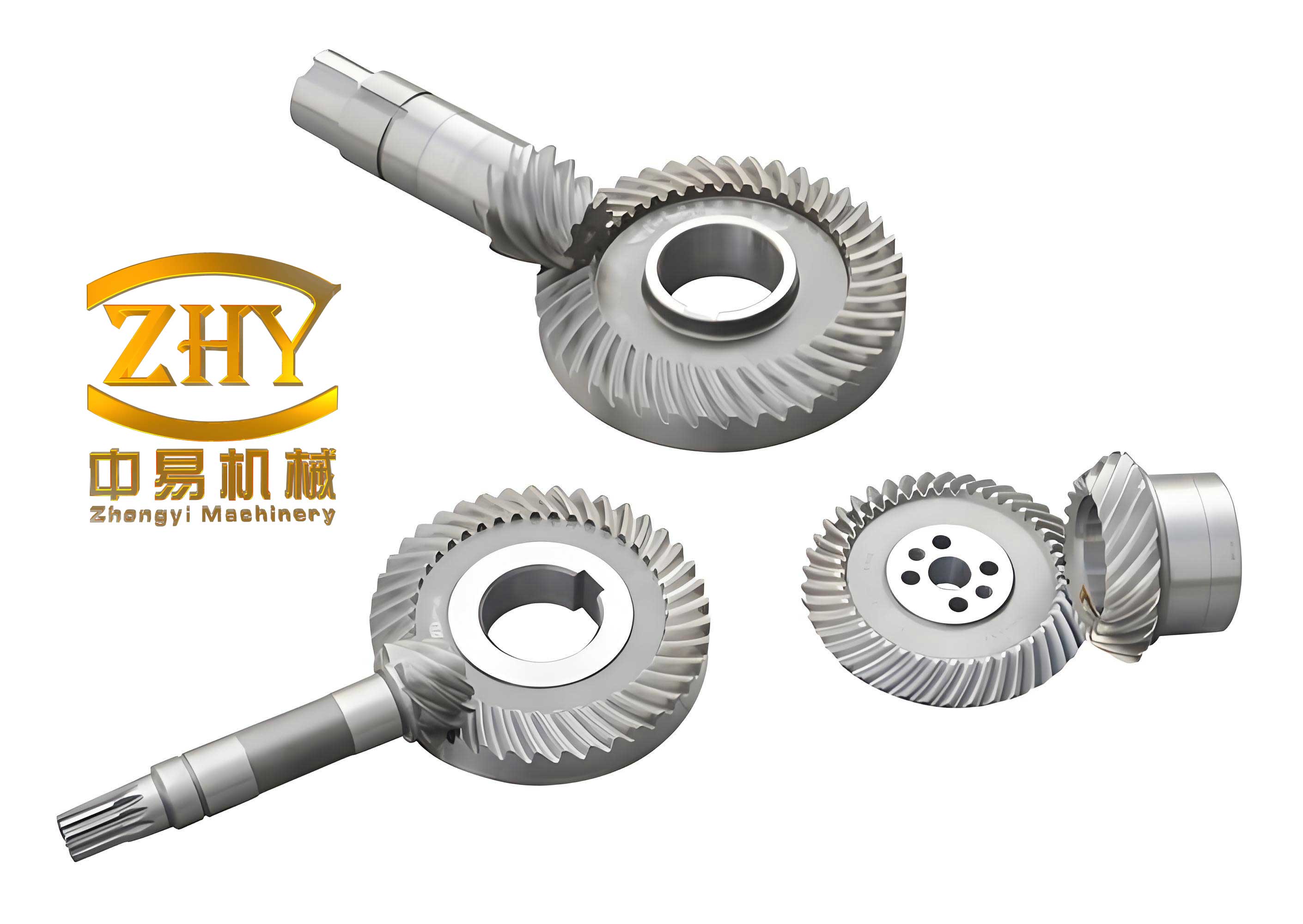
The lapping process for hypoid gears is a critical finishing step that enhances surface quality and reduces啮合 noise. Traditionally, lapping parameters are derived from theoretical tooth contact analysis (TCA) based on design settings. However, manufacturing errors and heat treatment distortions cause deviations from the ideal tooth geometry, rendering theoretical models inadequate. Consequently, lapping adjustments often depend on operator experience, resulting in unstable outcomes. Our research aims to overcome these limitations by utilizing real tooth surfaces—obtained through precise measurement—to dynamically control lapping positions. This ensures consistent and accurate full-tooth-surface研磨 for hypoid gears, even in high-volume production.
Our methodology begins with the accurate measurement of hypoid gear tooth surfaces. We employ coordinate measuring machines (CMMs) to capture discrete points on both the pinion and gear teeth. For a typical hypoid gear pair, we sample 45 points per tooth surface: 9 points along the lengthwise direction (u-direction) and 5 points along the profile direction (v-direction). This grid ensures sufficient data for high-fidelity surface reconstruction. The measured coordinates, such as those for a hypoid gear pair example, are recorded as shown in Table 1.
| Point No. | Pinion (Concave) Coordinates (x, y, z) in mm | Gear (Convex) Coordinates (x, y, z) in mm |
|---|---|---|
| 1 | (101.8176, 26.7391, -17.9310) | (24.5239, -6.2855, -107.8554) |
| 2 | (102.2983, 24.0627, -18.3155) | (26.9414, -7.3721, -107.1787) |
| … | … | … |
| 45 | (147.4757, -22.4399, -26.3289) | (46.8586, 17.1954, -143.6804) |
To represent the real tooth surfaces mathematically, we use Non-Uniform Rational B-Spline (NURBS)曲面 fitting. NURBS offers excellent flexibility and accuracy for modeling complex geometries like hypoid gear teeth. The general expression for a bicubic NURBS surface is given by:
$$ \mathbf{S}(u, v) = \frac{\sum_{i=1}^{m} \sum_{j=1}^{n} N_{i,3}(u) N_{j,3}(v) w_{i,j} \mathbf{P}_{i,j}}{\sum_{i=1}^{m} \sum_{j=1}^{n} N_{i,3}(u) N_{j,3}(v) w_{i,j}} $$
Here, \( m \) and \( n \) are the numbers of control points in the u and v directions, respectively; \( \mathbf{P}_{i,j} \) are the control points; \( w_{i,j} \) are the corresponding weights; and \( N_{i,3}(u) \) and \( N_{j,3}(v) \) are the cubic B-spline basis functions. The fitting process involves two steps: first, we compute control points along the u-direction using the measured data as型值 points, then use these as new型值 points to compute final control points along the v-direction. This yields a smooth, continuous surface that closely approximates the real hypoid gear tooth surface. To validate the拟合精度, we compare the NURBS surface with theoretical points and calculate the normal distance errors. Our analysis shows that maximum fitting errors are within 0.1 μm, which is well below the 0.00635 mm threshold required for reliable contact pattern visualization, as established by Gleason. Thus, the digitized surfaces are sufficiently accurate for subsequent lapping analysis.
With the real tooth surfaces digitized, we proceed to tooth contact analysis (TCA) for hypoid gears. TCA is essential for understanding the啮合 behavior and contact patterns under various lapping conditions. The fundamental equations governing the contact between two gear tooth surfaces are derived from gear啮合 theory. Consider two coordinate systems: \( S_1 \) fixed to the pinion and \( S_2 \) fixed to the gear. The position vectors and unit normal vectors at the contact point must satisfy:
$$ \mathbf{r}_{h1}(u_1, v_1; \phi_1, V, H, J) = \mathbf{r}_{h2}(u_2, v_2; \phi_2) $$
$$ \mathbf{n}_{h1}(u_1, v_1; \phi_1) = \mathbf{n}_{h2}(u_2, v_2; \phi_2) $$
In these equations, \( u_k \) and \( v_k \) (with \( k = 1, 2 \)) are the surface parameters for the pinion and gear, respectively; \( \phi_1 \) and \( \phi_2 \) are the rotational angles of the pinion and gear; and \( V, H, J \) are the lapping adjustment parameters representing the pinion offset direction, pinion axis direction, and gear axis direction, respectively. Additionally, the啮合 equation must hold:
$$ \mathbf{n}^{(2)}_{h} \cdot \mathbf{v}^{(12)}_{h} = f(u_1, v_1, \phi_1, u_2, v_2, \phi_2, V, H, J) = 0 $$
Here, \( \mathbf{n}^{(2)}_{h} \) is the common unit normal vector at the contact point, and \( \mathbf{v}^{(12)}_{h} \) is the relative velocity vector. During lapping, we also enforce a condition for equal backlash, expressed as:
$$ J + H \tan \delta_1 + \sqrt{r_1^2 – E^2} – \sqrt{r_1^2 – V^2} = 0 $$
where \( \delta_1 \) is the pinion pitch angle, \( r_1 \) is the pinion nominal radius, and \( E \) is the offset distance. For a given set of \( V, H, J \), these equations can be solved numerically to determine the contact point coordinates and other unknowns. However, for lapping control, we need the inverse: given a desired contact point on the tooth surface, compute the required adjustments in \( V, H, J \). This is the core of our lapping position control model.
To establish the control model, we consider the gear tooth surface in a rotational projection coordinate system. For the gear convex side, let \( M \) be the nominal contact point and \( M^* \) be the target lapping point, with deviations \( s_1 \) and \( s_2 \) along the lengthwise and profile directions, respectively. The coordinates \( (X^*_2, Y^*_2) \) of \( M^* \) in the projection plane relate to the 3D surface coordinates \( (x_2, y_2, z_2) \) as follows:
$$ x_2 = X^*_2 $$
$$ \sqrt{y_2^2 + z_2^2} = Y^*_2 $$
Given the digitized surface equation \( \mathbf{r}^{(2)}(u_2, v_2) \), we can solve for \( u_2 \) and \( v_2 \) using these relations. Then, by combining the contact equations,啮合 equation, and backlash condition, we form a system of equations. Using Newton-Raphson iteration, we compute the Jacobian matrix and iteratively solve for \( V, H, J \) adjustments. This model allows precise positioning of the lapping contact point across the entire tooth surface of hypoid gears.
To perform TCA on real tooth surfaces, we need the principal curvatures and directions at contact points. These are derived from the first and second fundamental forms of the NURBS surface. The surface partial derivatives are computed by differentiating the NURBS basis functions:
$$ N^{q}_{i,3} = 3 \left( \frac{N^{q-1}_{i,2}}{u_{i+p} – u_i} – \frac{N^{q-1}_{i+1,2}}{u_{i+p+1} – u_{i+1}} \right) $$
where \( q \) denotes the derivative order. The first-order partial derivatives \( \mathbf{r}_{u_k} \) and \( \mathbf{r}_{v_k} \), second-order derivatives \( \mathbf{r}_{u_k u_k} \), \( \mathbf{r}_{v_k v_k} \), and mixed derivative \( \mathbf{r}_{u_k v_k} \) are obtained accordingly. The unit normal vector is:
$$ \mathbf{n}_k(u_k, v_k) = \frac{\mathbf{r}_{u_k} \times \mathbf{r}_{v_k}}{\|\mathbf{r}_{u_k} \times \mathbf{r}_{v_k}\|} $$
The principal directions \( \mathbf{T}_k \) are given by:
$$ \mathbf{T}_k = \mathbf{r}_{u_k} du + \mathbf{r}_{v_k} dv $$
and the principal curvatures \( \kappa_k \) satisfy the curvature formula:
$$ Q_k = \frac{L du^2 + 2M du dv + N dv^2}{E du^2 + 2F du dv + G dv^2} $$
Here, \( E, F, G \) are the coefficients of the first fundamental form, and \( L, M, N \) are those of the second fundamental form. The curvature line equation is:
$$ \begin{vmatrix} dv^2 & -du dv & du^2 \\ E & F & G \\ L & M & N \end{vmatrix} = 0 $$
From these, we calculate the major and minor axes of the contact ellipse at any啮合 point, which is crucial for simulating contact patterns during lapping of hypoid gears.
We now present a case study to validate our lapping position control method for hypoid gears. The basic parameters of the hypoid gear pair are listed in Table 2.
| Parameter | Pinion (Concave) | Gear (Convex) |
|---|---|---|
| Number of Teeth | 8 | 39 |
| Hand of Spiral | Left | Right |
| Pressure Angle (°) | 22.81 | 22.81 |
| Face Width (mm) | 44.91 | 41 |
| Offset Distance (mm) | 25.4 | |
| Spiral Angle (°) | 45.07 | 33.92 |
| Addendum (mm) | 9.86 | 1.75 |
| Dedendum (mm) | 3.51 | 11.48 |
After manufacturing, the tooth surfaces are measured, and NURBS fitting is applied. At the theoretical installation position \( V = 25.4 \), \( H = 0 \), \( J = 0 \), we solve the TCA equations to obtain the contact path and pattern on the gear convex side. The simulated contact pattern shows good agreement with actual roll test results, confirming the accuracy of our digitized surfaces for hypoid gears. To achieve full-tooth-surface lapping, we define a lapping path that covers five key points: from the nominal center to points shifted toward the toe, heel, top, and root of the tooth. The path is denoted as \( K_1 \to K_2 \to K_3 \to K_4 \to K_5 \), with corresponding deviations \( s_1 \) and \( s_2 \) as fractions of face width \( b \) and whole depth \( h \). For instance, moving to the root by \( h/4 \) corresponds to \( s_1 = 0 \), \( s_2 = -0.25h \); moving to the toe by \( b/4 \) corresponds to \( s_1 = -0.25b \), \( s_2 = 0 \); and so on. Using our control model, we compute the required adjustments in \( V, H, J \) for each target point, as summarized in Table 3.
| Projection Coordinate Shifts | Adjustments (mm) | |||
|---|---|---|---|---|
| \( s_1 \) | \( s_2 \) | \( \Delta V \) | \( \Delta H \) | \( \Delta J \) |
| -0.25b | 0 | 0.323 | -0.440 | 0.029 |
| 0.25b | 0 | -0.305 | 0.454 | -0.044 |
| 0 | 0.25h | 0.297 | 0.427 | -0.042 |
| 0 | -0.25h | -0.318 | -0.445 | 0.034 |
These adjustment values are programmed into a CNC roll testing machine to execute the full-tooth-surface lapping process. The program includes commands for positioning the axes (X, Y, Z) corresponding to \( V, H, J \), along with spindle rotations for lapping motion. For example, a segment of the program might look like:
G90 G01 Y -150 F1000
X -150 Z0
Z = 0.04 + R0 + R4 X = -443.399 + R1 + R5 + R7
R11 = -420.381 + R2 + (R3 + 5) + R8
R12 = -420.381 + R2 + R6 + R8
Y = R11
Y = R12 F100 FXS[Y1]=1 FXST[Y1]=15 FXSW[Y1]=0.5
IF $AA_IM[Y] < R12 + 1 GOTOF AA1
Y = R11 F500 FXS[Y1]=0
G91 G01 SP1 = 360 / (2 * R9) F500
G90 G01 Y = R12 F100 AA1
FXS[Y1]=0
G90 G01 Y -256.489 F100 X -164.411 Z -25.400 ; nominal position
M03 S100
G04 F10
M05
G04 F3
M04 S100
G04 F10
M05
; ... additional commands for other lapping points ...
M02
The CNC roll test is conducted, and the resulting contact patterns on the gear convex side are examined. The patterns show that the lapping contact point successfully traverses the entire tooth surface, from toe to heel and root to top, as intended. This demonstrates that our method effectively controls the lapping position based on real tooth surfaces of hypoid gears. The实验验证 confirms that full-tooth-surface lapping is achievable with high precision, eliminating reliance on operator skill and ensuring consistency in production.
Our study has several implications for the manufacturing of hypoid gears. By integrating real surface measurements into the lapping process, we bridge the gap between design and actual geometry. This is particularly important for hypoid gears, where minor deviations can significantly impact performance and noise. The use of NURBS fitting provides a robust digital twin of the tooth surface, enabling accurate TCA and control. Moreover, the mathematical model linking \( V, H, J \) adjustments to contact point shifts offers a systematic way to program lapping machines, paving the way for automated and adaptive finishing systems.
In conclusion, we have developed a comprehensive framework for lapping position control of hypoid gears based on real tooth surfaces. The method involves precise measurement, high-accuracy NURBS曲面 fitting, advanced tooth contact analysis, and a novel control model for determining lapping adjustments. Experimental results from CNC roll tests validate that full-tooth-surface lapping can be precisely achieved, enhancing the quality and consistency of hypoid gear finishing. This approach not only improves the lapping process but also contributes to the broader goal of digital manufacturing for complex gear systems. Future work may explore real-time adaptation using in-process measurement and machine learning to further optimize lapping parameters for hypoid gears under varying conditions.
Throughout this research, the importance of hypoid gears in modern transmission systems has been underscored. Their unique geometry and performance demands necessitate advanced finishing techniques like the one we propose. By leveraging digital technologies, we can ensure that hypoid gears meet stringent quality standards while reducing costs and lead times. We believe that our contributions will aid manufacturers in producing more reliable and efficient hypoid gears for automotive and aerospace applications.