
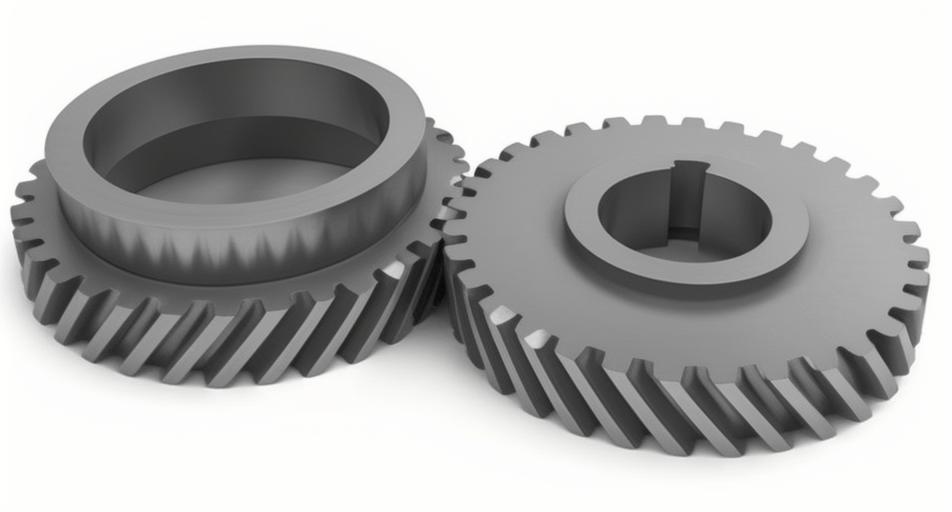
This study proposes a novel design theory for helical gear transmission based on curve contact elements to enhance load-bearing capacity and transmission performance. A mathematical model for non-orthogonal helical gears is established using conjugate curve geometry, and the contact mechanism is analyzed through spatial curve meshing relationships. The geometric conditions for tooth profile generation, undercutting, and stress distribution are systematically investigated, providing theoretical insights for optimizing helical gear design.
1. Mathematical Model of Non-Orthogonal Helical Gears
The coordinate systems for non-orthogonal helical gears are defined as follows:
- Fixed coordinate systems: \( S(O-x,y,z) \), \( S_p(O_p-x_p,y_p,z_p) \)
- Moving coordinate systems: \( S_1(O_1-x_1,y_1,z_1) \), \( S_2(O_2-x_2,y_2,z_2) \)
The relative velocity at contact point \( P \) is derived as:
$$
\mathbf{v}^{(12)}_1 = \left[ -y_1(1 + i_{21}\cos\Sigma) – z_1i_{21}\cos\phi_1\sin\Sigma – ai_{21}\sin\phi_1\cos\Sigma \right]\mathbf{i}_1 + \left[ x_1(1 + i_{21}\cos\Sigma) + z_1i_{21}\sin\phi_1\sin\Sigma – ai_{21}\cos\phi_1\cos\Sigma \right]\mathbf{j}_1 + i_{21}\sin\Sigma(x_1\cos\phi_1 – y_1\sin\phi_1 – a)\mathbf{k}_1
$$
where \( i_{21} = \phi_2/\phi_1 \) denotes the transmission ratio, and \( \Sigma \) represents the shaft angle.
2. Tooth Profile Equations
The cylindrical helix curve on the pinion is expressed as:
$$
\begin{cases}
x_1 = R\cos\theta \\
y_1 = R\sin\theta \\
z_1 = p\theta
\end{cases}
$$
where \( R \) = pitch radius, \( p \) = helix parameter, and \( \theta \) = curve parameter. The conjugate tooth profiles are derived using equidistant envelope method:
$$
\mathbf{r}_{\Gamma_i} = \mathbf{r}_i \pm \rho_i\mathbf{n}^0_{ni} \quad (i=1,2)
$$
Key design parameters are summarized in Table 1:
| Parameter | Value |
|---|---|
| Shaft angle \( \Sigma \) | 15° |
| Pinion pitch radius \( R_1 \) | 36 mm |
| Center distance \( a \) | 136 mm |
| Normal module \( m_n \) | 5 mm |
| Pressure angle \( \alpha \) | 30° |
| Contact ratio \( i_{21} \) | 31/11 |
3. Contact Characteristics Analysis
3.1 Undercutting Conditions
The singularity condition for generated surfaces is formulated as:
$$
\Delta^2_1 + \Delta^2_2 + \Delta^2_3 = F(t,\phi,\alpha) = 0
$$
where \( \Delta_1, \Delta_2, \Delta_3 \) represent gradient components derived from spatial differentiation.
3.2 Slip Ratio Analysis
The slip ratio for non-orthogonal helical gears is calculated as:
$$
U_1 = \lim_{\Delta S_1 \to 0} \frac{\Delta S_1 – \Delta S_2}{\Delta S_1}, \quad U_2 = \lim_{\Delta S_2 \to 0} \frac{\Delta S_2 – \Delta S_1}{\Delta S_2}
$$
Comparative results with involute gears demonstrate superior slip characteristics:
| Gear Type | Max Slip Ratio |
|---|---|
| Proposed Helical Gear | 0.42 |
| Involute Gear | 0.68 |
3.3 Contact Stress Distribution
Finite element analysis using ANSYS Workbench reveals stress patterns:
$$
\sigma_H = \sqrt{\frac{F}{\pi} \left( \frac{1-\nu_1^2}{E_1} + \frac{1-\nu_2^2}{E_2} \right)^{-1} \frac{1}{\rho_{eff}}}
$$
where \( \rho_{eff} \) = effective curvature radius. Stress comparison shows:
| Parameter | Proposed Gear | Involute Gear |
|---|---|---|
| Max Contact Stress | 1,266.5 MPa | 1,639 MPa |
| Von Mises Stress | 793.69 MPa | 1,233.8 MPa |
4. Experimental Validation
Prototype testing demonstrates transmission efficiency under varying loads:
$$
\eta = \frac{n_o T_o}{n_i T_i} \times 100\%
$$
| Speed (rpm) | 200 | 400 | 600 | 800 | 1000 |
|---|---|---|---|---|---|
| Efficiency (%) | 91.2 | 93.4 | 94.7 | 95.1 | 95.9 |
5. Conclusion
The proposed non-orthogonal helical gear system exhibits enhanced contact characteristics compared with traditional involute gears, demonstrating:
- 28.6% reduction in maximum contact stress
- 35.6% improvement in slip ratio
- 95.9% peak transmission efficiency
This research provides a theoretical foundation for optimizing helical gear design in high-performance transmission systems.